
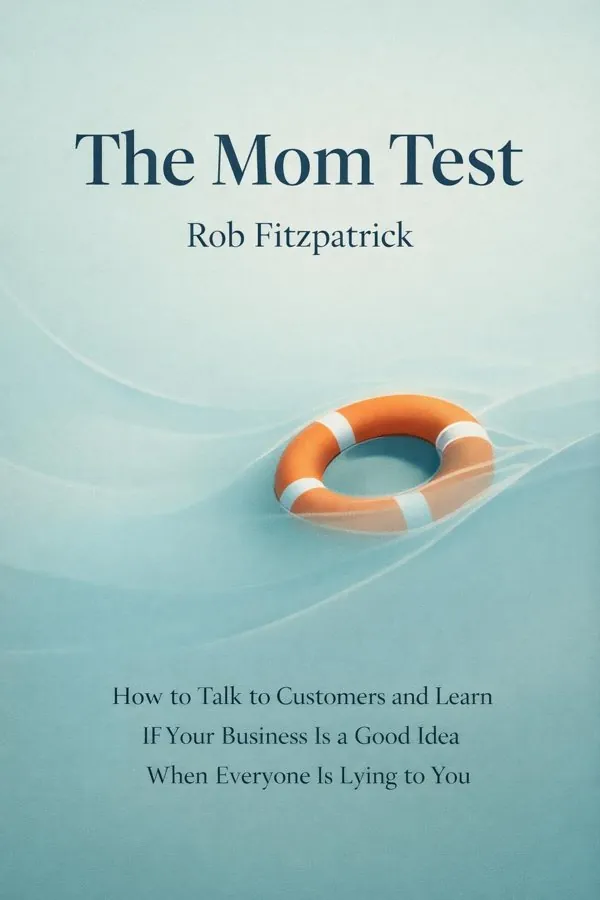
The Mom Test: Summary & Key Insights
 10 min9 chaptersAudio available
Key Takeaways from The Mom Test
The most dangerous words in early entrepreneurship are often the nicest ones.
The best customer conversations are not about your product at all.
Founders often assume that more interviews automatically lead to better insights.
A startup fails less often because of bad execution than because it solves an unimportant problem.
Customer conversations only work when you speak with people close enough to the problem to know what they are talking about.
What Is The Mom Test About?
The Mom Test by Rob Fitzpatrick is a business book published in 2013 spanning 11 pages. The Mom Test by Rob Fitzpatrick is a sharp, practical guide to one of the hardest parts of building a business: learning the truth from potential customers. Most founders think they are doing customer research when they ask friends, prospects, or investors what they think of an idea. But those conversations often produce polite lies, vague encouragement, and false confidence. Fitzpatrick’s core argument is simple: if you ask bad questions, people will accidentally mislead you, especially if they like you and want to be supportive. The solution is to stop pitching and start learning. Drawing on his experience as an entrepreneur, startup mentor, and Y Combinator founder, Fitzpatrick offers a field manual for having better conversations. He shows how to ask about a customer’s real life instead of your imagined solution, how to spot whether someone has a serious problem, and how to separate compliments from evidence. The book matters because it can save founders months or years of wasted effort. Whether you are testing a startup idea, refining a product, or selling a new service, The Mom Test teaches you how to gather honest, useful insights before you build the wrong thing.
This FizzRead summary covers all 9 key chapters of The Mom Test in approximately 10 minutes, distilling the most important ideas, arguments, and takeaways from Rob Fitzpatrick's work. Also available as an audio summary and Key Quotes Podcast.
The Mom Test
The Mom Test by Rob Fitzpatrick is a sharp, practical guide to one of the hardest parts of building a business: learning the truth from potential customers. Most founders think they are doing customer research when they ask friends, prospects, or investors what they think of an idea. But those conversations often produce polite lies, vague encouragement, and false confidence. Fitzpatrick’s core argument is simple: if you ask bad questions, people will accidentally mislead you, especially if they like you and want to be supportive. The solution is to stop pitching and start learning.
Drawing on his experience as an entrepreneur, startup mentor, and Y Combinator founder, Fitzpatrick offers a field manual for having better conversations. He shows how to ask about a customer’s real life instead of your imagined solution, how to spot whether someone has a serious problem, and how to separate compliments from evidence. The book matters because it can save founders months or years of wasted effort. Whether you are testing a startup idea, refining a product, or selling a new service, The Mom Test teaches you how to gather honest, useful insights before you build the wrong thing.
Who Should Read The Mom Test?
This book is perfect for anyone interested in business and looking to gain actionable insights in a short read. Whether you're a student, professional, or lifelong learner, the key ideas from The Mom Test by Rob Fitzpatrick will help you think differently.
- ✓Readers who enjoy business and want practical takeaways
- ✓Professionals looking to apply new ideas to their work and life
- ✓Anyone who wants the core insights of The Mom Test in just 10 minutes
Want the full summary?
Get instant access to this book summary and 100K+ more with Fizz Moment.
Get Free SummaryAvailable on App Store • Free to download
Key Chapters
The most dangerous words in early entrepreneurship are often the nicest ones. When people say, “That sounds cool,” “I’d totally use that,” or “You should build it,” founders feel encouraged. But Rob Fitzpatrick warns that these comments are usually emotional support, not market evidence. People want to be kind. They do not want to crush your enthusiasm, look uninformed, or create discomfort. So they give praise that feels valuable but predicts nothing.
This is the heart of the book’s title. Your mom loves you, so she will naturally encourage you. The problem is that many customer conversations sound like conversations with your mom. Investors, friends, and even strangers often behave the same way when you lead them into politeness. If you describe your idea and ask whether they like it, you are inviting approval rather than truth.
Real validation comes from what people have already done, not what they say they might do someday. A founder building invoicing software should not ask, “Would you use a simpler billing tool?” Instead, they should ask, “How are you currently sending invoices?” “What’s frustrating about that process?” and “How often does it delay payment?” These questions surface real behavior, real pain, and real consequences.
The practical shift is from opinions to facts. Ignore generic enthusiasm unless it is backed by evidence such as spending money, changing behavior, making introductions, or committing time. A smile is not traction. A promise is not proof. A compliment is not demand.
Actionable takeaway: Treat praise as social noise unless it is followed by a concrete sign of commitment or a detailed account of an existing problem.
The best customer conversations are not about your product at all. That sounds counterintuitive, but Fitzpatrick’s point is powerful: the more you talk about your idea, the more you contaminate the conversation. Once people hear your solution, they start reacting to it, imagining future behavior, and trying to be helpful. What you actually need is a clear view of their current reality.
Good questions focus on the customer’s life, work, habits, and frustrations. Instead of asking, “Would an AI planner help your team stay organized?” ask, “How does your team currently plan projects?” “What breaks down most often?” and “What happened the last time a deadline slipped?” These questions uncover facts. They reveal workflow, urgency, alternatives, and the emotional cost of the problem.
This principle protects founders from building solutions in search of problems. Suppose you want to launch a meal-planning app. If you ask people whether they would like personalized recipes, many will say yes. But if you ask what they cooked this week, how they decide what to buy, and what part of meal planning is most annoying, you may learn that the real issue is grocery waste, family preferences, or lack of time. That changes the product entirely.
Strong questions are specific, backward-looking, and grounded in reality. They ask about recent events, actual budgets, and current tools. Weak questions are hypothetical, future-looking, and flattering. They ask people to speculate rather than remember.
Actionable takeaway: In your next five customer interviews, ban yourself from explaining your product for the first half of the conversation and focus only on the customer’s existing behavior.
Founders often assume that more interviews automatically lead to better insights. Fitzpatrick argues the opposite: if your questions are flawed, more conversations just produce more misleading data. Bad data feels convincing because it is plentiful, but quantity cannot rescue a weak method. If you ask people to imagine a future purchase, evaluate a polished concept, or reassure you that the idea makes sense, you are collecting noise.
There are three especially dangerous types of bad questions. First are generic hypotheticals such as “Would you pay for this?” People are terrible at predicting future behavior, especially in a low-stakes conversation. Second are leading questions like “Don’t you hate how complicated this process is?” which pressure people to agree. Third are emotionally loaded questions that signal what answer you want.
Imagine a founder building a fitness subscription app. Asking, “Would you spend $20 a month for personalized workouts?” may get polite yeses. Asking, “What have you spent money on to improve your fitness in the last six months?” is much more revealing. If the answer is “nothing,” that matters. If they bought a Peloton, hired a trainer, or downloaded three fitness apps and quit, that matters even more.
Good customer development is not a persuasion contest. You are not trying to get approval. You are trying to make decisions under uncertainty. The value of a conversation lies in reducing that uncertainty with reliable evidence. That means asking neutral, concrete, and uncomfortable questions if necessary.
Actionable takeaway: Review your current interview script and remove every hypothetical, leading, or approval-seeking question before talking to another customer.
A startup fails less often because of bad execution than because it solves an unimportant problem. Fitzpatrick emphasizes that founders should spend far more time understanding the problem than describing the solution. Customers rarely wake up wanting your product. They wake up wanting relief from frustration, risk, wasted time, lost money, or missed opportunity.
To learn about the customer, you need to uncover context. What triggers the problem? How often does it happen? How painful is it? What does it cost them in time, stress, revenue, or reputation? What are they doing now to cope with it? A problem is real when people have adapted around it. They use spreadsheets, hacks, manual workarounds, consultants, or expensive tools because the pain is serious enough to demand action.
For example, if you are exploring software for small retailers, don’t begin with inventory analytics dashboards. Ask owners how they currently track stock, how often they run out of popular items, and what those mistakes cost. If they casually shrug and say occasional stockouts are no big deal, that is weak pain. If they describe losing repeat customers and spending weekends fixing errors, you may have found something meaningful.
This focus also helps you prioritize among many potential features. If a problem occurs rarely or has low consequences, it should not anchor the business. If it is frequent, painful, and expensive, it deserves attention. Strong products emerge from concentrated pain, not broad curiosity.
Actionable takeaway: In each interview, identify one specific recent incident where the customer felt the problem acutely, and measure its frequency, cost, and consequences.
Customer conversations only work when you speak with people close enough to the problem to know what they are talking about. One of Fitzpatrick’s practical insights is that many founders waste time interviewing the wrong audience: people too far from the purchase, too early in the market, or too loosely connected to the pain. Useful interviews come from relevance, not convenience.
This means you should start with the narrowest group most likely to experience the problem intensely. If you are building payroll software for remote startups, talking to random office workers is almost useless. Talk to founders, finance managers, or operations leads who actually deal with payroll complexity. If you are building software for dentists, speak to practice owners or office managers, not just patients.
The easiest conversations are often the least informative. Friends and friendly acquaintances are accessible, but they rarely represent your market. Better to pursue a smaller number of high-quality interviews with real prospects. Fitzpatrick encourages founders to use warm introductions, industry communities, shared contacts, and genuine curiosity rather than polished sales pitches. A good outreach message explains that you are researching how people handle a specific problem and would value hearing about their process.
Approaching customers this way lowers defensiveness. You are not trying to sell. You are trying to understand. That distinction matters because people open up more when they do not feel trapped in a pitch.
Actionable takeaway: Define your top customer segment in one sentence, then schedule interviews only with people who actively experience the problem and influence the buying decision.
Great customer interviews feel natural, but they are not accidental. Fitzpatrick shows that productive conversations usually follow a loose structure: establish context, explore the customer’s world, dig into specific problems, and only later, if useful, discuss possible next steps. Without structure, founders drift into pitching, rambling, or chasing random comments.
A strong opening sets the tone. You might say, “I’m trying to understand how teams manage handoffs between sales and onboarding. I’m not selling anything. I’d love to hear how your process works today.” This immediately removes pressure and signals that the customer is the expert. Then move into broad context questions before narrowing into pain points. Ask about their role, workflow, tools, recent incidents, and priorities.
The middle of the conversation should focus on specifics. If someone mentions a problem, do not move on too quickly. Ask what happened, how often it occurs, who it affects, and what they tried to do about it. These follow-up questions turn vague complaints into actionable insight.
Near the end, if the pain seems strong, you can test seriousness through next steps. Would they share a sample workflow, introduce you to a colleague, join a pilot, or pay for early access? This is more useful than asking whether they like the concept.
Good structure also requires discipline. Let pauses happen. Do not rush to fill silence with your idea. The less you explain, the more they reveal.
Actionable takeaway: Use a simple interview flow of context, recent behavior, painful moments, existing solutions, and concrete next steps, and keep your own speaking time below half.
What people say matters, but what they do matters more. Fitzpatrick repeatedly reminds readers that customer conversations are easy to misread because founders hear what they want to hear. Enthusiasm, curiosity, and intelligent feedback can all feel like buying signals even when they are not. To interpret conversations correctly, you must pay attention to evidence, stakes, and incentives.
For example, if someone says, “This is really interesting,” that may simply mean they enjoy talking about new ideas. If they say, “We need this,” that sounds stronger, but still may be empty unless paired with action. The real signs of demand are costly signals: willingness to spend money, invest time, share internal data, make introductions, commit to a trial, or prioritize the issue over other work.
This principle is crucial in B2B sales. A user might love your concept, but if they have no budget authority, their excitement does not equal a sale. In consumer products, someone may be enthusiastic in theory but never change habits. Founders must distinguish between problem importance, user interest, and actual purchase intent.
Interpreting what you hear also means noticing emotional intensity. A calm, detailed complaint about a recurring issue can be more valuable than loud praise for your solution. Similarly, strong evidence may be hidden inside frustration: “We’ve tried three tools and still have to fix this manually every Friday.” That sentence is gold because it reveals repeated pain and active attempts to solve it.
Actionable takeaway: After each interview, write down only the factual evidence of demand—money spent, tools used, workarounds, introductions offered, or commitments made—and ignore flattering language.
One of the clearest tests in The Mom Test is whether a conversation leads to commitment or advancement. Fitzpatrick argues that progress is not measured by how positive a meeting felt but by whether the customer takes a meaningful next step. If nothing changes after the conversation, you may have learned something, but you have not validated much.
Commitment can take several forms. A customer may pre-order, agree to a pilot, share sensitive workflow details, introduce you to a decision-maker, schedule a follow-up, or invest serious time helping you shape the product. Each of these involves a cost. That cost is what makes the signal credible. People protect their time, money, and reputation. If they are willing to spend one of those resources, they are telling you the problem matters.
Advancement is especially helpful when your product is early and not ready for sale. Maybe you cannot close a deal yet, but you can still move the relationship forward. For instance, a startup building recruiting software might ask an HR leader to walk through hiring metrics, review a prototype with their team, or provide anonymized sample data. These are stronger signals than a compliment because they create momentum.
This mindset keeps founders honest. Instead of celebrating positive meetings, they must ask: what changed? Did the customer commit anything? Did we earn a deeper conversation? Did we get closer to real usage or revenue?
Actionable takeaway: End every promising interview with one concrete ask that requires effort, and treat the response as your clearest signal of true interest.
Customer conversations create value only when the learning shapes action. Fitzpatrick notes that many teams do interviews, collect notes, nod thoughtfully, and then continue building what they already planned. Research becomes theater instead of decision-making. To avoid this, teams need a disciplined way to capture, share, and apply insights.
First, record evidence in a structured format. Instead of writing vague summaries like “Customers liked the idea,” document exact behaviors, quotes, current tools, frequency of pain, budget clues, and commitments offered. This prevents interpretation from becoming wishful thinking. Second, share findings across the team quickly. Engineers, designers, and founders should hear the same customer reality so they can align around actual needs rather than assumptions.
Patterns matter more than anecdotes. A single customer’s request should not dominate the roadmap unless it reflects a broader market pattern or a strategically important segment. On the other hand, repeated complaints about the same workflow bottleneck are a strong signal to prioritize. Interviews should influence not only features but positioning, target segment, pricing, onboarding, and go-to-market strategy.
For example, if five operations managers all describe reporting delays as a bigger problem than data accuracy, your product messaging and roadmap should reflect speed first, not precision alone. If customers consistently rely on spreadsheets even after trying specialized tools, your product may need easier adoption rather than more functionality.
Actionable takeaway: After every interview round, summarize the top three validated pains, the strongest evidence of urgency, and one product or strategy decision that should change because of what you learned.
All Chapters in The Mom Test
About the Author
Rob Fitzpatrick is an entrepreneur, writer, and startup mentor known for his practical work on customer development and early-stage product validation. He has founded multiple companies and was part of Y Combinator, one of the world’s best-known startup accelerators. Through his experience building businesses and advising founders, Fitzpatrick saw how often entrepreneurs were misled by friendly but unhelpful customer feedback. That insight led to The Mom Test, a widely recommended book on how to ask better questions and gather reliable evidence before building a product. His advice is valued for being clear, direct, and rooted in real startup experience rather than abstract theory. Fitzpatrick has become a trusted voice for founders who want to make smarter decisions, reduce wasted effort, and build products people genuinely need.
Get This Summary in Your Preferred Format
Read or listen to the The Mom Test summary by Rob Fitzpatrick anytime, anywhere. FizzRead offers multiple formats so you can learn on your terms — all free.
Available formats: App · Audio · PDF · EPUB — All included free with FizzRead
Download The Mom Test PDF and EPUB Summary
Key Quotes from The Mom Test
“The most dangerous words in early entrepreneurship are often the nicest ones.”
“The best customer conversations are not about your product at all.”
“Founders often assume that more interviews automatically lead to better insights.”
“A startup fails less often because of bad execution than because it solves an unimportant problem.”
“Customer conversations only work when you speak with people close enough to the problem to know what they are talking about.”
Frequently Asked Questions about The Mom Test
The Mom Test by Rob Fitzpatrick is a business book that explores key ideas across 9 chapters. The Mom Test by Rob Fitzpatrick is a sharp, practical guide to one of the hardest parts of building a business: learning the truth from potential customers. Most founders think they are doing customer research when they ask friends, prospects, or investors what they think of an idea. But those conversations often produce polite lies, vague encouragement, and false confidence. Fitzpatrick’s core argument is simple: if you ask bad questions, people will accidentally mislead you, especially if they like you and want to be supportive. The solution is to stop pitching and start learning. Drawing on his experience as an entrepreneur, startup mentor, and Y Combinator founder, Fitzpatrick offers a field manual for having better conversations. He shows how to ask about a customer’s real life instead of your imagined solution, how to spot whether someone has a serious problem, and how to separate compliments from evidence. The book matters because it can save founders months or years of wasted effort. Whether you are testing a startup idea, refining a product, or selling a new service, The Mom Test teaches you how to gather honest, useful insights before you build the wrong thing.
You Might Also Like





Browse by Category
Ready to read The Mom Test?
Get the full summary and 100K+ more books with Fizz Moment.