
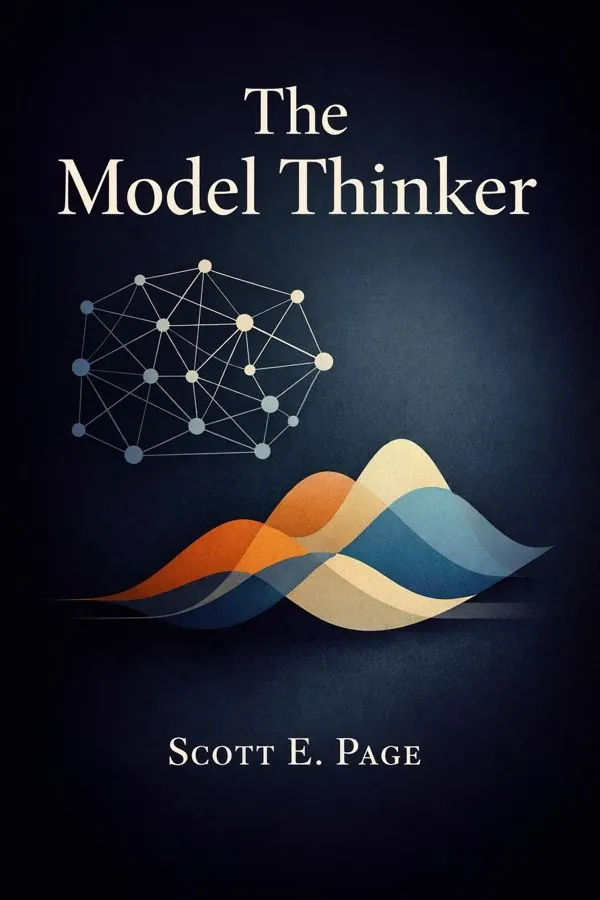
The Model Thinker: What You Need to Know to Make Data Work for You: Summary & Key Insights
 10 min5 chaptersAudio available
What Is The Model Thinker: What You Need to Know to Make Data Work for You About?
The Model Thinker: What You Need to Know to Make Data Work for You by Scott E. Page is a data_science book spanning 5 pages. In The Model Thinker, Scott E. Page explains how using multiple models—mathematical, statistical, and conceptual—can help individuals and organizations make better decisions in complex, data-rich environments. The book introduces a wide range of models from economics, sociology, and computer science, showing how they can be combined to interpret data, predict outcomes, and design effective strategies.
This FizzRead summary covers all 5 key chapters of The Model Thinker: What You Need to Know to Make Data Work for You in approximately 10 minutes, distilling the most important ideas, arguments, and takeaways from Scott E. Page's work. Also available as an audio summary and Key Quotes Podcast.
The Model Thinker: What You Need to Know to Make Data Work for You
In The Model Thinker, Scott E. Page explains how using multiple models—mathematical, statistical, and conceptual—can help individuals and organizations make better decisions in complex, data-rich environments. The book introduces a wide range of models from economics, sociology, and computer science, showing how they can be combined to interpret data, predict outcomes, and design effective strategies.
Who Should Read The Model Thinker: What You Need to Know to Make Data Work for You?
This book is perfect for anyone interested in data_science and looking to gain actionable insights in a short read. Whether you're a student, professional, or lifelong learner, the key ideas from The Model Thinker: What You Need to Know to Make Data Work for You by Scott E. Page will help you think differently.
- ✓Readers who enjoy data_science and want practical takeaways
- ✓Professionals looking to apply new ideas to their work and life
- ✓Anyone who wants the core insights of The Model Thinker: What You Need to Know to Make Data Work for You in just 10 minutes
Want the full summary?
Get instant access to this book summary and 100K+ more with Fizz Moment.
Get Free SummaryAvailable on App Store • Free to download
Key Chapters
Throughout my career, I have learned that the most common failure in reasoning is not ignorance but overconfidence in a single viewpoint. Individuals and institutions alike often hinge their decisions on one favored model—a linear regression, a supply-demand curve, an optimization rule—and then fall short when reality refuses to conform. The world is not linear, nor is it neatly predictable; it is composed of overlapping mechanisms, each partially true. That’s why multiplicity matters.
When you combine models, you combine insights. Each model brings its own set of assumptions, strengths, and blind spots. A linear model may capture proportional responses but miss thresholds. A network model may explain diffusion but ignore individual incentives. When diverse models converge, they correct each other’s biases and expand explanatory power.
Take forecasting economic growth. Economists might apply time-series models to reveal historical trends, agent-based models to simulate individual choices, and equilibrium models to estimate macro outcomes. Alone, each provides a fragment. Together, they create a more resilient picture, accommodating both pattern and deviation. This multiplicity reflects what I call “ensemble thinking”—the intellectual equivalent of diversification.
Model diversity is not about intellectual indulgence. It’s about robustness. By triangulating through multiple representations, we minimize the risk of being wrong in the same way. In complex systems—from ecosystems to financial markets—no single viewpoint captures the whole truth. Hence, the challenge is not to pick the one right model, but to weave a tapestry of models that together approximate the truth. The mature thinker moves fluidly among models, using each when its assumptions fit and discarding it when they don’t.
This principle mirrors the diversity advantage I’ve explored elsewhere: groups composed of varied thinkers outperform homogeneous ones because they bring different heuristics to bear. Similarly, multiple models embody collective intelligence within an individual’s reasoning process. The more models you command, the greater your ability to match them to problems. Model diversity isn’t complexity for its own sake; it’s complexity harnessed to serve clarity.
Every model begins with an act of simplification—an intentional distortion of reality for the sake of understanding. When I construct a model, I’m not trying to replicate the world but to reveal its underlying logic. This means accepting a trade-off: the more precise the model’s scope, the less general its reach. Yet this distortion is intellectually productive; it frees us to study cause and effect.
Take, for example, a model of voter behavior. One version may assume all individuals are rational, seeking to maximize utility. Another might treat them as rule-followers within social networks, influenced by neighbors and norms. Both simplify, but in different ways. The first yields clarity about incentives; the second yields insight about contagion and conformity. Neither is the whole truth, yet each tells a vital story.
Understanding a model’s assumptions is central to using it well. Every model implicitly answers three questions: what matters most, what can be ignored, and how the parts interact. A thoughtful modeler is always testing these decisions. Simplifications are not mistakes—they are design choices. But if we forget that models are simplifications, we risk confusing maps with territory. The art of modeling lies not in achieving perfection but in managing imperfection.
This awareness leads to humility. A model is a tool, not a truth. By recognizing its logic and limitations, we use it appropriately. Models help us think through possible worlds: what would happen if people behaved differently, if prices changed, if networks expanded? They let us reason about outcomes without being constrained by anecdote. But they work only when handled with respect for the assumptions that sustain them.
In practice, this mindset trains you to ask sharper questions. Before applying any model, ask yourself: what are its foundations? Which dynamics does it illuminate? Where might it mislead? Model logic is about cultivating this disciplined skepticism—the habit of examining the architecture of explanation itself.
+ 3 more chapters — available in the FizzRead app
All Chapters in The Model Thinker: What You Need to Know to Make Data Work for You
About the Author
Scott E. Page is an American social scientist and professor at the University of Michigan, known for his work on diversity, complexity, and modeling in the social sciences. He has authored several influential books on complexity theory and decision-making.
Get This Summary in Your Preferred Format
Read or listen to the The Model Thinker: What You Need to Know to Make Data Work for You summary by Scott E. Page anytime, anywhere. FizzRead offers multiple formats so you can learn on your terms — all free.
Available formats: App · Audio · PDF · EPUB — All included free with FizzRead
Download The Model Thinker: What You Need to Know to Make Data Work for You PDF and EPUB Summary
Key Quotes from The Model Thinker: What You Need to Know to Make Data Work for You
“Throughout my career, I have learned that the most common failure in reasoning is not ignorance but overconfidence in a single viewpoint.”
“Every model begins with an act of simplification—an intentional distortion of reality for the sake of understanding.”
Frequently Asked Questions about The Model Thinker: What You Need to Know to Make Data Work for You
The Model Thinker: What You Need to Know to Make Data Work for You by Scott E. Page is a data_science book that explores key ideas across 5 chapters. In The Model Thinker, Scott E. Page explains how using multiple models—mathematical, statistical, and conceptual—can help individuals and organizations make better decisions in complex, data-rich environments. The book introduces a wide range of models from economics, sociology, and computer science, showing how they can be combined to interpret data, predict outcomes, and design effective strategies.
You Might Also Like

Data Science from Scratch: First Principles with Python
Joel Grus
10 min
Applied Predictive Modeling
Max Kuhn, Kjell Johnson
10 min
Better Data Visualizations: A Guide for Scholars, Researchers, and Wonks
Jonathan Schwabish
10 min
Big Data: A Revolution That Will Transform How We Live, Work, and Think
Viktor Mayer-Schönberger, Kenneth Cukier
10 min
Big Data: Principles and Best Practices of Scalable Real-Time Data Systems
Nathan Marz
10 min
Data Points: Visualization That Means Something
Nathan Yau
10 minBrowse by Category
Ready to read The Model Thinker: What You Need to Know to Make Data Work for You?
Get the full summary and 100K+ more books with Fizz Moment.