
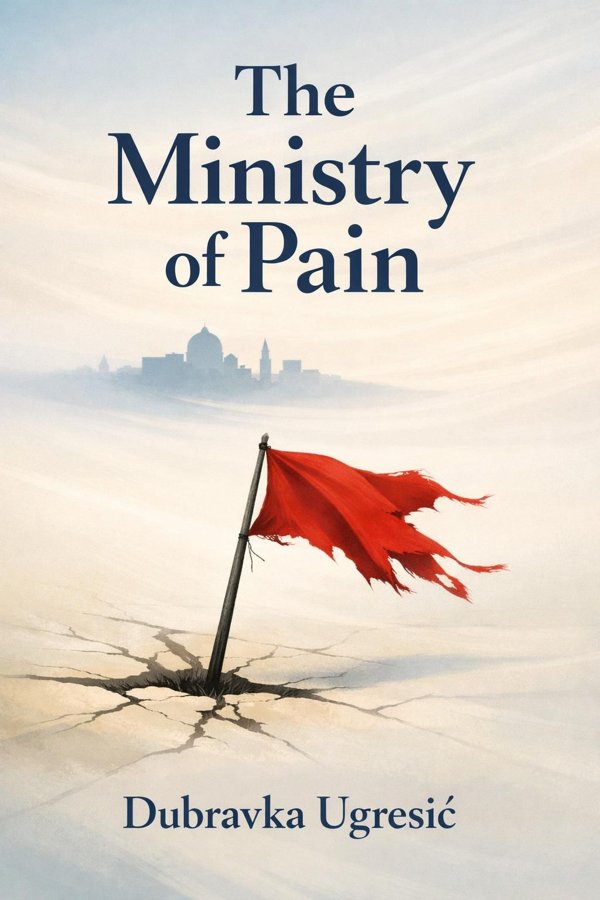
The Ministry of Pain: Summary & Key Insights
 10 min9 chaptersAudio available
Key Takeaways from The Ministry of Pain
A classroom can become a border crossing when everyone inside has lost a country.
When a language is renamed, divided, or politicized, speakers can feel as if their own inner life has been partitioned.
Suffering often attracts attention, but attention can quickly become a market.
Leaving danger does not end suffering; sometimes it rearranges it into guilt.
Nostalgia feels like tenderness, but it can also become a private prison.
What Is The Ministry of Pain About?
The Ministry of Pain by Dubravka Ugresic is a classics book spanning 4 pages. Dubravka Ugresic’s The Ministry of Pain is a brilliant, unsettling novel about what remains after a country collapses: damaged language, fractured memory, and people forced to reinvent themselves far from home. Set largely in Amsterdam, the book follows Tanja Lucic, a teacher from the former Yugoslavia, as she leads a class of displaced students who share a broken cultural inheritance but no longer share a stable nation, identity, or even agreed-upon language. What begins as an academic setting gradually becomes something stranger and deeper: a laboratory of exile, nostalgia, shame, and emotional survival. The novel matters because it captures a modern condition that extends far beyond the Balkans. Ugresic shows how political violence does not end with ceasefires; it lingers in speech, memory, bureaucracy, and intimate relationships. Her perspective carries unusual authority. Having left Croatia during the nationalist upheavals of the 1990s, Ugresic wrote from lived experience of estrangement and public hostility, and she became one of the most incisive literary voices on exile and post-Yugoslav identity. The Ministry of Pain is at once satire, elegy, and intellectual reckoning—a powerful classic for anyone interested in displacement, belonging, and the stories nations force people to tell.
This FizzRead summary covers all 9 key chapters of The Ministry of Pain in approximately 10 minutes, distilling the most important ideas, arguments, and takeaways from Dubravka Ugresic's work. Also available as an audio summary and Key Quotes Podcast.
The Ministry of Pain
Dubravka Ugresic’s The Ministry of Pain is a brilliant, unsettling novel about what remains after a country collapses: damaged language, fractured memory, and people forced to reinvent themselves far from home. Set largely in Amsterdam, the book follows Tanja Lucic, a teacher from the former Yugoslavia, as she leads a class of displaced students who share a broken cultural inheritance but no longer share a stable nation, identity, or even agreed-upon language. What begins as an academic setting gradually becomes something stranger and deeper: a laboratory of exile, nostalgia, shame, and emotional survival.
The novel matters because it captures a modern condition that extends far beyond the Balkans. Ugresic shows how political violence does not end with ceasefires; it lingers in speech, memory, bureaucracy, and intimate relationships. Her perspective carries unusual authority. Having left Croatia during the nationalist upheavals of the 1990s, Ugresic wrote from lived experience of estrangement and public hostility, and she became one of the most incisive literary voices on exile and post-Yugoslav identity. The Ministry of Pain is at once satire, elegy, and intellectual reckoning—a powerful classic for anyone interested in displacement, belonging, and the stories nations force people to tell.
Who Should Read The Ministry of Pain?
This book is perfect for anyone interested in classics and looking to gain actionable insights in a short read. Whether you're a student, professional, or lifelong learner, the key ideas from The Ministry of Pain by Dubravka Ugresic will help you think differently.
- ✓Readers who enjoy classics and want practical takeaways
- ✓Professionals looking to apply new ideas to their work and life
- ✓Anyone who wants the core insights of The Ministry of Pain in just 10 minutes
Want the full summary?
Get instant access to this book summary and 100K+ more with Fizz Moment.
Get Free SummaryAvailable on App Store • Free to download
Key Chapters
A classroom can become a border crossing when everyone inside has lost a country. In The Ministry of Pain, Tanja Lucic’s Amsterdam seminar is not merely an academic space; it is a compressed version of the former Yugoslavia, populated by students who have fled war, nationalism, and social collapse. They arrive carrying different passports, accents, loyalties, and wounds, yet they also share references, jokes, songs, and habits from a common past that official politics has tried to erase or divide.
Tanja quickly realizes that teaching literature in the ordinary sense is almost impossible. The students do not simply need interpretation of texts; they are themselves living archives of rupture. Their exchanges reveal how exile produces contradictory emotions: relief at having escaped, guilt at having survived, and resentment toward those who interpret them too easily. The classroom becomes a space where identity is constantly negotiated. A casual word choice can imply allegiance. A memory can unite the group one moment and divide it the next.
Ugresic uses this setting to show how institutions often pretend neutrality while absorbing historical trauma. A seminar, supposedly devoted to learning, becomes a place where political disintegration resurfaces in intimate form. This is recognizable far beyond the novel. Any group marked by displacement—migrants, refugees, diasporic communities, even people from polarized societies—can recreate these tensions in schools, workplaces, and social circles.
The practical insight is that shared background does not automatically create solidarity. People with similar histories may carry very different interpretations of what happened and what must be forgotten. If you lead or participate in diverse groups shaped by conflict or upheaval, resist the urge to flatten experience into a single story. Create room for ambiguity, contradiction, and emotional complexity. Actionable takeaway: when discussing identity in any group setting, ask not only what people share, but also what losses and silences shape their participation.
When a language is renamed, divided, or politicized, speakers can feel as if their own inner life has been partitioned. One of the novel’s deepest concerns is the fate of Serbo-Croatian after the breakup of Yugoslavia. For Tanja, language once represented continuity: education, culture, humor, intimacy, and intellectual life flowed through a shared linguistic world. After disintegration, that same language is reclassified into national variants, and words become ideological markers.
Ugresic shows that language is never just a technical system of communication. It carries memory, class, region, affection, and belonging. In exile, speaking becomes fraught. A familiar phrase may suddenly identify someone as Serbian, Croatian, Bosnian, or insufficiently loyal to any of them. Even the effort to speak “correctly” can become absurd, because political authorities try to impose purity on a living, mixed, everyday speech. Tanja’s awareness of these shifts makes teaching almost impossible: how do you discuss literature when the language of that literature has become a battlefield?
This tension remains relevant in many contexts. People whose native tongues have been stigmatized, standardized, or split by politics know the feeling of being corrected out of their own history. The novel invites readers to notice how arguments over vocabulary often conceal deeper struggles over legitimacy and power.
Practically, Ugresic encourages a more humane relation to speech. Instead of treating language differences as proof of division, we can regard them as evidence of layered histories. In daily life, this means listening for what language carries emotionally, not only semantically. In classrooms, media, or intercultural work, it means avoiding simplistic assumptions that one official label can capture lived speech. Actionable takeaway: the next time language becomes politically charged, ask what human bonds, memories, and exclusions are being fought over beneath the words.
Suffering often attracts attention, but attention can quickly become a market. One of Ugresic’s sharpest satirical insights is that exile is not experienced only as pain; it is also packaged, interpreted, and consumed by institutions, media, and Western cultural audiences. The displaced person can be invited to speak, teach, perform, and represent trauma, but usually in forms that fit preexisting expectations. The exile becomes interesting when their pain is legible, morally useful, or aesthetically pleasing.
In Tanja’s world, the West often wants a digestible version of Balkan suffering: the refugee as witness, the intellectual as interpreter, the victim as cultural exhibit. This creates a humiliating paradox. Exiles need jobs, visas, grants, and recognition, yet they may secure these only by turning personal and collective disaster into a narrative for others. The result is alienation layered on top of alienation. One is not only far from home; one is asked to perform distance and damage for an audience.
Ugresic’s critique reaches beyond the post-Yugoslav context. Today, identity categories, trauma stories, and geopolitical crises are routinely transformed into conference themes, publishing trends, social media personas, and prestige commodities. The novel asks us to examine who benefits when suffering becomes cultural capital.
This does not mean testimony has no value. It means ethical listening matters. Readers, educators, and institutions should ask whether they are making space for complexity or merely rewarding familiar scripts. Are they allowing contradiction, boredom, anger, irony, and refusal—or only the most marketable version of pain?
Actionable takeaway: whenever you encounter a story of displacement or trauma, pause before consuming it as insight or inspiration. Ask what pressures may shape how that story is told, what remains unsaid, and how to respond without turning another person’s loss into your emotional product.
Leaving danger does not end suffering; sometimes it rearranges it into guilt. In The Ministry of Pain, exile is not portrayed as liberation alone. Those who have escaped war and collapse remain haunted by what they abandoned: family, language, social roles, and the dead. Even safety can feel morally contaminated. Why did one person get out while another stayed? What does success abroad mean when it rests on a history of destruction back home?
Tanja embodies this tension. She is physically removed from violence, but she cannot inhabit her new life innocently. The students around her also display forms of disintegration: emotional numbness, irony, passivity, compulsive memory, and private shame. Ugresic resists sentimental narratives of healing. Instead, she shows that exile often produces suspended identities. People continue living, working, and desiring, but parts of the self remain lodged in unresolved history.
An important aspect of the novel is that guilt is not always rational. It may arise from survival, from adaptation, from forgetting too much, or from remembering too vividly. It can also become self-protective: if one remains guilty, one remains connected to what was lost. Letting go may feel like betrayal.
This insight applies widely. Many people experience a version of survivor’s guilt after family upheaval, migration, social mobility, or personal reinvention. You can leave a painful environment yet still feel disloyal for moving on. Ugresic suggests that such guilt cannot be argued away through logic alone; it must be recognized as part of emotional history.
Actionable takeaway: if your growth is shadowed by guilt, name the contradiction instead of hiding it. Write down what you left, what you gained, and whom you feel you owe. Clarity does not erase guilt, but it can prevent guilt from silently organizing your life.
Nostalgia feels like tenderness, but it can also become a private prison. Throughout the novel, memories of Yugoslavia surface through cultural fragments: songs, slang, television references, habits, jokes, and emotional rhythms. These remnants create moments of recognition among Tanja and her students, offering relief from alienation. Shared recollection becomes a temporary homeland. Yet Ugresic is too intelligent to romanticize this process. Nostalgia can preserve continuity, but it can also freeze people inside an idealized past that never truly existed.
What makes the novel so powerful is its refusal to treat nostalgia as either good or bad. It is both medicine and sedative. On one hand, remembering common cultural life resists nationalist rewriting and affirms that something valuable was destroyed. On the other hand, constant return to old forms of belonging may block the difficult work of building a livable present. The more vivid the lost world becomes, the more inadequate current reality can feel.
This dynamic is familiar to anyone who has left a place, relationship, profession, or version of self. We often curate the past into a coherent refuge, highlighting its warmth while muting its contradictions. In diasporic life especially, nostalgia can become a social glue, but also an emotional economy built on repetition.
Ugresic’s lesson is not to reject memory but to examine its uses. Are memories helping us mourn honestly, or are they protecting us from change? Are they connecting us to others, or isolating us inside a myth of what once was?
Actionable takeaway: revisit one cherished memory and ask two questions—what comfort does this memory give me, and what present difficulty does it help me avoid? That small act can turn nostalgia from passive longing into active self-understanding.
Some truths become visible only when treated with irony. Although The Ministry of Pain is saturated with sorrow, Ugresic does not write in a purely solemn mode. She uses satire to expose the absurdities surrounding war’s aftermath: academic jargon, international bureaucracy, identity branding, moral posturing, and the awkward rituals through which displaced people are categorized and managed. This humor is not decorative. It is a method of diagnosis.
Satire works here because trauma often generates public language that is false, inflated, or sentimental. Official statements, media narratives, and intellectual frameworks can make catastrophe sound comprehensible when it is not. Ugresic cuts through these simplifications by highlighting contradiction and absurdity. The result is unsettling but clarifying. We see how institutions can treat profound human dislocation as paperwork, policy issue, or cultural theme.
At the same time, satire protects the novel from becoming self-pitying. Tanja’s voice can be sharp, skeptical, and self-aware. That tonal complexity matters because exile rarely produces noble suffering alone. It also produces pettiness, boredom, vanity, erotic confusion, and dark comedy. By allowing these less flattering textures in, Ugresic restores human reality.
Readers can apply this insight in their own lives. Humor, used carefully, can reveal where social scripts no longer match lived experience. In organizations, families, or public discourse, jokes often point toward tensions people cannot express directly. The danger, of course, is using irony to evade feeling altogether. Ugresic avoids that trap by letting satire coexist with grief rather than replace it.
Actionable takeaway: when a painful situation starts generating clichés, pay attention to what feels absurd. Write down the phrases, rituals, or expectations that ring false. That act of noticing can expose hidden power structures and restore your ability to think clearly.
Political collapse does not remain political; it enters the body, the bedroom, and the most private forms of attachment. One of the novel’s subtler achievements is its portrayal of how exile reshapes intimacy. Relationships in The Ministry of Pain are marked by instability, projection, and emotional asymmetry. People seek comfort in one another, but they also use one another as mirrors, witnesses, substitutes, and escape routes.
Displacement intensifies desire because ordinary structures of identity have been weakened. Home, profession, language, and social roles no longer provide stable orientation, so intimacy can seem like a shortcut to belonging. Yet the very instability that creates longing also undermines connection. Partners may not share the same relationship to memory, guilt, or adaptation. A person trying to forget collides with a person trying to remember. One seeks reinvention; another seeks confirmation of the past.
Tanja’s emotional life reflects this fragmentation. Her connections are shaped not only by present feelings but by the residue of cultural and historical loss. Ugresic suggests that exile changes the terms on which people love. It can make them more dependent on recognition, more suspicious of misunderstanding, and more vulnerable to repetition of old wounds in new settings.
This idea travels well beyond forced migration. Any major rupture—divorce, bereavement, class transition, career collapse, relocation—can destabilize intimacy in similar ways. When identity is in flux, relationships often bear more symbolic weight than they can carry.
Actionable takeaway: if you are building or repairing closeness during a period of major transition, separate what you need from the other person from what you need from life itself. Ask yourself: am I seeking this person, or am I seeking rescue, witness, or return? That distinction can make relationships more honest and less burdened.
The most painful identities are often the ones that no longer have a recognized name. In the aftermath of Yugoslavia’s breakup, Tanja and her students inhabit a strange zone: they are expected to fit new national categories, yet many of their memories, habits, and cultural references belong to a shared world that no longer officially exists. They are not simply between places; they are between narratives. The result is an unfinished self.
Ugresic rejects the comforting idea that identity naturally restabilizes after crisis. Instead, she presents selfhood as contingent, historically shaped, and vulnerable to political rewriting. A person may be told to adopt a new label, but inwardly remain attached to older forms of belonging. At the same time, clinging to old labels may no longer reflect social reality. This mismatch produces estrangement not only from states or communities, but from one’s own biography.
The novel therefore speaks to anyone whose life has outlived the categories available to describe it: migrants, children of diaspora, people from dissolved countries, mixed-heritage individuals, or those who have crossed class, gender, or ideological boundaries. Ugresic shows that confusion is not a failure of maturity; it may be an accurate response to historical violence.
Importantly, unfinished identity is not only loss. It can also open space for critical freedom. Those who no longer fit cleanly into official narratives may see their artificiality more clearly. They can resist the demand to become simple.
Actionable takeaway: if no available label fully fits you, stop treating that as a defect to be corrected immediately. Instead, list the identities others assign you, the identities you inherit, and the identities you choose. The gaps between them may be the most truthful map of your experience.
Nations depend on selective memory, but individuals often remember inconveniently. A major force in The Ministry of Pain is the clash between lived recollection and the tidy narratives demanded by postwar nationalism. States want clear stories: heroes and traitors, victims and aggressors, authentic languages and proper histories. Yet Tanja and her students possess memories that are mixed, intimate, and resistant to purification. They remember popular culture, friendships, cross-regional habits, linguistic overlap, and emotional life that does not fit new ideological boundaries.
Ugresic highlights how power works not only through censorship, but through simplification. Once a society begins dividing a formerly shared world into mutually exclusive identities, memory itself becomes suspect. To remember overlap is to challenge separation. To remember ordinary coexistence is to undermine narratives built on total difference. This makes memory politically charged.
The novel’s contribution lies in showing that preserving complexity is a moral act. Not because memory is perfectly reliable—it is not—but because homogenized history is often more dangerous than imperfect recollection. Private memory can protect what official discourse needs to erase.
This has broad relevance. In polarized societies, organizations, and even families, people are often pressured to accept simplified versions of the past. Nuance may be treated as betrayal. Ugresic reminds us that fidelity to lived experience sometimes requires resisting group-approved memory.
Actionable takeaway: when you encounter a neat collective story about a conflict, ask what ordinary details have been excluded. Seek out the small memories—shared routines, mixed affiliations, unresolved contradictions—that official accounts cannot easily absorb. Those details often reveal the most human truth.
All Chapters in The Ministry of Pain
About the Author
Dubravka Ugresic (1949–2023) was a Croatian-born novelist, essayist, and literary scholar whose work explored exile, nationalism, memory, and the cultural consequences of the breakup of Yugoslavia. She studied comparative literature and Russian at the University of Zagreb and later worked in academia and publishing. During the nationalist upheavals of the 1990s, her public criticism of war rhetoric and conformist culture made her a target in Croatia, and she eventually left the country. She later lived and worked in the Netherlands, writing essays and fiction that earned international acclaim for their intellectual sharpness, irony, and moral clarity. Ugresic became one of the most important European voices on displacement and identity, with major works including The Museum of Unconditional Surrender, Thank You for Not Reading, and The Ministry of Pain.
Get This Summary in Your Preferred Format
Read or listen to the The Ministry of Pain summary by Dubravka Ugresic anytime, anywhere. FizzRead offers multiple formats so you can learn on your terms — all free.
Available formats: App · Audio · PDF · EPUB — All included free with FizzRead
Download The Ministry of Pain PDF and EPUB Summary
Key Quotes from The Ministry of Pain
“A classroom can become a border crossing when everyone inside has lost a country.”
“When a language is renamed, divided, or politicized, speakers can feel as if their own inner life has been partitioned.”
“Suffering often attracts attention, but attention can quickly become a market.”
“Leaving danger does not end suffering; sometimes it rearranges it into guilt.”
“Nostalgia feels like tenderness, but it can also become a private prison.”
Frequently Asked Questions about The Ministry of Pain
The Ministry of Pain by Dubravka Ugresic is a classics book that explores key ideas across 9 chapters. Dubravka Ugresic’s The Ministry of Pain is a brilliant, unsettling novel about what remains after a country collapses: damaged language, fractured memory, and people forced to reinvent themselves far from home. Set largely in Amsterdam, the book follows Tanja Lucic, a teacher from the former Yugoslavia, as she leads a class of displaced students who share a broken cultural inheritance but no longer share a stable nation, identity, or even agreed-upon language. What begins as an academic setting gradually becomes something stranger and deeper: a laboratory of exile, nostalgia, shame, and emotional survival. The novel matters because it captures a modern condition that extends far beyond the Balkans. Ugresic shows how political violence does not end with ceasefires; it lingers in speech, memory, bureaucracy, and intimate relationships. Her perspective carries unusual authority. Having left Croatia during the nationalist upheavals of the 1990s, Ugresic wrote from lived experience of estrangement and public hostility, and she became one of the most incisive literary voices on exile and post-Yugoslav identity. The Ministry of Pain is at once satire, elegy, and intellectual reckoning—a powerful classic for anyone interested in displacement, belonging, and the stories nations force people to tell.
More by Dubravka Ugresic

You Might Also Like


Browse by Category
Ready to read The Ministry of Pain?
Get the full summary and 100K+ more books with Fizz Moment.