
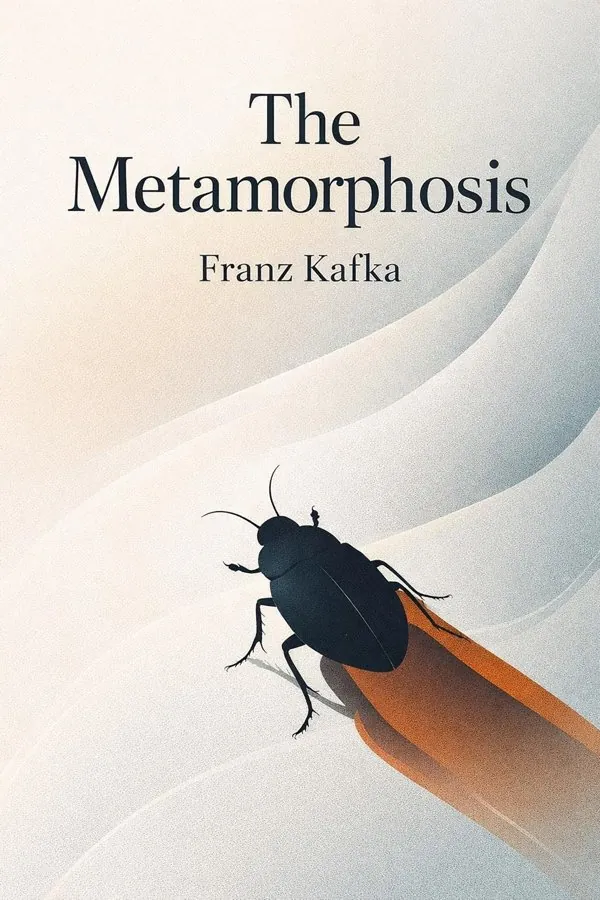
The Metamorphosis: Summary & Key Insights
by Franz Kafka
 10 min9 chaptersAudio available
Key Takeaways from The Metamorphosis
Sometimes the deepest forms of isolation begin not when we are abandoned, but when we can no longer participate in the ordinary rhythm of life.
A society reveals its values most clearly in how it treats those who can no longer work.
Crisis does not create character from nothing; it exposes what was already there.
One of the cruelest forms of suffering is not pain itself, but being unable to make yourself understood.
People often withdraw not because they have stopped needing others, but because they have begun to believe they are unbearable to be seen.
What Is The Metamorphosis About?
The Metamorphosis by Franz Kafka is a classics book spanning 3 pages. What would remain of your identity if the role you play for others suddenly vanished overnight? Franz Kafka’s The Metamorphosis begins with one of the most startling openings in literature: Gregor Samsa, a hardworking traveling salesman, wakes to discover he has become a gigantic insect. Yet the novella’s true shock is not the transformation itself, but what follows—his family’s fear, resentment, dependence, and eventual rejection. First published in 1915, this compact classic has endured because it turns an absurd premise into an unforgettable study of alienation, duty, shame, and the fragile conditions on which love is often offered. Kafka, one of the defining literary voices of the 20th century, wrote with uncanny precision about anxiety, bureaucracy, guilt, and the strangeness of modern life. In The Metamorphosis, he captures the feeling of becoming invisible even while physically present, of being valued only for usefulness, and of losing language when no one is willing to listen. The novella matters not simply as a masterpiece of modernism, but as a mirror held up to family life, work culture, and the human fear of becoming unnecessary.
This FizzRead summary covers all 9 key chapters of The Metamorphosis in approximately 10 minutes, distilling the most important ideas, arguments, and takeaways from Franz Kafka's work. Also available as an audio summary and Key Quotes Podcast.
The Metamorphosis
What would remain of your identity if the role you play for others suddenly vanished overnight? Franz Kafka’s The Metamorphosis begins with one of the most startling openings in literature: Gregor Samsa, a hardworking traveling salesman, wakes to discover he has become a gigantic insect. Yet the novella’s true shock is not the transformation itself, but what follows—his family’s fear, resentment, dependence, and eventual rejection. First published in 1915, this compact classic has endured because it turns an absurd premise into an unforgettable study of alienation, duty, shame, and the fragile conditions on which love is often offered. Kafka, one of the defining literary voices of the 20th century, wrote with uncanny precision about anxiety, bureaucracy, guilt, and the strangeness of modern life. In The Metamorphosis, he captures the feeling of becoming invisible even while physically present, of being valued only for usefulness, and of losing language when no one is willing to listen. The novella matters not simply as a masterpiece of modernism, but as a mirror held up to family life, work culture, and the human fear of becoming unnecessary.
Who Should Read The Metamorphosis?
This book is perfect for anyone interested in classics and looking to gain actionable insights in a short read. Whether you're a student, professional, or lifelong learner, the key ideas from The Metamorphosis by Franz Kafka will help you think differently.
- ✓Readers who enjoy classics and want practical takeaways
- ✓Professionals looking to apply new ideas to their work and life
- ✓Anyone who wants the core insights of The Metamorphosis in just 10 minutes
Want the full summary?
Get instant access to this book summary and 100K+ more with Fizz Moment.
Get Free SummaryAvailable on App Store • Free to download
Key Chapters
Sometimes the deepest forms of isolation begin not when we are abandoned, but when we can no longer participate in the ordinary rhythm of life. That is the terror at the heart of Gregor Samsa’s first morning. He wakes transformed into a monstrous insect, but his first thoughts are not philosophical or dramatic. He worries about missing the train, disappointing his employer, and failing his family. Kafka makes this moment powerful by showing that alienation does not arrive as a grand idea; it enters through interrupted routines, broken communication, and the sudden inability to perform one’s social role.
Gregor’s body has become unrecognizable, yet his mind remains painfully attached to his old obligations. This split reveals a key truth: identity is often held together by habit. Once Gregor can no longer leave his bed, dress himself, or speak in a human voice, the world around him begins to treat him as something other than a person. His transformation is grotesque, but it also functions as an exaggeration of a common experience—feeling inwardly the same while outwardly becoming unreadable to others.
Kafka’s insight applies far beyond fiction. Illness, burnout, unemployment, disability, aging, or social exclusion can all produce a similar rupture. A person may still possess feelings, loyalty, intelligence, and memory, yet be reduced in the eyes of others to inconvenience. The novella asks us to notice how quickly empathy collapses when someone can no longer fit expected patterns.
The practical lesson is uncomfortable but necessary: do not define yourself or others only by productivity and routine. Build identities rooted in character, not function. When life changes suddenly, ask not just “How do I get back to normal?” but “What remains human in me when normal disappears?”
A society reveals its values most clearly in how it treats those who can no longer work. In The Metamorphosis, Gregor’s life before his transformation is already dehumanized. He is a traveling salesman trapped in exhausting labor, pressured by schedules, monitored by superiors, and burdened by debt. His job is not a source of fulfillment; it is a mechanism of obligation. Even after becoming an insect, his first panic is not about his body but about being late for work. That detail tells us everything about how deeply duty has colonized his identity.
Kafka shows that Gregor has been valued primarily as an economic provider. He supports his parents and sister, and that role gives him importance in the household. Once he can no longer earn money, the family’s emotional structure begins to shift. Their concern quickly mixes with frustration, then resentment. This is not because they are uniquely cruel, but because their relationships were already built on dependence and utility. Gregor’s transformation merely makes visible a truth that had been hidden beneath routine.
This theme remains strikingly modern. Many people tie self-worth to career status, income, or usefulness. When they lose a job, experience burnout, or need care instead of giving it, they may feel shame out of proportion to the event itself. Organizations also often praise devotion while quietly treating workers as replaceable once performance slips.
Kafka invites readers to ask a difficult question: if usefulness disappears, does dignity remain? The answer the novella demands is yes—but the characters struggle to live by it. In practical terms, this means resisting the habit of valuing people only for output. In families, workplaces, and friendships, make space for people to matter even when they are failing, resting, grieving, or dependent. Your actionable takeaway: examine where your sense of worth comes from, and deliberately separate your humanity from your productivity.
Crisis does not create character from nothing; it exposes what was already there. Gregor’s transformation throws his family into upheaval, but Kafka is less interested in horror than in revelation. Each family member becomes a mirror reflecting a different response to dependency, fear, and social pressure. The mother embodies helpless love—she grieves for her son yet cannot truly face his condition. The father responds with anger, humiliation, and violence, as if Gregor’s existence itself were an accusation. Grete, at first the most tender, gradually shifts from caretaker to judge. Together, they reveal how affection can curdle when care becomes costly.
This is one of Kafka’s sharpest insights: family bonds are not automatically unconditional. They are tested by inconvenience, financial pressure, embarrassment, and prolonged need. At the beginning, Gregor’s income quietly holds the household together. Once that support vanishes, the family must work, adapt, and confront its own fragility. Their changing attitude toward him reflects not only disgust, but also resentment toward the dependence that had previously structured their lives.
In modern terms, the novella captures what happens when a family must suddenly care for someone with chronic illness, mental health struggles, or disability, especially when there is little emotional maturity or financial stability. Love may remain, but it becomes entangled with exhaustion, denial, and blame. Kafka does not excuse the family, but he does show how fear can masquerade as practicality.
The lesson is to look honestly at the conditions under which affection is offered. Do we love people for who they are, or for how seamlessly they fit our needs? Families often imagine themselves as naturally loyal, but loyalty must be practiced, not assumed. Actionable takeaway: in times of strain, pay attention to whether your response to another person’s vulnerability is guided by compassion or by the wish to remove discomfort as quickly as possible.
One of the cruelest forms of suffering is not pain itself, but being unable to make yourself understood. Gregor remains mentally aware after his transformation, yet his speech becomes unintelligible to others. He still thinks like a son and worker, still worries, remembers, and interprets the world, but when he tries to communicate, those around him hear only animal noise. Kafka turns this into a devastating meditation on the limits of language and the fragility of mutual recognition.
The tragedy is not simply that Gregor cannot talk. It is that once his words fail, others stop trying to understand him. They interpret his intentions through fear and disgust. Even actions that might express concern or confusion are perceived as threat. In this way, Kafka shows that communication is never just about vocabulary; it depends on willingness, patience, and shared assumptions about personhood. When someone is no longer seen as fully human, their meaning becomes inaccessible.
This dynamic appears in everyday life more often than we admit. People who are depressed, neurodivergent, grieving, ill, elderly, or speaking from a marginalized position may struggle to express themselves in ways others find familiar. Rather than slowing down, listeners often rush to label them difficult, irrational, or inconvenient. Misunderstanding then hardens into exclusion.
Kafka’s message is practical as well as literary: if someone’s expression becomes unfamiliar, our responsibility to interpret them with care increases, not decreases. Good communication is not only saying things clearly; it is making room for meanings that arrive imperfectly. Actionable takeaway: when someone is struggling to express themselves, resist the urge to judge the form of their message. Ask clarifying questions, attend to behavior with empathy, and remember that being heard is a core human need.
A home is often imagined as a refuge, but Kafka shows that it can also become a map of power, exclusion, and emotional decay. Gregor’s room is central to The Metamorphosis. At first it is a familiar bedroom, the place from which he used to leave for work. After his transformation, it becomes a site of confinement, observation, neglect, and symbolic erasure. The changing treatment of the room reflects the family’s changing treatment of Gregor himself.
When furniture is removed from the room, the scene carries more than practical significance. On one level, the family is trying to adapt the space to Gregor’s new insect body. On another, they are stripping away the objects that connect him to his human identity—desk, pictures, and traces of former life. Grete’s care appears helpful, but it also assists in rewriting Gregor as something less than the son and brother he once was. Space, in Kafka, is never neutral. It records emotional decisions.
This idea has practical relevance. The environments we create for vulnerable people communicate what we believe about them. A room can preserve dignity or announce abandonment. Think of a sick relative moved into a back corner of the house, an elderly parent whose possessions are discarded without consultation, or a child whose privacy is erased under the logic of control. Physical arrangements often reveal emotional truths more clearly than words.
Kafka encourages readers to pay attention to space as a moral language. Does a home make room for dependence without humiliation? Does it preserve identity during change, or erase it for convenience? Actionable takeaway: look around your own environments—home, workplace, care settings—and ask what they communicate about the worth of the people in them. Then make one concrete change that affirms belonging rather than mere containment.
Sometimes a life ends long before the body does, through neglect, exhaustion, and the slow withdrawal of meaning. Gregor’s final decline is not driven by the shock of transformation alone. It emerges from accumulated injury: physical harm, emotional abandonment, hunger, and the realization that his presence has become intolerable to those he loves. Kafka refuses melodrama. Gregor does not die as a heroic martyr or a triumphant rebel. He fades through dispossession, and that quietness is precisely what makes the ending so devastating.
His death marks the completion of the family’s emotional trajectory. They have shifted from dependence to discomfort to rejection. Most chillingly, his disappearance brings them relief. They feel lighter, more hopeful, more capable of planning a future. Kafka offers no comforting moral correction. Instead, he exposes an unsettling fact about human beings: we can adapt not only to suffering, but also to the removal of the sufferer, especially when that person has come to symbolize inconvenience.
Yet Gregor’s death is not meaningless. It crystallizes the novella’s critique of conditional love and social usefulness. He is mourned less as a person than replaced as a problem solved. That is why the ending lingers. It forces readers to confront the ethical consequences of gradual dehumanization.
In life, most abandonment happens incrementally rather than dramatically. A struggling colleague stops being included. A dependent relative becomes spoken about instead of spoken to. A friend in crisis is quietly avoided because their pain is exhausting. Kafka asks us to notice these small rehearsals of erasure before they harden into moral failure.
Actionable takeaway: do not wait for catastrophe to recognize someone’s isolation. Intervene early where neglect is becoming normal. Human dignity often depends on ordinary acts of sustained presence.
The strangest stories often tell the most realistic truths. A man waking up as an insect is an absurd premise, but Kafka uses this impossibility not to escape reality, but to intensify it. By removing the need for a realistic explanation, he directs our attention away from causes and toward consequences. Why Gregor transforms matters less than what the transformation reveals about work, family, identity, and social worth.
This is one reason The Metamorphosis remains so powerful. In ordinary realist fiction, readers might debate whether Gregor’s decline is believable in social or medical terms. Kafka sidesteps such arguments. The impossible event becomes a spotlight, exaggerating dynamics that are otherwise easy to ignore. We see with unusual clarity how quickly others reinterpret a person once that person no longer fits a functional role. Absurdity strips away excuses.
The novella also demonstrates that meaning in literature does not depend on neat allegory. Gregor is not “simply” this or that—illness, depression, disability, capitalism, guilt. He can evoke all of these without collapsing into one symbolic formula. Kafka’s method invites active reading. We are unsettled because the story refuses to settle into a single explanation, much like real experiences of estrangement resist easy labels.
There is a practical lesson here for readers and thinkers. Sometimes direct description fails to capture emotional truth. Metaphor, exaggeration, and surreal framing can reveal hidden structures more effectively than literal reporting. In conversation, education, therapy, or art, unusual images can sometimes express what plain language cannot.
Actionable takeaway: when trying to understand a difficult experience, do not insist only on literal explanation. Ask what image, metaphor, or story best captures the feeling. The language of the absurd may help you recognize truths your rational vocabulary has overlooked.
A person can be surrounded by family, obligations, and daily activity and still experience radical loneliness. That is one of Kafka’s most enduring insights. Gregor is not isolated because he begins alone; he is isolated despite being embedded in a household and a job. Before his transformation, his life is already marked by exhaustion, emotional suppression, and self-sacrifice. The metamorphosis externalizes an inner condition that modern life often produces: the sense of being trapped in a role no one truly sees beyond.
Kafka writes at the beginning of the 20th century, but his portrait feels uncannily contemporary. Many people live in systems that reward compliance, speed, and economic usefulness while leaving little room for rest, self-knowledge, or authentic connection. A person may fulfill expectations yet feel unreal inside. Gregor’s insect form makes visible the way modern structures can make individuals feel ugly, trapped, and mute without any supernatural event at all.
Existential loneliness in the novella is not just social separation. It is the realization that one’s inner life may remain inaccessible even to those physically closest. Gregor cannot bridge the gap between what he feels and what others perceive. That gap is widened by fear, habit, and the practical concerns of survival. Kafka suggests that loneliness is not solved by proximity alone; it requires recognition.
For modern readers, this is both warning and invitation. If your life is built entirely around obligation, others may know your function without knowing you. If your relationships depend only on roles, they may fail under strain. Actionable takeaway: create moments in which you and others can exist outside utility—through honest conversation, rest, attention, and shared presence. Recognition is one of the few antidotes to modern loneliness.
All Chapters in The Metamorphosis
About the Author
Franz Kafka (1883–1924) was a German-speaking Jewish writer born in Prague, then part of the Austro-Hungarian Empire. Though he worked primarily in insurance and published only a small number of works during his lifetime, he became one of the most influential authors of modern literature. Kafka’s writing is known for its unsettling blend of realism and absurdity, as well as its focus on alienation, guilt, authority, bureaucracy, and existential anxiety. His best-known works include The Metamorphosis, The Trial, and The Castle. Much of his writing was published posthumously by his friend Max Brod, despite Kafka’s wish that his manuscripts be destroyed. Today, “Kafkaesque” describes situations that feel surreal, oppressive, and incomprehensibly threatening—a testament to his lasting impact on literature and culture.
Get This Summary in Your Preferred Format
Read or listen to the The Metamorphosis summary by Franz Kafka anytime, anywhere. FizzRead offers multiple formats so you can learn on your terms — all free.
Available formats: App · Audio · PDF · EPUB — All included free with FizzRead
Download The Metamorphosis PDF and EPUB Summary
Key Quotes from The Metamorphosis
“Sometimes the deepest forms of isolation begin not when we are abandoned, but when we can no longer participate in the ordinary rhythm of life.”
“A society reveals its values most clearly in how it treats those who can no longer work.”
“Crisis does not create character from nothing; it exposes what was already there.”
“One of the cruelest forms of suffering is not pain itself, but being unable to make yourself understood.”
“People often withdraw not because they have stopped needing others, but because they have begun to believe they are unbearable to be seen.”
Frequently Asked Questions about The Metamorphosis
The Metamorphosis by Franz Kafka is a classics book that explores key ideas across 9 chapters. What would remain of your identity if the role you play for others suddenly vanished overnight? Franz Kafka’s The Metamorphosis begins with one of the most startling openings in literature: Gregor Samsa, a hardworking traveling salesman, wakes to discover he has become a gigantic insect. Yet the novella’s true shock is not the transformation itself, but what follows—his family’s fear, resentment, dependence, and eventual rejection. First published in 1915, this compact classic has endured because it turns an absurd premise into an unforgettable study of alienation, duty, shame, and the fragile conditions on which love is often offered. Kafka, one of the defining literary voices of the 20th century, wrote with uncanny precision about anxiety, bureaucracy, guilt, and the strangeness of modern life. In The Metamorphosis, he captures the feeling of becoming invisible even while physically present, of being valued only for usefulness, and of losing language when no one is willing to listen. The novella matters not simply as a masterpiece of modernism, but as a mirror held up to family life, work culture, and the human fear of becoming unnecessary.
More by Franz Kafka



You Might Also Like





Browse by Category
Ready to read The Metamorphosis?
Get the full summary and 100K+ more books with Fizz Moment.