
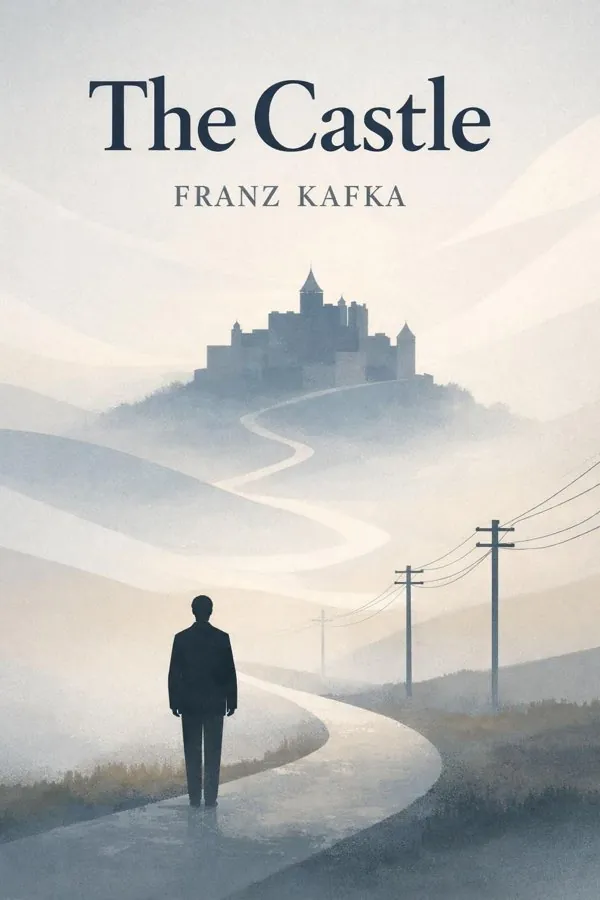
The Castle: Summary & Key Insights
by Franz Kafka
 10 min10 chaptersAudio available
Key Takeaways from The Castle
Power often announces itself not through force but through atmosphere.
Nothing is more frustrating than reaching out for clarity and receiving only noise.
People often confuse closeness to power with power itself.
A title can promise identity while delivering nothing.
Desire becomes destructive when it is forced to survive on uncertainty alone.
What Is The Castle About?
The Castle by Franz Kafka is a classics book spanning 10 pages. Franz Kafka’s The Castle is one of the defining novels of modern literature: eerie, unfinished, darkly comic, and unsettlingly familiar. First published after Kafka’s death in 1926, it follows a man known only as K., who arrives in a snowbound village claiming to have been summoned as the castle’s land surveyor. Instead of beginning work, he enters a maze of contradictory messages, petty officials, social suspicion, and endless delays. The castle, which rules the village from a distance, remains visible yet inaccessible, powerful yet strangely elusive. As K. struggles for recognition, employment, and belonging, Kafka turns a simple premise into a profound meditation on authority, alienation, desire, and the human need for meaning in systems that refuse to explain themselves. The novel still matters because its world feels uncannily modern. Anyone who has faced impersonal institutions, unclear rules, or the exhausting need to prove their legitimacy will recognize Kafka’s vision. Kafka’s authority comes not from abstract theory but from artistic precision: he captures how power works through confusion, ritual, and delay. The Castle remains essential because it transforms bureaucratic frustration into a timeless inquiry into existence itself.
This FizzRead summary covers all 10 key chapters of The Castle in approximately 10 minutes, distilling the most important ideas, arguments, and takeaways from Franz Kafka's work. Also available as an audio summary and Key Quotes Podcast.
The Castle
Franz Kafka’s The Castle is one of the defining novels of modern literature: eerie, unfinished, darkly comic, and unsettlingly familiar. First published after Kafka’s death in 1926, it follows a man known only as K., who arrives in a snowbound village claiming to have been summoned as the castle’s land surveyor. Instead of beginning work, he enters a maze of contradictory messages, petty officials, social suspicion, and endless delays. The castle, which rules the village from a distance, remains visible yet inaccessible, powerful yet strangely elusive. As K. struggles for recognition, employment, and belonging, Kafka turns a simple premise into a profound meditation on authority, alienation, desire, and the human need for meaning in systems that refuse to explain themselves.
The novel still matters because its world feels uncannily modern. Anyone who has faced impersonal institutions, unclear rules, or the exhausting need to prove their legitimacy will recognize Kafka’s vision. Kafka’s authority comes not from abstract theory but from artistic precision: he captures how power works through confusion, ritual, and delay. The Castle remains essential because it transforms bureaucratic frustration into a timeless inquiry into existence itself.
Who Should Read The Castle?
This book is perfect for anyone interested in classics and looking to gain actionable insights in a short read. Whether you're a student, professional, or lifelong learner, the key ideas from The Castle by Franz Kafka will help you think differently.
- ✓Readers who enjoy classics and want practical takeaways
- ✓Professionals looking to apply new ideas to their work and life
- ✓Anyone who wants the core insights of The Castle in just 10 minutes
Want the full summary?
Get instant access to this book summary and 100K+ more with Fizz Moment.
Get Free SummaryAvailable on App Store • Free to download
Key Chapters
Power often announces itself not through force but through atmosphere. In The Castle, K. arrives on a winter night expecting to take up a position as the castle’s land surveyor. Instead of welcome, he meets suspicion. He is questioned, watched, delayed, and made to feel that his presence requires justification. Before any official command is issued, the village itself communicates the castle’s authority. The rules are unclear, but everyone behaves as if those rules are absolute.
This opening matters because Kafka shows that systems of power do not depend only on laws or direct orders. They become real through habit, custom, and social obedience. The villagers may not fully understand the castle any more than K. does, but they have internalized its prestige. They know how to defer, whom not to question, and how to treat outsiders. K.’s first obstacle is not a locked gate but a culture already arranged against him.
This is one reason the novel feels so modern. In workplaces, schools, and government institutions, newcomers often encounter invisible expectations before they encounter formal structures. A person may technically belong yet still feel unwelcome because everyone else knows the unwritten code. Titles, permissions, and procedures matter less than the feeling that legitimacy is granted by others.
K.’s arrival also establishes his defining trait: refusal. He does not quietly accept the village’s judgment. He insists on his right to be there, even when evidence remains uncertain. That persistence makes him admirable, but it also pushes him deeper into conflict with a world that resists clarity.
Actionable takeaway: When entering any institution or community, pay attention not just to official rules but to the invisible habits that shape belonging. Understanding the culture is often the first step to navigating power.
Nothing is more frustrating than reaching out for clarity and receiving only noise. Early in the novel, K. tries to contact the castle and confirm his status. The telephone should provide a direct line to authority, but the experience is bewildering. Voices seem to answer without answering. Signals fade. Information arrives in fragments. Instead of reducing uncertainty, communication multiplies it.
Kafka’s genius lies in showing that confusion can be a form of control. The problem is not simple silence. The castle communicates constantly, but in ways that never settle anything. Messages are delayed, contradictory, formal, and strangely hollow. K. is left to interpret sounds, tones, and implications. Because no single reply carries final authority, he remains trapped in dependence. He cannot stop seeking confirmation, yet confirmation never arrives.
This idea reaches far beyond the novel. Anyone who has tried to resolve an issue through customer support, official email chains, or automated systems knows the feeling. You are not ignored exactly. You are processed. Responses come, but they do not answer the real question. The result is exhaustion and self-doubt. You begin wondering whether the fault lies in the system or in your inability to understand it.
Kafka also anticipates the modern problem of overcommunication without understanding. More channels do not necessarily create more truth. Institutions can preserve distance precisely by surrounding people with forms, intermediaries, and endless procedural language.
K. believes that if he can only reach the right person, the situation will become rational. The tragedy is that the search for the right contact may itself be the mechanism that keeps him powerless.
Actionable takeaway: When dealing with opaque systems, do not mistake activity for progress. Define the exact answer you need, document every exchange, and recognize when a communication process is designed more to defer resolution than to provide it.
People often confuse closeness to power with power itself. K.’s relationship with Frieda embodies this mistake. Frieda works in connection with the castle’s world and, through her prior intimacy with the official Klamm, seems to offer K. a path inward. Their relationship develops quickly, charged by desire, need, and mutual projection. For K., Frieda is not merely a companion. She appears to be a bridge to legitimacy, a sign that he may yet gain entry into the castle’s hidden order.
Kafka treats love here with both tenderness and skepticism. Frieda and K. genuinely seek attachment, but their bond is never free from the pressure of status. K. wants personal recognition and institutional recognition at once, and the two become entangled. Frieda, meanwhile, is drawn to K.’s energy and defiance, yet she also carries the social meanings attached to her former association with Klamm. Their intimacy is shaped by the very system K. hopes to escape.
This dynamic is deeply recognizable. In many settings, relationships become instruments of belonging. A friendship, romance, or mentorship can feel meaningful in itself while also serving as access to a network, profession, or social circle. That pressure can hollow out the relationship, turning affection into strategy and vulnerability into negotiation.
K. misreads Frieda because he imagines that emotional closeness can solve structural exclusion. But personal connection cannot overcome a system built on distance and ambiguity. The result is disappointment on both sides. Their bond strains under the impossible burden of representing salvation.
Kafka’s point is not that love is false. It is that love cannot remain healthy when forced to carry the weight of bureaucratic redemption.
Actionable takeaway: In your own relationships, ask whether you value the person for who they are or for the access, validation, or status they seem to provide. Clearer motives create stronger bonds.
A title can promise identity while delivering nothing. K. arrives as a land surveyor, but the role never stabilizes into real work. He is told he may have been summoned, then told his position may be unnecessary, then surrounded by assistants and obligations that do not clarify his actual purpose. The title gives him a claim, yet it fails to secure a place in the world of the village.
Kafka exposes a painful truth here: institutional recognition is often symbolic before it is practical. People may be hired, promoted, certified, or designated, yet still lack authority, resources, or acceptance. K.’s title becomes a cruel abstraction, something he must defend without ever being able to inhabit. Instead of grounding him, it traps him in endless explanation.
This is one of the novel’s sharpest insights into modern identity. Many people define themselves through roles: employee, citizen, expert, student, manager. But when those roles become unstable, the self can begin to wobble. If others refuse to acknowledge the reality of your position, official wording offers little comfort. Kafka shows how fragile social identity becomes when institutions distribute legitimacy unevenly.
The irony is that K. clings to the title all the more fiercely because it is uncertain. The less real the job becomes, the more he must insist on it. In this way, bureaucracy manufactures obsession. It forces individuals to defend formal status precisely because practical belonging is absent.
The novel invites us to distinguish between role and reality. What do you actually do? Who recognizes it? What structures support it? A label without function can become a psychological burden.
Actionable takeaway: Do not build your whole identity on titles. Focus on concrete work, real relationships, and demonstrable value; these endure better than institutional labels when systems become unstable.
Desire becomes destructive when it is forced to survive on uncertainty alone. As K.’s struggle with the castle intensifies, his relationship with Frieda deteriorates. Misunderstanding, exhaustion, jealousy, and disappointment slowly erode the intimacy that once seemed to promise rescue. Frieda’s departure is not just a personal loss. It reveals how life under opaque power deforms emotional life itself.
Kafka suggests that sustained instability makes trust difficult. K. cannot simply love Frieda as a partner because he is consumed by his position, by access, by the castle, by his need for recognition. Frieda, in turn, cannot remain untouched by the social hierarchies surrounding them. Their relationship becomes crowded with symbols. It is no longer just about mutual feeling; it is about escape, proof, resentment, and failed expectation.
Many readers recognize this pattern outside literature. Chronic stress often damages relationships not through dramatic betrayal but through attrition. When work, status anxiety, or unresolved conflict dominates life, tenderness starts to feel secondary. Communication becomes reactive. People stop seeing each other clearly because each person is carrying too much unmet need.
Frieda’s departure also reveals a deeper irony in K.’s quest. He wants entry into the castle’s order, yet the pursuit leaves him less capable of sustaining the human connection available to him. Kafka thus asks a troubling question: what is the cost of dedicating oneself to a goal that never yields? How much of one’s life can be consumed by waiting for validation from an indifferent system?
The answer, in the novel, is devastatingly high. Desire collapses not because it was false, but because it was asked to endure conditions under which no private life can remain secure.
Actionable takeaway: If a long struggle for recognition is damaging your closest relationships, pause and take inventory. Ambition matters, but protecting human connection may be the clearer sign of what truly deserves your loyalty.
Institutions often punish without fully explaining either the offense or the sentence. Through Barnabas and his family, Kafka gives this reality a human face. Barnabas serves as a kind of messenger linked to the castle, and his family lives under the shadow of an obscure disgrace connected to his sister Amalia’s refusal of a degrading summons from an official. After that refusal, no clear trial occurs, no formal verdict is announced, and yet the family is socially ruined. Their exclusion is total, even though its legal basis remains vague.
This storyline broadens the novel beyond K.’s personal frustration. It shows that the castle’s power reaches deeply into private life, reputation, and communal memory. The family’s punishment operates through omission, silence, and shared understanding. Nobody can point to a precise rule, but everyone behaves as though the stigma is justified. In that sense, social enforcement becomes more powerful than explicit law.
Kafka is especially perceptive about how people respond to such situations. The family continues hoping for reversal, interpreting tiny signs, preserving dignity through patience, and trying to read meaning into every contact with authority. Their suffering is intensified by uncertainty. If they knew the punishment was final, they might grieve and move on. Instead, they live in a suspended state between hope and condemnation.
This pattern appears in many forms today: reputational damage without due process, exclusion through rumor, and professional or social penalties imposed by systems too diffuse to challenge directly. Kafka shows how devastating it is when a person must answer to a judgment that is never fully stated.
Barnabas’s family also provides K. with a mirror. Their story warns him that the search for explanation may never end and that bureaucratic systems can define people through permanent unresolvedness.
Actionable takeaway: When confronting institutional or social judgment, seek documentation, clarity, and trusted witnesses early. Ambiguity benefits systems of punishment; it rarely benefits the person being judged.
Some systems sustain themselves by keeping people almost close enough. Throughout The Castle, K. appears to move forward. He gains scraps of information, speaks with intermediaries, hears of relevant officials, receives hints of possible appointments, and imagines that the next step will finally bring resolution. Yet every apparent advance leads into another corridor of delay. The castle remains near in visibility and infinitely far in practice.
This is one of Kafka’s most penetrating ideas: hope can be a mechanism of entrapment. If K. were clearly rejected, his situation would become simpler. But because access always seems possible, he cannot disengage. He keeps interpreting obstacles as temporary rather than structural. The promise of eventual recognition keeps him available to endless postponement.
The same dynamic shapes many areas of life. People stay in dysfunctional jobs, stalled careers, toxic institutions, or draining administrative processes because the breakthrough always seems one step away. A pending email, a meeting, a review, a recommendation, a new contact, one final application: each creates the sensation of progress. Yet the underlying pattern may be designed to continue indefinitely.
Kafka does not advise simple cynicism. K.’s persistence is understandable and, in some sense, noble. Human beings need to believe that effort matters. But The Castle asks readers to distinguish between genuine pathways and procedural mirages. Progress is not the same as movement. Activity is not the same as access.
The emotional cost of endless waiting is profound. It consumes attention, distorts priorities, and turns life into preparation for a future that never arrives. K. is not only delayed by the system; he is remade by it into someone who lives in relation to delay.
Actionable takeaway: Periodically ask whether your efforts are producing measurable change or merely sustaining hope. If the pattern is endless deferral, redefining success may be wiser than doubling down.
The most durable power is the kind people carry within themselves. In The Castle, the villagers do not simply obey the castle because they are coerced. They believe in its authority, defer to its representatives, reproduce its values, and treat its decisions as natural even when those decisions are confusing or unfair. The result is a social order in which domination feels normal.
Kafka’s village is a masterclass in internalized obedience. People monitor themselves before anyone needs to command them. They accept hierarchy as part of the structure of reality. They gossip, classify, and distance themselves from those who fall out of favor. Their submission is not always enthusiastic, but it is habitual. This is what makes K.’s resistance so unsettling: he acts as if explanation should be possible, whereas the village has largely abandoned that expectation.
This insight helps explain why institutions persist even when individuals privately doubt them. Social belonging often depends on performing agreement. People fear isolation more than inconsistency. As a result, systems of authority survive not because everyone finds them just, but because most people learn to live within them and teach others to do the same.
The novel also shows that obedience can offer psychological comfort. A world governed by inaccessible authority may be harsh, but it relieves people of the burden of questioning fundamentals. To submit is to belong. To challenge is to stand alone. The villagers’ faith in the castle is therefore not merely political; it is existential.
Kafka invites readers to notice the everyday rituals by which power reproduces itself: tone, deference, naming, exclusions, and assumptions about what cannot be changed. Once these patterns are seen, they become less inevitable.
Actionable takeaway: Pay attention to the small habits through which you accept authority. Asking one sincere question about an “obvious” rule can reveal whether it exists for a real purpose or merely through repetition.
A person can lose themselves not through dramatic catastrophe but through prolonged confusion. As K. continues his struggle, his identity becomes increasingly unstable. He is introduced as a surveyor, an outsider, a claimant, a suitor, a guest, a worker, and a nuisance. None of these roles fully fit, yet each shapes how others respond to him. Over time, K. becomes less a man with a clear purpose than a bundle of contested statuses.
Kafka captures an existential crisis that feels strikingly contemporary. In large systems, people are often reduced to categories, files, functions, or procedural problems. When recognition is fragmented, selfhood can become fragmented too. You start explaining yourself differently to different audiences. You adapt your language, your posture, your claims. Eventually, it becomes hard to know whether there is a stable core beneath all these performances.
K.’s struggle is therefore not only social but ontological. He wants the castle to tell him who he is by acknowledging his role. That desire is understandable. Human beings need recognition. But Kafka shows the danger of outsourcing identity to institutions incapable of giving coherent answers. The more K. seeks confirmation from the castle, the more his inner certainty weakens.
This has practical relevance in modern life. Careers shift, systems reorganize, platforms rank us, and institutions classify us in ways we cannot control. If self-worth depends entirely on external validation, each bureaucratic contradiction feels like an assault on existence.
Kafka does not offer a neat solution, but the novel implies one by contrast: identity must have sources beyond official acknowledgment. Relationships, values, craft, memory, and moral judgment can anchor a person when systems cannot.
Actionable takeaway: Build a sense of self that does not rely solely on institutional approval. Write down the values, commitments, and abilities that remain yours even when titles and permissions become uncertain.
Sometimes the deepest truth of a journey is that it does not end. The Castle remains unfinished, and that incompletion is not a flaw to be repaired but part of its meaning. K.’s wandering through snow, corridors, inns, conversations, and half-promises creates a world in which destination continually recedes. The castle is visible but unreachable, and the novel itself mirrors that structure by refusing final resolution.
Kafka’s unfinished form intensifies the book’s philosophical power. Life rarely grants the kind of closure stories promise. Questions about legitimacy, purpose, belonging, and justice often remain unresolved. We continue anyway. In that sense, K.’s endless journey is not merely his own; it reflects the human condition. We pursue explanations that remain partial, seek order in systems we only dimly understand, and hope for recognition that may never arrive in complete form.
Yet the novel is not simply nihilistic. K.’s persistence, however futile it appears, testifies to a refusal to surrender the demand for meaning. He insists that his presence should count, that authority should answer, that existence should not be reduced to passive submission. Even if he fails, the insistence itself has moral force.
This is why The Castle continues to matter. It speaks to anyone who has felt trapped in uncertainty but still resisted disappearing into it. The snowy landscape becomes a metaphor for life under conditions of obscurity: we move with limited visibility, guided by incomplete signs, trying to remain human.
Kafka leaves us not with a solution but with a challenge. How do we live without guaranteed access to explanation? How do we preserve dignity when systems remain opaque? The novel suggests that endurance, attention, and honesty are forms of courage.
Actionable takeaway: Do not wait for perfect clarity before living meaningfully. Choose principles you can act on now, even in uncertainty, and let those guide your next step through the fog.
All Chapters in The Castle
About the Author
Franz Kafka was born in Prague in 1883, then part of the Austro-Hungarian Empire, and wrote primarily in German. Though he worked professionally in insurance, he became one of the most influential literary voices of the modern era. Kafka’s fiction is known for its unsettling blend of realism, absurdity, psychological precision, and existential depth. His major works include The Metamorphosis, The Trial, and The Castle, all of which explore themes such as alienation, guilt, authority, and the bewildering structures of modern life. Much of his writing was unpublished during his lifetime, and his global reputation grew after his death in 1924, when his friend Max Brod preserved and published his manuscripts. Today, Kafka is regarded as a foundational figure in modern literature, and the word “Kafkaesque” has entered common language to describe oppressive, irrational systems.
Get This Summary in Your Preferred Format
Read or listen to the The Castle summary by Franz Kafka anytime, anywhere. FizzRead offers multiple formats so you can learn on your terms — all free.
Available formats: App · Audio · PDF · EPUB — All included free with FizzRead
Download The Castle PDF and EPUB Summary
Key Quotes from The Castle
“Power often announces itself not through force but through atmosphere.”
“Nothing is more frustrating than reaching out for clarity and receiving only noise.”
“People often confuse closeness to power with power itself.”
“A title can promise identity while delivering nothing.”
“Desire becomes destructive when it is forced to survive on uncertainty alone.”
Frequently Asked Questions about The Castle
The Castle by Franz Kafka is a classics book that explores key ideas across 10 chapters. Franz Kafka’s The Castle is one of the defining novels of modern literature: eerie, unfinished, darkly comic, and unsettlingly familiar. First published after Kafka’s death in 1926, it follows a man known only as K., who arrives in a snowbound village claiming to have been summoned as the castle’s land surveyor. Instead of beginning work, he enters a maze of contradictory messages, petty officials, social suspicion, and endless delays. The castle, which rules the village from a distance, remains visible yet inaccessible, powerful yet strangely elusive. As K. struggles for recognition, employment, and belonging, Kafka turns a simple premise into a profound meditation on authority, alienation, desire, and the human need for meaning in systems that refuse to explain themselves. The novel still matters because its world feels uncannily modern. Anyone who has faced impersonal institutions, unclear rules, or the exhausting need to prove their legitimacy will recognize Kafka’s vision. Kafka’s authority comes not from abstract theory but from artistic precision: he captures how power works through confusion, ritual, and delay. The Castle remains essential because it transforms bureaucratic frustration into a timeless inquiry into existence itself.
More by Franz Kafka


You Might Also Like




Browse by Category
Ready to read The Castle?
Get the full summary and 100K+ more books with Fizz Moment.