
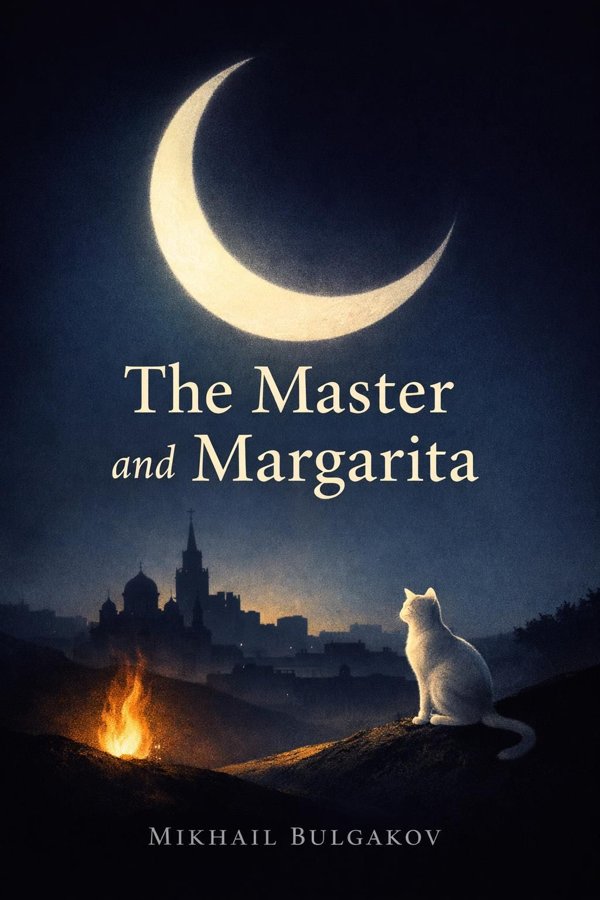
The Master and Margarita: Summary & Key Insights
 10 min9 chaptersAudio available
Key Takeaways from The Master and Margarita
A society becomes most vulnerable to evil when it is convinced evil is impossible.
Laughter can sometimes tell the truth more effectively than argument.
The most dangerous prison is not censorship alone, but the moment a creator begins to doubt the value of truth.
Evil often begins not in cruelty, but in cowardice.
Love becomes transformative when it rejects fear.
What Is The Master and Margarita About?
The Master and Margarita by Mikhail Bulgakov is a classics book spanning 6 pages. What happens when the Devil arrives in a city that insists he cannot exist? Mikhail Bulgakov’s The Master and Margarita answers that question with astonishing wit, chaos, and emotional force. Set in Stalin-era Moscow, the novel begins as a darkly comic satire of literary bureaucrats, petty officials, and ideological certainty. But it quickly becomes something far larger: a philosophical fantasy, a love story, a spiritual parable, and a meditation on truth under oppression. Interwoven with the Moscow plot is the haunting story of Pontius Pilate and Yeshua, which gives the novel its moral and metaphysical depth. The book matters because it exposes how fear, conformity, and power can deform human life—while also defending imagination, mercy, and inner freedom. Bulgakov wrote under intense censorship, and that struggle gives the novel unusual authority. He understood firsthand what it meant for art to be attacked, distorted, or silenced. Yet instead of producing a grim political tract, he created a dazzling, genre-defying masterpiece. The Master and Margarita remains one of the most original novels of the twentieth century because it shows that even in a corrupt world, truth and love can still outlast terror.
This FizzRead summary covers all 9 key chapters of The Master and Margarita in approximately 10 minutes, distilling the most important ideas, arguments, and takeaways from Mikhail Bulgakov's work. Also available as an audio summary and Key Quotes Podcast.
The Master and Margarita
What happens when the Devil arrives in a city that insists he cannot exist? Mikhail Bulgakov’s The Master and Margarita answers that question with astonishing wit, chaos, and emotional force. Set in Stalin-era Moscow, the novel begins as a darkly comic satire of literary bureaucrats, petty officials, and ideological certainty. But it quickly becomes something far larger: a philosophical fantasy, a love story, a spiritual parable, and a meditation on truth under oppression. Interwoven with the Moscow plot is the haunting story of Pontius Pilate and Yeshua, which gives the novel its moral and metaphysical depth.
The book matters because it exposes how fear, conformity, and power can deform human life—while also defending imagination, mercy, and inner freedom. Bulgakov wrote under intense censorship, and that struggle gives the novel unusual authority. He understood firsthand what it meant for art to be attacked, distorted, or silenced. Yet instead of producing a grim political tract, he created a dazzling, genre-defying masterpiece. The Master and Margarita remains one of the most original novels of the twentieth century because it shows that even in a corrupt world, truth and love can still outlast terror.
Who Should Read The Master and Margarita?
This book is perfect for anyone interested in classics and looking to gain actionable insights in a short read. Whether you're a student, professional, or lifelong learner, the key ideas from The Master and Margarita by Mikhail Bulgakov will help you think differently.
- ✓Readers who enjoy classics and want practical takeaways
- ✓Professionals looking to apply new ideas to their work and life
- ✓Anyone who wants the core insights of The Master and Margarita in just 10 minutes
Want the full summary?
Get instant access to this book summary and 100K+ more with Fizz Moment.
Get Free SummaryAvailable on App Store • Free to download
Key Chapters
A society becomes most vulnerable to evil when it is convinced evil is impossible. Bulgakov opens the novel at Patriarch’s Ponds, where Berlioz, a literary official, and Ivan Bezdomny, a poet, discuss religion with smug confidence. Their secular certainty is interrupted by the arrival of Woland, a mysterious foreigner who calmly predicts Berlioz’s death and begins unraveling the assumptions of everyone around him. What follows is not merely supernatural mischief. It is a test of a city that prides itself on rational control while being driven by vanity, greed, fear, and bureaucratic absurdity.
Woland’s presence exposes Moscow rather than simply attacking it. The people he encounters are already compromised: opportunistic administrators, self-important writers, officials obsessed with status, and citizens eager for comfort without conscience. The Devil does not invent their flaws; he reveals them theatrically. This is why the early chapters are so sharp as satire. Bulgakov shows that a dishonest culture can function normally for years, until one disruptive force suddenly makes its hidden corruption visible.
In modern life, this insight still applies. Organizations often collapse not because one villain appears, but because systems already reward cowardice, pretense, and self-interest. A scandal, crisis, or outsider simply makes those traits impossible to ignore. Whether in politics, media, or workplace culture, denial can be more dangerous than open conflict.
The lesson is clear: do not measure moral health by appearances or official language. Pay attention to what people do when their status, certainty, or comfort is challenged. Actionable takeaway: examine one institution in your life—work, school, or community—and ask what hidden weaknesses would be exposed if a disruptive truth suddenly arrived.
Laughter can sometimes tell the truth more effectively than argument. One of Bulgakov’s greatest achievements is his use of satire to dismantle Soviet Moscow’s pretensions. Through scenes of comic confusion, disappearing bureaucrats, magical money, public scandals, and theatrical humiliation, he reveals a world built on ideological performance rather than honest human life. The comedy is extravagant, but the target is serious: institutions that demand conformity while rewarding mediocrity and self-preservation.
The Variety Theatre episode is a perfect example. Woland and his retinue stage a grotesque performance that seduces the audience with luxury, fashion, and spectacle. The crowd lunges eagerly for free gifts and instant gratification, only to discover later that the rewards were illusion. Bulgakov is mocking more than greed. He is showing how easily people surrender judgment when temptation is wrapped in public excitement and collective approval. A supposedly rational, disciplined society proves just as foolish and hungry for illusion as any other.
Satire works here because it bypasses defenses. Readers may resist a sermon, but they recognize vanity when it is exaggerated into farce. In daily life, satire still helps us see absurdity in corporate jargon, political spin, social media posturing, and cultural hypocrisy. It punctures the false seriousness with which institutions often protect themselves.
Bulgakov reminds us that ridicule can be morally clarifying when directed at dishonesty. But he also suggests that we should not laugh only at others. We are all susceptible to the desire for status, approval, and self-deception.
Actionable takeaway: the next time you encounter a polished public performance—whether from an institution, leader, or influencer—ask what human weakness is being flattered, and what reality the spectacle may be hiding.
The most dangerous prison is not censorship alone, but the moment a creator begins to doubt the value of truth. After Ivan’s frantic pursuit of Woland lands him in a psychiatric clinic, he meets the Master, a writer broken by rejection. The Master tells the story of his novel about Pontius Pilate, his love for Margarita, and the devastating campaign against his work by critics and literary authorities. Unable to withstand the pressure, he burns his manuscript and retreats from the world.
This section transforms the novel from social satire into a meditation on artistic vulnerability. The Master is not simply a victim of bad reviews. He is crushed by a system in which literature is policed by ideology, and originality is punished as a threat. Bulgakov understood this intimately. The Master’s despair reflects the emotional reality of making art in a culture where institutions can deny not only publication, but legitimacy, memory, and selfhood.
Yet the novel refuses to end with defeat. The famous idea that “manuscripts don’t burn” suggests that genuine creation possesses a durability beyond official suppression. Art may be delayed, distorted, or hidden, but truth expressed with conviction is stubborn. In personal terms, this applies beyond writers. Anyone doing meaningful work—teachers, researchers, entrepreneurs, artists, moral dissenters—may face ridicule, silence, or pressure to conform.
The practical lesson is not to romanticize suffering, but to recognize that external rejection should not become internal erasure. A project, idea, or conviction may need protection, revision, or patience, but not self-annihilation.
Actionable takeaway: identify one important piece of work or belief you have abandoned because of criticism or fear, and take one small step to restore it—revise it, return to it, or defend it privately if not publicly.
Evil often begins not in cruelty, but in cowardice. Running through the Moscow narrative is the Master’s novel about Pontius Pilate and Yeshua Ha-Notsri. These chapters are written in a different tone—solemn, lucid, deeply psychological—and they provide the book’s moral center. Pilate recognizes that Yeshua is not the criminal he is accused of being. He is moved by him, unsettled by him, and in some sense understands him. Yet Pilate still authorizes his execution because he fears political consequences and the instability that moral courage would require.
This is one of Bulgakov’s most enduring insights: people often betray truth not because they cannot perceive it, but because they cannot bear the cost of acting on it. Pilate is not ignorant. He is divided. His tragedy lies in seeing clearly and choosing safety anyway. That conflict makes him one of literature’s most compelling portraits of conscience under pressure.
The Pilate chapters also elevate the novel beyond satire. They frame the absurdities of Moscow within an older, universal drama: the conflict between temporal power and spiritual truth. Whether or not a reader approaches the book religiously, the ethical point remains powerful. Institutions repeatedly produce moments when individuals know the right thing and still evade it.
This appears in contemporary life whenever someone stays silent about wrongdoing, signs off on a harmful decision, or hides behind procedure to avoid responsibility. Pilate’s weakness is recognizable precisely because it is ordinary.
Actionable takeaway: when you feel the temptation to postpone a difficult truth for the sake of comfort or image, name the fear explicitly. Conscience becomes stronger when cowardice is identified rather than disguised as prudence.
Love becomes transformative when it rejects fear. Margarita enters the novel fully in the second half, and with her arrival the emotional stakes deepen. She is not merely the beloved of the Master. She is one of Bulgakov’s boldest creations: a woman trapped in a comfortable but spiritually empty life, willing to risk everything for loyalty, passion, and truth. When offered supernatural power and the chance to serve as hostess at Satan’s ball, she accepts—not out of corruption, but out of fierce devotion and a refusal to remain passive.
Margarita’s transformation into a witch is one of the novel’s most exhilarating sequences, yet its meaning goes beyond fantasy. She experiences liberation from social constraints, respectability, and helplessness. Her flight over Moscow symbolizes release from the petty world of surveillance, compromise, and domestic emptiness. In becoming outrageous, she becomes fully herself.
Importantly, Margarita’s power is moral as well as magical. At the ball, where she could seek selfish reward, she instead asks mercy for another suffering woman. This choice reveals the difference between rebellion and cruelty. True freedom does not simply break rules; it preserves compassion.
In practical terms, Margarita speaks to anyone who has felt trapped by roles that look successful from the outside but hollow from within. Sometimes reclaiming one’s life requires a dramatic refusal of passivity—leaving a false path, defending a loved one, or accepting reputational risk in pursuit of something real.
Actionable takeaway: consider one area where comfort has replaced conviction in your life. Choose one concrete act of loyal defiance—speaking honestly, ending pretense, or supporting someone at personal cost—to move closer to the life you actually value.
Not all justice arrives in comforting forms. Woland is the Devil, but Bulgakov does not present him as a simple embodiment of evil. Instead, he functions as a dark agent of exposure, irony, and retribution. He punishes greed, hypocrisy, cowardice, and fraud, yet he is not a moral teacher in any conventional sense. This ambiguity is central to the novel’s power. Bulgakov asks readers to think beyond simplistic categories of good and bad, legality and righteousness, appearance and essence.
Woland’s interventions are disturbing because they often seem more just than the official structures of Moscow. Bureaucrats lie, critics destroy, institutions humiliate, and the innocent suffer. Against that backdrop, the Devil becomes a paradoxical corrector, revealing truths human systems refuse to acknowledge. His famous line about light and shadow suggests that reality includes tensions modern ideologies try to flatten. A world that denies mystery, transcendence, and moral complexity becomes absurdly easy to manipulate.
This does not mean Woland is good in a sentimental sense. Rather, Bulgakov portrays a universe in which forces outside ordinary human control may still serve a larger balance. Readers are pushed to ask difficult questions: Can truth emerge from frightening sources? Can punishment be deserved even when delivered by troubling agents? Can a morally broken society still be judged accurately from outside itself?
In everyday life, this idea encourages intellectual humility. We may receive needed correction from people we dislike, crises we did not choose, or failures that expose our illusions.
Actionable takeaway: when confronted by an unpleasant disruption, ask not only how to resist it, but what truth it may be uncovering about your habits, assumptions, or environment.
What is true can be buried, but it is remarkably hard to erase. One of the novel’s most famous claims—“manuscripts don’t burn”—captures Bulgakov’s faith in the endurance of art and memory. The Master burns his novel in despair, convinced that hostile critics and institutions have defeated him. Yet the work survives, because meaningful creation does not depend entirely on official approval, physical copies, or public recognition. It persists in memory, in love, in moral consequence, and eventually in cultural life itself.
This idea is especially powerful because Bulgakov was writing in a repressive environment where manuscripts really could disappear, careers really could be destroyed, and truth really could be rewritten. The phrase is therefore not naive optimism. It is a hard-won assertion that spiritual and artistic reality exceeds the reach of censors. The same principle applies to personal history. Attempts to suppress grief, love, betrayal, or conscience rarely eliminate them. They return in altered forms until they are acknowledged.
For readers today, this theme speaks to creative persistence, historical memory, and the danger of allowing institutions to define reality. Stories that matter often survive through unofficial channels: private circles, loyal friendships, copied notes, oral transmission, rediscovery by later generations. Even in the digital age, where information can be flooded or buried, durable work tends to outlast trends.
The practical application is to respect the long life of honest effort. Do not confuse immediate invisibility with failure. A work, idea, or testimony may need time, protection, and the right readers.
Actionable takeaway: preserve something meaningful that might otherwise vanish—a draft, journal, family story, research idea, or testimony. What seems small now may become the record that outlives noise and suppression.
Not every happy ending looks like triumph. Near the novel’s conclusion, the Master and Margarita are reunited and granted release, but notably not “light.” Instead, they receive peace. This distinction matters. Bulgakov does not offer sentimental salvation or simple reward for suffering. His characters are judged according to complicated moral truths: what they loved, what they feared, what they endured, and what they failed to become. Redemption in this novel is real, but it is measured, exact, and shaped by mercy rather than fantasy.
The Master is sympathetic, yet he is not a heroic conqueror. He has retreated, despaired, and surrendered his work. Margarita’s devotion helps rescue him, but even their union is granted as rest rather than exaltation. Meanwhile, Pilate, trapped in his ancient guilt, is finally released through the completion of the Master’s story. This suggests that art itself can participate in redemption by naming truth fully enough to free what history has left unresolved.
Bulgakov’s moral world is therefore neither bleak nor simplistic. Justice exists, but so does compassion. Human weakness is acknowledged, yet not all weakness is condemned equally. This is a profound comfort for readers who know that real life rarely divides people neatly into saints and villains.
Applied practically, the novel encourages a mature understanding of healing. Some wounds are not erased; they are integrated. Some forms of redemption mean reconciliation, closure, or rest rather than victory or public vindication.
Actionable takeaway: redefine redemption in one area of your life. Instead of waiting for a perfect reversal, ask what peace, closure, or honest acceptance would look like—and take one step toward that form of mercy.
Awakening often begins in humiliation. Ivan Bezdomny starts the novel as an obedient Soviet poet, eager to defend official atheism and literary orthodoxy. After witnessing Berlioz’s death and trying to expose Woland, he appears ridiculous to everyone around him and ends up institutionalized. Yet this collapse is the beginning of his transformation. Stripped of certainty, reputation, and ideological confidence, Ivan becomes capable of genuine listening. Through his conversations with the Master, he moves from propaganda to reflection.
Ivan’s development shows that insight often requires the breakdown of inherited language. At the beginning, he speaks in formulas. By the end, he has become quieter, more inward, and more alert to mystery. He cannot fully solve what he has encountered, but he is no longer imprisoned by official explanations. In the epilogue, he remains haunted by dreams and memories, suggesting that true awakening is not a clean conversion but a lifelong disturbance.
This makes Ivan one of the novel’s most relatable figures. Many people begin by repeating the beliefs, slogans, or assumptions of their environment. A crisis then disrupts those certainties: a personal loss, a moral contradiction, a humiliating failure, or an encounter with someone who sees differently. The process is uncomfortable because it dismantles identity before offering clarity.
Bulgakov treats this discomfort as necessary. To wake up is to accept that reality is larger than ideology, and that truth may arrive through experiences we cannot immediately explain.
Actionable takeaway: notice one belief you hold mainly because it is socially rewarded or intellectually convenient. Instead of defending it automatically, spend time asking what evidence, experience, or unanswered questions might complicate it.
All Chapters in The Master and Margarita
About the Author
Mikhail Bulgakov (1891–1940) was a Russian novelist, playwright, and trained physician whose work became renowned for its blend of satire, fantasy, psychological insight, and moral seriousness. Born in Kyiv, he studied medicine and practiced as a doctor before turning fully to literature. His writing was deeply shaped by the upheavals of revolution, civil war, and the repressive cultural climate of the Soviet Union. Bulgakov often faced censorship, and many of his works were criticized or suppressed during his lifetime. Despite these obstacles, he produced enduring works such as The White Guard, Heart of a Dog, and his masterpiece, The Master and Margarita. Published after his death, that novel secured his reputation as one of the most original and influential writers of twentieth-century literature.
Get This Summary in Your Preferred Format
Read or listen to the The Master and Margarita summary by Mikhail Bulgakov anytime, anywhere. FizzRead offers multiple formats so you can learn on your terms — all free.
Available formats: App · Audio · PDF · EPUB — All included free with FizzRead
Download The Master and Margarita PDF and EPUB Summary
Key Quotes from The Master and Margarita
“A society becomes most vulnerable to evil when it is convinced evil is impossible.”
“Laughter can sometimes tell the truth more effectively than argument.”
“The most dangerous prison is not censorship alone, but the moment a creator begins to doubt the value of truth.”
“Evil often begins not in cruelty, but in cowardice.”
“Love becomes transformative when it rejects fear.”
Frequently Asked Questions about The Master and Margarita
The Master and Margarita by Mikhail Bulgakov is a classics book that explores key ideas across 9 chapters. What happens when the Devil arrives in a city that insists he cannot exist? Mikhail Bulgakov’s The Master and Margarita answers that question with astonishing wit, chaos, and emotional force. Set in Stalin-era Moscow, the novel begins as a darkly comic satire of literary bureaucrats, petty officials, and ideological certainty. But it quickly becomes something far larger: a philosophical fantasy, a love story, a spiritual parable, and a meditation on truth under oppression. Interwoven with the Moscow plot is the haunting story of Pontius Pilate and Yeshua, which gives the novel its moral and metaphysical depth. The book matters because it exposes how fear, conformity, and power can deform human life—while also defending imagination, mercy, and inner freedom. Bulgakov wrote under intense censorship, and that struggle gives the novel unusual authority. He understood firsthand what it meant for art to be attacked, distorted, or silenced. Yet instead of producing a grim political tract, he created a dazzling, genre-defying masterpiece. The Master and Margarita remains one of the most original novels of the twentieth century because it shows that even in a corrupt world, truth and love can still outlast terror.
You Might Also Like
Browse by Category
Ready to read The Master and Margarita?
Get the full summary and 100K+ more books with Fizz Moment.