
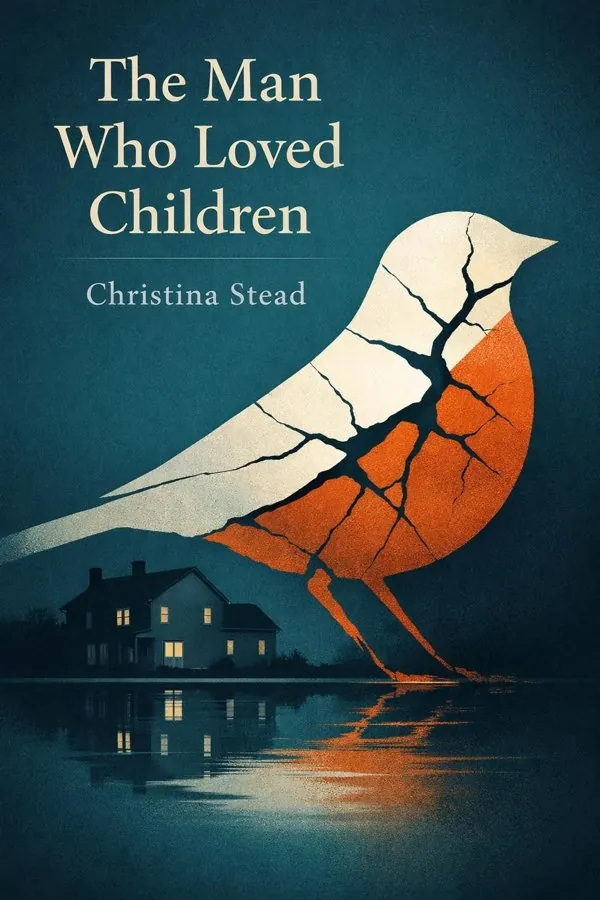
The Man Who Loved Children: Summary & Key Insights
 10 min9 chaptersAudio available
Key Takeaways from The Man Who Loved Children
Some of the most damaging people are convinced they are doing good.
Domestic conflict is rarely just about arguments; it is often about accumulated humiliation.
Children do not merely witness family drama; they become its interpreters, carriers, and often its casualties.
Every family myth eventually meets reality.
Affection is not always evidence of generosity.
What Is The Man Who Loved Children About?
The Man Who Loved Children by Christina Stead is a classics book spanning 4 pages. What happens when love becomes a form of control? Christina Stead’s The Man Who Loved Children is a devastating, darkly comic, and psychologically precise portrait of family life that follows the Pollits, an eccentric household in Washington, D.C., dominated by the endlessly talkative, self-dramatizing Sam Pollit and his embittered wife, Henny. On the surface, Sam appears affectionate, imaginative, and devoted to his children. But as the novel unfolds, his sentimental idealism reveals a more troubling reality: his love suffocates, manipulates, and distorts everyone around him. Henny, trapped in resentment and poverty, wages her own war inside the home, while the children—especially Louie—absorb the damage and struggle toward self-understanding. First published in 1940, the novel is now widely regarded as a classic of domestic fiction and psychological realism. Stead writes with astonishing emotional intelligence, exposing the hidden economies of power, humiliation, fantasy, and survival inside family life. Her authority comes not from abstract theory but from her unmatched ability to render people as contradictory, vulnerable, and terrifyingly real. This is not just a novel about one unhappy household; it is a profound study of how personality becomes fate inside the family.
This FizzRead summary covers all 9 key chapters of The Man Who Loved Children in approximately 10 minutes, distilling the most important ideas, arguments, and takeaways from Christina Stead's work. Also available as an audio summary and Key Quotes Podcast.
The Man Who Loved Children
What happens when love becomes a form of control? Christina Stead’s The Man Who Loved Children is a devastating, darkly comic, and psychologically precise portrait of family life that follows the Pollits, an eccentric household in Washington, D.C., dominated by the endlessly talkative, self-dramatizing Sam Pollit and his embittered wife, Henny. On the surface, Sam appears affectionate, imaginative, and devoted to his children. But as the novel unfolds, his sentimental idealism reveals a more troubling reality: his love suffocates, manipulates, and distorts everyone around him. Henny, trapped in resentment and poverty, wages her own war inside the home, while the children—especially Louie—absorb the damage and struggle toward self-understanding.
First published in 1940, the novel is now widely regarded as a classic of domestic fiction and psychological realism. Stead writes with astonishing emotional intelligence, exposing the hidden economies of power, humiliation, fantasy, and survival inside family life. Her authority comes not from abstract theory but from her unmatched ability to render people as contradictory, vulnerable, and terrifyingly real. This is not just a novel about one unhappy household; it is a profound study of how personality becomes fate inside the family.
Who Should Read The Man Who Loved Children?
This book is perfect for anyone interested in classics and looking to gain actionable insights in a short read. Whether you're a student, professional, or lifelong learner, the key ideas from The Man Who Loved Children by Christina Stead will help you think differently.
- ✓Readers who enjoy classics and want practical takeaways
- ✓Professionals looking to apply new ideas to their work and life
- ✓Anyone who wants the core insights of The Man Who Loved Children in just 10 minutes
Want the full summary?
Get instant access to this book summary and 100K+ more with Fizz Moment.
Get Free SummaryAvailable on App Store • Free to download
Key Chapters
Some of the most damaging people are convinced they are doing good. At the center of The Man Who Loved Children stands Sam Pollit, a father who sees himself as generous, visionary, playful, and morally superior. He fills the home with songs, jokes, pet names, speeches, fantasies, and endless proclamations about kindness and truth. To outsiders—and sometimes even to his children—he can seem enchanting. Yet Christina Stead steadily reveals the darker truth: Sam’s idealism is inseparable from his need to dominate. He does not simply love his family; he wants to define reality for them.
Sam is the kind of patriarch who mistakes attention for care and performance for intimacy. He overwhelms everyone with his personality. He decides what counts as virtue, what emotions are acceptable, and what stories may be told about family life. His children are encouraged to orbit him, admire him, and participate in his imaginative world. But the price of this apparent warmth is the loss of independent thought. Genuine disagreement becomes disloyalty. Private feeling becomes material for his authority.
Stead’s portrait remains startlingly modern because many families still operate through similar dynamics. A parent may present as loving, humorous, or sacrificial while quietly demanding emotional obedience. In workplaces, friendships, and politics, too, charismatic idealists can become tyrants when they cannot tolerate contradiction.
The novel asks us to look beyond declared intentions and examine effects. Does someone’s love leave room for your autonomy? Does their generosity make you stronger or smaller? Sam reminds us that people can sincerely believe in their own goodness while causing enormous harm.
Actionable takeaway: judge care not by how loudly it is proclaimed, but by whether it allows others dignity, boundaries, and an independent inner life.
Domestic conflict is rarely just about arguments; it is often about accumulated humiliation. Opposite Sam stands Henny Pollit, one of the most unforgettable figures in twentieth-century fiction. Fierce, intelligent, sarcastic, and emotionally exhausted, Henny has been ground down by years of financial strain, unhappy marriage, and frustrated pride. Where Sam performs optimism, Henny speaks from injury. Their marriage becomes less a partnership than a battlefield in which every conversation carries old wounds.
Henny is not presented as a saintly victim. That complexity is part of Stead’s brilliance. She can be cruel, volatile, and destructive, especially toward the children. But the novel insists that her bitterness has a history. She is trapped in a household where her husband monopolizes moral authority while failing to provide stability or respect. Her anger becomes both protest and poison: it names the truth of the household, yet it also deepens the suffering within it.
Stead shows how despair can become contagious. A home filled with sarcasm, blame, and contempt teaches everyone to anticipate attack. Children learn to scan for danger, interpret mood shifts, and choose sides. In modern terms, we might call this emotional dysregulation, chronic stress, or living in a high-conflict environment. The novel captures these realities long before such language became common.
Henny’s story also illustrates how social and economic dependence can intensify psychological imprisonment. She lacks meaningful escape routes. Her rage comes from feeling cornered, unseen, and reduced.
For readers today, Henny offers a difficult but useful lesson: suffering does not automatically ennoble a person. Unprocessed pain often spills outward. Recognizing someone’s wounds does not require denying the damage they inflict.
Actionable takeaway: when conflict becomes a permanent household atmosphere, address the structure beneath it—money, power, dependence, and unresolved resentment—not just the latest argument.
Children do not merely witness family drama; they become its interpreters, carriers, and often its casualties. Louie Pollit, the adolescent daughter at the emotional center of the novel, embodies this truth. Sensitive, imaginative, awkward, and intellectually hungry, Louie grows up in the shadow of both her father’s engulfing idealism and her mother’s corrosive despair. Her development gives the novel much of its emotional force because through her we see what it costs to come of age inside a family where language itself has been distorted.
Louie is especially vulnerable because she is trying to build a self while surrounded by stronger personalities who constantly define her. Sam recruits her into his world of playful nonsense and moral theater. Henny, in her misery, projects disappointment and hostility. Louie absorbs contradiction: she longs for love but distrusts it, wants recognition but fears ridicule, and turns inward because the outer world feels unstable. Her imagination becomes both refuge and trap.
Stead captures a universal experience here: the moment when a child realizes that parents are neither omniscient nor emotionally safe. This awakening is painful, but it is also the beginning of freedom. Louie starts to perceive the family system rather than merely inhabit it. She sees that adults often act from vanity, fear, and injury. That recognition does not erase harm, but it creates the possibility of choosing another life.
Modern readers may see in Louie the psychology of many children from chaotic homes: self-consciousness, hypervigilance, divided loyalties, and the desperate use of creativity to survive. Writing, observation, and reflection become tools for self-creation.
Actionable takeaway: if your childhood environment was confusing or controlling, name the patterns clearly—through journaling, therapy, or honest reflection—so inherited family roles do not become your permanent identity.
Every family myth eventually meets reality. One of the novel’s deepest achievements is its portrayal of collapse: not just the breakdown of a marriage, but the disintegration of the stories people tell to justify how they live. Sam’s dream of himself as a benevolent father-philosopher cannot survive unchanged under the pressure of poverty, hostility, and emotional truth. Henny’s bitterness also reaches a terminal point. The household, long held together by repetition and denial, begins to fracture.
This collapse matters because Stead refuses melodramatic simplification. Disaster does not arrive as a single revelation; it emerges from years of imbalance. Financial insecurity, pride, disappointed ambition, parental favoritism, and habitual cruelty accumulate until the family structure can no longer contain them. By the time consequences become undeniable, everyone has already been shaped by the damage.
The aftermath is equally important. Stead is interested in what remains after illusion fails. For the children, especially Louie, the end of one family narrative creates the painful opportunity for another kind of life. Loss becomes a harsh teacher. If the old idealism was suffocating, its collapse leaves a frightening emptiness—but also room for truth.
This pattern is recognizable far beyond literature. Institutions, relationships, and personal identities often survive on narratives that no longer match reality: “We’re a close family,” “He means well,” “Things will improve on their own.” When these narratives fall apart, the experience feels catastrophic. Yet collapse can also expose what must finally be faced.
The novel suggests that disillusionment is not purely destructive. It can be a necessary stage in moral and emotional maturity. We cannot build honest lives on fantasies about who people are.
Actionable takeaway: when a cherished story about a relationship collapses, resist the urge to restore the illusion immediately; use the rupture to identify what was true, what was denied, and what must change next.
Affection is not always evidence of generosity. One of Christina Stead’s sharpest insights is that love, especially parental love, can become a mask for vanity, need, and possession. Sam genuinely delights in children, language, play, and emotional intimacy. Yet his version of love often centers himself. He loves being adored, consulted, imitated, and needed. His tenderness is real, but it is mixed with self-display. That mixture is what makes him so disturbing: he is not a cartoon villain but a man whose warmth and selfishness are fused.
The novel challenges a sentimental assumption that intensity equals depth. Sam is intensely present, intensely verbal, intensely involved—yet he does not consistently see others as separate beings with legitimate needs of their own. He confuses his emotional appetite with care. If his children reflect him back beautifully, he feels loving. If they resist or individuate, he experiences it as betrayal or absurdity.
This dynamic appears in many settings. A parent may insist on closeness but reject a child’s boundaries. A partner may call jealousy devotion. A friend may offer constant advice that actually serves their own need for control. In each case, the language of love hides an inability to tolerate other people’s freedom.
Stead’s achievement is to show that harmful love does not look loveless. It can be exuberant, charming, and even sacrificial on the surface. That is why those inside such relationships often struggle to name what is wrong. They feel smothered, guilty, and indebted all at once.
The practical lesson is subtle but crucial: healthy love includes restraint. It allows opacity. It does not require perpetual access to another person’s emotional world. To care well for others, one must value their separateness.
Actionable takeaway: ask of any intense relationship, “Does this bond support my growth, or does it demand that I remain emotionally available on someone else’s terms?”
Families are built not only through behavior but through recurring speech. In The Man Who Loved Children, language is one of the main instruments of power. Sam’s household is flooded with nicknames, jokes, invented phrases, teasing rituals, lectures, and dramatic performances. This verbal abundance creates intimacy, but it also controls meaning. Whoever dominates language often dominates the emotional climate.
Sam uses words to charm, distract, redefine, and overpower. He can turn criticism into comedy, discomfort into a performance, and dissent into an apparent misunderstanding. By speaking constantly and creatively, he leaves little space for other people’s interpretations. Henny, by contrast, uses language like a weapon—cutting, bitter, exposing. Between them, words become both shelter and shrapnel. The children grow up in a world where speech is never neutral; it can pull them close, shame them, recruit them, or erase them.
Stead understood something that psychology now often emphasizes: naming matters. If a child’s experience is repeatedly rephrased by an adult—“You’re too sensitive,” “We were only joking,” “You know I love you”—the child may lose confidence in their own perception. This is one reason the novel feels so contemporary. It dramatizes how family vocabularies can normalize dysfunction.
The book also points toward liberation through language. Louie’s development suggests that finding one’s own words is part of escaping a suffocating family system. Writing, thinking, and accurately describing experience become acts of resistance.
For modern readers, this idea has practical relevance. Pay attention to the repeated phrases in your family or close relationships. Do they invite honesty or shut it down? Do jokes conceal cruelty? Does one person always get the final definition of events?
Actionable takeaway: reclaim your perspective by naming situations plainly, especially when habitual family language has made harmful behavior seem normal or inevitable.
Emotional suffering is often intensified by material insecurity. The Pollits’ troubles are not caused solely by personality; they are sharpened by money problems, instability, and dependence. Stead never lets us forget that ideas about love, dignity, and family authority are lived through practical conditions. Financial strain narrows options, magnifies resentment, and makes every conflict harder to escape.
Henny’s misery is inseparable from her dependence. She is tied to a husband she neither respects nor can easily leave. Sam’s grandiosity is easier to sustain because others bear its costs. The children, meanwhile, are raised in an atmosphere where scarcity is both economic and emotional. There is not enough money, not enough peace, and not enough room for anyone to become fully themselves without threatening the fragile balance of the household.
This aspect of the novel gives it social depth. Stead shows that private life is never entirely private. Economic arrangements shape who gets to speak, who must endure, and who can imagine alternatives. A trapped person may appear irrational, angry, or passive when in fact their choices have been structurally constrained.
The insight travels well beyond the novel. In modern families, financial dependence can keep people in manipulative marriages, delay separation from controlling parents, or force adult children to remain in toxic environments. Even less dramatic situations can be influenced by money: who pays, who decides, who feels entitled, and who stays silent.
Recognizing the material dimension of emotional life can prevent shallow judgment. Not every harmful household persists because people are weak or blind; many persist because leaving is costly, dangerous, or socially punishing.
Actionable takeaway: when evaluating a troubled relationship, assess the practical conditions—income, housing, childcare, debt, support networks—because emotional freedom often depends on material options.
The strategies that help us survive childhood can quietly govern adulthood. This is one of the novel’s enduring psychological truths. In the Pollit family, each child learns to adapt to instability in different ways: seeking favor, becoming invisible, performing, placating, fantasizing, or observing. These are not random quirks. They are survival responses to a home where affection and conflict are unpredictable.
Louie’s inwardness and imaginative intensity illustrate how a child may preserve dignity by building a private world. Other children in the household respond differently, but the principle is the same: family systems teach us what role keeps us safest. The trouble is that such roles often outlast the conditions that created them. The peacemaker cannot stop managing other people’s feelings. The clown fears seriousness. The achiever equates worth with usefulness. The scapegoat assumes rejection everywhere.
Stead does not turn these patterns into neat diagnoses; she dramatizes them through daily life. That makes the insight more powerful. We see how repeated interactions carve identity. A child who is laughed at develops one kind of self-consciousness; a child pulled into parental alliances develops another. Over time, adaptation hardens into personality.
This is why the novel matters to contemporary readers even if their family looked very different from the Pollits’. It helps explain why intelligent adults may still feel trapped in familiar emotional scripts. We often mistake adaptation for essence. “I’m just this way” can mean “This is how I learned to survive.”
The hopeful side of this idea is that patterns can be revised once they are recognized. The first step is not self-blame but curiosity about origin.
Actionable takeaway: identify one recurring role you play in relationships and ask, “When did I first need this role, and do I still need it now?”
Great novels do not flatter us; they deepen our honesty. The lasting power of The Man Who Loved Children lies in Christina Stead’s refusal to simplify human beings into heroes and villains. Sam is absurd, magnetic, selfish, loving, manipulative, inventive, and emotionally blind. Henny is wounded, perceptive, cruel, trapped, and intermittently tender. The children are innocent, but they are also watchful, strategic, and shaped by the pressures around them. Everyone is compromised by need.
This unsparing vision is what elevates the novel from a family melodrama to a major work of psychological realism. Stead understands that people rarely experience themselves as monstrous. They justify, rationalize, exaggerate their virtues, cling to grievance, and rewrite memory. At the same time, they remain vulnerable, craving recognition and fearing humiliation. The novel’s brilliance is that it makes these contradictions vivid without reducing them to moral slogans.
For readers, this complexity offers more than literary pleasure. It sharpens judgment. In real life, simplistic categories can keep us from seeing danger, responsibility, or possibility. If we insist that harmful people must be wholly malicious, we will miss the damage done by charming, idealistic, or apparently loving personalities. If we assume sufferers are always gentle, we will fail to understand how pain can breed aggression.
Stead’s realism also encourages humility. We are all capable of self-deception, especially in intimate relationships where need clouds perception. The novel asks us to examine not only how others fail us, but how we participate in family myths, emotional habits, and evasions.
Actionable takeaway: practice holding two truths at once—that someone may be deeply damaged and still responsible, and that understanding complexity is not the same as excusing harm.
All Chapters in The Man Who Loved Children
About the Author
Christina Stead (1902–1983) was an Australian novelist and short story writer celebrated for her fierce intelligence, psychological depth, and unsparing portraits of family and social life. Born in Sydney, she later lived in Europe, the United States, and England, experiences that broadened the range of her fiction and sharpened her view of class, politics, and human behavior. Although her work did not always receive immediate popular recognition, her reputation grew steadily, and she is now regarded as one of the most important English-language novelists of the twentieth century. Her best-known book, The Man Who Loved Children, is admired for its extraordinary treatment of domestic power and childhood consciousness. Other notable works include Letty Fox: Her Luck and For Love Alone. Stead’s fiction remains valued for its moral complexity, verbal energy, and emotional truth.
Get This Summary in Your Preferred Format
Read or listen to the The Man Who Loved Children summary by Christina Stead anytime, anywhere. FizzRead offers multiple formats so you can learn on your terms — all free.
Available formats: App · Audio · PDF · EPUB — All included free with FizzRead
Download The Man Who Loved Children PDF and EPUB Summary
Key Quotes from The Man Who Loved Children
“Some of the most damaging people are convinced they are doing good.”
“Domestic conflict is rarely just about arguments; it is often about accumulated humiliation.”
“Children do not merely witness family drama; they become its interpreters, carriers, and often its casualties.”
“Every family myth eventually meets reality.”
“Affection is not always evidence of generosity.”
Frequently Asked Questions about The Man Who Loved Children
The Man Who Loved Children by Christina Stead is a classics book that explores key ideas across 9 chapters. What happens when love becomes a form of control? Christina Stead’s The Man Who Loved Children is a devastating, darkly comic, and psychologically precise portrait of family life that follows the Pollits, an eccentric household in Washington, D.C., dominated by the endlessly talkative, self-dramatizing Sam Pollit and his embittered wife, Henny. On the surface, Sam appears affectionate, imaginative, and devoted to his children. But as the novel unfolds, his sentimental idealism reveals a more troubling reality: his love suffocates, manipulates, and distorts everyone around him. Henny, trapped in resentment and poverty, wages her own war inside the home, while the children—especially Louie—absorb the damage and struggle toward self-understanding. First published in 1940, the novel is now widely regarded as a classic of domestic fiction and psychological realism. Stead writes with astonishing emotional intelligence, exposing the hidden economies of power, humiliation, fantasy, and survival inside family life. Her authority comes not from abstract theory but from her unmatched ability to render people as contradictory, vulnerable, and terrifyingly real. This is not just a novel about one unhappy household; it is a profound study of how personality becomes fate inside the family.
You Might Also Like





Browse by Category
Ready to read The Man Who Loved Children?
Get the full summary and 100K+ more books with Fizz Moment.