
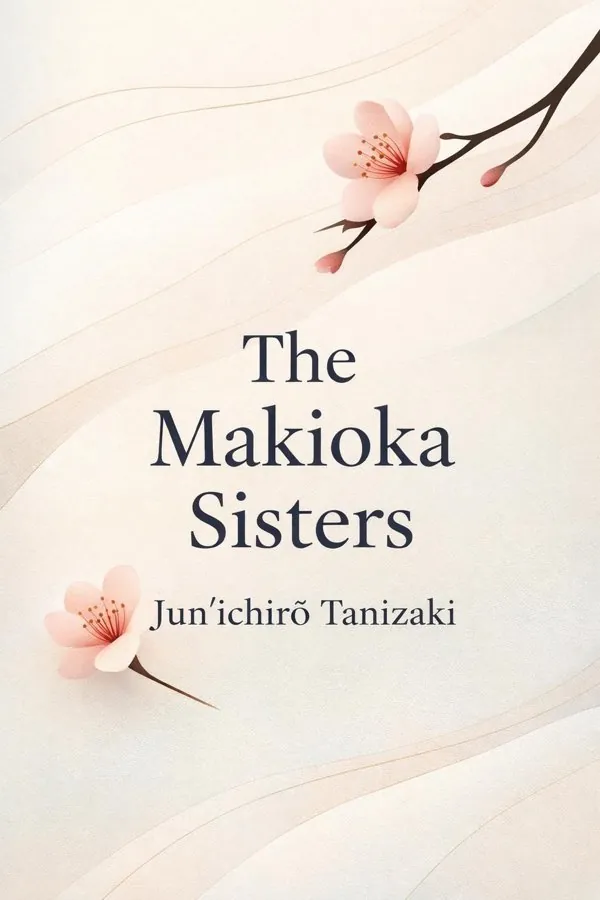
The Makioka Sisters: Summary & Key Insights
 10 min8 chaptersAudio available
Key Takeaways from The Makioka Sisters
A family does not collapse all at once; often, it fades through small humiliations, postponed decisions, and the quiet erosion of confidence.
Few things reveal a society’s values more clearly than the way it treats marriage, especially when marriage becomes a public test of family worth.
Modernity often enters family life not as an abstract idea but as one person who refuses to live by inherited rules.
In The Makioka Sisters, war is not treated primarily as battlefield spectacle.
One of the most powerful truths in The Makioka Sisters is that daily rituals matter most when the larger world becomes unstable.
What Is The Makioka Sisters About?
The Makioka Sisters by Jun'ichirō Tanizaki is a classics book spanning 4 pages. The Makioka Sisters is one of the great family novels of the twentieth century: intimate in scale, rich in observation, and quietly devastating in what it reveals about social change. Set in the years leading up to World War II, Jun'ichirō Tanizaki’s masterpiece follows four sisters from a once-distinguished Osaka merchant family as they negotiate marriage, reputation, money, and personal freedom. On the surface, the novel is concerned with practical matters—arranged meetings, household disputes, illnesses, seasonal visits, and the search for a suitable husband for the shy third sister, Yukiko. Beneath that surface, however, Tanizaki captures the slow fading of an entire world. Refinement, family prestige, and inherited customs still shape the sisters’ lives, but modern desires and historical pressures steadily undermine them. What makes the novel endure is its extraordinary balance of beauty and realism. Tanizaki, one of modern Japan’s most important novelists, writes with unmatched sensitivity about manners, femininity, memory, and the tension between tradition and change. The result is both a portrait of one family and an elegy for a vanishing culture.
This FizzRead summary covers all 8 key chapters of The Makioka Sisters in approximately 10 minutes, distilling the most important ideas, arguments, and takeaways from Jun'ichirō Tanizaki's work. Also available as an audio summary and Key Quotes Podcast.
The Makioka Sisters
The Makioka Sisters is one of the great family novels of the twentieth century: intimate in scale, rich in observation, and quietly devastating in what it reveals about social change. Set in the years leading up to World War II, Jun'ichirō Tanizaki’s masterpiece follows four sisters from a once-distinguished Osaka merchant family as they negotiate marriage, reputation, money, and personal freedom. On the surface, the novel is concerned with practical matters—arranged meetings, household disputes, illnesses, seasonal visits, and the search for a suitable husband for the shy third sister, Yukiko. Beneath that surface, however, Tanizaki captures the slow fading of an entire world. Refinement, family prestige, and inherited customs still shape the sisters’ lives, but modern desires and historical pressures steadily undermine them. What makes the novel endure is its extraordinary balance of beauty and realism. Tanizaki, one of modern Japan’s most important novelists, writes with unmatched sensitivity about manners, femininity, memory, and the tension between tradition and change. The result is both a portrait of one family and an elegy for a vanishing culture.
Who Should Read The Makioka Sisters?
This book is perfect for anyone interested in classics and looking to gain actionable insights in a short read. Whether you're a student, professional, or lifelong learner, the key ideas from The Makioka Sisters by Jun'ichirō Tanizaki will help you think differently.
- ✓Readers who enjoy classics and want practical takeaways
- ✓Professionals looking to apply new ideas to their work and life
- ✓Anyone who wants the core insights of The Makioka Sisters in just 10 minutes
Want the full summary?
Get instant access to this book summary and 100K+ more with Fizz Moment.
Get Free SummaryAvailable on App Store • Free to download
Key Chapters
A family does not collapse all at once; often, it fades through small humiliations, postponed decisions, and the quiet erosion of confidence. That is the central emotional atmosphere of The Makioka Sisters. The Makiokas still possess the signs of old status—good breeding, refined habits, respected connections, and an awareness of what their name once meant in Osaka society. Yet the novel makes clear that these symbols are no longer enough to preserve their place. Their finances are less secure than they appear, their influence is weaker than they imagine, and their carefully maintained dignity masks increasing vulnerability.
Tanizaki does not present decline as melodrama. Instead, he shows it through practical details: anxiety over marriage negotiations, disputes between branches of the family, concern over appearances, and the constant need to protect social standing. The Makiokas continue to behave as if the old rules still govern their world, but history has already shifted beneath them. Prestige has become performance. The more tightly they cling to inherited standards, the more obvious it becomes that those standards no longer guarantee stability.
This idea extends far beyond one aristocratic household. Individuals, families, and even institutions often rely on legacy long after circumstances have changed. A company may trust its brand while ignoring new competitors. A family may preserve rituals while avoiding hard conversations about money or expectations. The novel reminds us that decline is not simply loss of wealth; it is the painful gap between self-image and reality.
Actionable takeaway: Examine where you may be relying on reputation, habit, or past success instead of confronting present conditions honestly.
Few things reveal a society’s values more clearly than the way it treats marriage, especially when marriage becomes a public test of family worth. In The Makioka Sisters, Yukiko’s unmarried status becomes far more than a private concern. Her prospects are tied to the family’s prestige, discipline, and adherence to proper order. Suitor after suitor is considered, investigated, discussed, and often rejected. What should be a personal decision becomes a ritualized process shaped by social scrutiny, rank, timing, rumor, and etiquette.
Yukiko herself is reserved, delicate, and difficult to read. Her quietness makes her less a dramatic rebel than a figure around whom the family’s anxieties gather. Every failed meeting exposes how rigid the Makiokas’ standards have become. They want a suitable husband, but suitability is defined so narrowly—and judged so anxiously—that the search turns into paralysis. Age advances, expectations remain high, and each missed opportunity increases the sense of embarrassment.
Tanizaki’s brilliance lies in showing how tradition can become vanity. The family insists it is defending standards, but often it is defending pride. This dynamic is familiar in many cultures today. Parents may claim to want “the best” for a child while actually protecting status, community approval, or an idealized self-image. Organizations do the same when they reject good opportunities because they do not fit an outdated model of success.
Yukiko’s situation also invites compassion. Not everyone trapped by tradition openly resists it; some simply endure its weight. Actionable takeaway: When evaluating important life choices, ask whether your standards truly serve well-being—or merely preserve appearances.
Modernity often enters family life not as an abstract idea but as one person who refuses to live by inherited rules. In The Makioka Sisters, that person is Taeko, the youngest sister. Unlike Yukiko, whose life is governed by restraint and family management, Taeko represents movement, experimentation, desire, and risk. She rejects the expectation that her life must unfold according to carefully supervised custom, and in doing so she becomes the novel’s sharpest challenge to the Makioka order.
Taeko’s choices—in love, work, and self-presentation—disturb the family because they are not merely unconventional; they are self-directed. She engages in romantic relationships that the family considers unsuitable, pursues work and practical independence, and embraces the rhythms of a more modern urban identity. Her behavior threatens the household’s reputation, but it also exposes the limitations of the values used to judge her. The family condemns scandal, yet often seems less concerned with happiness or truth than with what others might say.
Tanizaki does not romanticize rebellion. Taeko’s independence is not pure liberation; it carries consequences, vulnerability, and heartbreak. That realism matters. The novel suggests that breaking from tradition may be necessary, but it is never cost-free. Freedom can be exhilarating and destabilizing at once.
Taeko’s story remains deeply relevant. Many people today still face tensions between familial expectation and self-made identity: career choices that disappoint parents, relationships that cross social boundaries, or lifestyles that reject inherited norms. The challenge is not simply to rebel, but to build a life strong enough to sustain autonomy.
Actionable takeaway: If you choose a path outside expectations, pair courage with responsibility—independence lasts only when supported by practical self-reliance.
One of the most powerful truths in The Makioka Sisters is that daily rituals matter most when the larger world becomes unstable. The novel is filled with seasonal outings, meals, visits, clothing choices, festivals, weather observations, and family conversations that might seem minor in a plot summary. Yet these details are not decorative. They create the moral and emotional fabric of the sisters’ world. Through them, Tanizaki shows how culture is lived—not in grand principles, but in repeated acts of attention.
The famous scenes surrounding cherry blossoms are a perfect example. The blossoms are beautiful, but their beauty is intensified by transience. They gather memory, family feeling, and national sensibility into a single fleeting image. In the same way, the sisters’ routines express continuity even as continuity becomes harder to maintain. The elegance of dress, the planning of visits, and the observance of social niceties all serve as forms of resistance against disorder.
This does not mean ritual saves the family. Sometimes these customs become restrictive or empty. But Tanizaki insists that form has value. Ritual gives shape to time, helps preserve identity, and allows beauty to survive amid uncertainty. In modern life, where speed often replaces reflection, that insight feels urgent. Shared dinners, annual gatherings, handwritten notes, and seasonal traditions can seem trivial until they disappear—then we understand they were carrying belonging all along.
The practical application is simple but meaningful. Do not dismiss small cultural or family habits as unimportant just because they are ordinary. Often they are the very things holding relationships together.
Actionable takeaway: Protect a few deliberate rituals in your own life; they create continuity when circumstances change.
Societies that speak proudly of honor often place its heaviest burden on women. The Makioka Sisters makes this painfully clear. The sisters are expected to embody refinement, restraint, loyalty, and social correctness, while the family’s prestige is repeatedly measured through their conduct. Marriageability, decorum, romantic discretion, and domestic competence become not just personal traits but collective assets. The women are treated as individuals, yet also as carriers of family legitimacy.
What is remarkable is how differently the sisters respond to this burden. Tsuruko, the eldest, is dutiful and formal, helping preserve the old hierarchy. Sachiko, often the emotional center of the novel, is more compassionate and practical, mediating between obligation and sympathy. Yukiko bears expectation through silence and passivity. Taeko challenges the system openly. Together, they reveal that there is no single “female experience” under patriarchy; there are multiple strategies of survival, adaptation, and resistance.
Tanizaki does not reduce these women to symbols. Their personalities are too specific for that. But the novel clearly shows how reputation disciplines female life. Even affection is filtered through concern for appearance. This remains recognizable today in subtler forms: professional women judged more harshly for public mistakes, daughters expected to maintain family harmony, or women navigating contradictory demands to be both independent and acceptable.
The novel invites readers to ask who in any family or institution is silently performing the labor of preserving respectability. Often that labor is invisible until someone refuses it.
Actionable takeaway: Notice where expectations are unevenly assigned, and challenge systems that make one person responsible for everyone else’s image.
Not every important conflict is spoken aloud. In fact, one of Tanizaki’s greatest achievements is his ability to reveal intense feeling through restraint. The Makioka Sisters is not a novel of dramatic confession. Its emotions emerge through pauses, indirect remarks, social gestures, hesitations, and what family members choose not to say. This creates a reading experience in which silence becomes meaningful rather than empty.
Yukiko in particular embodies this dynamic, but all the sisters participate in it. Much of the family’s emotional life is managed through implication. Concerns about aging, resentment between branches of the family, worries over Taeko’s conduct, and the sadness of fading status are often expressed obliquely. This reflects cultural patterns of politeness and reserve, but it also captures a universal truth: people frequently protect themselves and others by speaking indirectly.
For readers accustomed to explicit psychological narration, this subtlety can be revealing. The novel teaches us to pay attention to tone, ritual, context, and repetition. A postponed meeting may indicate fear. Excessive courtesy may signal disapproval. A practical discussion about marriage may conceal grief over passing time. Tanizaki trusts readers to detect the emotional pressure beneath the calm surface.
This has practical relevance in ordinary life. Many conflicts at work or in families are not about the stated topic. A disagreement about scheduling may really concern respect. Silence at dinner may signal exhaustion, shame, or disappointment. The ability to read indirect communication can deepen empathy and prevent shallow misunderstandings.
Actionable takeaway: Listen not only to words but to patterns, omissions, and tone; often the real issue lives beneath the surface.
Modernization is rarely a clean break between old and new; more often, it produces households in which different eras coexist at the same table. That is one of the novel’s most illuminating insights. The four Makioka sisters do not respond to social change in the same way, and Tanizaki uses their differences to show that history is experienced unevenly. Tradition persists in some rooms, weakens in others, and is openly rejected elsewhere.
Tsuruko represents continuity with formal hierarchy. Sachiko occupies a middle ground, preserving custom while adapting where necessary. Yukiko remains suspended in old structures, especially around marriage. Taeko moves toward modern self-definition. These are not neat categories but overlapping tendencies, and that complexity is what makes the novel feel true. Families in transitional periods often contain conservatives, pragmatists, conformists, and innovators all at once.
This unevenness explains why change can feel so exhausting. It is not only that society is shifting; it is that people close to one another are living by different assumptions about duty, freedom, class, and respectability. The resulting tension is often interpreted as personal conflict when it is actually historical conflict expressed through personality.
Modern readers can easily recognize this pattern. One sibling values stability, another reinvention. One generation treats marriage or career as obligation, another as self-expression. One family member thinks preserving tradition is love; another experiences it as control. The novel offers no easy resolution, but it suggests that understanding different relationships to change can reduce moral simplification.
Actionable takeaway: When family conflicts repeat, ask whether the deeper issue is not character but different assumptions about what kind of world you are living in.
All Chapters in The Makioka Sisters
About the Author
Jun'ichirō Tanizaki (1886–1965) was one of the most celebrated writers in modern Japanese literature. Born in Tokyo, he began publishing in the early twentieth century and built a career marked by stylistic elegance, psychological subtlety, and a fascination with beauty, desire, and cultural identity. His work often explores the tension between Westernized modern life and older Japanese ideals, making him a central voice in Japan’s literary response to modernity. Among his best-known books are Naomi, Some Prefer Nettles, The Makioka Sisters, The Key, and his influential essay In Praise of Shadows. Tanizaki’s writing ranges from ironic and provocative to deeply nostalgic, but it is always distinguished by precision and insight. Today, he is regarded as a major world novelist whose works continue to shape conversations about aesthetics, gender, and tradition.
Get This Summary in Your Preferred Format
Read or listen to the The Makioka Sisters summary by Jun'ichirō Tanizaki anytime, anywhere. FizzRead offers multiple formats so you can learn on your terms — all free.
Available formats: App · Audio · PDF · EPUB — All included free with FizzRead
Download The Makioka Sisters PDF and EPUB Summary
Key Quotes from The Makioka Sisters
“A family does not collapse all at once; often, it fades through small humiliations, postponed decisions, and the quiet erosion of confidence.”
“Few things reveal a society’s values more clearly than the way it treats marriage, especially when marriage becomes a public test of family worth.”
“Modernity often enters family life not as an abstract idea but as one person who refuses to live by inherited rules.”
“In The Makioka Sisters, war is not treated primarily as battlefield spectacle.”
“One of the most powerful truths in The Makioka Sisters is that daily rituals matter most when the larger world becomes unstable.”
Frequently Asked Questions about The Makioka Sisters
The Makioka Sisters by Jun'ichirō Tanizaki is a classics book that explores key ideas across 8 chapters. The Makioka Sisters is one of the great family novels of the twentieth century: intimate in scale, rich in observation, and quietly devastating in what it reveals about social change. Set in the years leading up to World War II, Jun'ichirō Tanizaki’s masterpiece follows four sisters from a once-distinguished Osaka merchant family as they negotiate marriage, reputation, money, and personal freedom. On the surface, the novel is concerned with practical matters—arranged meetings, household disputes, illnesses, seasonal visits, and the search for a suitable husband for the shy third sister, Yukiko. Beneath that surface, however, Tanizaki captures the slow fading of an entire world. Refinement, family prestige, and inherited customs still shape the sisters’ lives, but modern desires and historical pressures steadily undermine them. What makes the novel endure is its extraordinary balance of beauty and realism. Tanizaki, one of modern Japan’s most important novelists, writes with unmatched sensitivity about manners, femininity, memory, and the tension between tradition and change. The result is both a portrait of one family and an elegy for a vanishing culture.
You Might Also Like


Browse by Category
Ready to read The Makioka Sisters?
Get the full summary and 100K+ more books with Fizz Moment.