
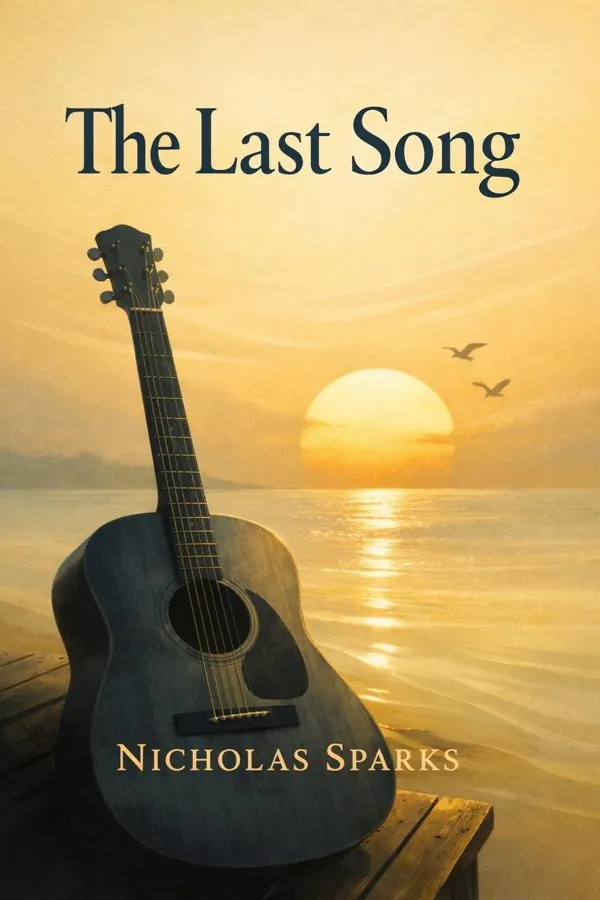
The Last Song: Summary & Key Insights
 10 min9 chaptersAudio available
Key Takeaways from The Last Song
Sometimes the people we miss most are the ones we work hardest to shut out.
Growth rarely begins with a grand decision; more often, it starts when we care about something outside ourselves.
What words cannot repair, art sometimes can.
Young love becomes memorable not because it is perfect, but because it reveals who we are when we begin to trust.
A single event can force people to stop living inside excuses.
What Is The Last Song About?
The Last Song by Nicholas Sparks is a romantic_relationships book spanning 5 pages. Set against the sunlit beaches and quiet emotional undercurrents of a North Carolina summer, The Last Song tells the story of seventeen-year-old Veronica “Ronnie” Miller, a talented but angry teenager sent to spend the summer with her estranged father, Steve. Bitter over her parents’ divorce and determined to remain distant, Ronnie arrives armed with sarcasm, grief, and silence. Yet over the course of one life-changing season, she encounters first love, family conflict, painful truths, and the healing force of music. What begins as an unwanted visit slowly becomes a journey toward forgiveness, maturity, and emotional courage. Nicholas Sparks is known for writing love stories that blend romance with moral and emotional depth, and The Last Song is one of his most resonant novels. More than a teenage romance, it explores how people repair broken bonds, how loss can clarify what matters, and how love often arrives intertwined with sacrifice. The novel matters because it speaks to anyone who has struggled with family wounds, unresolved anger, or the fear of opening their heart again. In Ronnie’s story, Sparks offers not just heartbreak, but hope.
This FizzRead summary covers all 9 key chapters of The Last Song in approximately 10 minutes, distilling the most important ideas, arguments, and takeaways from Nicholas Sparks's work. Also available as an audio summary and Key Quotes Podcast.
The Last Song
Set against the sunlit beaches and quiet emotional undercurrents of a North Carolina summer, The Last Song tells the story of seventeen-year-old Veronica “Ronnie” Miller, a talented but angry teenager sent to spend the summer with her estranged father, Steve. Bitter over her parents’ divorce and determined to remain distant, Ronnie arrives armed with sarcasm, grief, and silence. Yet over the course of one life-changing season, she encounters first love, family conflict, painful truths, and the healing force of music. What begins as an unwanted visit slowly becomes a journey toward forgiveness, maturity, and emotional courage.
Nicholas Sparks is known for writing love stories that blend romance with moral and emotional depth, and The Last Song is one of his most resonant novels. More than a teenage romance, it explores how people repair broken bonds, how loss can clarify what matters, and how love often arrives intertwined with sacrifice. The novel matters because it speaks to anyone who has struggled with family wounds, unresolved anger, or the fear of opening their heart again. In Ronnie’s story, Sparks offers not just heartbreak, but hope.
Who Should Read The Last Song?
This book is perfect for anyone interested in romantic_relationships and looking to gain actionable insights in a short read. Whether you're a student, professional, or lifelong learner, the key ideas from The Last Song by Nicholas Sparks will help you think differently.
- ✓Readers who enjoy romantic_relationships and want practical takeaways
- ✓Professionals looking to apply new ideas to their work and life
- ✓Anyone who wants the core insights of The Last Song in just 10 minutes
Want the full summary?
Get instant access to this book summary and 100K+ more with Fizz Moment.
Get Free SummaryAvailable on App Store • Free to download
Key Chapters
Sometimes the people we miss most are the ones we work hardest to shut out. That emotional contradiction defines Ronnie Miller when The Last Song begins. Sent to spend the summer with her father, Steve, in his small beach town, Ronnie arrives angry, defensive, and unwilling to forgive him for the divorce that shattered her family. She has not spoken to him in years, and her resentment has become part of her identity. Her hostility is not just about what happened in the past; it is also about control. If she stays distant, she cannot be disappointed again.
Sparks uses Ronnie’s arrival to show how unresolved pain can harden into personality. Her sarcasm, rebellion, and withdrawal are all forms of self-protection. She refuses to connect with Steve, rejects his attempts at warmth, and treats the summer as a punishment rather than an opportunity. Yet beneath that behavior is a teenager who feels abandoned, confused, and deeply hurt. This is what makes Ronnie compelling: her anger is real, but so is her vulnerability.
The novel reminds readers that resentment often feels powerful, but it rarely brings peace. In real life, people do this all the time—avoiding a parent, freezing out an ex-friend, or replaying a betrayal until bitterness feels safer than conversation. Ronnie’s early behavior shows the emotional cost of carrying old wounds without examining them.
An actionable takeaway: when you feel intense anger toward someone, ask what deeper hurt that anger is guarding. Naming the wound is often the first step toward healing it.
Growth rarely begins with a grand decision; more often, it starts when we care about something outside ourselves. For Ronnie, that shift begins with a sea turtle nest she discovers on the beach. What appears at first to be a small subplot becomes one of the novel’s most meaningful symbols. Protecting the nest gives Ronnie a purpose that is separate from her anger. Instead of focusing only on what has been taken from her, she begins investing energy in something fragile, living, and worth defending.
At the same time, her relationship with Will Blakelee introduces another kind of responsibility: emotional openness. Will is not simply the handsome local boy. He represents trust, patience, and the possibility of connection after disappointment. Through long conversations, shared experiences, and quiet moments, Ronnie gradually lowers her guard. Sparks smartly balances young romance with personal development, showing that love is not only about attraction. It is also about attention, reliability, and choosing to show up.
This section of the story matters because it illustrates how healing often happens indirectly. Ronnie does not wake up one day and decide to become a better daughter or a more mature person. Instead, she changes because caring for the turtles, spending time outdoors, and allowing herself to trust Will begin to expand her emotional world.
In ordinary life, this lesson is practical. People emerging from grief or conflict often heal through routines of care—volunteering, mentoring, nurturing a pet, or committing to a meaningful responsibility. Purpose can reopen parts of the heart that pain has closed.
An actionable takeaway: if you feel emotionally stuck, take responsibility for something worthwhile. Caring for another life, project, or cause can create the momentum that inner change needs.
What words cannot repair, art sometimes can. In The Last Song, music is far more than a character detail; it is the emotional language between Ronnie and her father. Once a gifted pianist, Ronnie stopped playing after her parents’ divorce, turning away from music because it reminded her of a happier family life. Her silence at the keyboard mirrors her silence toward Steve. Both are refusals rooted in pain.
Steve understands this, which is why his quiet, patient encouragement matters. He does not force reconciliation through speeches or guilt. Instead, he leaves room for music to do its work. Their shared musical bond becomes a pathway back to one another, not because it erases the hurt, but because it gives them a way to reconnect without immediately confronting every wound head-on. Through music, Ronnie remembers who she was before anger took over, and Steve is able to show love in a language deeper than argument.
Sparks suggests that relationships are often rebuilt through shared experiences rather than dramatic declarations. A song, a meal, a routine walk, or a small ritual can become a bridge where direct conversation feels too difficult. Music in the novel symbolizes memory, identity, and grace. It reminds Ronnie that she is still capable of beauty, tenderness, and connection.
This applies beyond the story. Many strained relationships improve not through one perfect conversation, but through repeated moments of meaningful contact: cooking together, fixing something, revisiting a shared hobby, or participating in a tradition that predates the conflict.
An actionable takeaway: if a relationship feels emotionally blocked, reconnect through a shared activity that carries positive history. Sometimes doing something meaningful together makes honest conversation possible again.
Young love becomes memorable not because it is perfect, but because it reveals who we are when we begin to trust. Ronnie’s relationship with Will is one of the novel’s central emotional threads, yet Sparks treats it as more than a romantic fantasy. Their connection grows through curiosity, misjudgments, vulnerability, and eventual honesty. Ronnie is drawn to Will, but her history makes her suspicious. She expects betrayal because betrayal feels familiar. Will, meanwhile, must prove that affection is not enough; character matters too.
As their relationship develops, the novel explores a key truth: love exposes unresolved fears. Ronnie wants closeness, but she is afraid of dependence. She wants to be believed, but she struggles to believe in others. Will seems confident and kind, yet he must confront the consequences of his social world and the expectations attached to his background. Their romance works because it forces both characters to grow.
This is a useful reminder for readers of any age. Romantic relationships do not simply give us happiness; they also reveal our assumptions, insecurities, and habits. Do we communicate clearly? Do we withdraw when threatened? Do we project old wounds onto new people? Ronnie and Will’s story demonstrates that healthy love requires both feeling and responsibility.
Practical application is easy to see. In dating and partnership, attraction should not be the only guide. Observe how someone responds under stress, how they speak about other people, whether they are honest when things get complicated, and whether they make you feel safe enough to be truthful.
An actionable takeaway: evaluate love not only by intensity, but by the quality of behavior it produces. The right relationship should encourage honesty, steadiness, and growth in both people.
A single event can force people to stop living inside excuses. In The Last Song, the fire becomes one of the novel’s major turning points because it strips away illusion and demands accountability. Until then, much of Ronnie’s world has been governed by assumptions, half-truths, and emotional reactions. But when crisis erupts, hidden motives and difficult realities come to the surface.
The fire is important not just as plot drama, but as moral pressure. It asks each character to confront what they have done, what they have ignored, and what kind of person they want to be next. Ronnie, especially, must move beyond instinctive rebellion and begin making decisions grounded in responsibility. Her growth becomes visible because she no longer responds only as a wounded teenager; she starts responding as someone capable of discernment and courage.
Sparks uses this moment to show that maturity often comes through painful correction. Most people do not become wiser in comfort. We become wiser when actions lead to consequences, when trust is tested, and when we are forced to look squarely at reality. The fire acts as a symbolic cleansing, burning away confusion and clarifying loyalties.
This theme matters in everyday life as well. Conflict in families, friendships, and relationships often persists because people avoid hard truths. But real repair usually begins when someone admits what happened, names the damage, and chooses integrity over image. Accountability can be uncomfortable, but it is also liberating.
An actionable takeaway: when a crisis exposes a problem in your life, resist the urge to defend yourself immediately. First ask, “What truth is this situation revealing that I need to face honestly?”
The deepest love in The Last Song may not be romantic at all. Steve Miller, Ronnie’s father, embodies a form of love that is patient, humble, and often unspoken. He does not demand forgiveness from Ronnie, nor does he retaliate against her coldness. Instead, he continues showing up—cooking meals, respecting boundaries, offering opportunities for connection, and loving her even when she gives little back. His restraint is one of the novel’s most powerful emotional choices.
Through Steve, Sparks explores a mature vision of parenthood. Good parents are not flawless, and Steve is not portrayed as perfect. He has made mistakes, and those mistakes have consequences. Yet what defines him is not his failure, but his willingness to absorb pain without making the child carry the emotional burden of repair alone. He understands that reconciliation cannot be forced. It must be invited through consistency.
This portrayal resonates because many family relationships are shaped less by dramatic betrayal than by accumulated hurt, misunderstanding, and distance. Steve demonstrates that rebuilding trust often requires long-term steadiness rather than persuasive explanations. He keeps loving Ronnie in ways she can eventually recognize, even if she cannot accept them at first.
In real life, this applies to parenting, mentoring, and any relationship involving responsibility. Love is often measured not by emotional speeches, but by reliability: being present, staying kind under strain, and giving another person room to come back in their own time.
An actionable takeaway: if you are trying to rebuild trust, prioritize consistency over intensity. Small, repeated acts of care are often more healing than one dramatic attempt to make everything right.
We often imagine forgiveness as a single breakthrough, but The Last Song shows it is usually a gradual decision made many times. Ronnie does not suddenly become peaceful and accepting. Her resentment softens in stages—through observing her father’s kindness, confronting her own loneliness, rediscovering music, and learning truths that challenge her assumptions. This slow transformation makes the novel emotionally believable.
Forgiveness here is not presented as denial. Ronnie is not asked to pretend she was never hurt. Instead, Sparks presents forgiveness as the willingness to stop letting pain dictate every interaction. It involves remembering honestly while choosing differently. That distinction matters. Real forgiveness does not erase accountability, nor does it always restore a relationship to what it once was. But it does free the wounded person from being permanently governed by injury.
This is one of the novel’s most practical emotional lessons. Many people delay forgiveness because they think it means excusing behavior or surrendering justice. The story suggests something wiser: forgiveness is first an inner release, then possibly an outer reconciliation. Ronnie’s path shows that people often need evidence of sincerity, emotional readiness, and time before they can genuinely let go.
In daily life, this might look like writing down what hurt you, clarifying what you needed but did not receive, and then deciding whether holding the grievance is still serving your well-being. In some cases, forgiveness includes rebuilding connection; in others, it simply means loosening anger’s grip.
An actionable takeaway: treat forgiveness as a practice. Start by identifying one resentment you are ready to release, even partially, and take one small step toward emotional freedom.
Nothing reveals the value of connection more sharply than the threat of losing it. As The Last Song moves toward its final act, Steve’s illness changes the emotional meaning of everything Ronnie has been experiencing. What once felt like an inconvenient summer becomes precious time. Conversations gain weight. Music becomes memory. Love stops being abstract and becomes urgent.
Sparks is especially effective here because he does not use loss merely for sentiment. Instead, he uses it to clarify priorities. Ronnie is forced to confront how much time has already been lost to anger and silence. That realization is devastating, but also transformative. She begins to understand that love is not proven by never hurting each other; it is proven by choosing presence, tenderness, and honesty while there is still time.
This theme reaches far beyond the novel. Many people assume there will be another season to say what matters, repair what broke, or express gratitude. But life rarely guarantees perfect timing. One of the book’s emotional contributions is its insistence that love should not be postponed until conditions feel ideal.
Practically, this is a call to attention. Reach out to a parent. Ask a meaningful question. Preserve a story. Revisit a shared ritual. Say the thing that affection has been assuming but not voicing. Loss is painful, but awareness of mortality can sharpen our capacity to love more intentionally.
An actionable takeaway: identify one important person in your life and make a deliberate effort this week to strengthen that bond while you still can.
The most moving endings do not suggest that grief disappears; they show that love can continue in a changed form. The conclusion of The Last Song carries this idea through Ronnie’s emotional evolution and the symbolic power of the song itself. What remains after sorrow is not emptiness alone, but inheritance: memories, values, courage, and the part of another person that now lives inside us.
For Ronnie, the final stages of the novel unite all the major themes—music, family, romance, forgiveness, and maturity. She is no longer the girl who arrived at the beach house determined to stay closed off. She has learned that vulnerability is not weakness, that reconciliation is worth the risk, and that love often leaves behind responsibility. To honor someone we have loved, we must continue living with greater depth, compassion, and honesty.
This makes the title especially meaningful. The “last song” is not only an ending; it is also a legacy. Art, memory, and love outlast physical presence. Many readers connect strongly with this idea because it reflects real grief. When someone important dies or leaves, we carry forward their lessons in our choices, habits, and ways of seeing the world.
In practical terms, one healthy response to loss is to preserve meaning. Continue a tradition they cared about. Create something in their honor. Return to a shared piece of music or place not only to mourn, but to remember actively.
An actionable takeaway: when you experience loss, ask not only what is gone, but what gift from that relationship you can continue carrying into the rest of your life.
All Chapters in The Last Song
About the Author
Nicholas Sparks is an American novelist, screenwriter, and producer known for his bestselling romantic dramas. Born in 1965, he rose to international fame with The Notebook and has since written numerous popular novels, including A Walk to Remember, Dear John, Safe Haven, Message in a Bottle, and The Last Song. His fiction often explores love, family, grief, faith, and second chances, blending emotional storytelling with accessible prose. Many of his books have been adapted into successful films, helping establish him as one of the most recognizable names in contemporary romance fiction. Sparks’ stories frequently center on ordinary people facing life-changing emotional circumstances, which has earned him a wide and loyal global readership. His work remains especially popular with readers who enjoy heartfelt, character-driven narratives.
Get This Summary in Your Preferred Format
Read or listen to the The Last Song summary by Nicholas Sparks anytime, anywhere. FizzRead offers multiple formats so you can learn on your terms — all free.
Available formats: App · Audio · PDF · EPUB — All included free with FizzRead
Download The Last Song PDF and EPUB Summary
Key Quotes from The Last Song
“Sometimes the people we miss most are the ones we work hardest to shut out.”
“Growth rarely begins with a grand decision; more often, it starts when we care about something outside ourselves.”
“What words cannot repair, art sometimes can.”
“Young love becomes memorable not because it is perfect, but because it reveals who we are when we begin to trust.”
“A single event can force people to stop living inside excuses.”
Frequently Asked Questions about The Last Song
The Last Song by Nicholas Sparks is a romantic_relationships book that explores key ideas across 9 chapters. Set against the sunlit beaches and quiet emotional undercurrents of a North Carolina summer, The Last Song tells the story of seventeen-year-old Veronica “Ronnie” Miller, a talented but angry teenager sent to spend the summer with her estranged father, Steve. Bitter over her parents’ divorce and determined to remain distant, Ronnie arrives armed with sarcasm, grief, and silence. Yet over the course of one life-changing season, she encounters first love, family conflict, painful truths, and the healing force of music. What begins as an unwanted visit slowly becomes a journey toward forgiveness, maturity, and emotional courage. Nicholas Sparks is known for writing love stories that blend romance with moral and emotional depth, and The Last Song is one of his most resonant novels. More than a teenage romance, it explores how people repair broken bonds, how loss can clarify what matters, and how love often arrives intertwined with sacrifice. The novel matters because it speaks to anyone who has struggled with family wounds, unresolved anger, or the fear of opening their heart again. In Ronnie’s story, Sparks offers not just heartbreak, but hope.
More by Nicholas Sparks
You Might Also Like
Rebel
Beverly Jenkins
10 min
The Last Letter
Rebecca Yarros
10 min
A Thousand Boy Kisses
Tillie Cole
10 min
Aflame
Penelope Douglas
10 min
After The Bite
Lynsay Sands
10 min
Alchemised
SenLinYu
10 minBrowse by Category
Ready to read The Last Song?
Get the full summary and 100K+ more books with Fizz Moment.