
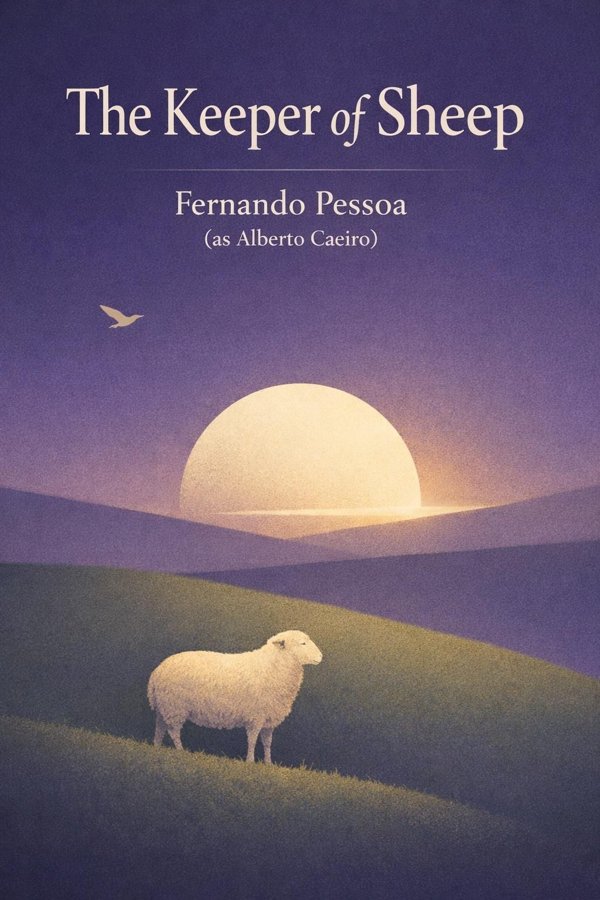
The Keeper of Sheep: Summary & Key Insights
by Fernando Pessoa (as Alberto Caeiro)
 10 min9 chaptersAudio available
Key Takeaways from The Keeper of Sheep
The moment we rush to explain something, we often stop truly seeing it.
What if the deepest truth is not hidden in complexity, but available to anyone willing to see plainly?
Nature does not need us to complete it.
Caeiro’s poetry asks a disarming question: why look behind things for truth when things themselves are already true?
Many poets are dreamers, visionaries, or makers of symbolic worlds.
What Is The Keeper of Sheep About?
The Keeper of Sheep by Fernando Pessoa (as Alberto Caeiro) is a classics book spanning 8 pages. The Keeper of Sheep is one of the purest and most radical poetic works of modern literature. Written by Fernando Pessoa under the heteronym Alberto Caeiro, this collection of poems presents a voice that rejects philosophical systems, religious explanations, and symbolic interpretation in favor of something much simpler and much harder: seeing reality as it is. Caeiro does not want to decode nature or discover hidden meanings behind things. He wants to look at a tree as a tree, the sun as the sun, and life as immediate experience rather than abstract theory. That simple stance becomes a profound challenge to how most people think. We are trained to interpret, compare, and explain. Caeiro asks what happens if we stop doing that and return to direct perception. In this way, The Keeper of Sheep becomes more than a book of poems; it becomes a philosophical antidote to overthinking and a spiritual defense of the ordinary world. Pessoa’s authority here is extraordinary. Through Alberto Caeiro, whom he called the master of his other literary selves, he created a complete worldview: lucid, natural, anti-metaphysical, and unforgettable. The result is a classic that feels both timeless and urgently modern.
This FizzRead summary covers all 9 key chapters of The Keeper of Sheep in approximately 10 minutes, distilling the most important ideas, arguments, and takeaways from Fernando Pessoa (as Alberto Caeiro)'s work. Also available as an audio summary and Key Quotes Podcast.
The Keeper of Sheep
The Keeper of Sheep is one of the purest and most radical poetic works of modern literature. Written by Fernando Pessoa under the heteronym Alberto Caeiro, this collection of poems presents a voice that rejects philosophical systems, religious explanations, and symbolic interpretation in favor of something much simpler and much harder: seeing reality as it is. Caeiro does not want to decode nature or discover hidden meanings behind things. He wants to look at a tree as a tree, the sun as the sun, and life as immediate experience rather than abstract theory.
That simple stance becomes a profound challenge to how most people think. We are trained to interpret, compare, and explain. Caeiro asks what happens if we stop doing that and return to direct perception. In this way, The Keeper of Sheep becomes more than a book of poems; it becomes a philosophical antidote to overthinking and a spiritual defense of the ordinary world.
Pessoa’s authority here is extraordinary. Through Alberto Caeiro, whom he called the master of his other literary selves, he created a complete worldview: lucid, natural, anti-metaphysical, and unforgettable. The result is a classic that feels both timeless and urgently modern.
Who Should Read The Keeper of Sheep?
This book is perfect for anyone interested in classics and looking to gain actionable insights in a short read. Whether you're a student, professional, or lifelong learner, the key ideas from The Keeper of Sheep by Fernando Pessoa (as Alberto Caeiro) will help you think differently.
- ✓Readers who enjoy classics and want practical takeaways
- ✓Professionals looking to apply new ideas to their work and life
- ✓Anyone who wants the core insights of The Keeper of Sheep in just 10 minutes
Want the full summary?
Get instant access to this book summary and 100K+ more with Fizz Moment.
Get Free SummaryAvailable on App Store • Free to download
Key Chapters
The moment we rush to explain something, we often stop truly seeing it. This is one of Caeiro’s boldest insights. In The Keeper of Sheep, he resists the habit of turning experience into theory. A field is not a symbol of freedom. A flower is not a moral lesson. A sunset does not need to stand for transcendence. For Caeiro, things lose their freshness the instant we cover them with abstract meaning.
This is not an attack on intelligence; it is a defense of presence. Human beings are constantly tempted to interpret life instead of inhabit it. We ask what nature means, what events symbolize, what hidden truth lies behind appearances. Caeiro insists that appearances are enough. The visible world is not a puzzle hiding another world behind it. It is the world.
This way of seeing is liberating because it removes the pressure to extract significance from every moment. You do not need to understand the sky to enjoy it. You do not need to philosophize about a river to recognize its movement. In practical terms, this means slowing down your mind when you encounter ordinary things. Sit by a window and notice the light without naming moods or assigning symbolism. Walk outdoors and pay attention to shapes, sounds, and textures before turning them into thoughts.
Caeiro’s lesson is especially powerful in an age of commentary and constant analysis. We are surrounded by interpretations of life, yet often starved of direct contact with it. His poetry reminds us that reality does not become richer when overexplained; it often becomes more distant.
Actionable takeaway: Choose one everyday moment today—a meal, a tree, the sky, a passing face—and observe it for one full minute without trying to explain what it means.
What if the deepest truth is not hidden in complexity, but available to anyone willing to see plainly? Caeiro builds his poetic worldview on this possibility. He distrusts the assumption that wisdom must be difficult, layered, and intellectually elaborate. Instead, he suggests that the mind often complicates what perception already knows.
In his poems, the child becomes an important figure—not because childhood is sentimental, but because it represents unforced seeing. A child looks at the sky and sees the sky. An adult often sees weather systems, metaphors, omens, or existential questions. Caeiro values the innocent gaze because it has not yet been burdened by the need to interpret everything. Simplicity, in his work, is not ignorance. It is fidelity to what is present.
This idea matters because modern life rewards sophistication and punishes directness. People often feel they must develop intricate opinions about everything to be taken seriously. Caeiro quietly overturns that demand. He proposes that clear perception can be truer than clever explanation. To live simply is not to live shallowly; it is to stop adding unnecessary layers between oneself and the world.
Practically, this can change how we approach conversations, art, and even personal struggles. Instead of reaching immediately for analysis, ask first: what is happening, exactly? If you feel tired, perhaps you are simply tired—not morally failing, not spiritually blocked, not in need of a grand theory. If a day is beautiful, perhaps it is enough to call it beautiful.
Caeiro’s simplicity is difficult because it asks for humility. It requires us to admit that not every experience needs our interpretation to become real.
Actionable takeaway: When you catch yourself overcomplicating an experience today, pause and describe it in the simplest possible words, as if explaining it to a child.
Nature does not need us to complete it. This conviction lies at the center of The Keeper of Sheep. Caeiro sees the natural world as self-sufficient, unconcerned with human ideas, and whole without metaphor. Trees do not aspire. Rivers do not symbolize time unless humans insist they do. The sun rises without trying to teach us anything.
This perspective is both humbling and soothing. Humbling, because it reminds us that the world is not arranged around human thought. Soothing, because it frees us from the burden of making nature carry our emotional or spiritual projections. We can simply encounter it. For Caeiro, this is a more honest and more peaceful way of being.
His naturalism also challenges the tendency to idealize nature as mystical revelation. He does not deny beauty, but he refuses to transform beauty into doctrine. A tree is beautiful because it exists in its form, not because it encodes secret truth. By stripping away symbolic excess, Caeiro restores immediacy. Nature becomes vivid again when it is no longer forced to mean something beyond itself.
In daily life, this can become a restorative practice. Spend time outdoors without turning the experience into self-improvement or spiritual productivity. Notice weather as weather. Notice birds as birds. If you garden, hike, or sit in a park, let the environment be itself rather than a background for introspection alone. Ironically, this often leads to deeper calm than deliberate reflection does.
Caeiro offers a corrective to anthropocentrism. The world is not empty because it lacks hidden messages. It is full because it already exists.
Actionable takeaway: The next time you are in nature, resist taking photos or framing the moment with a story. Spend five minutes letting the scene stand on its own, without turning it into a message about you.
Caeiro’s poetry asks a disarming question: why look behind things for truth when things themselves are already true? In much of philosophy and religion, visible reality is treated as surface—an outer shell pointing toward deeper meaning. Caeiro rejects this hierarchy. He does not believe reality is divided into appearance and essence, with essence hidden elsewhere. For him, the thing as it appears is not less than truth; it is truth.
This is why his poems often sound so plain and yet feel so radical. He refuses allegory as a default mode of understanding. A stone is not the image of permanence. A sheep is not innocence. A path is not destiny. These interpretations may be culturally familiar, but they risk replacing direct contact with conceptual habit. Caeiro wants us to recover the authority of the immediate.
This matters beyond poetry. Much anxiety comes from believing that ordinary life conceals some more important level we are failing to grasp. We search for hidden meanings in relationships, careers, moods, and setbacks. Sometimes there are deeper patterns to understand. But often we suffer because we cannot let the obvious be enough. Caeiro teaches a disciplined acceptance of what is in front of us.
Applied practically, this means asking whether you are responding to a real event or to a story about it. If a friend is quiet, perhaps they are simply quiet. If the day is gray, perhaps it is just gray. By staying close to concrete reality, we often avoid spirals of projection and false interpretation.
Caeiro’s truth is not mystical and not cynical. It is exact, modest, and strangely freeing. The world becomes more solid when we stop asking it to become a code.
Actionable takeaway: When faced with uncertainty today, write down the bare facts of the situation before adding any interpretation. Notice how much of your stress comes from meaning you supplied.
Many poets are dreamers, visionaries, or makers of symbolic worlds. Caeiro defines the poet differently: not as someone who escapes reality, but as someone who sees it more directly. This is one of the most original aspects of The Keeper of Sheep. Poetry, in his hands, is not ornament laid over life. It is disciplined attention to what is already there.
That stance changes what poetic authority means. Caeiro does not speak as a prophet revealing hidden mysteries, nor as an intellectual building a theory. He speaks as a witness. His gift is not transcendence but clarity. In this way, he transforms poetry from a medium of exaltation into a practice of honest presence.
This is also why his voice feels deceptively simple. The poems often sound conversational, almost anti-poetic, because he avoids the inflated language that would distance experience from itself. Yet this simplicity is carefully achieved. To say only what is seen requires restraint. To remain near the object instead of turning inward toward fantasy demands unusual discipline.
Readers can apply this insight beyond literature. In work, relationships, and self-understanding, there is value in becoming less of a dramatist and more of a witness. We often create unnecessary suffering by embellishing reality with fear, fantasy, and expectation. Seeing clearly does not remove pain, but it can reduce distortion.
For artists and writers especially, Caeiro offers a challenge: create from fidelity rather than performance. Describe before decorating. Observe before interpreting. Let form arise from attention.
His poetic identity suggests that imagination need not oppose reality. Sometimes the greatest artistic act is to remain close to the real enough that it can speak.
Actionable takeaway: Try describing an ordinary object—a cup, tree, shoe, cloud—in writing using only what you can directly perceive, without metaphor or symbolic language.
Much human suffering comes from arguing with the conditions of existence. Caeiro offers a different posture: acceptance without resignation. In The Keeper of Sheep, joy does not arise from controlling life, improving it endlessly, or discovering cosmic purpose. It arises from agreeing to reality as it presents itself. This agreement is not passive defeat. It is a form of harmony.
Caeiro’s speaker does not demand that the world be more meaningful, more dramatic, or more spiritually satisfying than it is. He accepts sunlight, fatigue, weather, change, and limitation without turning them into moral or metaphysical crises. This creates a distinctly calm kind of happiness—one rooted in contact rather than conquest.
That idea is deeply practical. Many people exhaust themselves by insisting that every day must feel significant, every choice must be ideal, and every emotion must have a lesson. Caeiro proposes a gentler measure of life. Some days are just days. Some pleasures are small and complete in themselves. A breeze, a field, a walk, or an ordinary afternoon may be enough.
Acceptance also supports authenticity. When you stop trying to fit life into grand narratives, you are more likely to notice what genuinely brings peace. You may find that your best moments are not the most dramatic ones, but the least divided ones—when you are simply where you are.
This does not mean denying injustice or refusing growth. It means refusing unnecessary struggle against the basic structure of reality: things are what they are before they become what we think about them.
Actionable takeaway: At the end of today, list three ordinary moments you enjoyed without improvement, explanation, or productivity. Practice valuing them exactly as they were.
One reason people fear life is that everything passes. Caeiro responds to this fact without melodrama. In his world, change is not a tragic flaw in reality but one of its natural conditions. Days end, seasons turn, bodies age, and death arrives as part of the same order that produces birth and growth. The point is not to sentimentalize mortality, but to stop treating it as an offense against existence.
This perspective is powerful because it strips death of some of the conceptual terror we add to it. Caeiro does not solve mortality through religion or metaphysics. He does not promise immortality, hidden purpose, or cosmic compensation. Instead, he places human life within the plain rhythm of nature. We die as leaves fall, as water moves, as afternoon becomes evening. This may sound austere, but it can also be consoling. What is natural need not be scandalous.
In practical life, this attitude can soften our relationship to impermanence. We often resist change by pretending stability is the default state. Then every transition feels like a violation. Caeiro teaches us to expect movement. Friendships evolve, children grow, work changes, landscapes alter, and moods pass. The goal is not indifference, but participation without illusion.
This can help in grief as well. While grief is personal and often overwhelming, there can be comfort in remembering that loss is not outside life’s order. To mourn someone is still to belong to the same world they belonged to.
Caeiro’s refusal of metaphysical comfort is demanding, but it yields a clean honesty: transience is not the enemy of reality. It is part of reality’s form.
Actionable takeaway: When facing a change you dislike, ask yourself: “What if this is not an interruption of life, but one of the ways life moves?” Let that question guide your response.
Caeiro does not construct a grand theory of unity, yet his poems quietly suggest one: reality is already whole before thought divides it. Humans split the world into categories—matter and spirit, appearance and essence, self and nature, body and soul. Caeiro has little patience for these partitions. For him, being is immediate. The world exists in one continuous order, and we belong to it not through ideas but through presence.
This is why his anti-metaphysical stance can feel almost spiritual, though it avoids spirituality in conventional terms. He does not preach transcendence, but he offers reconciliation. If we stop insisting that life must point beyond itself, we may discover that belonging was never absent. We are not alien visitors trapped in nature; we are part of the same existence as trees, roads, fields, weather, and animals.
In everyday terms, this can reduce the sense of inner fragmentation that modern people often feel. Much of that fragmentation comes from living too much in abstraction—treating the body as secondary, the mind as separate, and the world as external. Caeiro gently restores continuity. To breathe, walk, see, and feel sunlight is already to participate in being.
This perspective also encourages modesty. We do not stand above the world as interpreters of its secret truth. We stand within it, alongside other things. There is dignity in that position. It is smaller than mastery but larger than isolation.
The unity Caeiro offers is not mystical fusion or emotional ecstasy. It is simpler: the acceptance that existence does not need to be doubled by theory to be complete.
Actionable takeaway: Spend a few minutes today noticing ordinary bodily sensations—breathing, warmth, footsteps, wind on skin—and treat them as proof that you are in the world, not merely thinking about it.
Caeiro’s deepest rebellion may be his refusal to turn life into metaphysics. He does not merely reject specific doctrines; he resists the impulse to believe that reality is incomplete unless supported by invisible explanations. In The Keeper of Sheep, this refusal is not dry skepticism. It is an attempt to rescue aliveness from conceptual overload.
Metaphysical habits are often subtle. We imagine that every event must reveal destiny, that every beauty must imply transcendence, that every suffering must contain a hidden lesson. Caeiro sees these habits as obstacles to contact. They draw us away from the visible world and into a mental theater where reality is always being translated into something else.
To unlearn this tendency is difficult because abstraction can feel noble. It flatters the mind. But Caeiro suggests that abstraction often comes at a cost: we no longer inhabit what we experience. We become tourists in our own lives, always looking past the actual moment toward significance. His poetry invites us back.
This has striking relevance today, when people are overloaded with frameworks, commentary, and self-explanatory narratives. While reflection is valuable, it becomes damaging when it replaces immediacy. A person can know many theories of happiness and still fail to notice the breeze coming through an open window.
Unlearning metaphysics does not mean becoming anti-intellectual. It means restoring proportion. Thought should serve experience, not erase it. The mind is useful, but it should not occupy the whole field of life.
Caeiro’s alternative is a disciplined literalness that brings freshness back to the world. To see a thing as itself is, in his poems, a kind of recovery.
Actionable takeaway: The next time you search for a bigger meaning in an ordinary event, ask first, “What if this experience does not need to mean more than itself to matter?”
All Chapters in The Keeper of Sheep
About the Author
Fernando Pessoa (1888–1935) was one of the most original and influential writers of the twentieth century. A Portuguese poet, essayist, and literary innovator, he is best known for creating heteronyms: fully developed author-figures with distinct biographies, voices, and philosophies. Among them, Alberto Caeiro holds a special place. Pessoa described Caeiro as the master of his other heteronyms, including Ricardo Reis and Álvaro de Campos. Through Caeiro, Pessoa expressed a radically simple vision of life grounded in nature, direct perception, and the rejection of metaphysics. This ability to write from multiple interior worlds made Pessoa a singular figure in world literature. His work continues to shape poetry, philosophy, and modern ideas about identity, authorship, and the multiplicity of the self.
Get This Summary in Your Preferred Format
Read or listen to the The Keeper of Sheep summary by Fernando Pessoa (as Alberto Caeiro) anytime, anywhere. FizzRead offers multiple formats so you can learn on your terms — all free.
Available formats: App · Audio · PDF · EPUB — All included free with FizzRead
Download The Keeper of Sheep PDF and EPUB Summary
Key Quotes from The Keeper of Sheep
“The moment we rush to explain something, we often stop truly seeing it.”
“What if the deepest truth is not hidden in complexity, but available to anyone willing to see plainly?”
“This conviction lies at the center of The Keeper of Sheep.”
“Caeiro’s poetry asks a disarming question: why look behind things for truth when things themselves are already true?”
“Many poets are dreamers, visionaries, or makers of symbolic worlds.”
Frequently Asked Questions about The Keeper of Sheep
The Keeper of Sheep by Fernando Pessoa (as Alberto Caeiro) is a classics book that explores key ideas across 9 chapters. The Keeper of Sheep is one of the purest and most radical poetic works of modern literature. Written by Fernando Pessoa under the heteronym Alberto Caeiro, this collection of poems presents a voice that rejects philosophical systems, religious explanations, and symbolic interpretation in favor of something much simpler and much harder: seeing reality as it is. Caeiro does not want to decode nature or discover hidden meanings behind things. He wants to look at a tree as a tree, the sun as the sun, and life as immediate experience rather than abstract theory. That simple stance becomes a profound challenge to how most people think. We are trained to interpret, compare, and explain. Caeiro asks what happens if we stop doing that and return to direct perception. In this way, The Keeper of Sheep becomes more than a book of poems; it becomes a philosophical antidote to overthinking and a spiritual defense of the ordinary world. Pessoa’s authority here is extraordinary. Through Alberto Caeiro, whom he called the master of his other literary selves, he created a complete worldview: lucid, natural, anti-metaphysical, and unforgettable. The result is a classic that feels both timeless and urgently modern.
You Might Also Like


Browse by Category
Ready to read The Keeper of Sheep?
Get the full summary and 100K+ more books with Fizz Moment.