
Fernando Pessoa (as Alberto Caeiro) Books
Fernando Pessoa (1888–1935) was one of the greatest poets in the Portuguese language and one of the most complex literary figures of the twentieth century. He created multiple heteronyms, including Alberto Caeiro, Ricardo Reis, and Álvaro de Campos, each with their own style and worldview.
Known for: The Keeper of Sheep
Books by Fernando Pessoa (as Alberto Caeiro)
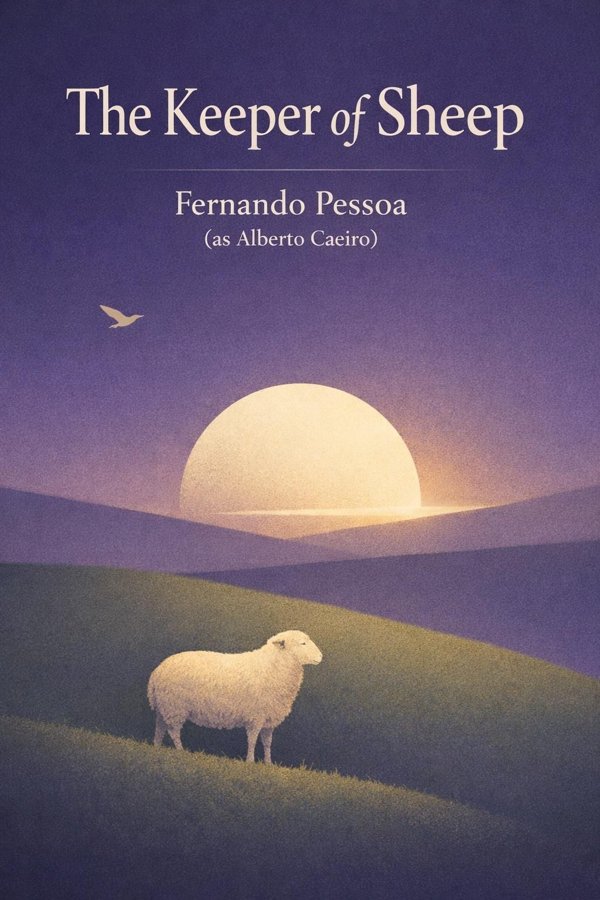
The Keeper of Sheep
The Keeper of Sheep is one of the purest and most radical poetic works of modern literature. Written by Fernando Pessoa under the heteronym Alberto Caeiro, this collection of poems presents a voice that rejects philosophical systems, religious explanations, and symbolic interpretation in favor of something much simpler and much harder: seeing reality as it is. Caeiro does not want to decode nature or discover hidden meanings behind things. He wants to look at a tree as a tree, the sun as the sun, and life as immediate experience rather than abstract theory. That simple stance becomes a profound challenge to how most people think. We are trained to interpret, compare, and explain. Caeiro asks what happens if we stop doing that and return to direct perception. In this way, The Keeper of Sheep becomes more than a book of poems; it becomes a philosophical antidote to overthinking and a spiritual defense of the ordinary world. Pessoa’s authority here is extraordinary. Through Alberto Caeiro, whom he called the master of his other literary selves, he created a complete worldview: lucid, natural, anti-metaphysical, and unforgettable. The result is a classic that feels both timeless and urgently modern.
Read SummaryKey Insights from Fernando Pessoa (as Alberto Caeiro)
Perceiving Without Explaining Away Reality
The moment we rush to explain something, we often stop truly seeing it. This is one of Caeiro’s boldest insights. In The Keeper of Sheep, he resists the habit of turning experience into theory. A field is not a symbol of freedom. A flower is not a moral lesson. A sunset does not need to stand for tr...
From The Keeper of Sheep
Simplicity Is a Form of Wisdom
What if the deepest truth is not hidden in complexity, but available to anyone willing to see plainly? Caeiro builds his poetic worldview on this possibility. He distrusts the assumption that wisdom must be difficult, layered, and intellectually elaborate. Instead, he suggests that the mind often co...
From The Keeper of Sheep
Nature Exists Before Human Meaning
Nature does not need us to complete it. This conviction lies at the center of The Keeper of Sheep. Caeiro sees the natural world as self-sufficient, unconcerned with human ideas, and whole without metaphor. Trees do not aspire. Rivers do not symbolize time unless humans insist they do. The sun rises...
From The Keeper of Sheep
Truth Lives in Things Themselves
Caeiro’s poetry asks a disarming question: why look behind things for truth when things themselves are already true? In much of philosophy and religion, visible reality is treated as surface—an outer shell pointing toward deeper meaning. Caeiro rejects this hierarchy. He does not believe reality is ...
From The Keeper of Sheep
The Poet Sees Instead of Escaping
Many poets are dreamers, visionaries, or makers of symbolic worlds. Caeiro defines the poet differently: not as someone who escapes reality, but as someone who sees it more directly. This is one of the most original aspects of The Keeper of Sheep. Poetry, in his hands, is not ornament laid over life...
From The Keeper of Sheep
Acceptance Creates a Quiet Joy
Much human suffering comes from arguing with the conditions of existence. Caeiro offers a different posture: acceptance without resignation. In The Keeper of Sheep, joy does not arise from controlling life, improving it endlessly, or discovering cosmic purpose. It arises from agreeing to reality as ...
From The Keeper of Sheep
About Fernando Pessoa (as Alberto Caeiro)
Fernando Pessoa (1888–1935) was one of the greatest poets in the Portuguese language and one of the most complex literary figures of the twentieth century. He created multiple heteronyms, including Alberto Caeiro, Ricardo Reis, and Álvaro de Campos, each with their own style and worldview. His work ...
Read more
Fernando Pessoa (1888–1935) was one of the greatest poets in the Portuguese language and one of the most complex literary figures of the twentieth century. He created multiple heteronyms, including Alberto Caeiro, Ricardo Reis, and Álvaro de Campos, each with their own style and worldview. His work ...
Fernando Pessoa (1888–1935) was one of the greatest poets in the Portuguese language and one of the most complex literary figures of the twentieth century. He created multiple heteronyms, including Alberto Caeiro, Ricardo Reis, and Álvaro de Campos, each with their own style and worldview. His work explores identity, the multiplicity of the self, and the nature of poetic creation.




Frequently Asked Questions
Fernando Pessoa (1888–1935) was one of the greatest poets in the Portuguese language and one of the most complex literary figures of the twentieth century. He created multiple heteronyms, including Alberto Caeiro, Ricardo Reis, and Álvaro de Campos, each with their own style and worldview.
Read Fernando Pessoa (as Alberto Caeiro)'s books in 15 minutes
Get AI-powered summaries with key insights from 1 book by Fernando Pessoa (as Alberto Caeiro).