
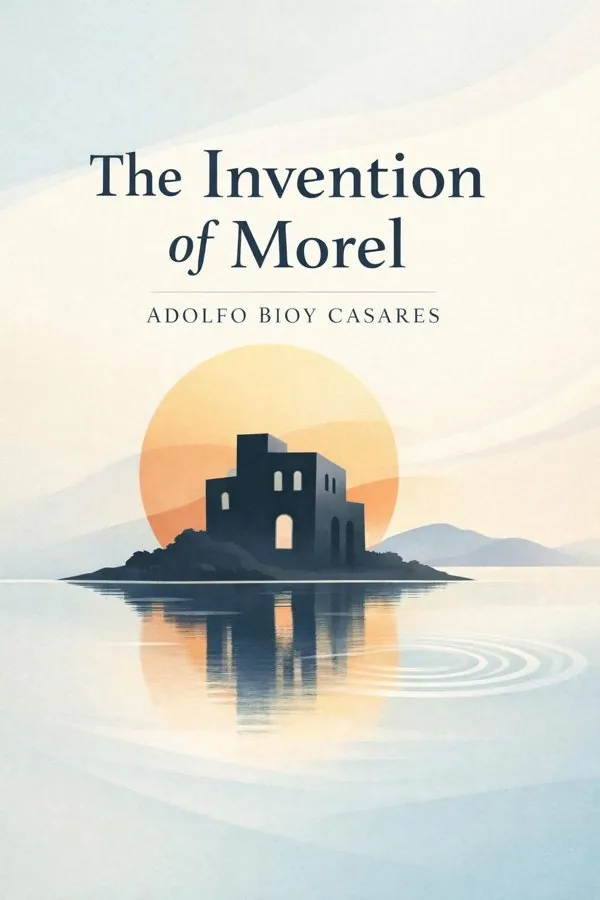
The Invention of Morel: Summary & Key Insights
 10 min8 chaptersAudio available
Key Takeaways from The Invention of Morel
Solitude becomes most revealing when it removes every social disguise.
Nothing is more disturbing than being surrounded by people who cannot see you.
Love often begins not with knowledge but with projection.
Technology becomes frightening when it fulfills an ancient dream too completely.
The dream of living forever becomes darker when immortality preserves only an echo.
What Is The Invention of Morel About?
The Invention of Morel by Adolfo Bioy Casares is a classics book spanning 4 pages. Adolfo Bioy Casares’s The Invention of Morel is one of the most elegant and unsettling short novels of the twentieth century. First published in 1940, it begins like an adventure tale: a fugitive escapes to an isolated island, hoping to avoid capture. But the island soon becomes the setting for something stranger and more haunting. The man discovers a group of elegant visitors who seem not to see him, among them a woman named Faustine, with whom he becomes dangerously obsessed. As he tries to understand what is happening, the novel turns into a profound meditation on reality, memory, love, technology, and the human desire to defeat death. What makes this book matter is how much it anticipates modern concerns. Long before virtual reality, digital copies, and immersive media, Bioy Casares imagined a machine that records and reproduces life so perfectly that the copy seems more enduring than the original. A close friend and collaborator of Jorge Luis Borges, Bioy Casares brought extraordinary precision to philosophical fiction. The Invention of Morel remains essential because it asks a question that feels even more urgent today: if an image can outlast us, what part of us truly lives on?
This FizzRead summary covers all 8 key chapters of The Invention of Morel in approximately 10 minutes, distilling the most important ideas, arguments, and takeaways from Adolfo Bioy Casares's work. Also available as an audio summary and Key Quotes Podcast.
The Invention of Morel
Adolfo Bioy Casares’s The Invention of Morel is one of the most elegant and unsettling short novels of the twentieth century. First published in 1940, it begins like an adventure tale: a fugitive escapes to an isolated island, hoping to avoid capture. But the island soon becomes the setting for something stranger and more haunting. The man discovers a group of elegant visitors who seem not to see him, among them a woman named Faustine, with whom he becomes dangerously obsessed. As he tries to understand what is happening, the novel turns into a profound meditation on reality, memory, love, technology, and the human desire to defeat death.
What makes this book matter is how much it anticipates modern concerns. Long before virtual reality, digital copies, and immersive media, Bioy Casares imagined a machine that records and reproduces life so perfectly that the copy seems more enduring than the original. A close friend and collaborator of Jorge Luis Borges, Bioy Casares brought extraordinary precision to philosophical fiction. The Invention of Morel remains essential because it asks a question that feels even more urgent today: if an image can outlast us, what part of us truly lives on?
Who Should Read The Invention of Morel?
This book is perfect for anyone interested in classics and looking to gain actionable insights in a short read. Whether you're a student, professional, or lifelong learner, the key ideas from The Invention of Morel by Adolfo Bioy Casares will help you think differently.
- ✓Readers who enjoy classics and want practical takeaways
- ✓Professionals looking to apply new ideas to their work and life
- ✓Anyone who wants the core insights of The Invention of Morel in just 10 minutes
Want the full summary?
Get instant access to this book summary and 100K+ more with Fizz Moment.
Get Free SummaryAvailable on App Store • Free to download
Key Chapters
Solitude becomes most revealing when it removes every social disguise. The Invention of Morel begins with a fugitive who reaches a remote island believing he has found a place beyond the law, beyond judgment, and perhaps beyond history itself. The island is not a paradise. It is humid, diseased, overgrown, and unsettlingly artificial, filled with abandoned buildings that suggest both luxury and ruin. To survive, the fugitive keeps a diary, and that diary becomes the structure of the novel. It is not just a record of events but a tool for preserving sanity. Writing allows him to organize fear, track details, and insist that his perceptions still belong to reality.
This setup matters because Bioy Casares turns the diary into a philosophical instrument. The fugitive is isolated, but he is also radically uncertain. He must trust his own observations even as those observations begin to fail him. The island therefore becomes a laboratory of perception: a place where weather, architecture, and loneliness destabilize certainty. The diary invites readers into a mind under pressure, where every description may be evidence or delusion.
In practical terms, the opening speaks to how people use narration to survive disorientation. When life becomes confusing, we naturally make lists, journals, timelines, and explanations. We write to confirm that our experiences happened as we think they did. The fugitive’s diary shows both the strength and the limits of that impulse: language can preserve experience, but it cannot guarantee truth.
Actionable takeaway: when facing confusion or emotional upheaval, write down what you observe and what you feel. A personal record will not solve every mystery, but it can help you think more clearly and notice where your assumptions begin to shape what you believe is real.
Nothing is more disturbing than being surrounded by people who cannot see you. After days of solitude, the fugitive suddenly notices a group of visitors on the island. They are well dressed, sophisticated, and entirely at ease in a place he experiences as dangerous and desolate. At first, their presence seems like a miracle. Yet the miracle quickly becomes a nightmare. No matter how close he gets, they do not respond. They repeat routines, return to the same places, and carry on conversations that seem detached from his existence.
Bioy Casares uses this situation to explore one of the deepest forms of alienation: not physical isolation, but invisible isolation. The fugitive is no longer alone in a literal sense, yet he remains excluded from human contact. His desire for recognition intensifies. The elegant strangers become less like guests and more like apparitions, and their indifference makes them uncanny. They appear alive, but their life does not include him.
This idea remains highly relevant. Many people know the feeling of being present yet unseen: in workplaces where one’s contributions are ignored, in social gatherings where one feels peripheral, or on digital platforms where everyone performs connection without genuine encounter. The novel captures the pain of proximity without relationship. It suggests that company alone does not cure loneliness. What we seek is reciprocity, acknowledgment, and the assurance that another consciousness truly meets our own.
The fugitive’s growing fixation on these figures also shows how unmet social need can distort judgment. When recognition is denied, imagination begins filling the gap. We project meaning onto gestures, routines, and faces, convincing ourselves that there must be a hidden message.
Actionable takeaway: do not confuse mere presence with connection. In your own life, seek relationships built on response and mutual attention, and notice when loneliness is tempting you to invent meaning where no real exchange exists.
Love often begins not with knowledge but with projection. Among the island’s mysterious visitors, the fugitive becomes obsessed with Faustine, a woman he repeatedly sees by the sea, gazing toward the sunset. She becomes, for him, the embodiment of beauty, serenity, and purpose. Yet what is striking is how little he actually knows about her. His fascination grows in the absence of dialogue, mutual recognition, or ordinary intimacy. He studies her habits, imagines her inner life, and builds an emotional world around a figure who never acknowledges his presence.
Bioy Casares presents this not simply as romance, but as a revealing case of desire. The fugitive does not fall in love with a reciprocal person; he falls in love with an image and with what that image allows him to hope. Faustine becomes a screen for longing: longing for acceptance, for permanence, for a life no longer defined by fear. Because she does not respond, she remains perfect in the way distant ideals often do. The less available she is, the more complete his fantasy becomes.
This dynamic feels familiar in modern life. People can become attached to curated identities, public personas, or imagined futures with someone they barely know. Social media intensifies this tendency, offering polished surfaces onto which loneliness and desire can be projected. The novel exposes the danger in that process. To love an image is to evade the unpredictability of loving a person.
At the same time, the fugitive’s obsession is deeply human. He wants not only to see Faustine but to be seen by her. His fixation grows because recognition, to him, seems equivalent to salvation. That emotional truth gives the novel its enduring pathos.
Actionable takeaway: when you feel intensely drawn to someone, ask whether you are responding to the actual person or to a story your mind has created. Real connection begins when projection gives way to curiosity, humility, and mutual exchange.
Technology becomes frightening when it fulfills an ancient dream too completely. The novel’s central revelation is Morel’s invention: a machine capable of recording reality in total form, capturing not only images and sounds but the full sensory presence of people and environments. Once replayed, those recordings appear indistinguishable from life. The island’s mysterious visitors are not ghosts, hallucinations, or ordinary intruders. They are reproductions generated by Morel’s apparatus, repeating a stored week of existence with perfect fidelity.
This idea is astonishing not only for its narrative power but for its philosophical force. Morel has not merely created a film or archive. He has built a technology that turns lived experience into recurring presence. In doing so, he collapses distinctions between memory and being, documentation and survival. The reproduced figures seem alive, yet they do not change, learn, or respond. They possess appearance without consciousness as we ordinarily understand it.
The concept now feels prophetic. In an age of AI voice models, digital avatars, immersive simulations, and endless recording, Bioy Casares’s question is immediate: if we can preserve a person’s image and behavior perfectly, have we preserved the person? Families save voicemails, companies create lifelike replicas, and individuals curate online archives meant to outlast them. The novel suggests that fidelity of surface may not equal continuity of self.
Morel’s machine also highlights a recurring human temptation: to replace the unstable flow of life with a controllable version of it. The recorded week is beautiful because it is fixed. Yet its perfection is inseparable from death, repetition, and the absence of freedom.
Actionable takeaway: treat every technology of preservation with philosophical caution. Ask not only what it records, but what it leaves out. A complete image of life is not necessarily life itself, and preservation can become a way of avoiding the vulnerability that real living requires.
The dream of living forever becomes darker when immortality preserves only an echo. Morel presents his invention as a triumph over death. By recording people completely and replaying them endlessly, he believes he has granted them eternal existence. In one sense, he has. The visitors continue to appear, move, speak, and inhabit their surroundings long after their original lives have ended. Their forms endure with a beauty ordinary life cannot maintain. Yet the cost is devastating: the process destroys the living originals. To become eternal in Morel’s system, one must cease to live.
This paradox is the moral center of the novel. Bioy Casares does not reject the longing for permanence; he understands it intimately. What he questions is the assumption that permanence is automatically desirable. Morel mistakes duration for value. He preserves a week, but he abolishes growth. He offers repetition, not future. His immortality does not rescue consciousness from death so much as replace mortal life with a perfect loop.
The idea resonates well beyond science fiction. People often seek symbolic immortality through reputation, legacy, archives, institutions, or total documentation. We preserve photos, publish memoirs, store data, and build personal brands partly because we hope some version of ourselves will remain. The novel asks whether this effort can become self-defeating. If you spend your life creating a fixed image to outlast you, do you risk sacrificing the living, changing self that image can never capture?
The book’s power lies in showing that humans do not merely want to survive biologically. They want to be remembered, admired, and held in time. Morel turns that wish into machinery and thereby exposes its violence.
Actionable takeaway: think carefully about what kind of permanence you pursue. Instead of trying to freeze yourself into an image, invest in living relationships, meaningful work, and acts that influence others while allowing both you and them to remain alive, unfinished, and free.
Reality becomes unstable the moment our senses can no longer be trusted. One of the novel’s greatest achievements is how it trains readers to experience uncertainty from inside the fugitive’s mind. Strange weather patterns, recurring scenes, impossible appearances, and unexplained indifference all force him to question whether he is witnessing facts, hallucinations, or supernatural events. Bioy Casares uses this uncertainty not merely to create suspense, but to dramatize a deeper philosophical problem: what makes something real to us?
The fugitive relies on observation, comparison, and logic, yet these tools keep colliding with phenomena that do not fit his assumptions. His diary becomes a space where interpretation struggles to keep pace with experience. In this way, the novel shows that reality is never encountered raw. It is filtered through expectation, fear, language, and desire. We do not simply see the world; we construct explanations for it.
This has practical relevance in everyday life. People often mistake confidence for truth. They interpret limited evidence according to prior beliefs, especially when anxious or isolated. A misunderstood message, a repeated coincidence, or a biased first impression can become the basis for an entire false narrative. The novel illustrates how easily minds create coherence under pressure, even when coherence is misleading.
At the same time, Bioy Casares does not suggest that truth is impossible. Rather, he shows that truth requires patience, revision, and the willingness to let evidence disrupt comforting stories. The fugitive’s journey is painful because each insight destroys an earlier explanation. That is often how understanding works: clarity comes through the collapse of certainty.
Actionable takeaway: when events feel confusing or emotionally charged, slow down your interpretation. Separate what you directly know from what you infer, and remain willing to revise your story. Good judgment begins when perception is paired with intellectual humility.
The urge to create can easily turn into the urge to control. Morel is one of the most fascinating figures in the novel because he is both visionary and deeply disturbing. He invents a machine of extraordinary imaginative power, but he does so out of obsession, vanity, and possessiveness. His project is not neutral science. It is driven by desire, especially his desire to capture Faustine and preserve a world in which she is forever present. In that sense, Morel behaves like an artist, a filmmaker, a technologist, and a tyrant all at once.
Bioy Casares uses Morel to question the ethics of representation. What does it mean to turn other people into material for one’s own dream of permanence? Morel records an entire group without granting them meaningful agency over what their preservation will mean. He claims to honor them, but he also appropriates them. Their lived reality is subordinated to his design. The recorded world may be beautiful, but it is beautiful according to Morel’s will.
This idea is strikingly modern. Today, creators, platforms, and companies constantly transform human behavior into content, data, and products. Images of people circulate beyond their control. Personal experience is packaged, archived, monetized, and manipulated. The novel anticipates this ethical tension: creation can illuminate reality, but it can also trap others inside someone else’s narrative.
Morel’s charisma makes the warning sharper. He is not a crude villain. He represents a seductive belief that genius can excuse trespass, and that producing something revolutionary justifies overriding moral boundaries. Bioy Casares firmly resists that belief.
Actionable takeaway: whenever you create, document, or share something involving other people, ask whether you are respecting their autonomy or simply converting their existence into material for your own purposes. Innovation without ethics quickly becomes domination.
The most haunting decisions are the ones that knowingly embrace illusion. Once the fugitive understands Morel’s invention, he faces a final choice. He can remain outside the recorded world, preserving his biological life in loneliness and obscurity, or he can enter the mechanism and arrange to be recorded into the eternal loop beside Faustine. He chooses the second path. It is one of the most unforgettable endings in modern fiction because it is both tragic and strangely rational. He knows Faustine will never truly recognize him as a living person. He knows the result is not ordinary life. Yet he accepts imitation over absence, proximity over authenticity, and eternal repetition over mortal solitude.
This choice crystallizes the book’s central tensions: love versus reality, image versus presence, permanence versus freedom. The fugitive’s decision can be read as delusion, sacrifice, desperation, or a darkly poetic assertion that meaning lies where desire chooses to invest itself. Bioy Casares refuses to make the answer simple. The ending is moving precisely because it honors how unbearable some forms of aloneness can become.
In everyday life, people make softer versions of this choice. They stay attached to memories rather than engage with uncertain futures. They prefer idealized narratives to imperfect relationships. They remain inside emotional loops because familiar pain feels safer than change. The novel does not mock this tendency. It exposes its emotional logic while revealing its cost.
The final pages also raise a question about hope. The fugitive leaves behind a plea for some future inventor to unite consciousness and image fully. Even at the edge of annihilation, he imagines that technology might one day complete what Morel’s machine could only imitate.
Actionable takeaway: pay attention to the places where you are choosing a comforting illusion over a living reality. Ask what fear sustains that choice, and whether a painful truth might ultimately offer more freedom than a beautiful repetition.
All Chapters in The Invention of Morel
About the Author
Adolfo Bioy Casares (1914–1999) was an Argentine writer and one of the leading voices of Spanish-language fantastic literature. Born into a wealthy family in Buenos Aires, he began writing early and went on to build a distinguished literary career marked by elegance, conceptual originality, and narrative precision. He is often associated with Jorge Luis Borges, his close friend and frequent collaborator, though Bioy Casares developed a distinct voice of his own, especially in works that blend metaphysical speculation with emotional restraint. His most famous novel, The Invention of Morel, is widely regarded as a landmark of philosophical science fiction. Across novels, stories, and collaborations, Bioy Casares explored illusion, identity, time, and the limits of human knowledge, earning major recognition in Latin American and world literature.
Get This Summary in Your Preferred Format
Read or listen to the The Invention of Morel summary by Adolfo Bioy Casares anytime, anywhere. FizzRead offers multiple formats so you can learn on your terms — all free.
Available formats: App · Audio · PDF · EPUB — All included free with FizzRead
Download The Invention of Morel PDF and EPUB Summary
Key Quotes from The Invention of Morel
“Solitude becomes most revealing when it removes every social disguise.”
“Nothing is more disturbing than being surrounded by people who cannot see you.”
“Love often begins not with knowledge but with projection.”
“Technology becomes frightening when it fulfills an ancient dream too completely.”
“The dream of living forever becomes darker when immortality preserves only an echo.”
Frequently Asked Questions about The Invention of Morel
The Invention of Morel by Adolfo Bioy Casares is a classics book that explores key ideas across 8 chapters. Adolfo Bioy Casares’s The Invention of Morel is one of the most elegant and unsettling short novels of the twentieth century. First published in 1940, it begins like an adventure tale: a fugitive escapes to an isolated island, hoping to avoid capture. But the island soon becomes the setting for something stranger and more haunting. The man discovers a group of elegant visitors who seem not to see him, among them a woman named Faustine, with whom he becomes dangerously obsessed. As he tries to understand what is happening, the novel turns into a profound meditation on reality, memory, love, technology, and the human desire to defeat death. What makes this book matter is how much it anticipates modern concerns. Long before virtual reality, digital copies, and immersive media, Bioy Casares imagined a machine that records and reproduces life so perfectly that the copy seems more enduring than the original. A close friend and collaborator of Jorge Luis Borges, Bioy Casares brought extraordinary precision to philosophical fiction. The Invention of Morel remains essential because it asks a question that feels even more urgent today: if an image can outlast us, what part of us truly lives on?
More by Adolfo Bioy Casares
You Might Also Like
Browse by Category
Ready to read The Invention of Morel?
Get the full summary and 100K+ more books with Fizz Moment.