
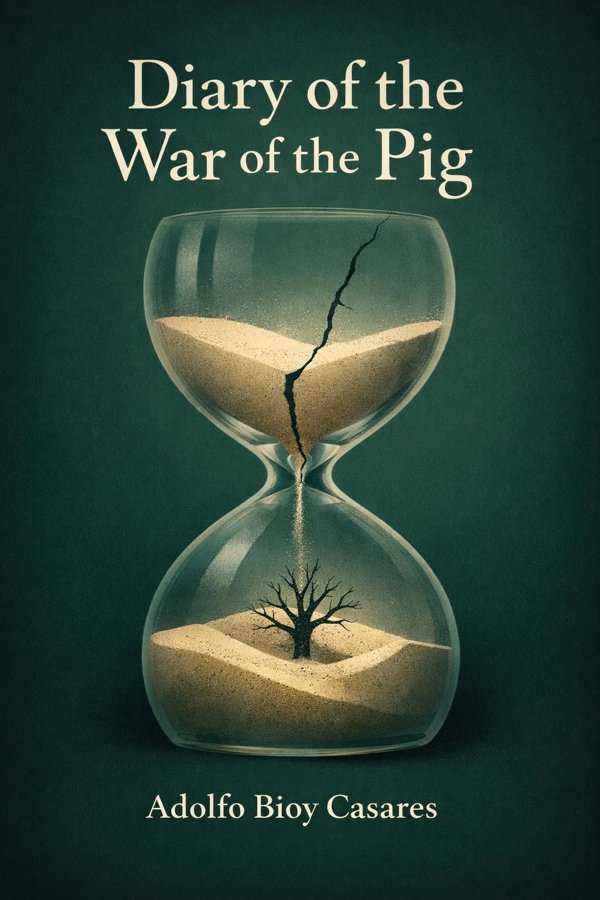
Diary of the War of the Pig: Summary & Key Insights
 10 min8 chaptersAudio available
Key Takeaways from Diary of the War of the Pig
A society rarely becomes cruel all at once; more often, cruelty first appears as a change in atmosphere.
Hatred becomes most dangerous when it acquires a name, a rhythm, and a false sense of legitimacy.
People under threat do not respond with a single emotion; they move between disbelief, terror, pride, and paralysis.
Tenderness matters most when the world insists on reducing life to survival.
The most frightening violence is often the violence that stops shocking people.
What Is Diary of the War of the Pig About?
Diary of the War of the Pig by Adolfo Bioy Casares is a classics book spanning 7 pages. What happens when a society decides that age itself is a provocation? In Diary of the War of the Pig, Adolfo Bioy Casares imagines Buenos Aires slipping into a chilling moral breakdown: young people begin targeting the elderly with insults, assaults, and organized cruelty, turning ordinary old age into a public offense. At the center is Isidoro Vidal, an aging man whose familiar routines—cafés, conversations, friendships, and small comforts—are suddenly overshadowed by fear. What begins as rumor and mockery gradually becomes a social epidemic. Published in 1969, the novel remains startlingly relevant because its real subject is larger than age. Bioy Casares explores how prejudice spreads, how communities normalize violence, and how fragile dignity becomes when people are reduced to a label. Combining psychological realism, satire, and an almost dreamlike sense of menace, he transforms a local crisis into a universal allegory about exclusion and mortality. As one of Argentina’s most accomplished writers and a master of philosophical fiction, Bioy Casares brings precision, irony, and emotional depth to a story that forces readers to confront not only how societies treat the vulnerable, but how easily anyone can become disposable.
This FizzRead summary covers all 8 key chapters of Diary of the War of the Pig in approximately 10 minutes, distilling the most important ideas, arguments, and takeaways from Adolfo Bioy Casares's work. Also available as an audio summary and Key Quotes Podcast.
Diary of the War of the Pig
What happens when a society decides that age itself is a provocation? In Diary of the War of the Pig, Adolfo Bioy Casares imagines Buenos Aires slipping into a chilling moral breakdown: young people begin targeting the elderly with insults, assaults, and organized cruelty, turning ordinary old age into a public offense. At the center is Isidoro Vidal, an aging man whose familiar routines—cafés, conversations, friendships, and small comforts—are suddenly overshadowed by fear. What begins as rumor and mockery gradually becomes a social epidemic.
Published in 1969, the novel remains startlingly relevant because its real subject is larger than age. Bioy Casares explores how prejudice spreads, how communities normalize violence, and how fragile dignity becomes when people are reduced to a label. Combining psychological realism, satire, and an almost dreamlike sense of menace, he transforms a local crisis into a universal allegory about exclusion and mortality. As one of Argentina’s most accomplished writers and a master of philosophical fiction, Bioy Casares brings precision, irony, and emotional depth to a story that forces readers to confront not only how societies treat the vulnerable, but how easily anyone can become disposable.
Who Should Read Diary of the War of the Pig?
This book is perfect for anyone interested in classics and looking to gain actionable insights in a short read. Whether you're a student, professional, or lifelong learner, the key ideas from Diary of the War of the Pig by Adolfo Bioy Casares will help you think differently.
- ✓Readers who enjoy classics and want practical takeaways
- ✓Professionals looking to apply new ideas to their work and life
- ✓Anyone who wants the core insights of Diary of the War of the Pig in just 10 minutes
Want the full summary?
Get instant access to this book summary and 100K+ more with Fizz Moment.
Get Free SummaryAvailable on App Store • Free to download
Key Chapters
A society rarely becomes cruel all at once; more often, cruelty first appears as a change in atmosphere. Isidoro Vidal begins the novel as an elderly man anchored in routine. He spends time in cafés, talks with friends, and inhabits a world of repeated habits that give shape to ordinary life. At first, nothing seems overtly catastrophic. Yet Bioy Casares carefully shows how daily familiarity starts to feel unstable. Comments from younger people grow sharper. Public spaces no longer feel neutral. A glance, a joke, or a passing insult suddenly carries menace.
This shift matters because Vidal’s experience captures how social persecution often begins: not with formal declarations, but with subtle signals that certain people no longer belong. The elderly are not immediately expelled from society; instead, they are made to feel inconvenient, ridiculous, and exposed. Vidal’s awakening is therefore not only personal. It reflects the moment when someone realizes that their identity has become visible in a dangerous way.
The novel’s realism makes this especially powerful. Vidal is not a heroic rebel or symbolic abstraction. He is an ordinary man who senses the world tightening around him. That ordinariness is the point. Bioy Casares suggests that exclusion often reaches people in the middle of ordinary life, when they are least prepared to defend themselves.
In practical terms, this idea applies far beyond the novel. In workplaces, neighborhoods, or digital spaces, hostility often starts with mockery, coded language, and repeated small humiliations. People may dismiss these signs as harmless until they become normalized.
Actionable takeaway: Pay attention to the emotional climate around vulnerable groups. When jokes, contempt, or dismissal become routine, recognize them as warning signs rather than harmless background noise.
Hatred becomes most dangerous when it acquires a name, a rhythm, and a false sense of legitimacy. In Diary of the War of the Pig, the persecution of older people escalates from rumor into a collective campaign. The phrase “War of the Pig” is grotesquely mocking, reducing the elderly to an animal image and making violence seem almost playful. That is one of Bioy Casares’s sharpest insights: dehumanizing language prepares the ground for physical aggression.
What begins as social contempt soon takes on the force of ideology. Young attackers no longer seem like isolated troublemakers. They become part of a pattern, driven by shared slogans, resentments, and a contagious energy. Once this shift occurs, violence no longer feels exceptional. It becomes something people expect, repeat, and excuse. The city starts to function according to a new moral logic in which the elderly are treated as obstacles, relics, or enemies.
The novel shows how quickly absurdity can harden into social reality. A ridiculous name does not make a movement less dangerous; often it makes it easier to spread. Humor, derision, and slogans can turn moral seriousness into entertainment. This is why the “war” feels so disturbing. It is not only violent; it is also culturally normalized.
This mechanism is highly recognizable in real life. Groups are often attacked first through labels that simplify and degrade them. Once those labels circulate widely, empathy weakens. People stop seeing individuals and start seeing categories.
Actionable takeaway: Challenge dehumanizing language early. Whether in conversation, media, or online culture, refuse to repeat labels that turn people into caricatures, because words often create the emotional permission for later cruelty.
People under threat do not respond with a single emotion; they move between disbelief, terror, pride, and paralysis. Bioy Casares captures this complexity through the elderly characters’ reactions to the growing violence. Some deny the seriousness of what is happening, clinging to old routines as if continuity itself could protect them. Others become fearful and withdrawn. Still others attempt small acts of resistance, asserting dignity in a world that increasingly treats them as expendable.
This emotional variety makes the novel psychologically rich. Vidal and his companions are not saints or symbols. They are flawed people trying to interpret a reality that has changed faster than their habits can adapt. Denial becomes a survival mechanism. If one admits the full scale of the threat, panic may follow. Yet denial is also dangerous, because it delays action and isolates individuals who might otherwise protect one another.
Bioy Casares also suggests that fear can become a form of exile. Even when older characters remain physically in the city, they are pushed out of public life. They avoid certain streets, alter routines, and begin living defensively. Their exclusion is therefore social and emotional before it becomes total.
This pattern appears whenever institutions fail to protect vulnerable people. Workers may normalize toxic treatment, citizens may dismiss authoritarian signs, and communities may retreat into private fear instead of collective action. The novel reminds us that courage is not always dramatic. Sometimes it consists of naming reality accurately, staying connected, and refusing to disappear inwardly.
Actionable takeaway: When facing hostility, do not confuse silence with safety. Acknowledge the threat clearly, share information with others, and build small circles of mutual support before isolation becomes the enemy’s greatest advantage.
Tenderness matters most when the world insists on reducing life to survival. One of the novel’s most moving dimensions is Vidal’s relationship with Nélida, which introduces warmth into an atmosphere dominated by suspicion and decay. In a story obsessed with aging, vulnerability, and social death, affection becomes more than romance. It becomes a refusal to accept the dehumanizing logic around them.
Bioy Casares treats love not as sentimental escape, but as an encounter that reawakens Vidal’s sense of being alive. His feelings for Nélida do not erase danger or restore youth. Instead, they deepen his awareness of time, fragility, and desire. This is what makes the relationship powerful: it does not deny mortality; it gives mortality emotional meaning. In a society that tells older people they are finished, love says that subjectivity persists, that longing and tenderness do not belong only to the young.
The relationship also complicates the novel’s bleakness. Vidal is not only a victim of historical cruelty. He remains capable of attachment, hope, and renewal. Through this, Bioy Casares resists reducing old age to decline alone. Aging contains loss, but it also contains emotional possibility.
In broader terms, this idea applies whenever social systems define people by usefulness, productivity, or appearance. Human worth is often defended not through abstract principles alone, but through acts of recognition: friendship, care, intimacy, and listening.
Actionable takeaway: Treat affection and attention as forms of resistance. In times of fear or exclusion, strengthen relationships that remind people they are more than the labels society assigns to them.
To age is not only to grow older; it is to discover how identity depends on the eyes of others. Diary of the War of the Pig uses its disturbing premise to ask philosophical questions about what it means to become old in a culture that worships vitality. Vidal’s crisis is not merely physical vulnerability. It is ontological. He is forced to confront the possibility that society no longer sees him as fully human, desirable, or relevant.
Bioy Casares explores the instability of identity with unusual precision. A person may feel inward continuity across decades, yet external perception can change brutally. The elderly characters still carry memory, humor, pride, and inner life, but public discourse flattens them into a category. The violence of the novel lies partly in this simplification. To be old is treated not as one dimension of being, but as total definition.
The book also exposes a deeper paradox: the young attack the old partly because old age reminds them of their own future. Hatred becomes a defense against mortality. By rejecting older people, the persecutors try symbolically to reject decline, dependence, and death. In that sense, the war is not just against the elderly; it is against the human condition.
Readers can apply this idea by noticing how often societies hide, segregate, or stereotype aging. Whether through advertising, hiring, or social attention, many cultures reward visibility only when it appears youthful. The novel asks us to resist that distortion.
Actionable takeaway: Examine how your own attitudes toward aging shape your behavior. Treat older people as complex individuals, and remember that respect for age is also respect for your own future self.
Oppression does not always destroy people through sudden catastrophe; often it wears them down through atmosphere, repetition, and loneliness. As the novel progresses, fear accumulates into exhaustion. Public danger becomes private despair. Vidal and those around him confront not only attacks from outside but also the corrosive effect of waiting, wondering, and losing confidence in the future. This is where Bioy Casares’s vision becomes especially haunting.
Decay in the novel is material, social, and emotional. The city feels less hospitable. Friendships become strained by anxiety. Hope fades not because every possibility disappears at once, but because each day narrows what feels livable. Solitude deepens when trust erodes. If streets are unsafe and public life hostile, even companionship becomes harder to sustain.
Yet the novel’s portrayal of fading hope is not merely pessimistic. It reveals how essential hope is to human dignity. People need more than biological survival; they need a horizon, however modest. When that horizon collapses, individuals begin to feel erased before they are physically destroyed.
This idea resonates in any context where people live under chronic social pressure—discrimination, bullying, economic precarity, or political intimidation. The damage is cumulative. A person may appear functional while inwardly shrinking.
Bioy Casares invites readers to notice the hidden costs of sustained hostility. The tragedy is not only the spectacular act of violence, but the slow conversion of life into defensive endurance.
Actionable takeaway: If you or others are living under prolonged stress, do not underestimate the effects of isolation. Rebuild hope through concrete routines of connection, safety, and meaning rather than waiting for relief to arrive on its own.
Sometimes fiction tells the truth most clearly by making reality slightly unreal. Diary of the War of the Pig is not a conventional realist social novel, even though its settings and emotions feel recognizable. Bioy Casares uses satire and allegory to intensify what everyday realism might soften. The premise of a generational “war” may seem exaggerated, but that exaggeration reveals patterns of scapegoating, tribal identity, and mass irrationality that operate in many societies.
The novel’s satirical edge is crucial. By giving the campaign a grotesque, almost absurd title, Bioy Casares shows how propaganda and collective fantasies simplify moral complexity. Satire exposes the ridiculousness of hatred without reducing its danger. In fact, the combination of absurdity and brutality makes the violence feel more modern, because public cruelty often wears the mask of entertainment, rhetoric, or group identity.
As allegory, the book can be read beyond age conflict. The elderly stand for any group turned into a social burden or symbolic enemy. This is why the novel remains timeless. It warns that democracies and urban societies are not immune to primitive forms of exclusion. Civility can collapse quickly when fear and resentment are given a target.
Readers can use this lens to think more deeply about current events. Which groups are being blamed for broad frustrations? What slogans simplify complex problems into emotionally satisfying enemies? What forms of mockery are preparing the way for harder exclusions?
Actionable takeaway: Read satirical and allegorical fiction politically. Ask not only what the story depicts, but what mechanisms of group hatred it reveals in your own time.
All Chapters in Diary of the War of the Pig
About the Author
Adolfo Bioy Casares (1914–1999) was an Argentine novelist, short story writer, and essayist, widely regarded as one of the finest authors of twentieth-century Spanish-language fiction. Born into an upper-class Buenos Aires family, he began writing early and went on to develop a distinctive style marked by clarity, irony, and conceptual elegance. He is perhaps best known for The Invention of Morel, a landmark of fantastic literature, as well as The Dream of Heroes and Diary of the War of the Pig. Bioy Casares maintained a long and influential friendship and collaboration with Jorge Luis Borges, with whom he co-authored several works. Across his career, he explored themes such as time, identity, illusion, mortality, and the hidden strangeness of everyday life, securing his place as a major voice in Argentine and world literature.
Get This Summary in Your Preferred Format
Read or listen to the Diary of the War of the Pig summary by Adolfo Bioy Casares anytime, anywhere. FizzRead offers multiple formats so you can learn on your terms — all free.
Available formats: App · Audio · PDF · EPUB — All included free with FizzRead
Download Diary of the War of the Pig PDF and EPUB Summary
Key Quotes from Diary of the War of the Pig
“A society rarely becomes cruel all at once; more often, cruelty first appears as a change in atmosphere.”
“Hatred becomes most dangerous when it acquires a name, a rhythm, and a false sense of legitimacy.”
“People under threat do not respond with a single emotion; they move between disbelief, terror, pride, and paralysis.”
“Tenderness matters most when the world insists on reducing life to survival.”
“The most frightening violence is often the violence that stops shocking people.”
Frequently Asked Questions about Diary of the War of the Pig
Diary of the War of the Pig by Adolfo Bioy Casares is a classics book that explores key ideas across 8 chapters. What happens when a society decides that age itself is a provocation? In Diary of the War of the Pig, Adolfo Bioy Casares imagines Buenos Aires slipping into a chilling moral breakdown: young people begin targeting the elderly with insults, assaults, and organized cruelty, turning ordinary old age into a public offense. At the center is Isidoro Vidal, an aging man whose familiar routines—cafés, conversations, friendships, and small comforts—are suddenly overshadowed by fear. What begins as rumor and mockery gradually becomes a social epidemic. Published in 1969, the novel remains startlingly relevant because its real subject is larger than age. Bioy Casares explores how prejudice spreads, how communities normalize violence, and how fragile dignity becomes when people are reduced to a label. Combining psychological realism, satire, and an almost dreamlike sense of menace, he transforms a local crisis into a universal allegory about exclusion and mortality. As one of Argentina’s most accomplished writers and a master of philosophical fiction, Bioy Casares brings precision, irony, and emotional depth to a story that forces readers to confront not only how societies treat the vulnerable, but how easily anyone can become disposable.
More by Adolfo Bioy Casares
You Might Also Like




Browse by Category
Ready to read Diary of the War of the Pig?
Get the full summary and 100K+ more books with Fizz Moment.