
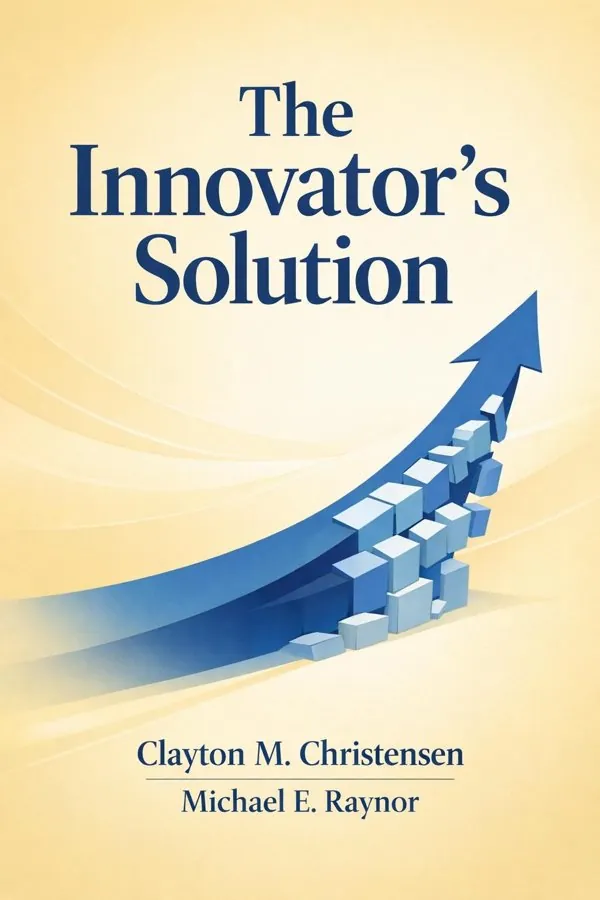
The Innovator’s Solution: Creating and Sustaining Successful Growth: Summary & Key Insights
by Clayton M. Christensen, Michael E. Raynor
 10 min10 chaptersAudio available
What Is The Innovator’s Solution: Creating and Sustaining Successful Growth About?
The Innovator’s Solution: Creating and Sustaining Successful Growth by Clayton M. Christensen, Michael E. Raynor is a strategy book spanning 10 pages. In this influential work, Christensen and Raynor expand on the theory of disruptive innovation first introduced in 'The Innovator’s Dilemma'. They provide a framework for managers and entrepreneurs to identify new growth opportunities and build businesses that can sustain innovation over time. The book explores how companies can create markets for disruptive technologies and maintain long-term success by understanding customer needs and market evolution.
This FizzRead summary covers all 10 key chapters of The Innovator’s Solution: Creating and Sustaining Successful Growth in approximately 10 minutes, distilling the most important ideas, arguments, and takeaways from Clayton M. Christensen, Michael E. Raynor's work. Also available as an audio summary and Key Quotes Podcast.
The Innovator’s Solution: Creating and Sustaining Successful Growth
In this influential work, Christensen and Raynor expand on the theory of disruptive innovation first introduced in 'The Innovator’s Dilemma'. They provide a framework for managers and entrepreneurs to identify new growth opportunities and build businesses that can sustain innovation over time. The book explores how companies can create markets for disruptive technologies and maintain long-term success by understanding customer needs and market evolution.
Who Should Read The Innovator’s Solution: Creating and Sustaining Successful Growth?
This book is perfect for anyone interested in strategy and looking to gain actionable insights in a short read. Whether you're a student, professional, or lifelong learner, the key ideas from The Innovator’s Solution: Creating and Sustaining Successful Growth by Clayton M. Christensen, Michael E. Raynor will help you think differently.
- ✓Readers who enjoy strategy and want practical takeaways
- ✓Professionals looking to apply new ideas to their work and life
- ✓Anyone who wants the core insights of The Innovator’s Solution: Creating and Sustaining Successful Growth in just 10 minutes
Want the full summary?
Get instant access to this book summary and 100K+ more with Fizz Moment.
Get Free SummaryAvailable on App Store • Free to download
Key Chapters
Every manager craves growth—but not all growth is created equal. To understand why, I often draw a distinction between sustaining innovations and disruptive ones. Sustaining innovations make good products better: they improve what already exists for demanding, high-end customers. Disruptive innovations, by contrast, bring less expensive, simpler, or more convenient solutions, often at the expense of performance. They flourish not because they compete head-on with leaders, but because they serve people whom leaders ignore.
In most industries, sustaining innovation is the natural gravitational pull. Established firms have incentives to keep serving their best customers, improving margins, and climbing the performance trajectory that these customers reward. The tragic irony, however, is that this very success traps them. A sustaining focus blinds them to opportunities below or beyond their existing customers—spaces of nonconsumption where simple products could enable new growth.
Growth that lasts must come from understanding this difference. Sustaining innovations can keep existing businesses profitable in the short term, but disruptive innovations create the new arenas where long-term prosperity lies. The challenge, then, is not to choose between them, but to design organizations capable of pursuing both in balance. To do so, you must stop looking only at market size or existing demand, and instead watch where nonconsumption flourishes.
The most fertile ground for growth is where customers are not consuming at all—areas of nonconsumption. Traditional market research tends to overlook such spaces because it asks existing customers what they want, rather than observing what jobs people are trying to get done but cannot. When I say 'jobs,' I mean the fundamental problems or aspirations that cause customers to hire a product or service into their lives.
Consider how early steel minimills disrupted integrated steel producers, or how Honda’s small motorcycles succeeded in markets large incumbents dismissed. Each began not by attacking established players on their own terms, but by finding jobs that were not being served. To identify new growth, you must go where ease, affordability, and convenience matter more than performance. This requires humility: instead of asking, 'How big is this market?' ask, 'Who is trying to accomplish something and failing?' Once you see nonconsumption, you can design an innovation that transforms it into new demand—and, eventually, into a new market.
+ 8 more chapters — available in the FizzRead app
All Chapters in The Innovator’s Solution: Creating and Sustaining Successful Growth
About the Authors
Clayton M. Christensen was a professor at Harvard Business School and a leading authority on innovation and growth. His research on disruptive innovation has shaped modern business strategy. Michael E. Raynor is a director at Deloitte Services LP and an expert in corporate strategy and innovation.
Get This Summary in Your Preferred Format
Read or listen to the The Innovator’s Solution: Creating and Sustaining Successful Growth summary by Clayton M. Christensen, Michael E. Raynor anytime, anywhere. FizzRead offers multiple formats so you can learn on your terms — all free.
Available formats: App · Audio · PDF · EPUB — All included free with FizzRead
Download The Innovator’s Solution: Creating and Sustaining Successful Growth PDF and EPUB Summary
Key Quotes from The Innovator’s Solution: Creating and Sustaining Successful Growth
“Every manager craves growth—but not all growth is created equal.”
“The most fertile ground for growth is where customers are not consuming at all—areas of nonconsumption.”
Frequently Asked Questions about The Innovator’s Solution: Creating and Sustaining Successful Growth
The Innovator’s Solution: Creating and Sustaining Successful Growth by Clayton M. Christensen, Michael E. Raynor is a strategy book that explores key ideas across 10 chapters. In this influential work, Christensen and Raynor expand on the theory of disruptive innovation first introduced in 'The Innovator’s Dilemma'. They provide a framework for managers and entrepreneurs to identify new growth opportunities and build businesses that can sustain innovation over time. The book explores how companies can create markets for disruptive technologies and maintain long-term success by understanding customer needs and market evolution.
You Might Also Like

Mastery
Robert Greene
10 min
Cut Costs Not Corners: A Practical Guide to Staying Competitive and Improving Profits
Colin Barrow
10 min
Good Strategy/Bad Strategy: The Difference and Why It Matters
Richard P. Rumelt
10 min
On Grand Strategy
John Lewis Gaddis
10 min
The Six Disciplines of Digital Transformation
George Westerman
10 min
7 Powers: The Foundations of Business Strategy
Hamilton Helmer
10 minBrowse by Category
Ready to read The Innovator’s Solution: Creating and Sustaining Successful Growth?
Get the full summary and 100K+ more books with Fizz Moment.