
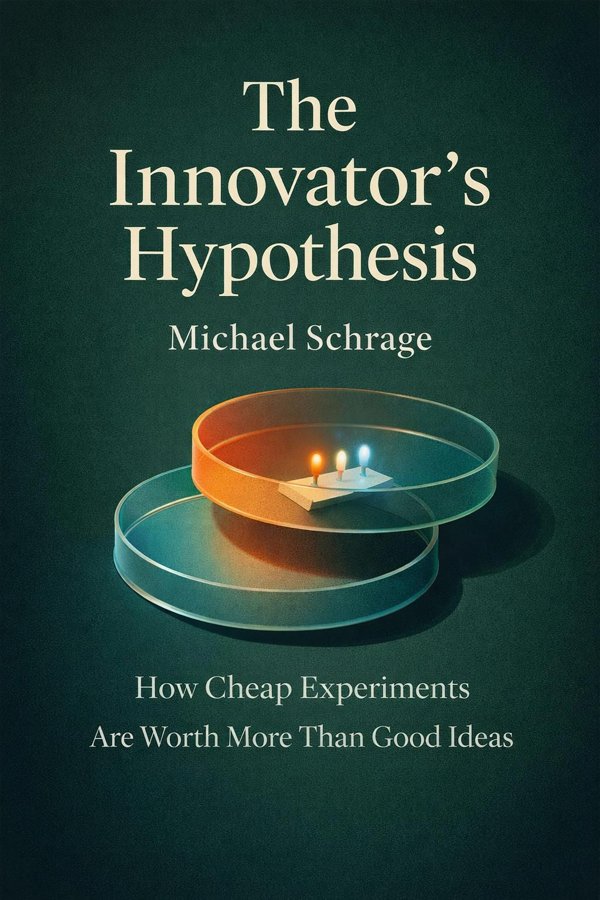
The Innovator's Hypothesis: How Cheap Experiments Are Worth More Than Good Ideas: Summary & Key Insights
 10 min12 chaptersAudio available
What Is The Innovator's Hypothesis: How Cheap Experiments Are Worth More Than Good Ideas About?
The Innovator's Hypothesis: How Cheap Experiments Are Worth More Than Good Ideas by Michael Schrage is a entrepreneurship book spanning 12 pages. In this book, Michael Schrage argues that the best way to innovate is not through brainstorming or big ideas, but through small, inexpensive experiments that test assumptions and generate real data. Drawing on examples from leading companies, he shows how organizations can create a culture of experimentation that drives continuous improvement and innovation.
This FizzRead summary covers all 12 key chapters of The Innovator's Hypothesis: How Cheap Experiments Are Worth More Than Good Ideas in approximately 10 minutes, distilling the most important ideas, arguments, and takeaways from Michael Schrage's work. Also available as an audio summary and Key Quotes Podcast.
The Innovator's Hypothesis: How Cheap Experiments Are Worth More Than Good Ideas
In this book, Michael Schrage argues that the best way to innovate is not through brainstorming or big ideas, but through small, inexpensive experiments that test assumptions and generate real data. Drawing on examples from leading companies, he shows how organizations can create a culture of experimentation that drives continuous improvement and innovation.
Who Should Read The Innovator's Hypothesis: How Cheap Experiments Are Worth More Than Good Ideas?
This book is perfect for anyone interested in entrepreneurship and looking to gain actionable insights in a short read. Whether you're a student, professional, or lifelong learner, the key ideas from The Innovator's Hypothesis: How Cheap Experiments Are Worth More Than Good Ideas by Michael Schrage will help you think differently.
- ✓Readers who enjoy entrepreneurship and want practical takeaways
- ✓Professionals looking to apply new ideas to their work and life
- ✓Anyone who wants the core insights of The Innovator's Hypothesis: How Cheap Experiments Are Worth More Than Good Ideas in just 10 minutes
Want the full summary?
Get instant access to this book summary and 100K+ more with Fizz Moment.
Get Free SummaryAvailable on App Store • Free to download
Key Chapters
The innovator’s hypothesis is a mental shift. It is the idea that a good innovation effort begins not with a fully formed idea but with a testable proposition: a statement about how something might create value for users, employees, or shareholders. When we begin with hypotheses, we free ourselves from the delusion that ideas are inherently valuable. What really matters is whether assumptions hold up under pressure.
I often begin with a simple question: what do you believe your customers will do differently because of your innovation? That belief is your hypothesis. The beauty of this approach is that it forces teams to articulate the behavioral change they expect to see, rather than just the feature they plan to build. Instead of saying, “We have an idea for a new mobile payment app,” the team should ask, “We believe that customers will use this app twice a week if payments take less than ten seconds.” The difference between these two statements is dramatic: one is vague; the other is measurable.
The innovator’s hypothesis is not about perfection—it is about provocation. It invites debate, demands testing, and connects every creative impulse to an empirical outcome. By treating every idea as a hypothesis, an organization shifts from evaluating creativity to evaluating evidence.
If hypotheses are the raw material of innovation, cheap experiments are the tools that shape them. In today’s business environment, experimentation is faster and cheaper than ever before. You can prototype a new feature overnight, test a marketing approach in minutes, or create a simulated service using off-the-shelf technology. The cost of trying an idea has dropped by several orders of magnitude, but most organizations still behave as if experimentation were expensive and rare.
Cheap experiments change not just the economics of innovation, but its psychology. When an experiment costs little, failure becomes affordable—and therefore, more frequent and more informative. Companies such as Amazon, Google, and Intuit have built cultures around thousands of small tests. They understand that the more experiments you run, the better your odds of discovering something transformative. The irony is that expensive experiments often discourage curiosity because the stakes feel too high. Cheap experiments, by contrast, liberate people to learn.
A quick and inexpensive test produces data, not debates. It allows you to learn directly from behavior rather than conjecture. In the long run, the collective learning from hundreds of such small trials becomes a company’s competitive advantage.
+ 10 more chapters — available in the FizzRead app
All Chapters in The Innovator's Hypothesis: How Cheap Experiments Are Worth More Than Good Ideas
About the Author
Michael Schrage is a research fellow at the MIT Sloan School’s Center for Digital Business. He is an expert on innovation, metrics, and the economics of experimentation, and has advised major global corporations on innovation strategy and digital transformation.
Get This Summary in Your Preferred Format
Read or listen to the The Innovator's Hypothesis: How Cheap Experiments Are Worth More Than Good Ideas summary by Michael Schrage anytime, anywhere. FizzRead offers multiple formats so you can learn on your terms — all free.
Available formats: App · Audio · PDF · EPUB — All included free with FizzRead
Download The Innovator's Hypothesis: How Cheap Experiments Are Worth More Than Good Ideas PDF and EPUB Summary
Key Quotes from The Innovator's Hypothesis: How Cheap Experiments Are Worth More Than Good Ideas
“The innovator’s hypothesis is a mental shift.”
“If hypotheses are the raw material of innovation, cheap experiments are the tools that shape them.”
Frequently Asked Questions about The Innovator's Hypothesis: How Cheap Experiments Are Worth More Than Good Ideas
The Innovator's Hypothesis: How Cheap Experiments Are Worth More Than Good Ideas by Michael Schrage is a entrepreneurship book that explores key ideas across 12 chapters. In this book, Michael Schrage argues that the best way to innovate is not through brainstorming or big ideas, but through small, inexpensive experiments that test assumptions and generate real data. Drawing on examples from leading companies, he shows how organizations can create a culture of experimentation that drives continuous improvement and innovation.
You Might Also Like
Lean Analytics
Alistair Croll, Benjamin Yoskovitz
10 min
21 Days To A Big Idea: Creating Breakthrough Business Concepts
Bryan Mattimore
10 min
Sam Walton: Made in America: My Story
Sam Walton
10 min
10x Is Easier Than 2x: How World-Class Entrepreneurs Achieve More by Doing Less
Dan Sullivan, Benjamin Hardy
10 min
12 Months to $1 Million: How to Pick a Winning Product, Build a Real Business, and Become a Seven-Figure Entrepreneur
Ryan Daniel Moran
10 min
24 Assets: Create a Digital, Scalable, Valuable Business
Daniel Priestley
10 minBrowse by Category
Ready to read The Innovator's Hypothesis: How Cheap Experiments Are Worth More Than Good Ideas?
Get the full summary and 100K+ more books with Fizz Moment.