
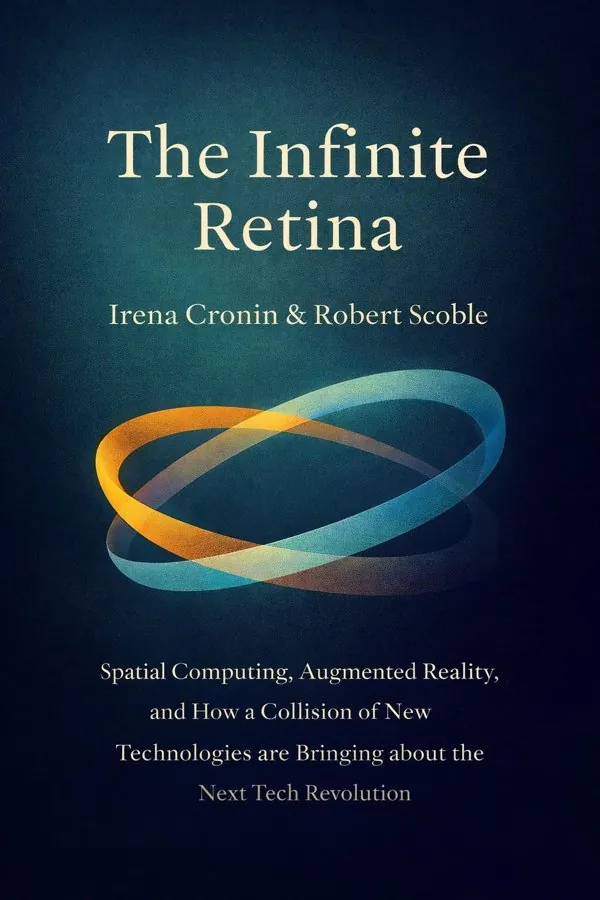
The Infinite Retina: Spatial Computing, Augmented Reality, and How a Collision of New Technologies are Bringing about the Next Tech Revolution: Summary & Key Insights
by Irena Cronin, Robert Scoble
 10 min5 chaptersAudio available
What Is The Infinite Retina: Spatial Computing, Augmented Reality, and How a Collision of New Technologies are Bringing about the Next Tech Revolution About?
The Infinite Retina: Spatial Computing, Augmented Reality, and How a Collision of New Technologies are Bringing about the Next Tech Revolution by Irena Cronin & Robert Scoble is a emerging_tech book spanning 5 pages. The Infinite Retina explores the emerging world of spatial computing and augmented reality, examining how these technologies are reshaping industries, human interaction, and the future of work. The authors analyze the convergence of hardware, software, and data that enables immersive experiences, and they outline the opportunities and challenges that come with this technological shift.
This FizzRead summary covers all 5 key chapters of The Infinite Retina: Spatial Computing, Augmented Reality, and How a Collision of New Technologies are Bringing about the Next Tech Revolution in approximately 10 minutes, distilling the most important ideas, arguments, and takeaways from Irena Cronin & Robert Scoble's work. Also available as an audio summary and Key Quotes Podcast.
The Infinite Retina: Spatial Computing, Augmented Reality, and How a Collision of New Technologies are Bringing about the Next Tech Revolution
The Infinite Retina explores the emerging world of spatial computing and augmented reality, examining how these technologies are reshaping industries, human interaction, and the future of work. The authors analyze the convergence of hardware, software, and data that enables immersive experiences, and they outline the opportunities and challenges that come with this technological shift.
Who Should Read The Infinite Retina: Spatial Computing, Augmented Reality, and How a Collision of New Technologies are Bringing about the Next Tech Revolution?
This book is perfect for anyone interested in emerging_tech and looking to gain actionable insights in a short read. Whether you're a student, professional, or lifelong learner, the key ideas from The Infinite Retina: Spatial Computing, Augmented Reality, and How a Collision of New Technologies are Bringing about the Next Tech Revolution by Irena Cronin & Robert Scoble will help you think differently.
- ✓Readers who enjoy emerging_tech and want practical takeaways
- ✓Professionals looking to apply new ideas to their work and life
- ✓Anyone who wants the core insights of The Infinite Retina: Spatial Computing, Augmented Reality, and How a Collision of New Technologies are Bringing about the Next Tech Revolution in just 10 minutes
Want the full summary?
Get instant access to this book summary and 100K+ more with Fizz Moment.
Get Free SummaryAvailable on App Store • Free to download
Key Chapters
To grasp the magnitude of this shift, you first need to understand what spatial computing truly is. In its simplest form, spatial computing refers to the ability of digital systems to understand and interact with the three-dimensional world — not as a collection of pixels on a screen, but as a living environment with depth, surfaces, objects, and people.
It is the meeting point of multiple technologies: augmented reality, virtual reality, and mixed reality. Augmented reality overlays digital elements on the physical world, while virtual reality immerses us entirely within synthetic spaces. Mixed reality allows physical and digital objects to coexist and interact in real time. Spatial computing binds them all through context awareness — a computer’s ability to perceive where you are, what you’re doing, and what you’re looking at.
This understanding is made possible by a marriage of sensors and intelligent software. Cameras, LiDAR, GPS, motion tracking, and biometric inputs feed continuous streams of spatial data into systems that analyze and predict behavior. Artificial intelligence interprets that data, while advances in cloud computing and 5G ensure real-time responsiveness. The result: a computing environment that can see and understand you.
We emphasize that spatial computing is not confined to headsets. Yes, AR glasses will eventually become common, but the shift is broader — vehicles that perceive the world around them, manufacturing systems aware of their spatial environment, or healthcare devices understanding a body in three dimensions. Spatial computing means the digital and physical merge seamlessly into a single operational layer.
When we look back historically — from mainframes, to personal computers, to networks, to mobile computing — each phase brought technology closer to the human body. The next obvious step is computing that encounters the world as we do: spatially. That, simply put, is what makes this change inevitable.
The rise of spatial computing isn’t happening in isolation. It rests on a foundation built by several converging technological trends. This convergence is what makes the new platform viable for the first time.
Sensors act as the eyes and ears of digital systems. New generations of inexpensive, low-latency sensors — depth cameras, motion sensors, and environmental detectors — provide an unprecedented level of environmental data. Artificial intelligence serves as the brain, analyzing that data, recognizing patterns, and learning from behavior. Cloud computing operates as the memory and connective tissue of this ecosystem, enabling distributed computation and data sharing at scale.
And then there’s 5G — the neural network. Its promise of ultra-low-latency communication means that spatial applications requiring millisecond responsiveness — like real-time AR collaboration or autonomous driving — become practical. These technologies combine into a coherent system that lets computers not only see the world but respond to it intelligently.
The implications are profound. Imagine a retail store that recognizes you and arranges its layout dynamically; a hospital where surgeons view patient anatomy through holographic overlays during procedures; a factory floor where machines and workers are aware of one another’s positions, optimizing efficiency and safety. These examples are not distant projections — early prototypes exist today.
At the heart of all this lies our capacity to simulate and augment spatial experience. For decades, digital technology has focused on compressing information into screens. Now, it’s about expanding that information back into our lived environment.
+ 3 more chapters — available in the FizzRead app
All Chapters in The Infinite Retina: Spatial Computing, Augmented Reality, and How a Collision of New Technologies are Bringing about the Next Tech Revolution
About the Authors
Irena Cronin is the CEO of Infinite Retina, specializing in spatial computing and immersive technology strategy. Robert Scoble is a technology evangelist and author known for his work on emerging technologies and their societal impact.
Get This Summary in Your Preferred Format
Read or listen to the The Infinite Retina: Spatial Computing, Augmented Reality, and How a Collision of New Technologies are Bringing about the Next Tech Revolution summary by Irena Cronin & Robert Scoble anytime, anywhere. FizzRead offers multiple formats so you can learn on your terms — all free.
Available formats: App · Audio · PDF · EPUB — All included free with FizzRead
Download The Infinite Retina: Spatial Computing, Augmented Reality, and How a Collision of New Technologies are Bringing about the Next Tech Revolution PDF and EPUB Summary
Key Quotes from The Infinite Retina: Spatial Computing, Augmented Reality, and How a Collision of New Technologies are Bringing about the Next Tech Revolution
“To grasp the magnitude of this shift, you first need to understand what spatial computing truly is.”
“The rise of spatial computing isn’t happening in isolation.”
Frequently Asked Questions about The Infinite Retina: Spatial Computing, Augmented Reality, and How a Collision of New Technologies are Bringing about the Next Tech Revolution
The Infinite Retina: Spatial Computing, Augmented Reality, and How a Collision of New Technologies are Bringing about the Next Tech Revolution by Irena Cronin & Robert Scoble is a emerging_tech book that explores key ideas across 5 chapters. The Infinite Retina explores the emerging world of spatial computing and augmented reality, examining how these technologies are reshaping industries, human interaction, and the future of work. The authors analyze the convergence of hardware, software, and data that enables immersive experiences, and they outline the opportunities and challenges that come with this technological shift.
You Might Also Like
Blockchain Technology Guide (Chinese Edition)
Li Qilei
10 min
21st Century Technologies Revisited: What is Happening and What is Next
Organisation for Economic Co-operation and Development (OECD)
10 min
Autonomous Vehicles: Opportunities, Strategies, and Challenges
Various Authors
10 min
Autonomy
Lawrence Burns
10 min
Blockchain Basics: A Non-Technical Introduction in 25 Steps
Daniel Drescher
10 min
Blockchain Revolution: How the Technology Behind Bitcoin and Other Cryptocurrencies Is Changing the World
Don Tapscott & Alex Tapscott
10 minBrowse by Category
Ready to read The Infinite Retina: Spatial Computing, Augmented Reality, and How a Collision of New Technologies are Bringing about the Next Tech Revolution?
Get the full summary and 100K+ more books with Fizz Moment.