
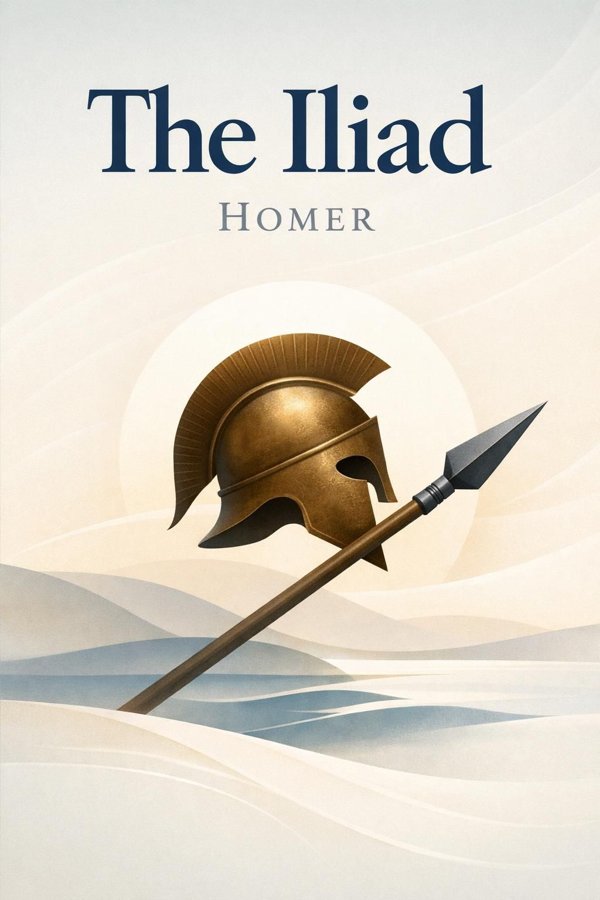
The Iliad: Summary & Key Insights
by Homer
 10 min9 chaptersAudio available
Key Takeaways from The Iliad
Great stories often begin by naming the force that drives everything else.
Conflicts become most dangerous when they erupt among people who are supposed to be united.
People often wait too long to repair a broken relationship, then assume generous offers can erase deep insult.
True heroism is often less glamorous than conquest.
Human beings like to imagine that conflict can be neatly settled, yet The Iliad repeatedly shows how larger forces keep peace just out of reach.
What Is The Iliad About?
The Iliad by Homer is a classics book spanning 9 pages. The Iliad is not simply a war story. It is a profound meditation on rage, honor, mortality, and the fragile dignity of human life under extreme pressure. Attributed to Homer, the foundational poet of ancient Greece, the epic unfolds during the final weeks of the Trojan War, yet its real subject is not strategy or conquest. It is the destructive force of Achilles’ anger and the chain of suffering that follows when wounded pride overrules judgment. Across scenes of battlefield glory, intimate grief, divine intervention, and desperate pleading, Homer reveals how public conflict is always driven by intensely personal emotions. What makes The Iliad endure is its astonishing psychological depth. Heroes are not flat symbols of courage; they are proud, fearful, loving, stubborn, and doomed. Kings make disastrous choices. Parents mourn. Friends die. Enemies recognize themselves in one another. Homer’s authority rests not only on his place at the beginning of Western literature, but on his unmatched ability to capture the grandeur and terror of being human. Read today, The Iliad still speaks to leadership failures, ego clashes, the cost of vengeance, and the possibility of compassion even in the midst of violence.
This FizzRead summary covers all 9 key chapters of The Iliad in approximately 10 minutes, distilling the most important ideas, arguments, and takeaways from Homer's work. Also available as an audio summary and Key Quotes Podcast.
The Iliad
The Iliad is not simply a war story. It is a profound meditation on rage, honor, mortality, and the fragile dignity of human life under extreme pressure. Attributed to Homer, the foundational poet of ancient Greece, the epic unfolds during the final weeks of the Trojan War, yet its real subject is not strategy or conquest. It is the destructive force of Achilles’ anger and the chain of suffering that follows when wounded pride overrules judgment. Across scenes of battlefield glory, intimate grief, divine intervention, and desperate pleading, Homer reveals how public conflict is always driven by intensely personal emotions.
What makes The Iliad endure is its astonishing psychological depth. Heroes are not flat symbols of courage; they are proud, fearful, loving, stubborn, and doomed. Kings make disastrous choices. Parents mourn. Friends die. Enemies recognize themselves in one another. Homer’s authority rests not only on his place at the beginning of Western literature, but on his unmatched ability to capture the grandeur and terror of being human. Read today, The Iliad still speaks to leadership failures, ego clashes, the cost of vengeance, and the possibility of compassion even in the midst of violence.
Who Should Read The Iliad?
This book is perfect for anyone interested in classics and looking to gain actionable insights in a short read. Whether you're a student, professional, or lifelong learner, the key ideas from The Iliad by Homer will help you think differently.
- ✓Readers who enjoy classics and want practical takeaways
- ✓Professionals looking to apply new ideas to their work and life
- ✓Anyone who wants the core insights of The Iliad in just 10 minutes
Want the full summary?
Get instant access to this book summary and 100K+ more with Fizz Moment.
Get Free SummaryAvailable on App Store • Free to download
Key Chapters
Great stories often begin by naming the force that drives everything else. In The Iliad, that force is not the Trojan War itself, but the wrath of Achilles. Homer opens with an invocation to the Muse, asking for help in telling a tale too large for any ordinary speaker. This opening does more than establish epic style. It frames the poem as an exploration of a single emotion so powerful that it reshapes armies, fates, and lives. Achilles’ anger is not a passing irritation. It is a moral and social crisis. His rage leads to the deaths of countless Achaean warriors, strains the bonds of command, and exposes the fragility of heroic culture.
The invocation also signals that memory matters. The Muse represents the power to preserve human action against oblivion. Achilles seeks glory that will outlast death, but Homer suggests that what gets remembered is not only strength. It is also consequence. Rage may feel justified to the one who suffers insult, yet once unleashed it spills far beyond its original cause.
In practical terms, this idea remains painfully relevant. A single act of resentment in a family, workplace, or political system can expand into lasting damage. The poem invites readers to ask not only whether anger is justified, but what it will cost if allowed to rule. Achilles becomes unforgettable because his fury is both magnificent and ruinous.
Actionable takeaway: When strong emotion takes hold, pause before acting and ask what chain of consequences your anger may set in motion for others as well as yourself.
Conflicts become most dangerous when they erupt among people who are supposed to be united. The quarrel between Achilles and Agamemnon is the central human rupture of The Iliad. Agamemnon, commander of the Greek forces, is forced to return Chryseis to appease Apollo, but he compensates for this humiliation by taking Briseis, the war prize awarded to Achilles. What might look like a dispute over property is really a struggle over honor, status, and recognition. In Homer’s world, public esteem defines identity. To strip Achilles of Briseis is to deny his worth before the entire army.
Achilles’ response is devastating. Rather than fight under a leader who has dishonored him, he withdraws from battle and asks his divine mother, Thetis, to persuade Zeus to let the Greeks suffer. Pride thus destroys solidarity from within. Agamemnon leads badly because he confuses authority with entitlement. Achilles acts destructively because he confuses insult with a reason to abandon the common cause. Both men are powerful, and both are trapped by ego.
This dynamic applies far beyond epic warfare. Teams fail when leaders humiliate top contributors. Organizations weaken when talented people respond to insult by withholding effort instead of seeking resolution. The Iliad shows how status anxieties can sabotage shared goals. The tragedy is not that one side is wholly right and the other wholly wrong. It is that mutual pride makes repair nearly impossible until the damage is immense.
Actionable takeaway: In any group conflict, address wounded dignity early. Respectful recognition and honest apology often prevent a destructive power struggle from becoming a full crisis.
People often wait too long to repair a broken relationship, then assume generous offers can erase deep insult. After Achilles withdraws and the Greeks begin to suffer severe losses, Agamemnon finally tries to reconcile. He sends an embassy led by Odysseus, Phoenix, and Ajax, each representing a different mode of persuasion: diplomacy, emotional appeal, and blunt practicality. They offer gifts, honor, and promises of restored standing. Yet Achilles refuses. The moment reveals one of Homer’s sharpest insights: once humiliation hardens into identity, compromise becomes extraordinarily difficult.
Achilles is not merely bargaining for better terms. He is questioning the entire heroic system. Why should he risk death when the brave and the coward alike die in the end? Why pursue honor from leaders who distribute it unjustly? His speech exposes a deep moral exhaustion. The embassy fails because it treats the conflict as transactional, while Achilles experiences it as existential. Material gifts cannot heal a wound to selfhood.
This episode is rich with practical lessons. In modern life, negotiations often fail because one party offers solutions to the wrong problem. A salary increase cannot heal chronic disrespect. Public praise cannot undo private betrayal. People need to feel heard before they can be persuaded. At the same time, Achilles shows the danger of absolute refusal. A person can become so attached to grievance that no path back remains visible.
Actionable takeaway: When trying to resolve a serious conflict, identify whether the real injury is practical, emotional, or moral. Tailor your response to the true wound, not just the visible dispute.
True heroism is often less glamorous than conquest. Hector, prince of Troy, stands as the moral center of The Iliad because he fights not for vanity, but for duty. Unlike Achilles, whose struggle is tied to personal honor, Hector carries the weight of an entire city. He is warrior, son, husband, father, and defender. His courage is therefore more complicated than battlefield ferocity. He knows Troy may fall. He knows death is near. Yet he continues because retreat would mean abandoning those who depend on him.
One of the poem’s most moving scenes is Hector’s farewell to Andromache and their infant son. Here Homer strips away epic distance and shows the cost of public duty in private terms. Andromache begs him not to return to battle. Hector understands her fear, but he also knows that shame and responsibility bind him to the field. He does not fight because he is fearless. He fights because fear does not cancel obligation.
This makes Hector deeply relevant to modern readers. Many people know the burden of carrying others: parents, managers, caregivers, soldiers, teachers, and community leaders. Responsibility often means acting amid uncertainty, not because success is guaranteed, but because one’s role demands steadiness. Hector also illustrates the danger of societies that rely too heavily on a single capable person. The noblest individual cannot indefinitely compensate for a failing collective order.
Actionable takeaway: Measure leadership not by dominance or charisma alone, but by the willingness to shoulder responsibility, protect others, and act honorably even when outcomes are uncertain.
Human beings like to imagine that conflict can be neatly settled, yet The Iliad repeatedly shows how larger forces keep peace just out of reach. The duel between Paris and Menelaus appears to offer a simple resolution to the war: let the two men fight, and let the result determine Helen’s fate. Menelaus clearly gains the upper hand, and the conflict should end. But it does not. Aphrodite intervenes, rescuing Paris and returning him to safety. Soon the truce collapses, and war resumes.
This episode highlights one of the poem’s deepest tensions: the gap between human intention and actual outcome. Mortals make plans, swear oaths, and seek closure, but the gods repeatedly interfere according to their rivalries, preferences, and grudges. Homer’s gods personify the unpredictable pressures that shape real life: luck, emotion, politics, history, desire, and irrationality. Even when a rational solution is available, hidden forces may undermine it.
The lesson is not fatalistic surrender. Rather, it is a call to humility. Negotiations, policies, and personal agreements can fail for reasons beyond the obvious. In organizations, a carefully designed plan may collapse because of ego, hidden alliances, or conflicting incentives. In relationships, a supposedly settled issue may return because deeper attachments were never addressed. The duel teaches that visible disputes often conceal larger systems of influence.
Actionable takeaway: When solving a conflict, look beyond the formal agreement. Ask what unseen loyalties, emotions, or structural pressures might quietly disrupt the outcome if left unexamined.
When we step into another person’s role, we may inherit dangers we do not fully understand. Patroclus enters the war at a moment of Greek desperation. Seeing the suffering of the Achaeans and frustrated by Achilles’ refusal to fight, he begs permission to wear Achilles’ armor and lead the Myrmidons into battle. The plan is strategic and symbolic: the Trojans, believing Achilles has returned, will retreat. At first the tactic works brilliantly. Patroclus drives the Trojans back and relieves the pressure on the Greek ships.
But success becomes overreach. Despite Achilles’ warning to stop after saving the ships, Patroclus pushes onward toward Troy. In doing so, he crosses the line between borrowed identity and self-determining ambition. Apollo strikes him, Euphorbus wounds him, and Hector delivers the fatal blow. His death is one of the poem’s great turning points because it reveals how quickly courage, loyalty, and imitation can slide into tragedy.
Patroclus matters because he embodies relational heroism. He fights not for his own fame, but out of compassion for comrades and devotion to Achilles. Yet his goodness does not protect him from fatal miscalculation. In modern terms, this episode speaks to anyone who takes on responsibilities shaped by another’s reputation, authority, or unfinished conflict. Acting in someone else’s place can be noble, but it also carries hidden risk.
Actionable takeaway: Before stepping into a high-stakes role for someone else, clarify the mission, limits, and exit point. Loyalty is admirable, but wise boundaries prevent courage from turning into avoidable loss.
Grief can make justice feel indistinguishable from revenge. After Patroclus is killed, Achilles undergoes a profound transformation. The warrior who refused to fight suddenly returns with superhuman fury. He reconciles with Agamemnon, receives newly forged armor from Hephaestus, and reenters battle like a force of nature. His sorrow for Patroclus becomes an appetite for destruction. He kills Trojans relentlessly, desecrates the river with corpses, and finally faces Hector outside the walls of Troy.
The death of Hector is one of the epic’s most famous scenes. Hector, abandoned by deceptive divine hope and realizing his fate, stands and fights. Achilles kills him and then does something even more shocking: he pierces Hector’s ankles, ties the body to his chariot, and drags it before the city and later around Patroclus’ tomb. Here Homer shows vengeance at its most corrosive. Achilles seeks relief through domination of the dead, but grief remains unhealed.
This section of The Iliad is crucial because it refuses to romanticize retaliatory violence. Achilles is magnificent in battle, but morally diminished in cruelty. The same heroic excellence that inspires awe becomes horrifying when detached from restraint and pity. In everyday life, the poem warns against letting pain authorize dehumanization. Whether in personal grudges, public discourse, or geopolitical conflict, revenge often exceeds its initial motive and reshapes the avenger.
Actionable takeaway: In moments of deep hurt, separate the desire for accountability from the desire to humiliate. Justice restores order; vengeance often deepens ruin for everyone involved.
Not every ending resolves the larger war, yet some endings reveal what matters most. The Iliad concludes not with the fall of Troy or the triumph of the Greeks, but with Hector’s funeral. This choice is deliberate and profound. Homer turns away from spectacle and focuses on mourning, ritual, and communal remembrance. The city that has endured terror now gathers to honor its dead defender. Andromache, Hecuba, and Helen each lament Hector from a different relationship, showing how one person’s death radiates through an entire social world.
The closing peace is temporary. The war continues beyond the poem. Troy is still doomed. Achilles will also die. But the funeral creates a sacred pause in which violence is suspended and humanity is restored through ceremony. In a poem filled with combat, Homer ends by reminding us that communities are held together not only by victory, but by how they grieve, remember, and honor loss. Ritual gives form to pain and prevents suffering from dissolving into chaos.
For modern readers, this ending is deeply instructive. Institutions and families alike need ways to acknowledge sacrifice, process grief, and mark transitions. Without such practices, trauma lingers unspoken and becomes corrosive. The Iliad suggests that dignity is preserved not by denying death, but by bearing witness to it collectively. Peace may begin not with forgetting conflict, but with properly mourning what it has destroyed.
Actionable takeaway: Create intentional space to acknowledge loss after any major struggle. Reflection, remembrance, and shared ritual are essential steps in turning survival into genuine recovery.
All Chapters in The Iliad
About the Author
Homer is the name traditionally given to the ancient Greek poet credited with The Iliad and The Odyssey, the two epics that stand at the beginning of Western literature. Almost nothing certain is known about his life, and scholars continue to debate whether Homer was a single historical poet, a legendary figure, or the representative name for a long oral tradition of bardic composition. He is generally dated to around the 8th century BCE. Whatever the historical truth, the works attributed to Homer transformed literature through their scale, poetic artistry, memorable characters, and enduring moral questions. His epics shaped Greek education, influenced drama, philosophy, and history, and remain central to the study of mythology, war, heroism, and human nature.
Get This Summary in Your Preferred Format
Read or listen to the The Iliad summary by Homer anytime, anywhere. FizzRead offers multiple formats so you can learn on your terms — all free.
Available formats: App · Audio · PDF · EPUB — All included free with FizzRead
Download The Iliad PDF and EPUB Summary
Key Quotes from The Iliad
“Great stories often begin by naming the force that drives everything else.”
“Conflicts become most dangerous when they erupt among people who are supposed to be united.”
“People often wait too long to repair a broken relationship, then assume generous offers can erase deep insult.”
“True heroism is often less glamorous than conquest.”
“Human beings like to imagine that conflict can be neatly settled, yet The Iliad repeatedly shows how larger forces keep peace just out of reach.”
Frequently Asked Questions about The Iliad
The Iliad by Homer is a classics book that explores key ideas across 9 chapters. The Iliad is not simply a war story. It is a profound meditation on rage, honor, mortality, and the fragile dignity of human life under extreme pressure. Attributed to Homer, the foundational poet of ancient Greece, the epic unfolds during the final weeks of the Trojan War, yet its real subject is not strategy or conquest. It is the destructive force of Achilles’ anger and the chain of suffering that follows when wounded pride overrules judgment. Across scenes of battlefield glory, intimate grief, divine intervention, and desperate pleading, Homer reveals how public conflict is always driven by intensely personal emotions. What makes The Iliad endure is its astonishing psychological depth. Heroes are not flat symbols of courage; they are proud, fearful, loving, stubborn, and doomed. Kings make disastrous choices. Parents mourn. Friends die. Enemies recognize themselves in one another. Homer’s authority rests not only on his place at the beginning of Western literature, but on his unmatched ability to capture the grandeur and terror of being human. Read today, The Iliad still speaks to leadership failures, ego clashes, the cost of vengeance, and the possibility of compassion even in the midst of violence.
More by Homer
You Might Also Like






Browse by Category
Ready to read The Iliad?
Get the full summary and 100K+ more books with Fizz Moment.