
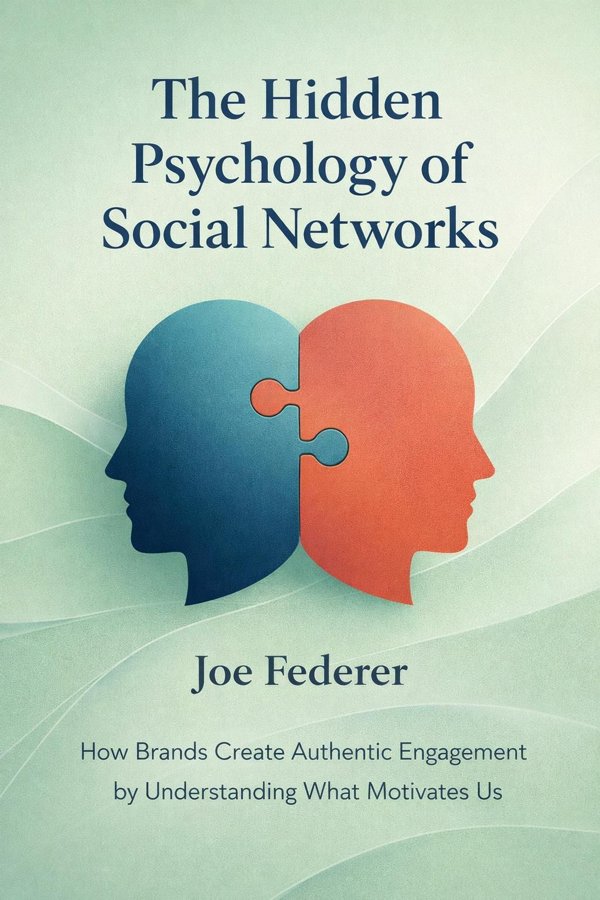
The Hidden Psychology of Social Networks: How Brands Create Authentic Engagement by Understanding What Motivates Us: Summary & Key Insights
by Joe Federer
 10 min3 chaptersAudio available
What Is The Hidden Psychology of Social Networks: How Brands Create Authentic Engagement by Understanding What Motivates Us About?
The Hidden Psychology of Social Networks: How Brands Create Authentic Engagement by Understanding What Motivates Us by Joe Federer is a marketing book spanning 3 pages. This book explores the psychological principles underlying social media behavior and how brands can leverage these insights to build authentic engagement. Drawing from Jungian psychology and cognitive science, Joe Federer explains how different social platforms appeal to distinct aspects of human identity and motivation, offering a framework for more meaningful digital communication.
This FizzRead summary covers all 3 key chapters of The Hidden Psychology of Social Networks: How Brands Create Authentic Engagement by Understanding What Motivates Us in approximately 10 minutes, distilling the most important ideas, arguments, and takeaways from Joe Federer's work. Also available as an audio summary and Key Quotes Podcast.
The Hidden Psychology of Social Networks: How Brands Create Authentic Engagement by Understanding What Motivates Us
This book explores the psychological principles underlying social media behavior and how brands can leverage these insights to build authentic engagement. Drawing from Jungian psychology and cognitive science, Joe Federer explains how different social platforms appeal to distinct aspects of human identity and motivation, offering a framework for more meaningful digital communication.
Who Should Read The Hidden Psychology of Social Networks: How Brands Create Authentic Engagement by Understanding What Motivates Us?
This book is perfect for anyone interested in marketing and looking to gain actionable insights in a short read. Whether you're a student, professional, or lifelong learner, the key ideas from The Hidden Psychology of Social Networks: How Brands Create Authentic Engagement by Understanding What Motivates Us by Joe Federer will help you think differently.
- ✓Readers who enjoy marketing and want practical takeaways
- ✓Professionals looking to apply new ideas to their work and life
- ✓Anyone who wants the core insights of The Hidden Psychology of Social Networks: How Brands Create Authentic Engagement by Understanding What Motivates Us in just 10 minutes
Want the full summary?
Get instant access to this book summary and 100K+ more with Fizz Moment.
Get Free SummaryAvailable on App Store • Free to download
Key Chapters
At the core of this book lies a simple but powerful idea: our online behavior is shaped by the same psychological forces that have always guided human expression, only now they manifest through digital mediums. Carl Jung’s framework of the psyche provides a map for understanding this landscape. Jung taught us that every person contains multiple layers of identity: the ego, the persona, and the shadow. When we move across social networks, we navigate these layers—sometimes consciously, more often not—as we share, post, and respond.
The ego represents how we see ourselves, the anchor of our personal narrative. It’s where self-worth and validation live. The persona is the mask we wear to engage the world—the polished, performative version of ourselves that seeks acceptance within our social groups. The shadow, by contrast, hides what we hesitate to show: our curiosities, contradictions, humor, and impulses that may not fit neatly into social norms.
These psychological dimensions don’t disappear online; they intensify. The anonymity, audience dynamics, and visual features of social platforms amplify certain archetypes while suppressing others. The curated worlds of Instagram invite the persona to shine. The identity-driven networks of Facebook nourish the ego through recognition. Spaces like Reddit, where anonymity fosters authenticity, give the shadow room to roam. Each network, then, becomes an archetypal stage upon which we enact a part of the self.
Understanding these forces allows marketers—and anyone hoping to connect meaningfully online—to look beneath surface behavior. A photo, a meme, a comment: each is an artifact of human motivation. Rather than asking, “How can we get more followers?” we must ask, “Which part of the psyche are we engaging—and why does it matter to the person on the other side of the screen?” Only then can we design messages and experiences that feel psychologically congruent with the user’s motivations.
Different social platforms succeed precisely because each speaks to a particular psychological need. In this book, I analyze major social networks—Facebook, Instagram, Twitter, Reddit—not as technological products, but as emotional environments.
Facebook, in its earliest form, was built upon ego expression. Its foundations in real identity and personal networks created a digital mirror of our social worlds. Posts here are performative but sincere—we curate moments that affirm our sense of belonging and status. The metrics of likes and comments are cues of social validation; they activate the ego’s hunger for recognition. For brands, understanding Facebook’s ego-driven nature means recognizing that people interact from a place of self-definition. The most effective brand communication here does not shout; it empathizes, offering content that reinforces users’ self-concept and strengthens their community identity.
Instagram, by contrast, appeals to the persona. Its aesthetic and visual emphasis enables users to present an idealized version of themselves. Every filtered photo, every story, every visual narrative is a crafted mask of aspiration—who we want to be, or at least how we want to be perceived. Brands that thrive on Instagram do so by aligning with that aspirational energy, not through manipulation but resonance. They help users see themselves as more expressive, creative, or stylish participants in the culture. The key is authenticity of aesthetic—not just polished visuals, but an emotional tone that feels human and true to the community it engages.
Then there’s Reddit, a very different ecosystem. Here, anonymity dismantles ego and persona, allowing the shadow to emerge. In Jungian terms, this is where the collective unconscious finds voice through humor, critique, and curiosity. People join subreddits to explore shared interests without the constraints of identity. This leads to rawer, often more honest conversation—and also to trolling or controversy when that freedom goes unchecked. For brands, participation here requires humility and genuine contribution. Users quickly recognize inauthentic infiltration. The brands that succeed on Reddit—those that listen, respond, and speak the community’s language—embed themselves as equals within a collective psyche.
Finally, Twitter embodies the persona as performance. It’s a stage for commentary and influence. The brevity and virality of tweets reward wit and relevance, not introspection. Brands that succeed here treat the platform as a conversational amplifier, assuming a voice, not just an account. When done well, this voice becomes part of cultural dialogue, a persona that can both shape and be shaped by the collective mind of the moment.
Taken together, these environments illustrate a fundamental truth: social networks are not neutral tools. They are psychological architectures—each optimized for particular expressions of identity. Understanding this architecture allows brands to move from broadcasting to belonging.
+ 1 more chapters — available in the FizzRead app
All Chapters in The Hidden Psychology of Social Networks: How Brands Create Authentic Engagement by Understanding What Motivates Us
About the Author
Joe Federer is a marketing strategist and former head of brand strategy at Reddit. He is known for his expertise in digital communities, social media psychology, and brand engagement. His work combines insights from psychology and technology to help organizations connect authentically with audiences online.
Get This Summary in Your Preferred Format
Read or listen to the The Hidden Psychology of Social Networks: How Brands Create Authentic Engagement by Understanding What Motivates Us summary by Joe Federer anytime, anywhere. FizzRead offers multiple formats so you can learn on your terms — all free.
Available formats: App · Audio · PDF · EPUB — All included free with FizzRead
Download The Hidden Psychology of Social Networks: How Brands Create Authentic Engagement by Understanding What Motivates Us PDF and EPUB Summary
Key Quotes from The Hidden Psychology of Social Networks: How Brands Create Authentic Engagement by Understanding What Motivates Us
“Carl Jung’s framework of the psyche provides a map for understanding this landscape.”
“Different social platforms succeed precisely because each speaks to a particular psychological need.”
Frequently Asked Questions about The Hidden Psychology of Social Networks: How Brands Create Authentic Engagement by Understanding What Motivates Us
The Hidden Psychology of Social Networks: How Brands Create Authentic Engagement by Understanding What Motivates Us by Joe Federer is a marketing book that explores key ideas across 3 chapters. This book explores the psychological principles underlying social media behavior and how brands can leverage these insights to build authentic engagement. Drawing from Jungian psychology and cognitive science, Joe Federer explains how different social platforms appeal to distinct aspects of human identity and motivation, offering a framework for more meaningful digital communication.
You Might Also Like

Captivology: The Science of Capturing People's Attention
Ben Parr
10 min
Marketing 5.0: Technology for Humanity
Philip Kotler, Hermawan Kartajaya, Iwan Setiawan
10 min
Marketing Strategy
Paul Fifield
10 min
UnMarketing: Stop Marketing. Start Engaging.
Scott Stratten
10 min
$100M Leads: How to Get Strangers to Want to Buy Your Stuff
Alex Hormozi
10 min
80/20 Sales and Marketing: The Definitive Guide to Working Less and Making More
Perry Marshall
10 minBrowse by Category
Ready to read The Hidden Psychology of Social Networks: How Brands Create Authentic Engagement by Understanding What Motivates Us?
Get the full summary and 100K+ more books with Fizz Moment.