
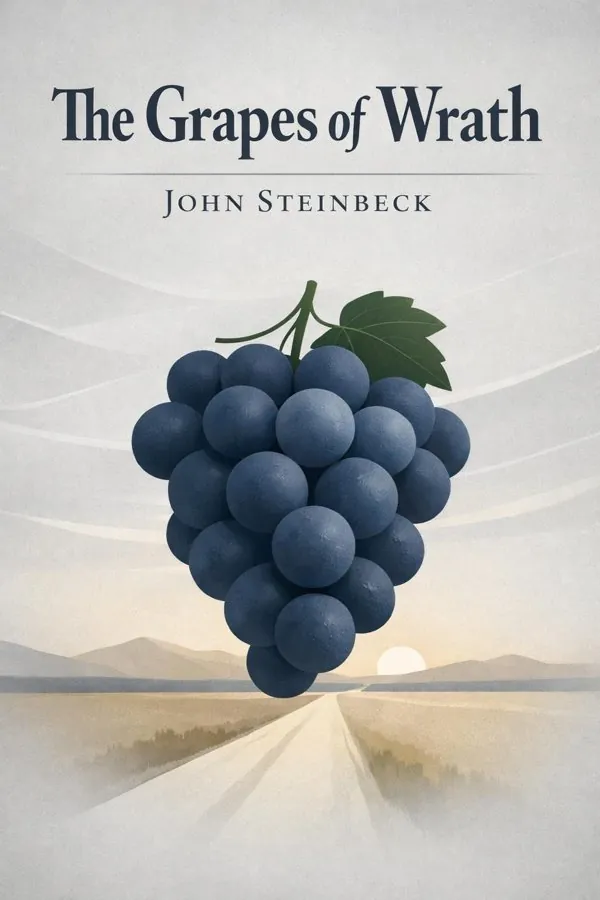
The Grapes of Wrath: Summary & Key Insights
 10 min9 chaptersAudio available
Key Takeaways from The Grapes of Wrath
A family’s road trip can become a nation’s diagnosis when every mile reveals a deeper wound.
Disaster becomes cruelty when nature’s damage is multiplied by human indifference.
Hope can be manipulated most easily when people are desperate enough to believe almost anything.
In times of collapse, the strongest person is often the one who refuses to let others become less human.
A person begins to change when private survival no longer feels like enough.
What Is The Grapes of Wrath About?
The Grapes of Wrath by John Steinbeck is a classics book spanning 3 pages. Published in 1939, The Grapes of Wrath is John Steinbeck’s unforgettable portrait of a family driven from their Oklahoma farm and forced onto the road during the Great Depression. The novel follows the Joads as they leave behind dust-choked fields, shattered livelihoods, and the illusion of stability, hoping California will offer work, food, and a future. Instead, they encounter exploitation, hunger, prejudice, and a system designed to keep desperate people powerless. Yet alongside suffering, Steinbeck reveals tenderness, endurance, and the stubborn human instinct to care for one another. What makes this novel endure is that it is far more than a historical story about migrant labor. It is a moral examination of what happens when economic systems treat people as disposable, and of how dignity survives under pressure. Steinbeck writes with unusual authority because he closely observed migrant camps and agricultural labor conditions in California, transforming reportage into powerful fiction. The result is a classic that feels both intimate and national in scope: one family’s journey becomes a reckoning with injustice, community, and the meaning of shared humanity.
This FizzRead summary covers all 9 key chapters of The Grapes of Wrath in approximately 10 minutes, distilling the most important ideas, arguments, and takeaways from John Steinbeck's work. Also available as an audio summary and Key Quotes Podcast.
The Grapes of Wrath
Published in 1939, The Grapes of Wrath is John Steinbeck’s unforgettable portrait of a family driven from their Oklahoma farm and forced onto the road during the Great Depression. The novel follows the Joads as they leave behind dust-choked fields, shattered livelihoods, and the illusion of stability, hoping California will offer work, food, and a future. Instead, they encounter exploitation, hunger, prejudice, and a system designed to keep desperate people powerless. Yet alongside suffering, Steinbeck reveals tenderness, endurance, and the stubborn human instinct to care for one another.
What makes this novel endure is that it is far more than a historical story about migrant labor. It is a moral examination of what happens when economic systems treat people as disposable, and of how dignity survives under pressure. Steinbeck writes with unusual authority because he closely observed migrant camps and agricultural labor conditions in California, transforming reportage into powerful fiction. The result is a classic that feels both intimate and national in scope: one family’s journey becomes a reckoning with injustice, community, and the meaning of shared humanity.
Who Should Read The Grapes of Wrath?
This book is perfect for anyone interested in classics and looking to gain actionable insights in a short read. Whether you're a student, professional, or lifelong learner, the key ideas from The Grapes of Wrath by John Steinbeck will help you think differently.
- ✓Readers who enjoy classics and want practical takeaways
- ✓Professionals looking to apply new ideas to their work and life
- ✓Anyone who wants the core insights of The Grapes of Wrath in just 10 minutes
Want the full summary?
Get instant access to this book summary and 100K+ more with Fizz Moment.
Get Free SummaryAvailable on App Store • Free to download
Key Chapters
A family’s road trip can become a nation’s diagnosis when every mile reveals a deeper wound. Steinbeck begins with the Joads’ eviction from Oklahoma, but their story is never merely personal. Their displacement grows out of the Dust Bowl, collapsing crop prices, bank foreclosures, and the rise of mechanized farming. The land that once sustained tenant families is transformed into property managed by distant institutions, and the people who worked it are treated as obstacles rather than human beings. This is why the journey west matters: it turns loss into movement, and movement into a grim education about power.
The Joads load their lives onto a battered truck and join thousands of other migrants heading toward California, lured by handbills promising jobs and abundance. On the road, they experience exhaustion, illness, death, and the erosion of family structure. Grandparents die. Dreams shrink. Yet the journey also reveals solidarity among strangers. Families share food, warnings, and scraps of hope at roadside camps. Steinbeck shows that migration is not just geographic; it is emotional, social, and moral. The Joads begin as one family protecting its own, but the road slowly pushes them toward a broader sense of collective identity.
The novel’s power lies in how recognizable this pattern remains. Economic disruption still uproots families today, whether through debt, climate disaster, war, or job loss. People often leave home not because they are reckless, but because staying has become impossible. Steinbeck asks readers to look beyond stereotypes and see the chain of forces behind displacement.
Actionable takeaway: When you encounter people in crisis or transition, ask what systems pushed them there before judging the choices they made afterward.
Disaster becomes cruelty when nature’s damage is multiplied by human indifference. In The Grapes of Wrath, the Dust Bowl is not presented as a random tragedy alone. Steinbeck frames it as a catastrophe intensified by greed, overuse of the land, and an economic order that values profit over stewardship. Drought and wind strip the soil bare, but banks and large landholders finish the work by removing tenant families with mechanical efficiency. Tractors replace human labor, and the machine becomes a symbol of impersonal power: it has no memory, no pity, and no loyalty to the people who once depended on the land.
This matters because Steinbeck is careful not to romanticize rural life. Farming was always hard. Poverty already existed. But the crisis exposes a brutal truth: when ownership is concentrated and decisions are made far away, communities can be destroyed without anyone feeling personally responsible. One man drives the tractor, but the bank ordered it. The bank follows the logic of profit. Responsibility becomes so diffuse that no individual seems guilty, even as entire families are uprooted.
The lesson extends beyond 1930s agriculture. Environmental collapse and economic exploitation often work together. Communities hit by floods, droughts, layoffs, or industrial decline frequently discover that the people with the least power absorb the greatest shock. Steinbeck invites readers to think about who bears the cost when systems fail and who gets protected when resources grow scarce.
In practical terms, this idea encourages closer attention to the hidden structures behind visible suffering. Whether considering housing, food systems, or labor markets, the important question is not only what went wrong, but who had the authority to shape the conditions.
Actionable takeaway: Look past individual misfortune and train yourself to identify the policies, incentives, and institutions that turn hardship into widespread injustice.
Hope can be manipulated most easily when people are desperate enough to believe almost anything. For the Joads, California appears first as a myth: fertile land, fruit hanging everywhere, jobs waiting, wages enough to restore dignity. Flyers advertising work circulate among ruined farming communities, drawing thousands west. But when the migrants arrive, they discover that abundance exists alongside exclusion. Crops flourish, yet families starve. Work exists, yet wages are driven so low by competition that laborers remain trapped in misery. California is not paradise denied by bad luck; it is a system arranged to keep labor cheap through oversupply and fear.
Steinbeck’s genius is to reveal how illusion itself becomes a tool of exploitation. The promise of opportunity keeps people moving, compliant, and willing to endure almost anything. When too many workers compete for too few jobs, growers gain leverage. If one hungry person refuses a humiliating wage, another will accept it. Police intimidation, anti-migrant prejudice, and controlled camps reinforce this imbalance. The result is a social order that depends on keeping workers fragmented and desperate.
This idea remains sharply relevant. Modern economies still market dreams that are selectively available: prosperity through relocation, gig work, education, or entrepreneurship. For some, those promises are real. For many, they conceal unstable wages, debt, or structural barriers. Steinbeck does not argue that hope is foolish; he shows that hope without clear-eyed understanding can be exploited.
A practical application is to examine attractive promises more critically. When an institution advertises abundance, ask who benefits, who competes, and what conditions are omitted from the sales pitch. California in the novel is not false because it has resources; it is false because access to those resources is tightly controlled.
Actionable takeaway: Treat grand promises with compassion and skepticism at once—honor hope, but always investigate the power structures behind it.
In times of collapse, the strongest person is often the one who refuses to let others become less human. Ma Joad emerges as the moral center of The Grapes of Wrath not through speeches or authority, but through steadiness. As the family loses home, elders, privacy, money, and certainty, she preserves something harder to quantify: coherence. She cooks, comforts, decides, negotiates, and insists that the family continue moving forward. Her strength is not glamorous. It is practical, emotional, and relentless.
Steinbeck uses Ma Joad to show that dignity is not the same as status. The Joads become poorer, more exhausted, and more vulnerable, yet Ma repeatedly acts as though each person still deserves care. She shares food when supplies are low. She contains panic so others do not collapse. She adapts to changing roles as traditional hierarchies weaken. Pa Joad’s authority fades under pressure, while Ma’s resilient leadership grows. This is not a simple reversal of power but a demonstration that survival often depends on those who can hold a group together when familiar structures fail.
Readers can recognize this pattern in everyday life. Families under financial stress, illness, displacement, or grief often depend on quiet organizers rather than official leaders. The person who keeps routines alive, notices emotional fractures, and protects mutual respect may be doing the deepest form of labor. Steinbeck honors that labor.
The novel also suggests that dignity is collective. Ma does not save herself by retreating into private toughness. She survives by enlarging her concern to include others, even strangers. Her endurance becomes ethical rather than merely personal.
Actionable takeaway: In moments of strain, focus less on controlling everything and more on preserving dignity—through calm action, shared care, and the refusal to treat anyone as disposable.
A person begins to change when private survival no longer feels like enough. Tom Joad starts the novel focused on himself and his immediate family. Recently released from prison, he is practical, wary, and not especially ideological. He understands violence, authority, and risk in individual terms. But the journey west exposes him to a broader social reality: suffering is not isolated, and injustice is not accidental. Through encounters with exploited workers, police intimidation, and the teachings of Jim Casy, Tom gradually shifts from personal defensiveness to collective awareness.
This transformation is central to the novel’s moral argument. Tom comes to see that the pain endured by the Joads is replicated everywhere around them. Families are hungry not because they failed individually, but because the system benefits from their desperation. Casy’s influence is crucial here. He pushes Tom toward the idea that human beings are deeply connected, and that moral action means standing with others rather than protecting only one’s own circle. By the end, Tom’s famous commitment to be present wherever people struggle signals a new kind of identity. He is no longer just a son, brother, or ex-convict. He becomes a representative of social conscience.
The practical power of Tom’s journey lies in its realism. He does not become a saint. He becomes aware. Many people begin there. Social concern often grows from direct contact with hardship rather than abstract theory. Once we understand that a problem is shared, indifference becomes harder to justify.
For modern readers, Tom’s arc offers a challenge: where are we still treating systemic problems as private misfortunes? Whether the issue is housing, wages, migration, or healthcare, the first ethical step is widening the frame.
Actionable takeaway: Let your concern expand beyond your immediate circle; when you recognize a shared injustice, look for one concrete way to stand in solidarity.
Sometimes faith becomes most powerful after it gives up the comfort of easy answers. Jim Casy, the former preacher who travels with the Joads, is one of Steinbeck’s most important vehicles for moral reflection. Casy has lost confidence in conventional religion, especially in rigid ideas of sin and salvation. Yet his spiritual crisis does not leave him empty. Instead, it leads him toward a deeper conviction: human beings are bound together, and goodness lies in shared life rather than isolated purity. He shifts from preaching individual repentance to recognizing collective suffering.
Casy’s role in the novel is subtle but profound. He observes, questions, and slowly articulates the ethical framework that the book itself advances. If people are part of one larger human whole, then hunger anywhere is not someone else’s problem. Exploitation is not merely unfortunate; it is a violation of our shared existence. Casy’s concern for labor organizing grows from this belief. He sees that charity alone cannot fix conditions deliberately structured to keep workers weak. Compassion must eventually become action.
This idea remains useful far beyond the novel. Many people feel moral concern but stop at personal kindness. Steinbeck, through Casy, suggests that kindness matters, but it is incomplete if it ignores systems. Feeding one hungry person is good. Asking why thousands are hungry is necessary. Solidarity connects empathy to structure.
Casy also reminds readers that moral authority does not require certainty. He doubts, revises, and searches. That makes him credible. Ethical maturity often begins when slogans stop satisfying us and we become willing to confront complexity.
Actionable takeaway: Pair personal compassion with structural awareness—help individuals in need, but also ask what collective action could change the conditions creating that need.
Hunger is easier to control than to cure when those in power profit from desperation. One of Steinbeck’s sharpest insights is that the migrants’ suffering in California is not chaotic misfortune. It is managed. Growers distribute job notices to far more workers than necessary, ensuring a constant oversupply of labor. Wages fall because the hungry underbid one another. Camps are policed, workers are intimidated, and any attempt to organize is treated as a threat. Poverty becomes not just a condition but a strategy.
The novel repeatedly shows how this system destroys social trust. Workers compete against one another rather than uniting. Fear turns neighbors into rivals. People become easier to exploit when they are isolated and exhausted. Steinbeck therefore links economic power to narrative power: if authorities can label migrants as dirty, lazy, or dangerous, then abuse becomes easier to justify. Dehumanization is practical. It lowers public sympathy and weakens resistance.
This theme has enduring relevance in discussions of labor rights, migrant work, temporary contracts, and wage insecurity. Whenever a labor system depends on a surplus of vulnerable workers who can be replaced cheaply, the conditions described in the novel begin to reappear. The details change, but the logic remains familiar.
For readers, the important application is learning to recognize exploitation in ordinary language. When low wages are called efficiency, when unsafe conditions are called flexibility, or when workers are blamed for the instability built into an industry, Steinbeck’s warning becomes visible again. Economic suffering is often presented as unavoidable when it is actually designed.
Actionable takeaway: Pay attention to how work is organized, not just how hard people work—fairness depends on conditions, bargaining power, and whether workers can act together without fear.
A single family can move us, but a chorus can reveal history. One of the most distinctive features of The Grapes of Wrath is Steinbeck’s use of interchapters—lyrical, panoramic sections that step away from the Joads to describe the broader social landscape. These chapters depict dust storms, used-car salesmen, roadside camps, migrant caravans, turtle crossings, and the language of commerce and fear. Their purpose is not decorative. They widen the novel from family drama into national testimony.
Through these interchapters, Steinbeck gives voice to people who might otherwise remain statistics. He captures not only events but atmosphere: the pressure of dust in the lungs, the nervous bargaining over old cars, the humiliation of poverty, the contagious spread of rumor and hope. The style shifts between biblical cadence, journalistic clarity, and near-documentary observation, creating a rhythm that feels communal rather than private. The reader comes to understand that the Joads are both unique and representative.
This technique matters because it changes how we read social suffering. Instead of focusing solely on individual choices, we are repeatedly returned to patterns, structures, and collective emotion. Steinbeck teaches us to zoom in and zoom out. That habit is useful well beyond literature. To understand any crisis fully, we need both personal stories and systemic context. One without the other can mislead.
In practical terms, this means resisting narratives that reduce broad problems to a handful of anecdotes. A moving story can open the heart, but larger patterns explain why that story exists. Steinbeck’s structure models a more responsible way of seeing.
Actionable takeaway: When confronting any social issue, alternate between the individual story and the larger system—compassion deepens when context is included.
The deepest human act may be to give life when the world has become organized around deprivation. The closing movement of The Grapes of Wrath is among the most discussed endings in American literature because it distills Steinbeck’s moral vision into one startling gesture. After relentless loss, flood, hunger, and displacement, the novel does not end with triumph in any ordinary sense. It ends with an act of intimate, bodily compassion offered to someone even more desperate. In that moment, survival is transformed into shared humanity.
What makes the ending so powerful is that it refuses sentimental comfort. The Joads are not rescued by institutions. Justice is not restored. Prosperity does not arrive. Yet Steinbeck insists that even in a broken world, people retain the power to answer suffering with generosity rather than hardness. This is not a naive solution to structural injustice. It is a statement about what must remain possible if people are not to become morally ruined by their conditions.
The image also gathers the novel’s themes into one point: family expanding into community, dignity surviving degradation, the body as a site of both vulnerability and care, and compassion as resistance to dehumanization. Readers may disagree about its symbolism, but its emotional claim is clear. When systems fail, human beings can still choose solidarity.
That lesson has practical force. In modern life, many crises feel too large for individual action. Steinbeck does not suggest that small acts replace systemic change. He suggests they keep us human while larger change remains unfinished.
Actionable takeaway: In conditions you cannot fully fix, do not underestimate the moral significance of direct, generous care—it can preserve humanity when everything else seems designed to strip it away.
All Chapters in The Grapes of Wrath
About the Author
John Steinbeck (1902–1968) was one of the most influential American writers of the twentieth century. Born in Salinas, California, he developed a deep interest in the lives of workers, migrants, farmers, and other ordinary people whose struggles became central to his fiction. His writing is known for its clarity, emotional power, and strong social conscience. Steinbeck achieved major success with works such as Of Mice and Men, East of Eden, and The Grapes of Wrath, the last of which won the Pulitzer Prize and helped define his public reputation. In 1962, he received the Nobel Prize in Literature for his imaginative and compassionate storytelling. Steinbeck’s enduring legacy lies in his ability to portray hardship without losing sight of humor, dignity, and the moral complexity of human life.
Get This Summary in Your Preferred Format
Read or listen to the The Grapes of Wrath summary by John Steinbeck anytime, anywhere. FizzRead offers multiple formats so you can learn on your terms — all free.
Available formats: App · Audio · PDF · EPUB — All included free with FizzRead
Download The Grapes of Wrath PDF and EPUB Summary
Key Quotes from The Grapes of Wrath
“A family’s road trip can become a nation’s diagnosis when every mile reveals a deeper wound.”
“Disaster becomes cruelty when nature’s damage is multiplied by human indifference.”
“Hope can be manipulated most easily when people are desperate enough to believe almost anything.”
“In times of collapse, the strongest person is often the one who refuses to let others become less human.”
“A person begins to change when private survival no longer feels like enough.”
Frequently Asked Questions about The Grapes of Wrath
The Grapes of Wrath by John Steinbeck is a classics book that explores key ideas across 9 chapters. Published in 1939, The Grapes of Wrath is John Steinbeck’s unforgettable portrait of a family driven from their Oklahoma farm and forced onto the road during the Great Depression. The novel follows the Joads as they leave behind dust-choked fields, shattered livelihoods, and the illusion of stability, hoping California will offer work, food, and a future. Instead, they encounter exploitation, hunger, prejudice, and a system designed to keep desperate people powerless. Yet alongside suffering, Steinbeck reveals tenderness, endurance, and the stubborn human instinct to care for one another. What makes this novel endure is that it is far more than a historical story about migrant labor. It is a moral examination of what happens when economic systems treat people as disposable, and of how dignity survives under pressure. Steinbeck writes with unusual authority because he closely observed migrant camps and agricultural labor conditions in California, transforming reportage into powerful fiction. The result is a classic that feels both intimate and national in scope: one family’s journey becomes a reckoning with injustice, community, and the meaning of shared humanity.
More by John Steinbeck

You Might Also Like






Browse by Category
Ready to read The Grapes of Wrath?
Get the full summary and 100K+ more books with Fizz Moment.