
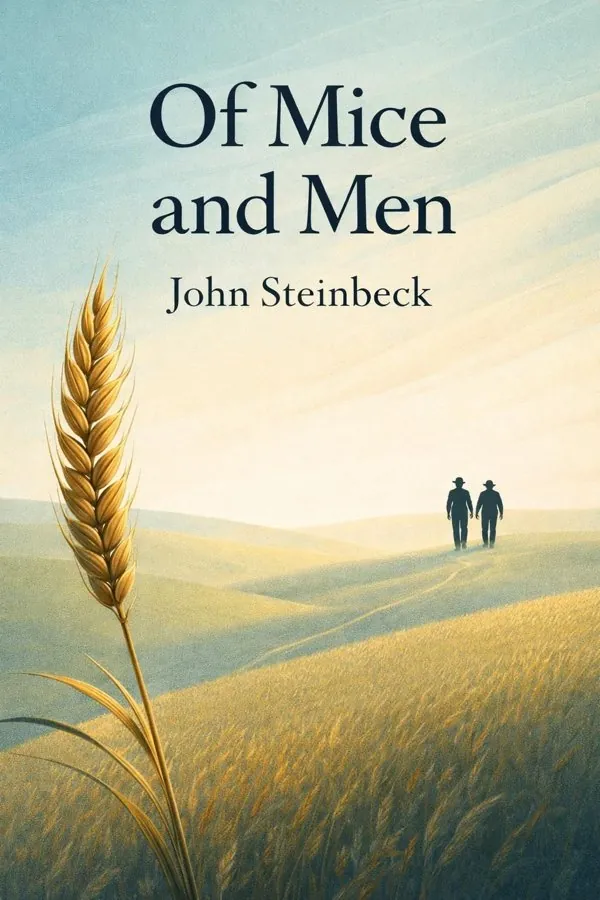
Of Mice and Men: Summary & Key Insights
 10 min4 chaptersAudio available
What Is Of Mice and Men About?
Of Mice and Men by John Steinbeck is a classics book spanning 4 pages. Set during the Great Depression, this novella tells the story of George Milton and Lennie Small, two displaced ranch workers who dream of owning their own land. Their friendship and pursuit of a better life are tested by loneliness, hardship, and tragedy in a world marked by economic struggle and human fragility.
This FizzRead summary covers all 4 key chapters of Of Mice and Men in approximately 10 minutes, distilling the most important ideas, arguments, and takeaways from John Steinbeck's work. Also available as an audio summary and Key Quotes Podcast.
Of Mice and Men
Set during the Great Depression, this novella tells the story of George Milton and Lennie Small, two displaced ranch workers who dream of owning their own land. Their friendship and pursuit of a better life are tested by loneliness, hardship, and tragedy in a world marked by economic struggle and human fragility.
Who Should Read Of Mice and Men?
This book is perfect for anyone interested in classics and looking to gain actionable insights in a short read. Whether you're a student, professional, or lifelong learner, the key ideas from Of Mice and Men by John Steinbeck will help you think differently.
- ✓Readers who enjoy classics and want practical takeaways
- ✓Professionals looking to apply new ideas to their work and life
- ✓Anyone who wants the core insights of Of Mice and Men in just 10 minutes
Want the full summary?
Get instant access to this book summary and 100K+ more with Fizz Moment.
Get Free SummaryAvailable on App Store • Free to download
Key Chapters
When I set George and Lennie on the road to Soledad, walking along the Salinas River, I wanted the reader to feel both the permanence and futility of their journey. The path they take is well-worn—a trail beaten by thousands of other displaced workers during the Depression—but it also feels intensely personal. Their talk of the ranch they will someday own, the rabbits Lennie will tend, becomes their way of surviving an otherwise empty present.
That evening by the riverbank is not idle exposition; it sets the emotional rhythm for everything that follows. George becomes the voice of reason and protection. He loves Lennie, though he hides that love beneath irritation and exhaustion. Lennie, in turn, embodies pure desire without understanding—he loves to touch soft things, to hold onto them, to make them his. His strength, both physical and emotional, is something George must continually manage. When George warns Lennie to remember the hiding place by the river ‘if something bad happens,’ I planted a seed of inevitability. In the moral world of *Of Mice and Men*, tenderness and tragedy are intertwined from the very beginning.
I wanted readers to see that this dream George and Lennie share is not merely economic—a piece of land, a bit of autonomy—but spiritual. It is a promise of belonging in a world designed to exclude them. In that promise lies both their hope and their doom.
The ranch near Soledad is more than a setting; it is a crucible in which the loneliness of every character is laid bare. When George and Lennie arrive, they are immediately the subject of suspicion because men in those days rarely traveled together. That bond makes them different, and difference is dangerous in such a bleak world.
Curley, the boss’s son, enters as a man consumed by smallness—small in stature, small in spirit. His aggression is a defense mechanism against his own inadequacy, and Lennie’s size becomes an irresistible target for his insecurity. Around Curley swirl others: the aging Candy, who clings to his decrepit dog as to the last thread of companionship; Slim, the quiet mule skinner, whose calm authority makes him a moral compass for the others; Crooks, the black stable hand banished to solitude by racial barriers. Each one inhabits a private cell of alienation.
Through the daily grind of the bunkhouse, I tried to capture the hollowness of itinerant life—men earning a few dollars and whiskey nights, saving nothing, connecting with no one. Yet when George confides in Slim about Lennie, we glimpse something rare: mutual understanding. Slim recognizes that George and Lennie’s companionship is both extraordinary and deeply human. It becomes a quiet testament to a truth I wanted to underline: that even in the hardest times, empathy survives, fragile but radiant.
Candy’s decision to join George and Lennie’s dream amplifies that theme. When he offers his life savings, suddenly the impossible farm seems almost within reach. Hope becomes communal. But in this world, hope is a dangerous thing; it sharpens the pain when the inevitable collapse comes. I structured the story so that the closer the dream comes to being real, the more certain its destruction becomes.
+ 2 more chapters — available in the FizzRead app
All Chapters in Of Mice and Men
About the Author
John Steinbeck (1902–1968) was an American author and Nobel laureate known for his realistic and compassionate portrayals of working-class life in the United States. His major works include *The Grapes of Wrath*, *East of Eden*, and *Of Mice and Men*, which explore themes of social justice, human dignity, and the American Dream.
Get This Summary in Your Preferred Format
Read or listen to the Of Mice and Men summary by John Steinbeck anytime, anywhere. FizzRead offers multiple formats so you can learn on your terms — all free.
Available formats: App · Audio · PDF · EPUB — All included free with FizzRead
Download Of Mice and Men PDF and EPUB Summary
Key Quotes from Of Mice and Men
“When I set George and Lennie on the road to Soledad, walking along the Salinas River, I wanted the reader to feel both the permanence and futility of their journey.”
“The ranch near Soledad is more than a setting; it is a crucible in which the loneliness of every character is laid bare.”
Frequently Asked Questions about Of Mice and Men
Of Mice and Men by John Steinbeck is a classics book that explores key ideas across 4 chapters. Set during the Great Depression, this novella tells the story of George Milton and Lennie Small, two displaced ranch workers who dream of owning their own land. Their friendship and pursuit of a better life are tested by loneliness, hardship, and tragedy in a world marked by economic struggle and human fragility.
More by John Steinbeck


You Might Also Like





Browse by Category
Ready to read Of Mice and Men?
Get the full summary and 100K+ more books with Fizz Moment.