
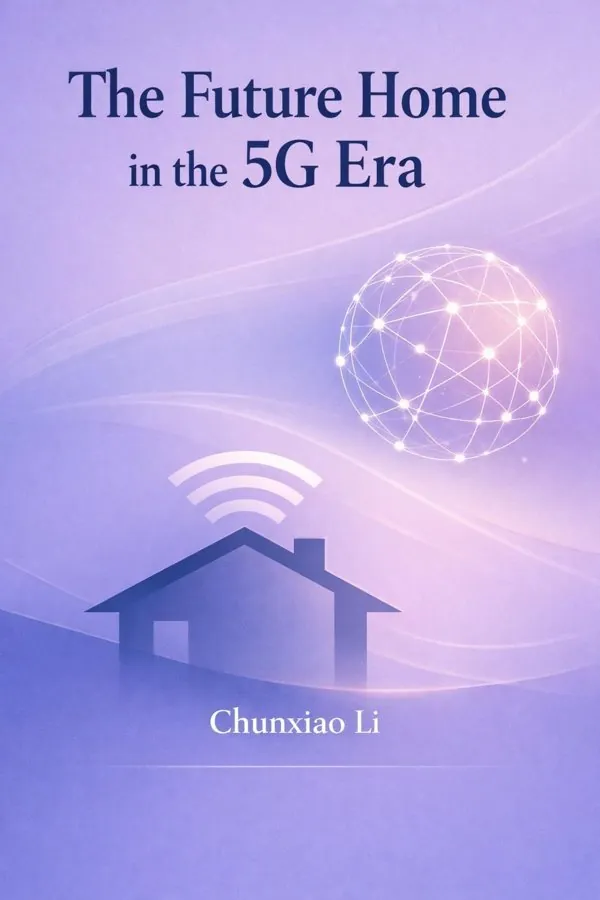
The Future Home in the 5G Era: Next Generation Strategies for Hyper-Connected Living: Summary & Key Insights
by Chunxiao Li
 10 min7 chaptersAudio available
What Is The Future Home in the 5G Era: Next Generation Strategies for Hyper-Connected Living About?
The Future Home in the 5G Era: Next Generation Strategies for Hyper-Connected Living by Chunxiao Li is a emerging_tech book spanning 7 pages. This book explores how 5G technology will transform the concept of home into a hyper-connected ecosystem. It discusses the integration of smart devices, AI, and IoT to create intelligent living environments that enhance convenience, security, and sustainability. The author provides insights into the technological, social, and economic implications of 5G-enabled homes, offering a forward-looking perspective on digital lifestyles.
This FizzRead summary covers all 7 key chapters of The Future Home in the 5G Era: Next Generation Strategies for Hyper-Connected Living in approximately 10 minutes, distilling the most important ideas, arguments, and takeaways from Chunxiao Li's work. Also available as an audio summary and Key Quotes Podcast.
The Future Home in the 5G Era: Next Generation Strategies for Hyper-Connected Living
This book explores how 5G technology will transform the concept of home into a hyper-connected ecosystem. It discusses the integration of smart devices, AI, and IoT to create intelligent living environments that enhance convenience, security, and sustainability. The author provides insights into the technological, social, and economic implications of 5G-enabled homes, offering a forward-looking perspective on digital lifestyles.
Who Should Read The Future Home in the 5G Era: Next Generation Strategies for Hyper-Connected Living?
This book is perfect for anyone interested in emerging_tech and looking to gain actionable insights in a short read. Whether you're a student, professional, or lifelong learner, the key ideas from The Future Home in the 5G Era: Next Generation Strategies for Hyper-Connected Living by Chunxiao Li will help you think differently.
- ✓Readers who enjoy emerging_tech and want practical takeaways
- ✓Professionals looking to apply new ideas to their work and life
- ✓Anyone who wants the core insights of The Future Home in the 5G Era: Next Generation Strategies for Hyper-Connected Living in just 10 minutes
Want the full summary?
Get instant access to this book summary and 100K+ more with Fizz Moment.
Get Free SummaryAvailable on App Store • Free to download
Key Chapters
Before 5G, our homes were dotted with intelligence but lacked integration. Smart lights, thermostats, and voice assistants operated independently, each speaking its own digital dialect. In this section, I trace the evolution from those fragmented smart homes to the holistic ecosystems enabled by 5G. The difference is profound. 5G doesn’t just add speed—it adds harmony.
Traditional smart homes relied on Wi-Fi and cloud processing, often resulting in delays and inefficiencies. In contrast, a 5G-enabled home supports instantaneous communication between devices, facilitated by edge computing that processes data locally. A simple command—say, adjusting temperature—becomes an orchestrated decision influenced by sensor input, weather forecasts, and energy demand patterns. Your home becomes intelligent not by reacting, but by anticipating.
To illustrate, I reference early implementations in South Korea and China, where households equipped with 5G IoT hubs demonstrated synchronized operation among appliances. Washing machines optimized cycles based on energy pricing, refrigerators monitored food freshness and suggested meal plans, and security systems dynamically adjusted access levels based on behavior. These are not isolated examples—they represent the new normal of coherence that 5G introduces.
Yet, this transformation isn’t purely technical. It reshapes our emotional and social engagement with living space. When connectivity becomes omnipresent, we begin to see the home less as a container of possessions and more as a responsive companion. It’s always learning, refining, and co-evolving with its residents.
Behind every seamless interaction lies a sophisticated network architecture. I devote this chapter to explaining, in accessible terms, how 5G achieves its revolutionary capabilities. Its main characteristics—millimeter-wave frequencies, massive MIMO (multiple-input multiple-output), network slicing, and ultra-reliable low-latency communication—combine to create a foundation sturdy enough for universal interconnection.
Network slicing stands out as particularly transformative. It allows customized virtual networks within a single physical infrastructure—enabling a home’s medical devices to operate on an ultra-secure and low-latency slice, while entertainment systems run on a high-bandwidth slice optimized for audiovisual quality. This level of differentiation was impossible in previous generations. Homes, now, can prioritize activities dynamically, balancing needs for security, comfort, and efficiency.
Such precision opens multidisciplinary implications. In remote healthcare, latency below ten milliseconds can support real-time holographic consultations. In augmented reality entertainment, it eliminates lag, merging physical and virtual experiences. Understanding these mechanics is not merely for engineers—it empowers residents to appreciate why responsiveness matters in daily living and policy design.
+ 5 more chapters — available in the FizzRead app
All Chapters in The Future Home in the 5G Era: Next Generation Strategies for Hyper-Connected Living
About the Author
Chunxiao Li is a researcher and technologist specializing in telecommunications and smart home innovation. His work focuses on the intersection of 5G networks, IoT, and digital transformation in everyday life.
Get This Summary in Your Preferred Format
Read or listen to the The Future Home in the 5G Era: Next Generation Strategies for Hyper-Connected Living summary by Chunxiao Li anytime, anywhere. FizzRead offers multiple formats so you can learn on your terms — all free.
Available formats: App · Audio · PDF · EPUB — All included free with FizzRead
Download The Future Home in the 5G Era: Next Generation Strategies for Hyper-Connected Living PDF and EPUB Summary
Key Quotes from The Future Home in the 5G Era: Next Generation Strategies for Hyper-Connected Living
“Before 5G, our homes were dotted with intelligence but lacked integration.”
“Behind every seamless interaction lies a sophisticated network architecture.”
Frequently Asked Questions about The Future Home in the 5G Era: Next Generation Strategies for Hyper-Connected Living
The Future Home in the 5G Era: Next Generation Strategies for Hyper-Connected Living by Chunxiao Li is a emerging_tech book that explores key ideas across 7 chapters. This book explores how 5G technology will transform the concept of home into a hyper-connected ecosystem. It discusses the integration of smart devices, AI, and IoT to create intelligent living environments that enhance convenience, security, and sustainability. The author provides insights into the technological, social, and economic implications of 5G-enabled homes, offering a forward-looking perspective on digital lifestyles.
You Might Also Like
Blockchain Technology Guide (Chinese Edition)
Li Qilei
10 min
21st Century Technologies Revisited: What is Happening and What is Next
Organisation for Economic Co-operation and Development (OECD)
10 min
Autonomous Vehicles: Opportunities, Strategies, and Challenges
Various Authors
10 min
Autonomy
Lawrence Burns
10 min
Blockchain Basics: A Non-Technical Introduction in 25 Steps
Daniel Drescher
10 min
Blockchain Revolution: How the Technology Behind Bitcoin and Other Cryptocurrencies Is Changing the World
Don Tapscott & Alex Tapscott
10 minBrowse by Category
Ready to read The Future Home in the 5G Era: Next Generation Strategies for Hyper-Connected Living?
Get the full summary and 100K+ more books with Fizz Moment.