
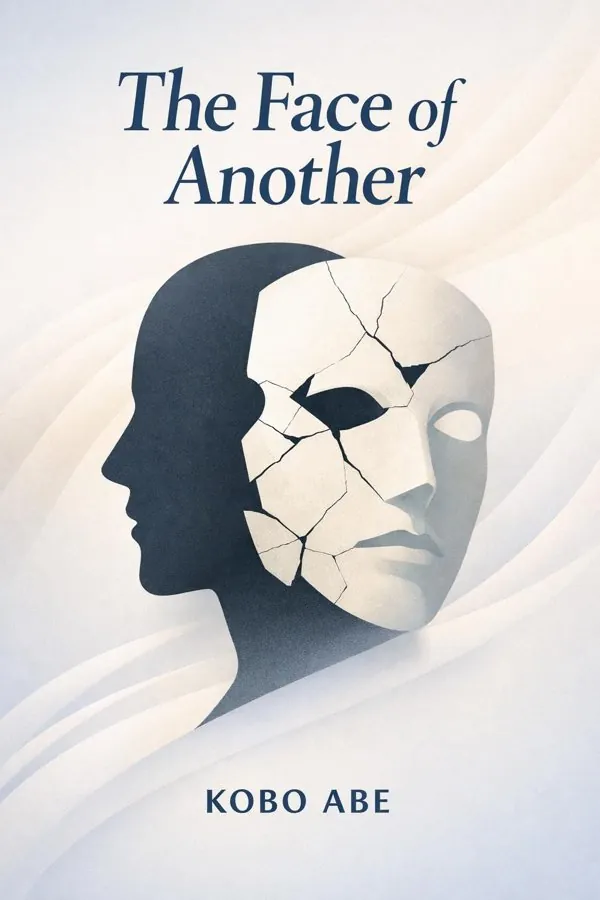
The Face of Another: Summary & Key Insights
by Kobo Abe
 10 min8 chaptersAudio available
Key Takeaways from The Face of Another
A scientific problem can hide a spiritual crisis.
We often assume the self lives inside us, but Abe insists that identity is also negotiated on the surface.
The deepest loneliness is not isolation from strangers, but estrangement from someone who once knew you intimately.
A mask does not merely hide the face; it releases impulses the old face kept in check.
To have a face is to carry a passport into everyday life.
What Is The Face of Another About?
The Face of Another by Kobo Abe is a classics book spanning 4 pages. What remains of a person when the face that once carried identity, desire, shame, and recognition is destroyed? In The Face of Another, Kobo Abe turns this unsettling question into a brilliant psychological and philosophical novel. The story follows a scientist whose face is ruined in an accident, leaving him physically alive but socially erased. In response, he designs an artificial mask so convincing that it allows him to move through the world as someone else. What begins as a scientific solution quickly becomes an existential experiment: if others respond to a new face, does the self change with it? Abe uses this premise to explore alienation, marriage, sexuality, social judgment, and the fragile boundary between inner life and outward appearance. The novel is suspenseful, but its deepest power lies in how it exposes the face as both a personal possession and a public contract. Few writers have examined identity with such eerie precision. Often compared with Kafka and Camus, Abe brings to this novel a rare mix of surreal imagination, psychological insight, and philosophical rigor, making The Face of Another one of the most unforgettable modern classics on selfhood and estrangement.
This FizzRead summary covers all 8 key chapters of The Face of Another in approximately 10 minutes, distilling the most important ideas, arguments, and takeaways from Kobo Abe's work. Also available as an audio summary and Key Quotes Podcast.
The Face of Another
What remains of a person when the face that once carried identity, desire, shame, and recognition is destroyed? In The Face of Another, Kobo Abe turns this unsettling question into a brilliant psychological and philosophical novel. The story follows a scientist whose face is ruined in an accident, leaving him physically alive but socially erased. In response, he designs an artificial mask so convincing that it allows him to move through the world as someone else. What begins as a scientific solution quickly becomes an existential experiment: if others respond to a new face, does the self change with it?
Abe uses this premise to explore alienation, marriage, sexuality, social judgment, and the fragile boundary between inner life and outward appearance. The novel is suspenseful, but its deepest power lies in how it exposes the face as both a personal possession and a public contract. Few writers have examined identity with such eerie precision. Often compared with Kafka and Camus, Abe brings to this novel a rare mix of surreal imagination, psychological insight, and philosophical rigor, making The Face of Another one of the most unforgettable modern classics on selfhood and estrangement.
Who Should Read The Face of Another?
This book is perfect for anyone interested in classics and looking to gain actionable insights in a short read. Whether you're a student, professional, or lifelong learner, the key ideas from The Face of Another by Kobo Abe will help you think differently.
- ✓Readers who enjoy classics and want practical takeaways
- ✓Professionals looking to apply new ideas to their work and life
- ✓Anyone who wants the core insights of The Face of Another in just 10 minutes
Want the full summary?
Get instant access to this book summary and 100K+ more with Fizz Moment.
Get Free SummaryAvailable on App Store • Free to download
Key Chapters
A scientific problem can hide a spiritual crisis. At the beginning of The Face of Another, the narrator approaches his disfigurement as a technical challenge: if his burned face has cut him off from normal life, then perhaps science can restore what injury has taken away. He records observations, materials, procedures, and hypotheses with the detached confidence of a researcher. Yet the more carefully he describes his artificial face, the more obvious it becomes that the project is not merely medical. It is an attempt to recover social existence itself.
Abe makes this scientific process deeply ironic. The narrator believes method will save him, but each step toward creating the mask also pushes him into moral and psychological uncertainty. The face he constructs is not simply a prosthetic. It becomes an instrument of reinvention, deception, and experimentation on other people. By treating identity as something that can be fabricated, he transforms a personal injury into a test of human relations. His clinical tone cannot conceal the desperation underneath: he does not only want to be seen again; he wants power over the conditions of being seen.
This idea feels modern because technology still promises identity repair. Cosmetic surgery, filters, avatars, and digital self-curation all emerge from a similar impulse: if appearance shapes how others respond, then changing the surface may change life itself. But Abe warns that technical mastery does not resolve emotional truth. A new face may alter social access, yet it cannot automatically restore trust, intimacy, or integrity.
A useful takeaway is to notice when a practical fix is carrying emotional expectations it cannot fulfill. Before pursuing a transformation, ask: am I solving a real problem, or trying to escape a deeper wound?
We often assume the self lives inside us, but Abe insists that identity is also negotiated on the surface. One of the novel’s central insights is that the face is not a passive feature. It is a social language. Before we speak, others read us through expression, symmetry, scars, age, beauty, and familiarity. The narrator’s disfigurement exposes how much of personhood depends on being visually legible to others.
As he reflects on his condition, the narrator begins to question whether the self can ever be separated from the image that carries it into the world. If people recoil from his face, are they rejecting only appearance, or the person attached to it? If they welcome him when masked, is that welcome directed toward him, or toward an invented version? Abe does not offer an easy answer. Instead, he shows that selfhood is unstable because it is constantly mediated by perception. We are never only what we believe ourselves to be; we are also what others can bear to see, interpret, and accept.
This is one reason the novel remains powerful in an age shaped by photography, social media, and performance. Profiles, portraits, and branded identities encourage us to think of ourselves as visible products. We know that appearance is incomplete, yet we also know it matters. Abe’s brilliance lies in refusing either naivete or cynicism. Appearance is neither everything nor nothing. It is a threshold through which relationships begin.
The practical application is simple but demanding: examine how much of your self-concept depends on being recognized in a certain way. When you feel unseen or misread, ask what part of your distress comes from inner conviction and what part comes from the social mirror.
The deepest loneliness is not isolation from strangers, but estrangement from someone who once knew you intimately. In The Face of Another, the narrator’s disfigurement affects every aspect of his life, but nowhere is the damage more painful than in his marriage. His wife remains physically present, yet emotional closeness becomes difficult, strained, and haunted by avoidance. The novel captures how trauma can create a silent third presence in a relationship: the altered body neither partner knows how to address.
Abe portrays marriage here not as a refuge from alienation but as one of its sharpest tests. The narrator wants his wife’s acceptance, but he also resents needing it. He watches her reactions obsessively, searching for proof of pity, disgust, loyalty, or desire. In turn, her behavior becomes hard to interpret. Is she compassionate, frightened, dutiful, or detached? Because the face is so central to everyday communication, its loss disrupts the subtle exchanges that sustain intimacy. What once passed effortlessly between spouses now turns awkward, theatrical, and uncertain.
The narrator’s decision to use the mask intensifies this fracture. Rather than rebuilding honesty, he turns the marriage into an experiment, testing whether desire can be redirected through a new identity. This is one of Abe’s most devastating insights: alienation can tempt us to replace vulnerability with manipulation. Instead of saying, "I am hurt and afraid," we may choose disguise, control, and secret trials of loyalty.
In ordinary life, the lesson extends beyond physical injury. Major changes in health, employment, status, or self-image can alter the emotional grammar of a relationship. When couples stop naming what has changed, distance grows in the silence.
An actionable takeaway is to treat altered circumstances as something to discuss directly rather than perform around. Intimacy survives change more readily than it survives unspoken interpretation.
A mask does not merely hide the face; it releases impulses the old face kept in check. As the narrator begins living behind his artificial face, he expects freedom, but what emerges is less liberation than unraveling. The mask grants anonymity, mobility, and social access, yet it also weakens the restraints imposed by shame and recognition. He becomes bolder, more manipulative, and more willing to treat others as objects in his private experiment. The disguise does not create an entirely new person, but it amplifies possibilities that were already latent.
Abe’s point is psychologically sharp. Identity is partly ethical because our ordinary selves are shaped by consequence. We behave differently when our history is attached to our actions. Once the narrator can act without immediate accountability, he experiences a dangerous exhilaration. The artificial face becomes permission. He can test his wife, provoke strangers, and pursue desires under conditions of concealment. In that sense, the mask is not only a covering but a technology of moral distance.
This idea resonates far beyond the novel. Online anonymity, role-playing, alternate accounts, and professional personas can all produce similar effects. People often reveal more when hidden, but revelation is not always noble. Concealment may expose truth, or it may enable cruelty, fantasy, and fragmentation. Abe is interested in that ambiguity. The collapse associated with the mask is not a simple failure of disguise. It is the revelation that identity contains unstable layers, and once one layer is removed, others rush forward.
The practical takeaway is to pay attention to how anonymity changes your behavior. If a hidden or alternate version of yourself becomes harsher, more reckless, or more seductive, ask what accountability your ordinary identity was quietly preserving.
Desire becomes dangerous when it is detached from mutual recognition. In The Face of Another, the narrator’s new face gives him not only social access but erotic opportunity. Yet rather than restoring healthy intimacy, the mask distorts desire into surveillance, testing, fantasy, and domination. He becomes fascinated by what the new identity allows him to provoke in others, especially in relation to his wife. Sexuality in the novel is never merely private appetite; it is tied to power, vulnerability, and the instability of who is perceiving whom.
Abe shows how desire can be warped by resentment. The narrator does not simply want to be loved. He wants proof. He wants to know whether his wife would respond to him if stripped of shared history and confronted by pure appearance. This turns seduction into an experiment and intimacy into theater. The wish for certainty corrodes the very conditions of trust. Instead of asking for honest contact, he designs a scenario that traps the other person inside his own obsession.
The novel’s treatment of voyeurism is similarly acute. To observe from behind a mask is to enjoy asymmetry: one person knows more, risks less, and controls interpretation. That imbalance can feel intoxicating. It also erodes empathy, because the other person becomes material for one’s psychological drama. In this way, Abe links hidden identity to hidden aggression.
Modern life offers many equivalents: anonymous messaging, curated dating profiles, emotional testing in relationships, and the temptation to stage situations rather than communicate directly. The book warns that when desire seeks control more than connection, it becomes corrosive.
The practical takeaway is to watch for moments when you want to test someone rather than talk to them. If your longing for certainty leads you toward manipulation, choose disclosure over experiment.
Once a person can act under two identities, conscience itself begins to divide. The narrator’s artificial face creates a double life in which the old self and the masked self interact like rivals. One identity bears injury, humiliation, and social exclusion. The other enjoys mobility, secrecy, and dangerous freedom. At first, the narrator seems to believe he can manage both. But Abe suggests that identity does not split cleanly. Each self begins to contaminate the other.
This is one of the novel’s most profound psychological insights. People often imagine compartmentalization as a form of control: work self versus private self, online self versus real self, fantasy self versus responsible self. Yet the more sharply these selves are separated, the more unstable the whole person becomes. The narrator’s masked life allows him to externalize impulses he would rather not own. He can attribute aggression, lust, or recklessness to the new face, as though the mask were acting for him. But the novel steadily dismantles that illusion. A disguise may alter behavior, but it does not remove authorship.
Abe’s vision is morally serious without becoming moralistic. He understands why people divide themselves. Shame, injury, exclusion, and unmet desire all encourage inner splitting. But he also shows the cost. A self that cannot integrate its contradictory elements becomes vulnerable to self-deception. The person begins to live as both actor and audience, forever narrating excuses.
In contemporary life, this appears whenever people justify harmful conduct by saying it was only a role, a persona, or an online version of themselves. The lesson is that masks reveal responsibility as much as they conceal it.
An actionable takeaway is to examine any area where you behave as though a certain context makes you "not really you." That phrase often marks the beginning of moral evasion.
Abe’s novel is strange not because it departs from reality, but because it makes ordinary reality impossible to ignore. The Face of Another belongs to a broader tradition of modern existential fiction in which everyday life becomes uncanny under pressure. The narrator’s disfigurement and mask are extreme events, yet they illuminate a common modern anxiety: the fear that identity is contingent, socially manufactured, and vulnerable to collapse.
The novel’s atmosphere of absurdity comes from the mismatch between rational systems and human experience. Science, medicine, marriage, civility, and social order all remain in place, yet none can fully address the narrator’s suffering. He can design a face, but not a stable self. He can enter society, but not belong to it. This gap between technical capability and existential meaning is central to Abe’s vision of modern alienation. The world is full of procedures, but poor in answers.
That is why the book feels so contemporary. Many people today inhabit institutions that function efficiently while leaving inward life unresolved. We are surrounded by tools for productivity, self-fashioning, and presentation, yet loneliness, fragmentation, and estrangement persist. Abe transforms this contradiction into narrative form. The result is not abstract philosophy but lived unease.
Reading the novel this way helps explain its enduring importance. It is not only about one man’s injury. It is about the instability of being human in a system that constantly categorizes, observes, and misrecognizes us. The absurd emerges when the frameworks meant to organize life fail to answer the question of who we are.
The practical takeaway is to treat efficiency and meaning as different needs. Solving the logistical problem in your life may still leave the existential one untouched.
All Chapters in The Face of Another
About the Author
Kobo Abe (1924–1993) was one of the most distinctive voices in modern Japanese literature. A novelist, playwright, screenwriter, and photographer, he became internationally known for works that blend surrealism, existential inquiry, and sharp psychological insight. Abe often wrote about alienation, unstable identity, urban modernity, and the absurd systems that shape human life. His best-known books include The Woman in the Dunes, The Face of Another, and The Box Man, all of which explore what happens when ordinary people are pushed into strange, disorienting conditions. Frequently compared to Franz Kafka and Albert Camus, Abe developed a style that was unmistakably his own: cool, unsettling, intellectually rigorous, and emotionally haunting. His work remains central to modern world literature and continues to resonate with readers interested in selfhood, estrangement, and the hidden mechanics of society.
Get This Summary in Your Preferred Format
Read or listen to the The Face of Another summary by Kobo Abe anytime, anywhere. FizzRead offers multiple formats so you can learn on your terms — all free.
Available formats: App · Audio · PDF · EPUB — All included free with FizzRead
Download The Face of Another PDF and EPUB Summary
Key Quotes from The Face of Another
“A scientific problem can hide a spiritual crisis.”
“We often assume the self lives inside us, but Abe insists that identity is also negotiated on the surface.”
“The deepest loneliness is not isolation from strangers, but estrangement from someone who once knew you intimately.”
“A mask does not merely hide the face; it releases impulses the old face kept in check.”
“To have a face is to carry a passport into everyday life.”
Frequently Asked Questions about The Face of Another
The Face of Another by Kobo Abe is a classics book that explores key ideas across 8 chapters. What remains of a person when the face that once carried identity, desire, shame, and recognition is destroyed? In The Face of Another, Kobo Abe turns this unsettling question into a brilliant psychological and philosophical novel. The story follows a scientist whose face is ruined in an accident, leaving him physically alive but socially erased. In response, he designs an artificial mask so convincing that it allows him to move through the world as someone else. What begins as a scientific solution quickly becomes an existential experiment: if others respond to a new face, does the self change with it? Abe uses this premise to explore alienation, marriage, sexuality, social judgment, and the fragile boundary between inner life and outward appearance. The novel is suspenseful, but its deepest power lies in how it exposes the face as both a personal possession and a public contract. Few writers have examined identity with such eerie precision. Often compared with Kafka and Camus, Abe brings to this novel a rare mix of surreal imagination, psychological insight, and philosophical rigor, making The Face of Another one of the most unforgettable modern classics on selfhood and estrangement.
More by Kobo Abe

You Might Also Like






Browse by Category
Ready to read The Face of Another?
Get the full summary and 100K+ more books with Fizz Moment.