
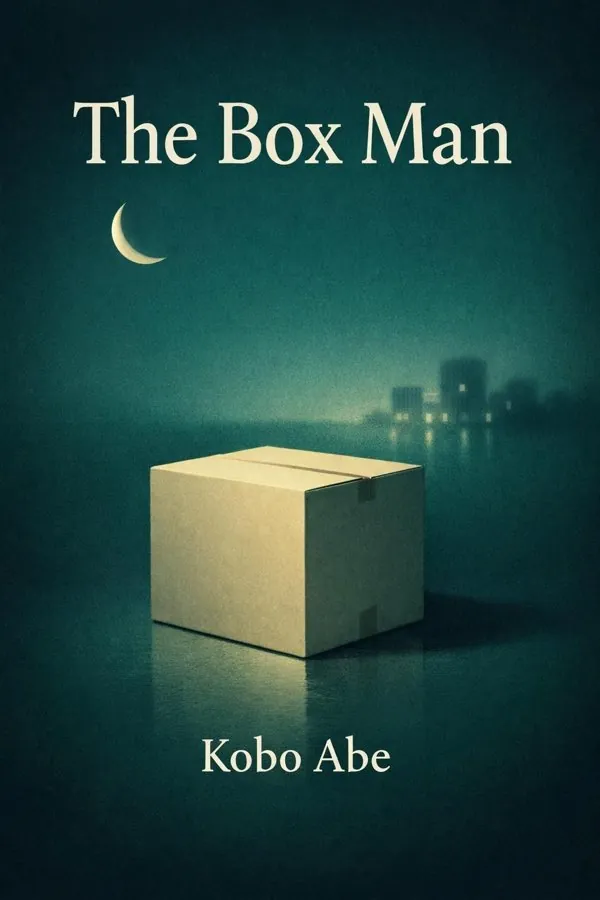
The Box Man: A Novel: Summary & Key Insights
by Kobo Abe
 10 min9 chaptersAudio available
Key Takeaways from The Box Man: A Novel
Abe’s first radical suggestion is that identity may be something we build as deliberately as a shelter.
To become unseen is, paradoxically, to see differently.
One of Abe’s most disorienting strategies is to make reality itself feel contested.
The self in The Box Man does not break all at once; it frays through competing voices, roles, and reflections.
Watching can feel safer than living.
What Is The Box Man: A Novel About?
The Box Man: A Novel by Kobo Abe is a classics book spanning 5 pages. What would it mean to disappear without actually leaving the world? In The Box Man, Kobo Abe imagines a man who rejects ordinary social life and begins living inside a cardboard box, wandering the city as both spectacle and nonperson. From that bizarre premise, Abe builds a haunting, intellectually charged novel about identity, surveillance, desire, and the unstable boundary between reality and performance. The story unfolds through notes, confessions, reports, and shifting points of view, making the reader question who is speaking, who is pretending, and whether the “box man” is a single individual or a role anyone might enter. The novel matters because it turns alienation into something visible. Abe shows how modern people often long to escape labels, obligations, and the gaze of others, even as that escape risks self-erasure. Few writers examine anonymity with such originality and psychological precision. Abe, one of Japan’s most celebrated avant-garde novelists, was renowned for blending existential philosophy with surreal storytelling in works like The Woman in the Dunes and The Face of Another. The Box Man stands as one of his boldest explorations of what remains of the self when recognition disappears.
This FizzRead summary covers all 9 key chapters of The Box Man: A Novel in approximately 10 minutes, distilling the most important ideas, arguments, and takeaways from Kobo Abe's work. Also available as an audio summary and Key Quotes Podcast.
The Box Man: A Novel
What would it mean to disappear without actually leaving the world? In The Box Man, Kobo Abe imagines a man who rejects ordinary social life and begins living inside a cardboard box, wandering the city as both spectacle and nonperson. From that bizarre premise, Abe builds a haunting, intellectually charged novel about identity, surveillance, desire, and the unstable boundary between reality and performance. The story unfolds through notes, confessions, reports, and shifting points of view, making the reader question who is speaking, who is pretending, and whether the “box man” is a single individual or a role anyone might enter.
The novel matters because it turns alienation into something visible. Abe shows how modern people often long to escape labels, obligations, and the gaze of others, even as that escape risks self-erasure. Few writers examine anonymity with such originality and psychological precision. Abe, one of Japan’s most celebrated avant-garde novelists, was renowned for blending existential philosophy with surreal storytelling in works like The Woman in the Dunes and The Face of Another. The Box Man stands as one of his boldest explorations of what remains of the self when recognition disappears.
Who Should Read The Box Man: A Novel?
This book is perfect for anyone interested in classics and looking to gain actionable insights in a short read. Whether you're a student, professional, or lifelong learner, the key ideas from The Box Man: A Novel by Kobo Abe will help you think differently.
- ✓Readers who enjoy classics and want practical takeaways
- ✓Professionals looking to apply new ideas to their work and life
- ✓Anyone who wants the core insights of The Box Man: A Novel in just 10 minutes
Want the full summary?
Get instant access to this book summary and 100K+ more with Fizz Moment.
Get Free SummaryAvailable on App Store • Free to download
Key Chapters
Abe’s first radical suggestion is that identity may be something we build as deliberately as a shelter. The novel opens with meticulous attention to the design and use of the box: its dimensions, openings, materials, and the practical knowledge required to inhabit it. This is not just odd detail for atmosphere. It reveals that becoming a “box man” is a process, almost a craft. Withdrawal from society does not happen in one dramatic gesture. It accumulates through exhaustion, resentment, detachment, and the desire to step outside the roles assigned by work, family, and public life.
The box serves two functions at once. It is protection from the world’s demands, and it is a new identity that replaces the old one. By entering it, the narrator is not merely hiding; he is adopting a method of existence. Abe makes us see how people do similar things in less extreme forms. We create routines, styles, online personas, and emotional defenses that shield us while also defining us. The modern office worker, the anonymous commuter, the carefully curated social-media user all construct “boxes” that organize their contact with others.
What makes the novel unsettling is that the box feels both absurd and understandable. It literalizes the private fantasy of escaping constant exposure. Yet the more carefully the box is constructed, the less spontaneous and fully human life becomes. The shelter that promises freedom can become a portable prison.
Practical lesson: pay attention to the structures you use to protect yourself—habits, labels, distance, irony—and ask whether they are serving your life or quietly replacing it. Actionable takeaway: identify one “box” you rely on in daily life and experiment with one small act of contact or vulnerability outside it.
To become unseen is, paradoxically, to see differently. Inside the box, the narrator discovers a strange liberation: because others no longer engage with him as a conventional person, he is freed from many social obligations. He can observe without being drawn into exchange. He is ignored, feared, dismissed, or misrecognized, and from that marginal position he develops a new perspective on ordinary life. Abe treats anonymity not merely as loneliness but as intoxication. To be invisible is to escape expectation.
This is one of the novel’s most enduring insights. Social identity is often maintained through the gaze of others. We become who we are partly because people continuously reflect us back to ourselves. The box interrupts that feedback loop. Without recognition, the narrator experiences a perverse autonomy. He no longer has to perform competence, politeness, masculinity, productivity, or respectability. In today’s terms, we might compare this to the appeal of anonymous internet spaces, burner accounts, masks, avatars, or withdrawing from hyper-visible digital culture. Many people crave moments when they are not being evaluated.
But Abe refuses to romanticize invisibility. The freedom it offers is unstable. If no one sees you, no one confirms you either. The observer gains distance but loses participation. Anonymity can sharpen perception, yet it can also hollow out identity and empathy. The novel asks whether liberation from social pressure is worth the cost of becoming unaccountable and emotionally remote.
In practical life, anonymity has value when it gives space for reflection, honesty, or safety. It becomes dangerous when it turns into permanent retreat. Actionable takeaway: create intentional periods of low visibility—such as private journaling, solo walks, or offline time—but use them to return to life with more clarity, not to disappear from it.
One of Abe’s most disorienting strategies is to make reality itself feel contested. Through the figures of the nurse and the doctor, the novel shifts from a meditation on social withdrawal into a labyrinth of seduction, impersonation, coercion, and doubt. Are these people exactly who they claim to be? Is the box man an observer, a patient, a pretender, or the target of manipulation? The narrative refuses stable footing, forcing the reader to inhabit the same uncertainty as the characters.
This instability matters because Abe is not simply trying to confuse us. He is dramatizing how identity depends on narrative control. Whoever defines the situation gains power. Medical authority, erotic attraction, social roles, and documentary language all compete to establish what is “really” happening. The doctor represents institutional explanation: diagnosis, classification, interpretation. The nurse introduces desire, vulnerability, and the possibility that intimacy itself may be a performance. Around them, the box man’s account becomes increasingly difficult to trust.
We encounter similar struggles outside fiction whenever systems tell us who we are. A workplace may define someone by productivity, a clinical setting by symptoms, a bureaucracy by category, an algorithm by behavior. Abe exposes the violence hidden in such certainty. The self is not easily pinned down, and reality often arrives filtered through power.
The practical value of this idea lies in learning to question authoritative stories without collapsing into total cynicism. Not every explanation is false, but no explanation is neutral. Actionable takeaway: when a person or institution assigns you a fixed identity—competent, broken, difficult, average, exceptional—pause and ask what interests that definition serves, and whether it matches your lived experience.
The self in The Box Man does not break all at once; it frays through competing voices, roles, and reflections. Abe fragments the narrative into notes, observations, seeming confessions, and layered accounts that resist clean assembly. This fractured form mirrors the novel’s central psychological condition: identity is unstable, performative, and vulnerable to substitution. The box man may be one person, many people, or a role that consumes whoever enters it. The question “Who is speaking?” becomes inseparable from “Who am I?”
This collapse of coherence is one of the novel’s most modern elements. Today, many people experience themselves across multiple platforms and contexts: professional self, family self, intimate self, online self, aspirational self. Each version may feel real, yet none fully captures the whole person. Abe pushes this condition to an existential extreme. If identity is assembled from social recognition, memory, and narrative continuity, what happens when those elements scatter? The answer is unsettling: the person does not vanish completely, but becomes difficult even to himself.
Abe’s fragmented style can feel demanding, but it teaches readers to tolerate ambiguity rather than rush toward neat conclusions. Human beings are not always unified characters in well-structured stories. We contradict ourselves, imitate others, lose track of motives, and inhabit masks so long they become skin.
The practical application is not to fear fragmentation, but to become conscious of it. A divided life becomes dangerous when we mistake performance for essence. Actionable takeaway: write down the different roles you play in a week and note where they align or conflict; then choose one value—honesty, kindness, independence, courage—to carry consistently across them.
Watching can feel safer than living. From within the box, the narrator occupies the position of observer, turning the world into a spectacle while minimizing his own exposure. This creates a subtle but important moral problem. The box man is not only a victim of alienation; he also takes pleasure in looking, withholding, and remaining inaccessible. Abe links anonymity with voyeurism, suggesting that retreat from society may carry hidden desires for control. To see without being seen is a form of power.
This is why the novel’s freedom never feels pure. The box protects the narrator from humiliation and demand, but it also enables passivity, fantasy, and depersonalized desire. He can consume images of life while avoiding the risks of mutual encounter. In contemporary life, this dynamic is everywhere: scrolling through other people’s lives without engaging, monitoring conversations without participating, consuming intimacy through screens while avoiding actual vulnerability. The observer position promises safety, but over time it can flatten both the self and others.
Abe does not preach against privacy or distance. Instead, he asks whether one can preserve interior freedom without withdrawing into emotional nonexistence. The liberation of self-erasure is ambiguous because it solves one pain by creating another. You escape judgment, but also reciprocity. You avoid rejection, but also recognition.
The practical lesson is to notice when observation has become a substitute for experience. Reflection is healthy; permanent spectatorship is deadening. Actionable takeaway: if you find yourself mostly watching—online, socially, emotionally—choose one concrete act of participation this week: start a conversation, share a true opinion, make something visible, or ask for genuine connection.
The box man appears to stand outside society, but Abe implies that society itself helps produce such figures. The man in the box is treated as an aberration, a scandal, a curiosity, or a nuisance. Yet his condition is not unrelated to the systems around him. Urban life, impersonality, pressure to conform, and the reduction of people to functions all contribute to the desire to vanish. The outsider does not emerge from nowhere; he is the residue of a social order that cannot absorb vulnerability without stigmatizing it.
This is one reason the novel feels political even when it remains intensely psychological. Abe examines how modern society classifies visible deviance while ignoring the hidden forms of alienation it normalizes. The box man is extreme, but many forms of socially accepted life are themselves boxed in: cramped roles, repetitive labor, scripted conversation, institutional dependence. The difference is that these boxes are considered normal. The cardboard box only makes the condition impossible to ignore.
We can apply this insight to how we respond to homelessness, burnout, social withdrawal, and eccentricity. It is easy to label people as failures or anomalies. Harder is asking what environments make disappearance attractive. Abe urges us to see alienation not only as a personal breakdown but as a collective symptom.
This does not eliminate individual responsibility, but it broadens moral attention. Instead of asking only why someone opts out, we also ask what forms of life become unlivable. Actionable takeaway: the next time you encounter someone on the margins, resist the instant label and ask what pressures, exclusions, or unmet needs might lie behind the visible behavior.
Abe fills the novel with records, notes, observations, and quasi-documentary fragments, and this stylistic choice carries a major idea: written evidence does not guarantee truth. The box man’s account often sounds precise, procedural, and factual. Yet the more documentation accumulates, the less certainty we have. The novel turns paperwork into a hall of mirrors. Testimony can clarify reality, but it can also stage it, distort it, and weaponize it.
This matters because modern life runs on documents. We trust medical files, police reports, résumés, personal statements, online profiles, texts, emails, and official forms. Abe shows that every record is framed by a perspective. It includes some details and excludes others. It appears objective while carrying motive, fear, fantasy, or strategy. In The Box Man, documentation becomes part of the performance of identity. To write oneself is also to invent oneself.
The insight is especially relevant in a digital era where people constantly produce archives of themselves. Photos, status updates, chats, and bios can create a convincing image that still misses the living person. The problem is not that documents are useless; it is that they are seductive. They make ambiguity feel solved.
A practical approach is to treat records as partial truths rather than final verdicts. Whether you are evaluating yourself or others, leave room for context and contradiction. Actionable takeaway: revisit one self-description you rely on—a bio, résumé, repeated story about your personality—and ask what it omits; then add one more honest detail that makes the picture more human and less polished.
Even in a novel obsessed with disappearance, the body refuses to vanish. The box may conceal the face, but it cannot erase physical need, erotic tension, discomfort, shame, or vulnerability. Abe repeatedly reminds us that abstraction has limits. The dream of pure anonymity collides with the stubborn fact of embodiment. Hunger, heat, smell, movement, and sexual desire keep dragging the box man back into material existence.
This is crucial because the novel is not only philosophical; it is sensuous and uneasy. Desire in The Box Man is rarely simple. It is entangled with power, secrecy, exposure, and fantasy. The hidden body becomes charged precisely because it is hidden. Shame and longing feed each other. Abe suggests that attempts to escape social identity often intensify bodily consciousness rather than dissolve it. If anything, concealment can make obsession stronger.
In everyday life, people often split themselves between mind and body, public image and private craving, polished identity and embarrassing need. Abe rejects that neat division. However much we intellectualize ourselves, we remain creatures of sensation and dependency. Denying that fact can lead to distorted relationships with intimacy and self-worth.
The practical lesson is not to indulge every impulse, but to stop imagining that withdrawal makes us less embodied. Emotional honesty requires acknowledging discomfort and desire without letting them rule us. Actionable takeaway: notice one feeling you typically disguise—loneliness, attraction, fatigue, embarrassment—and name it plainly to yourself instead of covering it with distraction or detachment.
The deepest challenge of The Box Man may be that it never fully resolves itself. Readers often want to know what literally happened, which narrator is reliable, and how the plot fits together. Abe withholds that comfort on purpose. Ambiguity here is not a puzzle flaw; it is the novel’s ethical method. By denying total clarity, Abe forces us to confront how quickly we seek certainty about people whose lives are messy, hidden, or contradictory.
In that sense, the book trains a kind of attention. Rather than sorting everyone into categories—mad or sane, victim or manipulator, authentic or fraudulent—it asks us to stay with uncertainty. This is difficult because certainty feels efficient and safe. Yet many of the harms in modern society come from premature interpretation: diagnoses without listening, judgments without context, identities imposed from outside. Abe’s ambiguity resists that violence.
This does not mean that truth is impossible or that all interpretations are equal. Some readings are better supported than others. But the novel reminds us that human reality often exceeds our neat summaries. The box man is not reducible to one explanation, and neither are most people we encounter in ordinary life.
The practical value is profound. Ambiguity can be frustrating, but it also cultivates humility, patience, and curiosity. These are moral strengths, not weaknesses. Actionable takeaway: when you feel the urge to define someone instantly—including yourself—replace the conclusion with one genuine question and allow the answer to remain incomplete a little longer.
All Chapters in The Box Man: A Novel
About the Author
Kobo Abe (1924–1993) was a Japanese novelist, playwright, screenwriter, and photographer celebrated for his inventive, unsettling explorations of modern identity. Born in Tokyo and raised partly in Manchuria, he trained in medicine before turning fully to literature, a background that sharpened his interest in the body, psychology, and social systems. Abe became internationally known for works that blend surrealism, existential inquiry, and sharp critiques of urban alienation. He is often compared to Kafka and Beckett, though his fiction remains uniquely his own in tone and imagery. His most acclaimed books include The Woman in the Dunes, The Face of Another, The Ruined Map, and The Box Man. Across genres, Abe examined masks, isolation, bureaucracy, and the instability of the self, securing his place as one of the most important Japanese writers of the twentieth century.
Get This Summary in Your Preferred Format
Read or listen to the The Box Man: A Novel summary by Kobo Abe anytime, anywhere. FizzRead offers multiple formats so you can learn on your terms — all free.
Available formats: App · Audio · PDF · EPUB — All included free with FizzRead
Download The Box Man: A Novel PDF and EPUB Summary
Key Quotes from The Box Man: A Novel
“Abe’s first radical suggestion is that identity may be something we build as deliberately as a shelter.”
“To become unseen is, paradoxically, to see differently.”
“One of Abe’s most disorienting strategies is to make reality itself feel contested.”
“The self in The Box Man does not break all at once; it frays through competing voices, roles, and reflections.”
“From within the box, the narrator occupies the position of observer, turning the world into a spectacle while minimizing his own exposure.”
Frequently Asked Questions about The Box Man: A Novel
The Box Man: A Novel by Kobo Abe is a classics book that explores key ideas across 9 chapters. What would it mean to disappear without actually leaving the world? In The Box Man, Kobo Abe imagines a man who rejects ordinary social life and begins living inside a cardboard box, wandering the city as both spectacle and nonperson. From that bizarre premise, Abe builds a haunting, intellectually charged novel about identity, surveillance, desire, and the unstable boundary between reality and performance. The story unfolds through notes, confessions, reports, and shifting points of view, making the reader question who is speaking, who is pretending, and whether the “box man” is a single individual or a role anyone might enter. The novel matters because it turns alienation into something visible. Abe shows how modern people often long to escape labels, obligations, and the gaze of others, even as that escape risks self-erasure. Few writers examine anonymity with such originality and psychological precision. Abe, one of Japan’s most celebrated avant-garde novelists, was renowned for blending existential philosophy with surreal storytelling in works like The Woman in the Dunes and The Face of Another. The Box Man stands as one of his boldest explorations of what remains of the self when recognition disappears.
More by Kobo Abe


You Might Also Like






Browse by Category
Ready to read The Box Man: A Novel?
Get the full summary and 100K+ more books with Fizz Moment.