
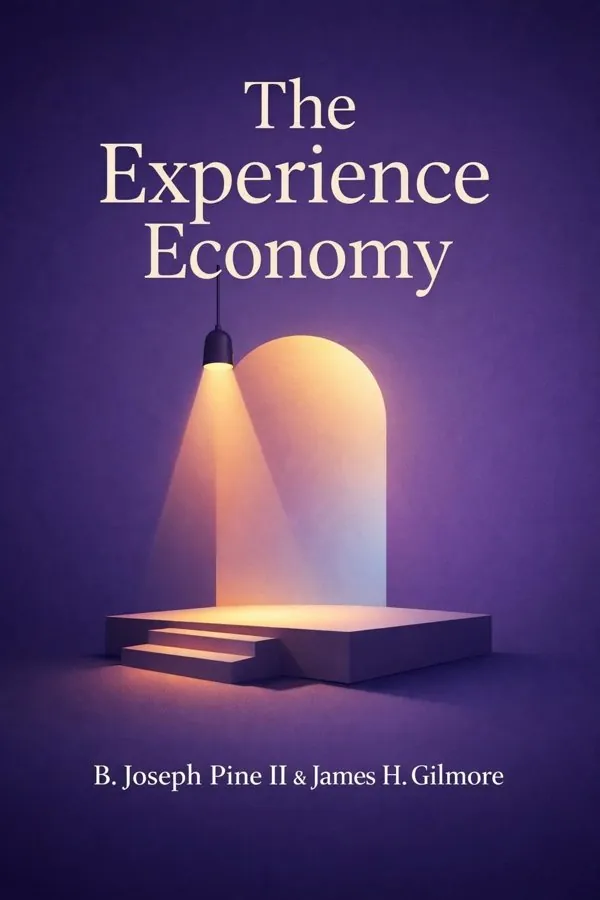
The Experience Economy: Work Is Theatre & Every Business a Stage: Summary & Key Insights
by B. Joseph Pine II, James H. Gilmore
 10 min5 chaptersAudio available
What Is The Experience Economy: Work Is Theatre & Every Business a Stage About?
The Experience Economy: Work Is Theatre & Every Business a Stage by B. Joseph Pine II & James H. Gilmore is a strategy book spanning 5 pages. In this influential business book, Pine and Gilmore argue that the economy has evolved beyond goods and services into an era where experiences are the primary source of economic value. They explain how companies can stage memorable experiences that engage customers on emotional, physical, intellectual, and even spiritual levels, transforming ordinary transactions into meaningful events. The book provides frameworks and examples for designing and managing experiences that differentiate brands and create lasting customer loyalty.
This FizzRead summary covers all 5 key chapters of The Experience Economy: Work Is Theatre & Every Business a Stage in approximately 10 minutes, distilling the most important ideas, arguments, and takeaways from B. Joseph Pine II & James H. Gilmore's work. Also available as an audio summary and Key Quotes Podcast.
The Experience Economy: Work Is Theatre & Every Business a Stage
In this influential business book, Pine and Gilmore argue that the economy has evolved beyond goods and services into an era where experiences are the primary source of economic value. They explain how companies can stage memorable experiences that engage customers on emotional, physical, intellectual, and even spiritual levels, transforming ordinary transactions into meaningful events. The book provides frameworks and examples for designing and managing experiences that differentiate brands and create lasting customer loyalty.
Who Should Read The Experience Economy: Work Is Theatre & Every Business a Stage?
This book is perfect for anyone interested in strategy and looking to gain actionable insights in a short read. Whether you're a student, professional, or lifelong learner, the key ideas from The Experience Economy: Work Is Theatre & Every Business a Stage by B. Joseph Pine II & James H. Gilmore will help you think differently.
- ✓Readers who enjoy strategy and want practical takeaways
- ✓Professionals looking to apply new ideas to their work and life
- ✓Anyone who wants the core insights of The Experience Economy: Work Is Theatre & Every Business a Stage in just 10 minutes
Want the full summary?
Get instant access to this book summary and 100K+ more with Fizz Moment.
Get Free SummaryAvailable on App Store • Free to download
Key Chapters
To understand the Experience Economy, we must trace the evolution of economic value itself. Pine and Gilmore illustrate this by moving through four progressive stages of economic output: commodities, goods, services, and experiences. Commodities—the raw materials we extract—are the foundation of all economies. They are traded purely by availability and price. Goods, which transform those commodities into tangible objects, add value through innovation and fabrication. Services, historically seen as the next level, add convenience and customization by performing tasks on behalf of customers.
Yet Pine and Gilmore point out that services have become increasingly interchangeable, subject to relentless price competition. Technology, automation, and efficiency have stripped many services of their differentiating human touch. What’s left is a leveling field where customers seek more than mere utility—they yearn for connection, emotion, and engagement.
Here lies the birth of experiences as economic offerings in their own right. Experiences occur when businesses intentionally stage events that engage customers in a personal way. When Disney sells tickets to Disneyland, they are not providing a mere service but inviting guests into a completely orchestrated world—a stage populated by stories, characters, sound, and spectacle.
This shift redefines the very structure of business. Just as manufacturing standardized goods and service industries standardized delivery, staging experiences requires mastering theatrical principles—design, sensory engagement, timing, and narrative coherence. Every detail counts because every detail contributes to memory. Successful experiences leave impressions that linger long after the physical event ends, becoming part of the customer’s personal story.
Pine and Gilmore emphasize that this is not about entertainment alone. Even a mundane service—say, a visit to the dentist or a car repair—can be elevated if designed thoughtfully. When customers leave feeling surprised or delighted, when the ordinary turns extraordinary through attentive detail, an experience has been born. And that experience commands a premium because it transforms time well spent into time well remembered.
In the Experience Economy, Pine and Gilmore invite us to view work through an entirely new metaphor—**theatre**. Imagine that every interaction between a business and its customer is a scene, actors are employees, the store is the set, and the product is a prop that helps advance the story. Under this lens, ordinary business routines transform into performances.
But theatre here does not mean artificiality or pretense. It means intentional design and emotional authenticity. In every performance, actors—your employees—become co-creators of meaning. Their gestures, tone, and timing convey messages that extend far beyond words. A barista who crafts coffee with flair, a salesperson who listens with genuine empathy, or even a call center agent who turns frustration into laughter—all are performers creating audience experience.
Pine and Gilmore divided the theatrical metaphor into two aspects: **frontstage** and **backstage**. Frontstage activities are what the customers see and sense—the visible performance. Backstage functions, though invisible, are the discipline, practice, and systems that make the frontstage possible. The harmony between these two spaces determines whether the experience feels seamless and convincing.
Disney exemplifies this interplay perfectly. Every Disneyland employee, from ride operator to janitor, is part of the show. Their actions and appearance are scripted around the guest’s emotional journey. The backstage logistics—the maintenance, scheduling, training—are invisible but indispensable to preserving the illusion.
When you adopt the theatre mindset, you stop viewing business as operations and start viewing it as narrative art. Performance replaces procedure, and engagement replaces efficiency as your success metric. The customer’s presence becomes the defining moment of creation. You are not just serving needs but staging experiences.
And like any theatre, every show must be rehearsed. Pine and Gilmore encourage leaders to reimagine employee training as creative preparation—learning cues, rhythms, and improvisational empathy. The result is a business that doesn’t just deliver service but awakens emotional responses. When every business becomes a stage, work itself becomes a celebration of human connection.
+ 3 more chapters — available in the FizzRead app
All Chapters in The Experience Economy: Work Is Theatre & Every Business a Stage
About the Authors
B. Joseph Pine II is an author, speaker, and management advisor known for his work on mass customization and the experience economy. James H. Gilmore is a business strategist and co-founder of Strategic Horizons LLP, focusing on innovation and customer experience design. Together, they have shaped modern thinking about how businesses create value through experiences.
Get This Summary in Your Preferred Format
Read or listen to the The Experience Economy: Work Is Theatre & Every Business a Stage summary by B. Joseph Pine II & James H. Gilmore anytime, anywhere. FizzRead offers multiple formats so you can learn on your terms — all free.
Available formats: App · Audio · PDF · EPUB — All included free with FizzRead
Download The Experience Economy: Work Is Theatre & Every Business a Stage PDF and EPUB Summary
Key Quotes from The Experience Economy: Work Is Theatre & Every Business a Stage
“To understand the Experience Economy, we must trace the evolution of economic value itself.”
“In the Experience Economy, Pine and Gilmore invite us to view work through an entirely new metaphor—**theatre**.”
Frequently Asked Questions about The Experience Economy: Work Is Theatre & Every Business a Stage
The Experience Economy: Work Is Theatre & Every Business a Stage by B. Joseph Pine II & James H. Gilmore is a strategy book that explores key ideas across 5 chapters. In this influential business book, Pine and Gilmore argue that the economy has evolved beyond goods and services into an era where experiences are the primary source of economic value. They explain how companies can stage memorable experiences that engage customers on emotional, physical, intellectual, and even spiritual levels, transforming ordinary transactions into meaningful events. The book provides frameworks and examples for designing and managing experiences that differentiate brands and create lasting customer loyalty.
You Might Also Like
Mastery
Robert Greene
10 min
Cut Costs Not Corners: A Practical Guide to Staying Competitive and Improving Profits
Colin Barrow
10 min
Good Strategy/Bad Strategy: The Difference and Why It Matters
Richard P. Rumelt
10 min
On Grand Strategy
John Lewis Gaddis
10 min
The Six Disciplines of Digital Transformation
George Westerman
10 min
7 Powers: The Foundations of Business Strategy
Hamilton Helmer
10 minBrowse by Category
Ready to read The Experience Economy: Work Is Theatre & Every Business a Stage?
Get the full summary and 100K+ more books with Fizz Moment.