
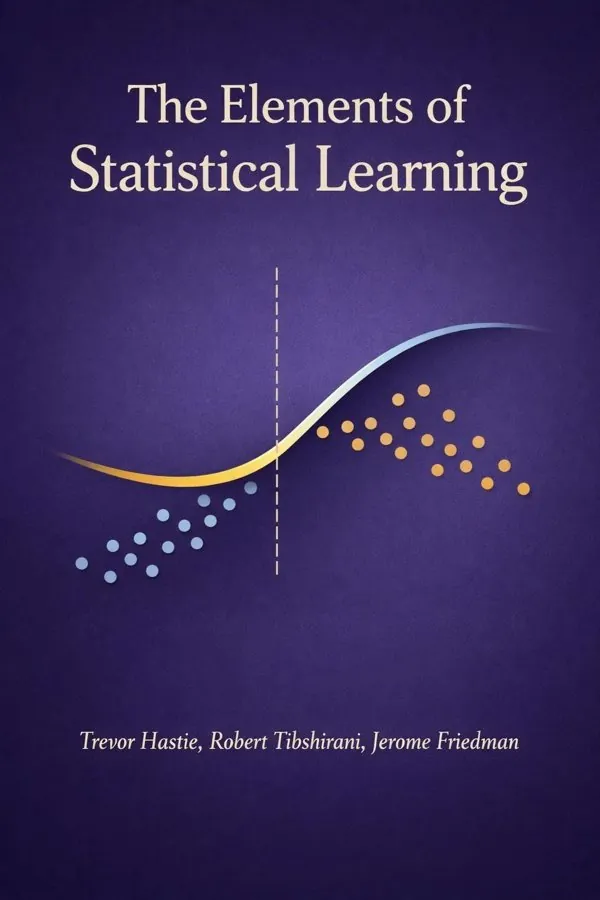
The Elements of Statistical Learning: Data Mining, Inference, and Prediction: Summary & Key Insights
by Trevor Hastie, Robert Tibshirani, Jerome Friedman
 10 min7 chaptersAudio available
What Is The Elements of Statistical Learning: Data Mining, Inference, and Prediction About?
The Elements of Statistical Learning: Data Mining, Inference, and Prediction by Trevor Hastie, Robert Tibshirani, Jerome Friedman is a data_science book spanning 7 pages. This influential textbook provides a comprehensive introduction to statistical learning theory and its applications in data mining and prediction. It covers key methods such as linear regression, classification, resampling, model selection, and ensemble learning, with a focus on conceptual understanding and practical implementation. The book bridges the gap between statistics and machine learning, making it a foundational reference for researchers and practitioners in data science.
This FizzRead summary covers all 7 key chapters of The Elements of Statistical Learning: Data Mining, Inference, and Prediction in approximately 10 minutes, distilling the most important ideas, arguments, and takeaways from Trevor Hastie, Robert Tibshirani, Jerome Friedman's work. Also available as an audio summary and Key Quotes Podcast.
The Elements of Statistical Learning: Data Mining, Inference, and Prediction
This influential textbook provides a comprehensive introduction to statistical learning theory and its applications in data mining and prediction. It covers key methods such as linear regression, classification, resampling, model selection, and ensemble learning, with a focus on conceptual understanding and practical implementation. The book bridges the gap between statistics and machine learning, making it a foundational reference for researchers and practitioners in data science.
Who Should Read The Elements of Statistical Learning: Data Mining, Inference, and Prediction?
This book is perfect for anyone interested in data_science and looking to gain actionable insights in a short read. Whether you're a student, professional, or lifelong learner, the key ideas from The Elements of Statistical Learning: Data Mining, Inference, and Prediction by Trevor Hastie, Robert Tibshirani, Jerome Friedman will help you think differently.
- ✓Readers who enjoy data_science and want practical takeaways
- ✓Professionals looking to apply new ideas to their work and life
- ✓Anyone who wants the core insights of The Elements of Statistical Learning: Data Mining, Inference, and Prediction in just 10 minutes
Want the full summary?
Get instant access to this book summary and 100K+ more with Fizz Moment.
Get Free SummaryAvailable on App Store • Free to download
Key Chapters
Linear regression is the oldest and perhaps most enduring method in statistical learning. It begins with a simple, powerful idea: that the expected value of a response can be expressed as a linear combination of predictors. This idea is so natural that it seems inevitable — and yet even this foundational technique contains deep insights about modeling, bias, and variance.
We start with least squares estimation. Imagine we have data pairs (x, y) and we wish to find coefficients β such that y ≈ β₀ + β₁x₁ + ... + βₚxₚ. The least squares approach minimizes the sum of squared residuals. Geometrically, it represents orthogonal projection onto the subspace spanned by predictors. This perspective blends algebra and geometry — leading to a vivid understanding of how models relate to data.
But the real challenge arises when there are many predictors or when they are correlated. Then least squares can become unstable, inflating variance and reducing predictive performance. To address this, extensions such as ridge regression and the LASSO impose regularization — penalties that constrain coefficients and balance bias against variance. These ideas form the cornerstone of high-dimensional modeling, where interpretability and stability must coexist.
When you apply these methods, you begin to sense the interplay between data complexity and model structure. Every coefficient tells a story of contribution, yet the strength of that story depends on how well the predictors cooperate. In practice, the art of regression lies not in finding perfect fits but in extracting signal without overfitting noise. The lesson is enduring: mathematical elegance must always serve predictive honesty.
Classification brings a new flavor to learning, where outcomes are labels rather than numeric values. The task is not to estimate a response, but to assign categories based on observed features. Logistic regression emerges as the natural analogue of linear regression for this setting — a model grounded in probabilistic interpretation, mapping inputs to probabilities through the sigmoid transformation.
In logistic regression, we model the log-odds of a response as a linear function of predictors. This simple change — moving from expectation to probability — brings statistics closer to decision theory. The geometry of decision boundaries becomes central. Each parameter adjusts the slope and position of the dividing line between classes. We discover that the power of classification lies not in rigidity but in flexibility, allowing probabilistic confidence rather than binary judgment.
Linear discriminant analysis (LDA) extends this insight by modeling class distributions directly. Assuming Gaussian populations with distinct means but shared covariance, LDA derives optimal boundaries that minimize misclassification risk. The method is elegant and interpretable, connecting data distributions with classification accuracy.
Across these methods, one theme persists: we learn boundaries that separate, but they also teach us about overlap and uncertainty. The best classifier is not necessarily the one that fits every training point; it is the one that generalizes, understanding where the boundary should bend and where it should remain firm. In our view, learning to classify is learning to discern — not only in data, but in thought: distinguishing signal from illusion.
+ 5 more chapters — available in the FizzRead app
All Chapters in The Elements of Statistical Learning: Data Mining, Inference, and Prediction
About the Authors
Trevor Hastie, Robert Tibshirani, and Jerome Friedman are leading statisticians and professors at Stanford University. They are renowned for their pioneering contributions to statistical learning, including the development of methods such as the LASSO, generalized additive models, and boosting algorithms.
Get This Summary in Your Preferred Format
Read or listen to the The Elements of Statistical Learning: Data Mining, Inference, and Prediction summary by Trevor Hastie, Robert Tibshirani, Jerome Friedman anytime, anywhere. FizzRead offers multiple formats so you can learn on your terms — all free.
Available formats: App · Audio · PDF · EPUB — All included free with FizzRead
Download The Elements of Statistical Learning: Data Mining, Inference, and Prediction PDF and EPUB Summary
Key Quotes from The Elements of Statistical Learning: Data Mining, Inference, and Prediction
“Linear regression is the oldest and perhaps most enduring method in statistical learning.”
“Classification brings a new flavor to learning, where outcomes are labels rather than numeric values.”
Frequently Asked Questions about The Elements of Statistical Learning: Data Mining, Inference, and Prediction
The Elements of Statistical Learning: Data Mining, Inference, and Prediction by Trevor Hastie, Robert Tibshirani, Jerome Friedman is a data_science book that explores key ideas across 7 chapters. This influential textbook provides a comprehensive introduction to statistical learning theory and its applications in data mining and prediction. It covers key methods such as linear regression, classification, resampling, model selection, and ensemble learning, with a focus on conceptual understanding and practical implementation. The book bridges the gap between statistics and machine learning, making it a foundational reference for researchers and practitioners in data science.
You Might Also Like
Data Science from Scratch: First Principles with Python
Joel Grus
10 min
Applied Predictive Modeling
Max Kuhn, Kjell Johnson
10 min
Better Data Visualizations: A Guide for Scholars, Researchers, and Wonks
Jonathan Schwabish
10 min
Big Data: A Revolution That Will Transform How We Live, Work, and Think
Viktor Mayer-Schönberger, Kenneth Cukier
10 min
Big Data: Principles and Best Practices of Scalable Real-Time Data Systems
Nathan Marz
10 min
Data Points: Visualization That Means Something
Nathan Yau
10 minBrowse by Category
Ready to read The Elements of Statistical Learning: Data Mining, Inference, and Prediction?
Get the full summary and 100K+ more books with Fizz Moment.