
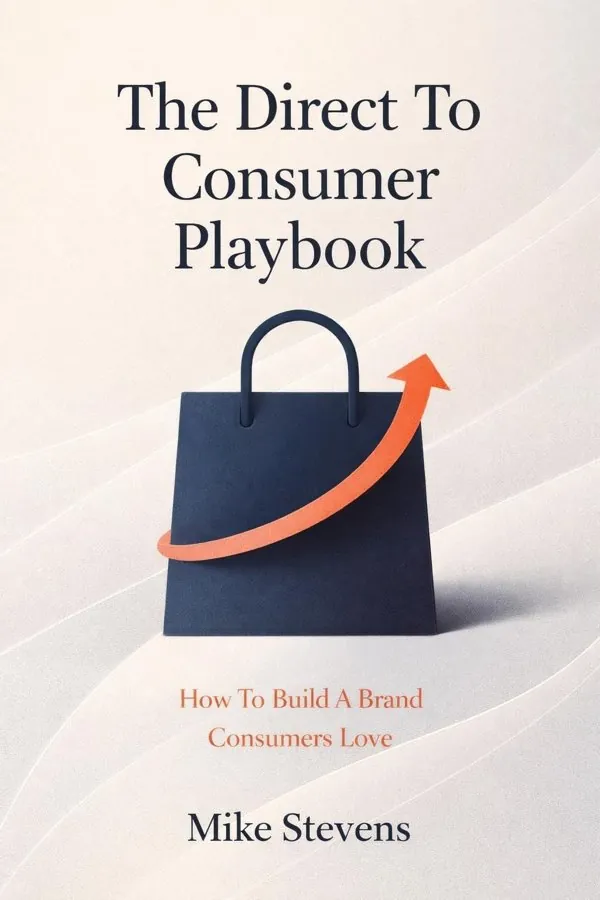
The Direct To Consumer Playbook: How To Build A Brand Consumers Love: Summary & Key Insights
by Mike Stevens
 10 min4 chaptersAudio available
What Is The Direct To Consumer Playbook: How To Build A Brand Consumers Love About?
The Direct To Consumer Playbook: How To Build A Brand Consumers Love by Mike Stevens is a entrepreneurship book spanning 4 pages. The Direct to Consumer Playbook offers a practical guide for entrepreneurs and brand builders seeking to create successful direct-to-consumer (DTC) businesses. Drawing on insights from leading DTC brands, the book explores strategies for brand positioning, customer engagement, digital marketing, and scaling operations in the modern e-commerce landscape.
This FizzRead summary covers all 4 key chapters of The Direct To Consumer Playbook: How To Build A Brand Consumers Love in approximately 10 minutes, distilling the most important ideas, arguments, and takeaways from Mike Stevens's work. Also available as an audio summary and Key Quotes Podcast.
The Direct To Consumer Playbook: How To Build A Brand Consumers Love
The Direct to Consumer Playbook offers a practical guide for entrepreneurs and brand builders seeking to create successful direct-to-consumer (DTC) businesses. Drawing on insights from leading DTC brands, the book explores strategies for brand positioning, customer engagement, digital marketing, and scaling operations in the modern e-commerce landscape.
Who Should Read The Direct To Consumer Playbook: How To Build A Brand Consumers Love?
This book is perfect for anyone interested in entrepreneurship and looking to gain actionable insights in a short read. Whether you're a student, professional, or lifelong learner, the key ideas from The Direct To Consumer Playbook: How To Build A Brand Consumers Love by Mike Stevens will help you think differently.
- ✓Readers who enjoy entrepreneurship and want practical takeaways
- ✓Professionals looking to apply new ideas to their work and life
- ✓Anyone who wants the core insights of The Direct To Consumer Playbook: How To Build A Brand Consumers Love in just 10 minutes
Want the full summary?
Get instant access to this book summary and 100K+ more with Fizz Moment.
Get Free SummaryAvailable on App Store • Free to download
Key Chapters
When I first started Peppersmith, I didn’t think of it as a 'direct-to-consumer' business. I just wanted to make great mints and gum with real ingredients, and to do so in a way that built a genuine connection with people who cared about quality and provenance. But soon enough, I realized we were pioneering something bigger — we were rejecting the old retail system’s inefficiencies and embracing a model centered entirely around the customer.
A successful DTC brand starts with purpose. You must know not only what you sell, but why you exist. Your purpose will guide decisions about your product, your tone of voice, and the way you engage with customers. Think of brands like Patagonia or Glossier. Their success isn’t accidental — it stems from clarity. They understand who they’re serving and why. In the DTC space, customers notice authenticity instantly; they reward honesty and coherence.
Clarity of purpose leads to differentiation. Traditional retail often homogenizes brands, forcing them to compete on shelf presence. In contrast, DTC enables each brand to stand out based on personality. That’s why mastering storytelling becomes critical. Your brand narrative isn’t just an 'about us' section — it’s your emotional DNA.
To illustrate, at Peppersmith we positioned ourselves not just as a confectionery brand but as advocates for dental health and sustainable sourcing. That narrative didn’t emerge overnight; it came through listening to customers, sharing behind-the-scenes details, and weaving those insights into our communications. We found that every message that aligned with our purpose strengthened customer loyalty.
The key takeaway is that DTC branding isn’t about bypassing retailers — it’s about bypassing indifference. You must make people care. By occupying a clear niche and communicating authentically, you set a foundation for lasting relationships built on mutual values.
Product development in the DTC world looks different from traditional manufacturing. There, you often create products for buyers and distributors, negotiating wholesale margins and shelf placement. Here, your audience is the end-consumer, and every interaction provides real-time feedback.
This changes everything. It means your innovation loop can be radically compressed. When we launched a new flavor at Peppersmith, we could measure reactions instantly — through reviews, social comments, and direct messages. The most forward-thinking brands use this feedback to iterate quickly. Brands like Allbirds refine their materials based on sustainable innovations suggested by consumers themselves. Glossier famously turned customer comments on blog posts into full product lines.
But being customer-centric doesn’t mean being reactive. You still need a guiding philosophy that anchors product design. The challenge is to balance vision with listening. Your vision provides direction; customer feedback provides calibration. In my experience, successful DTC founders treat their audience as co-creators rather than buyers.
From a practical standpoint, product innovation also ties closely to supply chain agility. DTC brands must handle fulfillment directly, which means every manufacturing decision affects shipping, packaging, margins, and customer experience. The unboxing moment, once trivial, becomes part of your brand’s emotional narrative.
When you build a product for DTC, remember that design, function, and delivery exist in the same conversation. Your goal isn’t just to satisfy a need — it’s to express care and craft in a way that resonates personally. In the direct model, even small details speak volumes, and the product becomes the most credible proof of your brand’s values.
+ 2 more chapters — available in the FizzRead app
All Chapters in The Direct To Consumer Playbook: How To Build A Brand Consumers Love
About the Author
Mike Stevens is a British entrepreneur and business advisor known for his expertise in direct-to-consumer brand strategy. He founded the confectionery brand Peppersmith and has worked with numerous startups and established companies to develop effective DTC growth strategies.
Get This Summary in Your Preferred Format
Read or listen to the The Direct To Consumer Playbook: How To Build A Brand Consumers Love summary by Mike Stevens anytime, anywhere. FizzRead offers multiple formats so you can learn on your terms — all free.
Available formats: App · Audio · PDF · EPUB — All included free with FizzRead
Download The Direct To Consumer Playbook: How To Build A Brand Consumers Love PDF and EPUB Summary
Key Quotes from The Direct To Consumer Playbook: How To Build A Brand Consumers Love
“When I first started Peppersmith, I didn’t think of it as a 'direct-to-consumer' business.”
“Product development in the DTC world looks different from traditional manufacturing.”
Frequently Asked Questions about The Direct To Consumer Playbook: How To Build A Brand Consumers Love
The Direct To Consumer Playbook: How To Build A Brand Consumers Love by Mike Stevens is a entrepreneurship book that explores key ideas across 4 chapters. The Direct to Consumer Playbook offers a practical guide for entrepreneurs and brand builders seeking to create successful direct-to-consumer (DTC) businesses. Drawing on insights from leading DTC brands, the book explores strategies for brand positioning, customer engagement, digital marketing, and scaling operations in the modern e-commerce landscape.
You Might Also Like

Lean Analytics
Alistair Croll, Benjamin Yoskovitz
10 min
21 Days To A Big Idea: Creating Breakthrough Business Concepts
Bryan Mattimore
10 min
Sam Walton: Made in America: My Story
Sam Walton
10 min
10x Is Easier Than 2x: How World-Class Entrepreneurs Achieve More by Doing Less
Dan Sullivan, Benjamin Hardy
10 min
12 Months to $1 Million: How to Pick a Winning Product, Build a Real Business, and Become a Seven-Figure Entrepreneur
Ryan Daniel Moran
10 min
24 Assets: Create a Digital, Scalable, Valuable Business
Daniel Priestley
10 minBrowse by Category
Ready to read The Direct To Consumer Playbook: How To Build A Brand Consumers Love?
Get the full summary and 100K+ more books with Fizz Moment.