
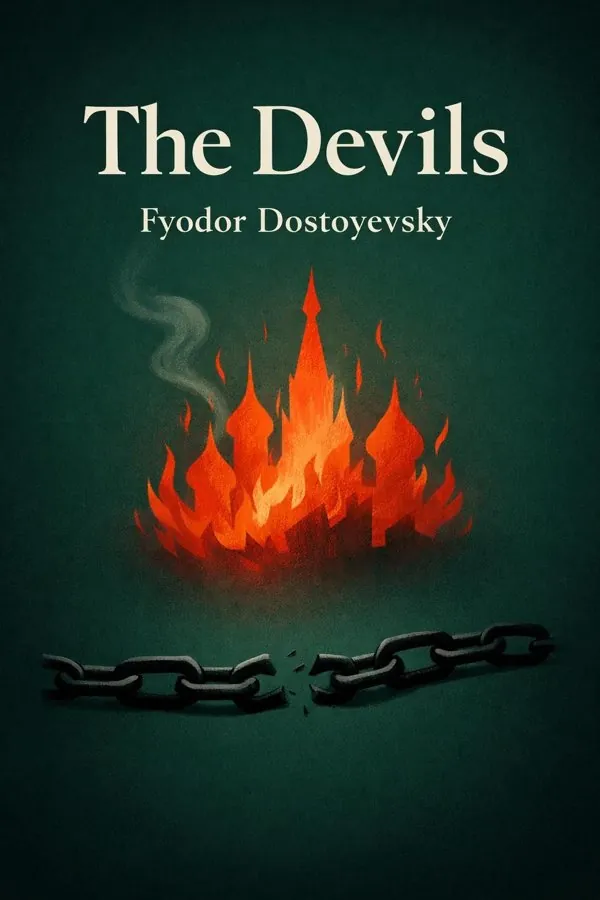
The Devils: Summary & Key Insights
 10 min9 chaptersAudio available
Key Takeaways from The Devils
A society can begin to decay long before violence appears, and Dostoyevsky suggests that decay often starts in the vanity of people who mistake performance for conviction.
Some of the most dangerous people are not driven by clear conviction but by spiritual emptiness that draws others into orbit.
Revolutions are not always led by philosophers; sometimes they are driven by organizers who understand resentment better than truth.
People seldom join destructive movements because they have carefully reasoned their way into evil; more often, they are seduced by belonging, momentum, and the fear of exclusion.
The most explosive debates in The Devils are not merely political; they are spiritual arguments about what remains when transcendence disappears.
What Is The Devils About?
The Devils by Fyodor Dostoyevsky is a classics book spanning 11 pages. The Devils, also translated as Demons or The Possessed, is Fyodor Dostoyevsky’s fierce and unsettling portrait of a society infected by ideas it no longer knows how to control. Set in provincial Russia but charged with national significance, the novel follows a circle of intellectuals, agitators, idealists, and moral weaklings as radical doctrines turn from conversation into conspiracy, humiliation, murder, and collapse. At its center stands a haunting question: what happens when people reject moral responsibility, spiritual truth, and human dignity in the name of abstract freedom or political necessity? What makes this novel endure is not only its historical relevance to 19th-century Russia, but its astonishing ability to anticipate modern extremism, ideological cults, and the psychology of social breakdown. Dostoyevsky does not merely criticize revolutionary politics; he exposes the emotional hunger, vanity, resentment, and spiritual emptiness that make destructive movements attractive in the first place. Few novelists have examined the inner life of fanaticism with such intensity. Dostoyevsky wrote with unusual authority. Having endured imprisonment, exile, political suspicion, and profound spiritual crisis, he understood both the seduction of radical ideas and the human cost of living without moral limits. The Devils remains one of literature’s most penetrating studies of chaos, belief, and the dark uses of freedom.
This FizzRead summary covers all 9 key chapters of The Devils in approximately 10 minutes, distilling the most important ideas, arguments, and takeaways from Fyodor Dostoyevsky's work. Also available as an audio summary and Key Quotes Podcast.
The Devils
The Devils, also translated as Demons or The Possessed, is Fyodor Dostoyevsky’s fierce and unsettling portrait of a society infected by ideas it no longer knows how to control. Set in provincial Russia but charged with national significance, the novel follows a circle of intellectuals, agitators, idealists, and moral weaklings as radical doctrines turn from conversation into conspiracy, humiliation, murder, and collapse. At its center stands a haunting question: what happens when people reject moral responsibility, spiritual truth, and human dignity in the name of abstract freedom or political necessity?
What makes this novel endure is not only its historical relevance to 19th-century Russia, but its astonishing ability to anticipate modern extremism, ideological cults, and the psychology of social breakdown. Dostoyevsky does not merely criticize revolutionary politics; he exposes the emotional hunger, vanity, resentment, and spiritual emptiness that make destructive movements attractive in the first place. Few novelists have examined the inner life of fanaticism with such intensity.
Dostoyevsky wrote with unusual authority. Having endured imprisonment, exile, political suspicion, and profound spiritual crisis, he understood both the seduction of radical ideas and the human cost of living without moral limits. The Devils remains one of literature’s most penetrating studies of chaos, belief, and the dark uses of freedom.
Who Should Read The Devils?
This book is perfect for anyone interested in classics and looking to gain actionable insights in a short read. Whether you're a student, professional, or lifelong learner, the key ideas from The Devils by Fyodor Dostoyevsky will help you think differently.
- ✓Readers who enjoy classics and want practical takeaways
- ✓Professionals looking to apply new ideas to their work and life
- ✓Anyone who wants the core insights of The Devils in just 10 minutes
Want the full summary?
Get instant access to this book summary and 100K+ more with Fizz Moment.
Get Free SummaryAvailable on App Store • Free to download
Key Chapters
A society can begin to decay long before violence appears, and Dostoyevsky suggests that decay often starts in the vanity of people who mistake performance for conviction. Stepan Trofimovich Verkhovensky is introduced as an aging intellectual who imagines himself a guardian of culture, progress, and enlightened values. Yet beneath his eloquence lies dependency, theatrical self-pity, and a striking inability to act responsibly. He has lived for years on reputation rather than substance, feeding on the admiration of others while contributing little of real moral courage.
Stepan matters because he represents a generation that prepared the ground for extremism without fully intending to. He delights in fashionable ideas, poses as a persecuted thinker, and mistakes emotional display for integrity. He is not a revolutionary leader, but his unseriousness helps create a climate in which more ruthless men can thrive. Dostoyevsky’s point is subtle and devastating: careless intellectual posturing can loosen a culture’s moral foundations, especially when it is disconnected from duty, humility, and truth.
This dynamic is easy to recognize beyond the novel. Public figures, teachers, commentators, and even ordinary social media users can celebrate disruption, mock tradition, or romanticize rebellion without considering what follows when slogans become programs. Stepan is a warning about the danger of enjoying radical rhetoric as a form of self-expression.
His life also exposes a personal truth: people may speak elegantly about humanity while neglecting the people closest to them. His relationship with his son Pyotr, in particular, is marked by distance and failure, showing how private irresponsibility can have public consequences.
Actionable takeaway: examine whether your beliefs are grounded in lived responsibility or merely in the desire to appear intelligent, progressive, or morally superior.
Some of the most dangerous people are not driven by clear conviction but by spiritual emptiness that draws others into orbit. Nikolai Stavrogin returns to the provincial town as a figure of fascination, scandal, and dread. He is handsome, controlled, intelligent, and magnetically self-possessed. Yet the more people try to understand him, the more elusive he becomes. Dostoyevsky builds Stavrogin as a man whose external power masks inner disintegration.
Stavrogin’s importance lies in the effect he has on others. People project onto him their desires, ideologies, grievances, and fantasies. Some worship him, some fear him, and some hope he will give shape to their own restless ambitions. But Stavrogin himself seems paralyzed by moral indifference and buried guilt. He can inspire loyalty without offering meaning, authority without principle, and intimacy without love. This makes him one of Dostoyevsky’s most chilling creations: a charismatic void.
In practical terms, Stavrogin embodies a pattern still familiar today. Charismatic individuals can captivate groups not because they stand for something coherent, but because their ambiguity invites projection. In workplaces, politics, or social circles, people often rally around personalities who appear strong and mysterious while ignoring signs of detachment, manipulation, or ethical instability.
Dostoyevsky also reveals how self-mastery can become a disguise for corruption. Stavrogin’s composure is not wisdom; often it is emotional deadness. His inability to commit to goodness leaves a vacuum that destruction rushes to fill.
The lesson is not to distrust charisma entirely, but to ask what lies beneath it. Does influence serve truth and responsibility, or merely aesthetic power and personal domination?
Actionable takeaway: when drawn to a powerful personality, look past magnetism and ask whether that person demonstrates moral accountability, empathy, and a clear sense of good.
Revolutions are not always led by philosophers; sometimes they are driven by organizers who understand resentment better than truth. Pyotr Verkhovensky, Stepan’s son, arrives as the novel’s most energetic political force. Unlike his father, he has little interest in elegant posturing. He is practical, cunning, shameless, and intensely focused on control. Where Stepan plays at ideas, Pyotr weaponizes them.
Pyotr’s genius is not intellectual depth but social manipulation. He senses weakness in every person he meets and uses flattery, fear, secrecy, and urgency to bind people together. He speaks in the name of equality and liberation, yet he seeks domination. His revolutionary circle is built less on shared ideals than on compromised loyalty. By involving others in small lies, whispered schemes, and moral concessions, he creates a network of people who become easier to command the more corrupted they are.
Dostoyevsky presents him as a prototype of the modern political extremist: a man who treats human beings as tools, ideology as cover, and chaos as opportunity. Pyotr knows that confused people are easier to govern than thoughtful ones. He inflames egos, stokes grievance, and pushes events toward violence because disorder increases his leverage.
This pattern remains strikingly relevant. In many movements, organizations, or online communities, manipulative actors create loyalty by manufacturing crisis, demanding total commitment, and isolating members from ordinary moral instincts. The language may be noble, but the structure often depends on coercion and humiliation.
Pyotr demonstrates that fanaticism is rarely sustained by ideas alone. It is sustained by status games, secrecy, and the thrill of belonging to an inner circle. Once people become invested in the group, they may commit acts they once considered impossible.
Actionable takeaway: be wary of leaders who demand secrecy, encourage moral shortcuts, and frame cruelty or deception as necessary for a greater cause.
People seldom join destructive movements because they have carefully reasoned their way into evil; more often, they are seduced by belonging, momentum, and the fear of exclusion. In The Devils, the formation of the revolutionary circle shows how ordinary weaknesses become political fuel. The group that gathers around Pyotr is not made up solely of hardened criminals or brilliant ideologues. It includes insecure, vain, lonely, ambitious, and confused people who want significance.
Dostoyevsky is remarkably perceptive about group psychology. The circle operates through coded intimacy: private meetings, hints of higher purpose, selective information, and the intoxicating suggestion that members are participating in history. This creates emotional dependency. Individuals who might resist an explicit call to violence can still be drawn in through smaller commitments—attendance, silence, gossip, symbolic gestures, and shared hostility toward outsiders.
One of the novel’s most enduring insights is that group membership can replace conscience. Once belonging becomes central to identity, moral judgment weakens. Members begin to think less about whether an action is right and more about whether it proves loyalty. The group also amplifies cowardice. People who are uncertain alone may support terrible decisions when they sense that everyone else has already agreed.
This is not confined to political conspiracies. Similar patterns appear in toxic offices, cult-like friend groups, online movements, and institutional scandals. When dissent is mocked, secrecy is normalized, and identity depends on compliance, people often rationalize behavior they would once condemn.
Dostoyevsky does not excuse this weakness, but he helps us understand it. He shows that evil can look communal, purposeful, and emotionally satisfying before it reveals its true cost.
Actionable takeaway: if a group makes you feel important at the cost of honesty, independent thought, or compassion, step back and test whether belonging is overriding your conscience.
The most explosive debates in The Devils are not merely political; they are spiritual arguments about what remains when transcendence disappears. Dostoyevsky stages ideological confrontations through characters who embody competing visions of freedom, equality, reason, and human destiny. The novel asks whether a society can abolish inherited moral structures without unleashing forces it cannot control.
For some characters, liberation means emancipation from religion, tradition, hierarchy, and inherited duties. But Dostoyevsky keeps pressing a harder question: if there is no sacred basis for human dignity, why should anyone restrain power, cruelty, or self-interest? He does not claim that every secular person becomes violent. Rather, he dramatizes how abstract systems can become ruthless when they sever ideas from lived moral responsibility.
The arguments in the book matter because they reveal how intellectual positions affect emotional life. Nihilism does not remain an idea in a notebook. It changes how people view suffering, guilt, obligation, and the value of persons. If all values are human inventions, then values can also be rearranged for strategy, pleasure, or historical necessity. In that sense, ideology becomes a weapon against conscience.
Modern readers can apply this insight broadly. Whenever a system—political, corporate, or cultural—treats people as expendable for the sake of efficiency, progress, purity, or victory, the same danger appears. The language may sound rational, but the result is often dehumanization.
Dostoyevsky’s challenge is not anti-intellectual. He demands that ideas answer to moral reality. Brilliant theories that cannot protect the vulnerable, acknowledge guilt, or honor truth are not liberating; they are corrosive.
Actionable takeaway: test every idea by its view of the human person—if a worldview makes it easier to justify humiliation, coercion, or expendability, reject it no matter how sophisticated it sounds.
The soul does not become free by denying guilt; it becomes more haunted. One of the darkest dimensions of The Devils lies in Stavrogin’s confession, which reveals the moral abyss beneath his poise. Here Dostoyevsky examines what happens when a person commits evil, refuses genuine repentance, and continues living as though intelligence or composure can neutralize the truth.
Stavrogin is not simply a sinner in the ordinary sense. He represents a consciousness that has seen its own corruption and still cannot surrender to humility. He is tormented, but his torment does not automatically lead to renewal. Dostoyevsky insists on a crucial distinction: suffering is not the same as repentance. A person may feel horror, shame, and inner fragmentation yet still cling to pride, self-absorption, or despair.
This makes the confession morally profound. It shows that evil damages not only victims and communities, but the perpetrator’s capacity for relation, meaning, and hope. Stavrogin’s tragedy is that he recognizes the seriousness of his condition without taking the path that might heal it. He circles around confession as revelation, not as transformation.
In everyday life, this insight appears whenever people admit wrongdoing in language that changes nothing. Public apologies, private admissions, and therapeutic self-awareness can all become substitutes for actual repentance if they are not joined to responsibility, restitution, and moral change.
Dostoyevsky is unsparing on this point. Psychological complexity does not erase guilt. Nor does eloquence. What matters is whether one moves toward truth humbly enough to be changed by it.
Actionable takeaway: when confronting your own failures, do not stop at self-knowledge—pair honest acknowledgment with concrete repair, accepted consequences, and a willingness to become different.
Ideas become most dangerous when they are lived to the point of self-destruction. Through the intertwined fates of Shatov and Kirillov, Dostoyevsky shows two stark responses to the crisis of belief. Shatov moves toward a renewed sense of rootedness, spiritual meaning, and moral obligation. Kirillov, by contrast, pushes philosophical rebellion to its extreme, treating suicide as a final act of metaphysical self-assertion. Their stories reveal how abstract convictions can shape life, death, and the value of the person.
Shatov is significant because he begins to reject the ideological arrogance that once seduced him. He gropes toward faith, nationhood, family, and the sanctity of life. He is still vulnerable and conflicted, but he is moving toward responsibility. That movement makes him dangerous to the revolutionary circle, because apostasy threatens systems built on total loyalty. His murder is therefore not just a crime; it is the logical expression of ideology defending itself through elimination.
Kirillov represents a different horror. He reasons that if God does not exist, human beings must become gods through absolute freedom. In his logic, suicide proves sovereignty over fear and moral law. Dostoyevsky exposes the spiritual madness in this position. What presents itself as liberation becomes annihilation.
These characters show opposite trajectories: one toward belonging and life, the other toward abstraction and death. Both illustrate Dostoyevsky’s belief that metaphysical ideas are never merely theoretical. They alter what people are willing to endure, protect, or destroy.
In practical terms, this invites us to ask what our deepest beliefs are training us to do. Do they strengthen family, responsibility, and reverence for life? Or do they isolate us in self-creation and contempt for limits?
Actionable takeaway: evaluate your beliefs not by how bold they sound, but by whether they lead toward greater responsibility, reverence, and care for human life.
Social collapse rarely begins with a single catastrophe; it emerges from accumulated evasions, humiliations, and manipulations that suddenly become impossible to contain. In the latter movements of The Devils, the town’s descent into scandal, confusion, violence, and public disgrace shows how fragile civilized order can be when moral authority has already eroded. What looked like eccentricity or political agitation gives way to fear, rumor, arson, death, and collective panic.
Dostoyevsky is especially sharp in showing that institutions fail not only because villains act, but because ordinary people hesitate, flatter, deny, and postpone judgment. Local elites are compromised by vanity. Respectable society is addicted to appearances. Individuals who sense danger often suppress their instincts because speaking clearly would be awkward, costly, or socially disruptive. By the time the truth becomes undeniable, events have escaped everyone’s control.
This is one of the novel’s broadest social warnings. Disorder becomes possible when communities lose the courage to name falsehood early. A culture of ambiguity, irony, and private cynicism creates openings for more decisive forms of evil. Once trust collapses, panic spreads faster than reason.
The deaths of Shatov, Kirillov, and ultimately Stavrogin underline that ideological corruption does not remain symbolic. Bodies accumulate. Families are shattered. Public life is poisoned. Dostoyevsky refuses the comforting illusion that moral confusion stays private.
Modern readers can apply this insight in many settings: institutions that tolerate abuse to preserve reputation, organizations that ignore manipulative leaders, or societies that normalize dehumanizing rhetoric until violence seems thinkable. The warning is less about one historical movement than about the anatomy of breakdown itself.
Actionable takeaway: confront lies, coercion, and moral evasions early, because chaos is easiest to prevent before it becomes visible to everyone.
The final impression of The Devils is not simply that evil destroys, but that a community must reckon truthfully with destruction if any renewal is to be possible. Stavrogin’s death and the aftermath that follows do not offer easy closure. There is no triumphant restoration, no neat reordering of a world briefly disturbed. Instead, Dostoyevsky leaves readers with exhaustion, grief, and the lingering recognition that spiritual sickness has consequences beyond any single conspiracy.
Stavrogin’s end is especially important because it reveals the destination of unrepented division. He is not defeated in a dramatic public showdown; he collapses under the weight of inward ruin. His death confirms one of the novel’s deepest claims: a person cannot live indefinitely without moral integration. Intelligence, beauty, and social power cannot save someone who has severed himself from truth and love.
The epilogue also reframes Stepan Trofimovich. In his wandering final days, he achieves a kind of belated sincerity that contrasts sharply with his earlier theatricality. His late awakening is imperfect, but it suggests that even compromised lives can move toward humility. Dostoyevsky therefore balances catastrophe with a small but meaningful possibility of repentance.
For readers, the aftermath matters because it resists sensationalism. The point is not merely that extremist ideas end badly, but that recovery requires moral seriousness. Communities must remember accurately, judge honestly, and rebuild on firmer spiritual and ethical foundations. Individuals, too, must ask where they have tolerated vanity, cowardice, or detachment.
The novel closes in darkness, but not in meaninglessness. Its severity is itself a form of hope: it insists that truth still matters enough to condemn falsehood.
Actionable takeaway: after any personal or collective breakdown, resist the urge to move on quickly—name what happened honestly, accept responsibility where needed, and rebuild around deeper principles than convenience or image.
All Chapters in The Devils
About the Author
Fyodor Dostoyevsky (1821–1881) was a Russian novelist, journalist, and one of literature’s greatest explorers of the human soul. His work is known for its intense psychological insight and its deep engagement with guilt, freedom, faith, suffering, and moral responsibility. Early in life, Dostoyevsky was arrested for participating in a political discussion circle, endured a mock execution, and spent years in Siberian exile—experiences that profoundly shaped his worldview. His major novels include Crime and Punishment, The Idiot, The Devils, and The Brothers Karamazov. Across these works, he examined the spiritual and social crises of modern life with rare force and complexity. His influence extends far beyond fiction, reaching philosophy, theology, psychology, and political thought.
Get This Summary in Your Preferred Format
Read or listen to the The Devils summary by Fyodor Dostoyevsky anytime, anywhere. FizzRead offers multiple formats so you can learn on your terms — all free.
Available formats: App · Audio · PDF · EPUB — All included free with FizzRead
Download The Devils PDF and EPUB Summary
Key Quotes from The Devils
“A society can begin to decay long before violence appears, and Dostoyevsky suggests that decay often starts in the vanity of people who mistake performance for conviction.”
“Some of the most dangerous people are not driven by clear conviction but by spiritual emptiness that draws others into orbit.”
“Revolutions are not always led by philosophers; sometimes they are driven by organizers who understand resentment better than truth.”
“People seldom join destructive movements because they have carefully reasoned their way into evil; more often, they are seduced by belonging, momentum, and the fear of exclusion.”
“The most explosive debates in The Devils are not merely political; they are spiritual arguments about what remains when transcendence disappears.”
Frequently Asked Questions about The Devils
The Devils by Fyodor Dostoyevsky is a classics book that explores key ideas across 9 chapters. The Devils, also translated as Demons or The Possessed, is Fyodor Dostoyevsky’s fierce and unsettling portrait of a society infected by ideas it no longer knows how to control. Set in provincial Russia but charged with national significance, the novel follows a circle of intellectuals, agitators, idealists, and moral weaklings as radical doctrines turn from conversation into conspiracy, humiliation, murder, and collapse. At its center stands a haunting question: what happens when people reject moral responsibility, spiritual truth, and human dignity in the name of abstract freedom or political necessity? What makes this novel endure is not only its historical relevance to 19th-century Russia, but its astonishing ability to anticipate modern extremism, ideological cults, and the psychology of social breakdown. Dostoyevsky does not merely criticize revolutionary politics; he exposes the emotional hunger, vanity, resentment, and spiritual emptiness that make destructive movements attractive in the first place. Few novelists have examined the inner life of fanaticism with such intensity. Dostoyevsky wrote with unusual authority. Having endured imprisonment, exile, political suspicion, and profound spiritual crisis, he understood both the seduction of radical ideas and the human cost of living without moral limits. The Devils remains one of literature’s most penetrating studies of chaos, belief, and the dark uses of freedom.
You Might Also Like

Browse by Category
Ready to read The Devils?
Get the full summary and 100K+ more books with Fizz Moment.