
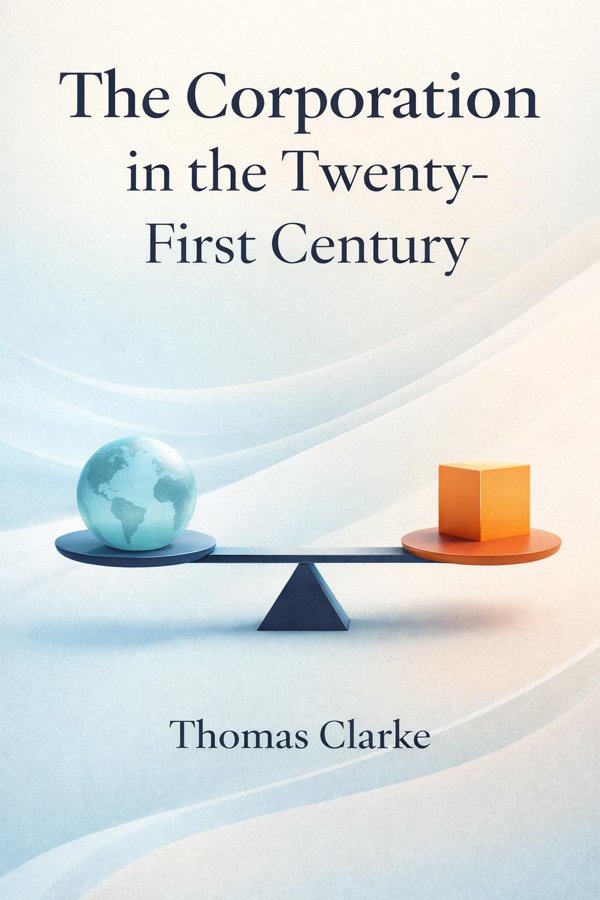
The Corporation in the Twenty-First Century: Summary & Key Insights
 10 min9 chaptersAudio available
Key Takeaways from The Corporation in the Twenty-First Century
One of the book’s most important insights is that corporations are not timeless market creatures that simply emerged from economic necessity.
A corporation can be governed for many ends, but for decades one idea came to dominate the field: the belief that companies exist primarily to maximize shareholder value.
As firms stretched supply chains across borders, sourced labor globally, and moved capital rapidly between jurisdictions, they gained extraordinary flexibility.
Technological change does more than create new products; it reshapes the corporation itself.
A business may be legally incorporated, but it is socially embedded.
What Is The Corporation in the Twenty-First Century About?
The Corporation in the Twenty-First Century by Thomas Clarke is a organization book spanning 5 pages. The modern corporation is one of the most powerful institutions ever created. It shapes economies, politics, labor markets, innovation, and even the future of the planet. In The Corporation in the Twenty-First Century, Thomas Clarke examines how this institution evolved, why its traditional governance models are under pressure, and what must change if corporations are to remain legitimate and effective in a turbulent global age. The book moves beyond narrow debates about profit and management efficiency to ask a bigger question: what should corporations exist for in a world defined by financial instability, technological disruption, climate risk, and rising public distrust? Clarke argues that the corporation is not a fixed or purely economic entity. It is a social, legal, and political construct whose purpose has always been contested. That makes corporate governance central to the future of capitalism itself. Drawing on history, law, finance, ethics, and management, he shows why shareholder primacy is no longer enough and why stakeholder responsibility, sustainability, and institutional reform now matter more than ever. As a leading scholar of corporate governance and business ethics, Clarke brings both authority and urgency to this essential account of corporate transformation.
This FizzRead summary covers all 9 key chapters of The Corporation in the Twenty-First Century in approximately 10 minutes, distilling the most important ideas, arguments, and takeaways from Thomas Clarke's work. Also available as an audio summary and Key Quotes Podcast.
The Corporation in the Twenty-First Century
The modern corporation is one of the most powerful institutions ever created. It shapes economies, politics, labor markets, innovation, and even the future of the planet. In The Corporation in the Twenty-First Century, Thomas Clarke examines how this institution evolved, why its traditional governance models are under pressure, and what must change if corporations are to remain legitimate and effective in a turbulent global age. The book moves beyond narrow debates about profit and management efficiency to ask a bigger question: what should corporations exist for in a world defined by financial instability, technological disruption, climate risk, and rising public distrust?
Clarke argues that the corporation is not a fixed or purely economic entity. It is a social, legal, and political construct whose purpose has always been contested. That makes corporate governance central to the future of capitalism itself. Drawing on history, law, finance, ethics, and management, he shows why shareholder primacy is no longer enough and why stakeholder responsibility, sustainability, and institutional reform now matter more than ever. As a leading scholar of corporate governance and business ethics, Clarke brings both authority and urgency to this essential account of corporate transformation.
Who Should Read The Corporation in the Twenty-First Century?
This book is perfect for anyone interested in organization and looking to gain actionable insights in a short read. Whether you're a student, professional, or lifelong learner, the key ideas from The Corporation in the Twenty-First Century by Thomas Clarke will help you think differently.
- ✓Readers who enjoy organization and want practical takeaways
- ✓Professionals looking to apply new ideas to their work and life
- ✓Anyone who wants the core insights of The Corporation in the Twenty-First Century in just 10 minutes
Want the full summary?
Get instant access to this book summary and 100K+ more with Fizz Moment.
Get Free SummaryAvailable on App Store • Free to download
Key Chapters
One of the book’s most important insights is that corporations are not timeless market creatures that simply emerged from economic necessity. They are human-made legal and social inventions, shaped by changing political choices, public needs, and institutional compromises. That matters because if corporations were created by society, then society also has the right to redefine them.
Clarke traces the development of corporate forms from chartered entities serving public purposes to the modern limited-liability corporation built for capital accumulation, expansion, and organizational continuity. Over time, the corporation evolved from a relatively constrained legal device into a dominant actor in global capitalism. Features such as legal personality, perpetual succession, transferable shares, and limited liability gave firms enormous advantages in raising capital and scaling operations. But these same features also insulated decision-makers from consequences and widened the gap between economic power and democratic accountability.
Seeing the corporation historically helps us avoid treating current arrangements as inevitable. For example, if board structures, shareholder rights, executive incentives, and disclosure standards changed dramatically over the last two centuries, they can change again. Public benefit corporations, stewardship-oriented ownership models, and new reporting frameworks are all modern examples of this ongoing redesign. Even debates over antitrust, tax justice, and environmental accountability become clearer when we remember that corporations were never meant to operate outside social obligation.
In practice, this means leaders, investors, and policymakers should ask not only whether a company is efficient, but whether its legal design still serves public needs. The actionable takeaway: treat corporate governance as a design choice, not a law of nature, and actively question which corporate structures best support long-term social and economic value.
The global corporation promised efficiency, growth, and integrated markets, but Clarke argues that globalization also revealed how vulnerable and politically consequential corporations had become. As firms stretched supply chains across borders, sourced labor globally, and moved capital rapidly between jurisdictions, they gained extraordinary flexibility. Yet that flexibility often outpaced the ability of national governments, labor institutions, and regulatory frameworks to keep up.
Globalization intensified competition and expanded opportunities, but it also created governance gaps. A corporation might be headquartered in one country, manufacture in several others, report profits elsewhere, and sell everywhere. In such a system, who is responsible when labor abuses occur, taxes are minimized, environmental harms multiply, or financial shocks spread? Clarke shows that the answer is often unclear, and that ambiguity has allowed corporations to enjoy the benefits of global integration while shifting many of the costs onto workers, communities, and states.
The global financial crisis is a vivid example. Large corporations and financial institutions operated through complex transnational structures that magnified risk and obscured accountability. When the crisis came, governments stepped in to stabilize systems that private actors had destabilized. Similar tensions appear in modern supply chains, where reputational damage to a brand can be triggered by hidden subcontracting practices many layers removed from the consumer.
For organizations, the lesson is that global expansion cannot rely on legal minimalism. A multinational needs stronger governance, not weaker governance, because complexity multiplies risk. Firms should map supply chains, standardize human-rights due diligence, align tax practices with public legitimacy, and monitor political exposure across jurisdictions. The actionable takeaway: treat globalization as a responsibility multiplier, and build governance systems that match the scale and complexity of your international operations.
Technological change does more than create new products; it reshapes the corporation itself. Clarke highlights how digitalization, automation, data analytics, platform models, and network effects are transforming how firms organize work, create value, and exercise market power. The twenty-first-century corporation is increasingly built not only on physical assets, but on software, intellectual property, algorithms, and data infrastructures.
This shift has major governance implications. Traditional systems designed for industrial firms may not work well for platform businesses or data-intensive companies. In these environments, scale can accelerate rapidly, competition can become winner-takes-most, and strategic decisions can affect privacy, labor conditions, information quality, and democratic discourse. A technology firm may look efficient in financial terms while generating social harms that conventional governance metrics fail to detect.
Technology also changes internal control. Surveillance tools can monitor workers in real time; algorithmic systems can shape hiring, pricing, and customer access; remote collaboration tools can flatten some hierarchies while deepening dependence on digital systems. These developments demand more sophisticated board competence. Directors now need to understand cyber risk, digital ethics, AI bias, and technological concentration, not just accounting and capital allocation.
A practical application is board renewal. If a company’s strategy depends heavily on data, automation, or platform economics, it should appoint directors who can interrogate technical assumptions and challenge management on ethical as well as strategic grounds. Similarly, companies deploying AI should establish review processes for fairness, transparency, and accountability before reputational or regulatory damage occurs.
The actionable takeaway: do not treat technology as merely an operational upgrade; govern it as a source of power, risk, and corporate responsibility that must be actively overseen from the top.
A business may be legally incorporated, but it is socially embedded. Clarke emphasizes that corporations do not create value in isolation; they depend on relationships with employees, customers, suppliers, creditors, communities, and natural systems. Stakeholder theory, in this sense, is not a moral add-on to capitalism. It is a more realistic account of how businesses actually survive and prosper over time.
The key argument is that firms focused exclusively on shareholders tend to underestimate the strategic importance of trust, cooperation, and legitimacy. Employees contribute knowledge and commitment, customers provide revenue and reputation, suppliers affect resilience and quality, and communities grant social permission to operate. When these groups are treated as disposable inputs, short-term profits may rise, but hidden liabilities accumulate. Labor disengagement, customer backlash, supply-chain breakdowns, activist pressure, and regulatory intervention often follow.
Clarke presents stakeholder governance as both ethical and practical. Consider a company facing inflation and margin pressure. It can squeeze suppliers, freeze wages, and reduce customer service to protect earnings, or it can collaborate with suppliers on efficiency, invest in workforce retention, and communicate openly with customers. The first path may help the next quarter; the second is more likely to preserve long-term performance and resilience.
Stakeholder thinking does not mean trying to please everyone equally at all times. It means recognizing interdependence and making governance decisions with broader consequences in view. Companies can operationalize this through employee voice mechanisms, supplier standards, customer outcome metrics, community consultation, and board-level oversight of social impacts.
The actionable takeaway: when evaluating a major business decision, ask which stakeholders bear the costs, which create the value, and whether the decision strengthens or weakens the relationships the company will depend on five years from now.
Environmental and social challenges are no longer peripheral issues to be handled by public relations teams. Clarke argues that sustainability has become a defining test of whether the corporation can remain a legitimate institution in the twenty-first century. Climate change, biodiversity loss, resource scarcity, and social inequality all expose the limits of a corporate model built on externalizing costs while privatizing gains.
The book’s point is not simply that companies should be more responsible. It is that sustainability risks are now strategic, financial, and systemic. A business that ignores emissions, energy transition, labor standards, or social inequality may face regulatory shocks, stranded assets, disrupted supply chains, investor pressure, recruitment problems, and declining trust. Sustainability, then, is not separate from performance; it increasingly shapes performance.
Clarke supports moving sustainability from voluntary rhetoric into governance architecture. That means integrating environmental and social concerns into board agendas, capital investment decisions, executive incentives, risk management systems, and reporting standards. For example, an energy-intensive manufacturer should not only publish a climate statement but also stress-test major investments against carbon pricing, transition scenarios, and resource constraints. A consumer brand should track not just sales growth but packaging waste, labor conditions, and product lifecycle impacts.
This broader approach helps firms avoid superficial ESG branding. Real sustainability means changing incentives and decisions, not just improving disclosure. It also means accepting that some profitable activities may be unacceptable if they depend on irreversible ecological or social damage.
The actionable takeaway: bring sustainability into the center of governance by linking it to board oversight, strategic planning, investment choices, and executive accountability rather than treating it as a separate corporate responsibility program.
If corporations wield great power, then governance cannot depend on trust alone. Clarke argues that both internal oversight and external regulation must be renewed to meet contemporary challenges. Many traditional governance mechanisms were built for a simpler era of industrial production, national markets, and relatively stable ownership patterns. Today’s corporations operate in a world of financial complexity, global supply chains, intangible assets, and systemic risks that old models struggle to manage.
Boards are central to this problem. Too often, they are formally independent but substantively weak, lacking the information, expertise, diversity, or courage needed to challenge executives effectively. Clarke suggests that governance failure is rarely just the result of bad individuals; it often reflects structural weaknesses in board composition, incentives, and accountability. When directors are selected from narrow networks, rely excessively on management for information, or focus mainly on compliance, they are unlikely to provide robust strategic oversight.
Regulation also matters. Markets do not automatically self-correct when incentives are distorted and harms are externalized. Financial crises, monopolistic behavior, environmental damage, and labor abuses all show the need for public frameworks that shape corporate conduct. Good regulation does not suppress enterprise; it creates fair rules, protects vulnerable stakeholders, and reinforces legitimacy.
Practical reforms include improving board diversity of expertise, strengthening risk committees, increasing transparency around political lobbying and tax practices, and clarifying directors’ duties in relation to long-term stakeholder interests. Policymakers can support this through better disclosure standards, stronger enforcement, and cross-border coordination where corporate activity is international.
The actionable takeaway: assess whether your governance system is merely compliant or genuinely capable of independent judgment, and advocate for board and regulatory reforms that match modern corporate risks.
A company’s balance sheet can reveal more than its finances; it can reveal its philosophy. Clarke examines the rise of financialization, a pattern in which corporate strategy becomes increasingly driven by financial markets, investor demands, and short-term returns rather than productive investment and institutional development. Under financialization, the corporation shifts from building capabilities to managing earnings, manipulating valuations, and optimizing capital structures.
This matters because the corporation’s social role depends on its willingness to invest in innovation, skills, infrastructure, and long-term resilience. When firms prioritize share price above all else, they may cut research budgets, suppress wages, defer maintenance, or rely heavily on buybacks and debt issuance to satisfy market expectations. Such behavior can enrich some investors in the near term while weakening the productive base of the company and the wider economy.
Clarke’s critique is especially relevant in industries where capability takes years to build. A pharmaceutical company that underinvests in research to preserve margins, or a manufacturer that neglects training to support earnings targets, may look successful until competitive pressure exposes the cost of short-termism. Financial discipline is necessary, but financial dominance is corrosive when it crowds out organizational learning and strategic patience.
Managers and boards can respond by broadening what counts as performance. Instead of using only earnings-per-share and total shareholder return, they can track innovation pipelines, workforce capabilities, customer retention, operational resilience, and sustainability metrics. Investors, too, can shift from extractive expectations toward stewardship models that reward patient value creation.
The actionable takeaway: examine whether financial metrics are guiding your company or governing it, and rebalance decision-making toward investment in capabilities that create durable economic and social value.
The deepest question in Clarke’s book is not how corporations can become slightly better managed, but how they can remain legitimate institutions in societies increasingly skeptical of concentrated private power. The answer, he suggests, lies in redefining corporate purpose. The twenty-first-century corporation cannot rely on an outdated social bargain in which profit-seeking is tolerated so long as growth continues. Citizens now expect transparency, fairness, environmental responsibility, and a contribution to shared prosperity.
Corporate purpose, in this framework, is not a slogan crafted by branding teams. It is a governing principle that should shape strategy, incentives, accountability, and public commitments. A credible purpose explains how the company creates value, for whom, and under what constraints. It requires consistency between what the corporation says and what it rewards. A firm cannot claim to serve society while exploiting regulatory loopholes, hiding labor abuses, or offloading environmental costs.
This new purpose does not reject profit. Profit remains necessary for survival, innovation, and investment. But profit is better understood as a condition of healthy enterprise than as the corporation’s sole reason for existence. Purpose gives direction to profit by connecting commercial success to public value.
For leaders, this means embedding purpose into real decisions: acquisitions, product design, workforce policy, supply chain management, political engagement, and capital allocation. For boards, it means asking whether strategy advances the firm’s stated social role or undermines it. For investors, it means judging companies by the quality and credibility of their value-creation model, not only by immediate returns.
The actionable takeaway: define corporate purpose in operational terms, then test every major strategic decision against it to ensure the company’s pursuit of profit remains aligned with long-term legitimacy.
All Chapters in The Corporation in the Twenty-First Century
About the Author
Thomas Clarke is a leading scholar in corporate governance, business ethics, and management. He has served as professor of management and director of the Centre for Corporate Governance at the University of Technology Sydney, and his work has focused on how corporations evolve in response to legal, financial, social, and environmental pressures. Clarke is widely known for examining the limits of shareholder primacy and for advancing broader approaches to corporate accountability, sustainability, and responsible governance. His research combines insights from management, political economy, law, and ethics, making his writing especially valuable for readers seeking a deeper understanding of the corporation as both an economic and social institution. Through his books and academic contributions, he has become an influential voice in debates about the future of capitalism and the reform of corporate purpose.
Get This Summary in Your Preferred Format
Read or listen to the The Corporation in the Twenty-First Century summary by Thomas Clarke anytime, anywhere. FizzRead offers multiple formats so you can learn on your terms — all free.
Available formats: App · Audio · PDF · EPUB — All included free with FizzRead
Download The Corporation in the Twenty-First Century PDF and EPUB Summary
Key Quotes from The Corporation in the Twenty-First Century
“One of the book’s most important insights is that corporations are not timeless market creatures that simply emerged from economic necessity.”
“A corporation can be governed for many ends, but for decades one idea came to dominate the field: the belief that companies exist primarily to maximize shareholder value.”
“The global corporation promised efficiency, growth, and integrated markets, but Clarke argues that globalization also revealed how vulnerable and politically consequential corporations had become.”
“Technological change does more than create new products; it reshapes the corporation itself.”
“A business may be legally incorporated, but it is socially embedded.”
Frequently Asked Questions about The Corporation in the Twenty-First Century
The Corporation in the Twenty-First Century by Thomas Clarke is a organization book that explores key ideas across 9 chapters. The modern corporation is one of the most powerful institutions ever created. It shapes economies, politics, labor markets, innovation, and even the future of the planet. In The Corporation in the Twenty-First Century, Thomas Clarke examines how this institution evolved, why its traditional governance models are under pressure, and what must change if corporations are to remain legitimate and effective in a turbulent global age. The book moves beyond narrow debates about profit and management efficiency to ask a bigger question: what should corporations exist for in a world defined by financial instability, technological disruption, climate risk, and rising public distrust? Clarke argues that the corporation is not a fixed or purely economic entity. It is a social, legal, and political construct whose purpose has always been contested. That makes corporate governance central to the future of capitalism itself. Drawing on history, law, finance, ethics, and management, he shows why shareholder primacy is no longer enough and why stakeholder responsibility, sustainability, and institutional reform now matter more than ever. As a leading scholar of corporate governance and business ethics, Clarke brings both authority and urgency to this essential account of corporate transformation.
You Might Also Like
A Guide to the Project Management Body of Knowledge (PMBOK® Guide)
Project Management Institute
10 min
Organizational Behavior
Stephen P. Robbins
10 min
Accelerate: The Science of Lean Software and DevOps – Building and Scaling High Performing Technology Organizations
Nicole Forsgren, Jez Humble, Gene Kim
10 min
Awakening Compassion at Work: The Quiet Power That Elevates People and Organizations
Monica C. Worline, Jane E. Dutton
10 min
Building an Inclusive Organization: Leveraging the Power of a Diverse Workforce
Stephen Frost
10 min
Collaborative Intelligence: Thinking with People Who Think Differently
Dawna Markova, Angie McArthur
10 minBrowse by Category
Ready to read The Corporation in the Twenty-First Century?
Get the full summary and 100K+ more books with Fizz Moment.