
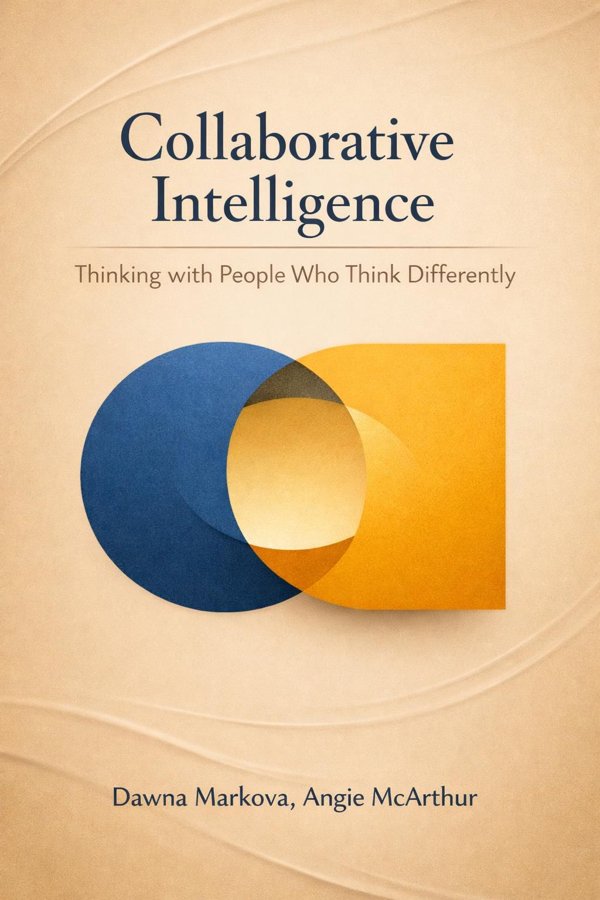
Collaborative Intelligence: Thinking with People Who Think Differently: Summary & Key Insights
by Dawna Markova, Angie McArthur
 10 min5 chaptersAudio available
What Is Collaborative Intelligence: Thinking with People Who Think Differently About?
Collaborative Intelligence: Thinking with People Who Think Differently by Dawna Markova, Angie McArthur is a organization book spanning 5 pages. Collaborative Intelligence explores how individuals and teams can harness diverse thinking styles to achieve more effective collaboration. Drawing on neuroscience and organizational psychology, the authors present practical tools for understanding cognitive diversity and improving communication across different ways of thinking.
This FizzRead summary covers all 5 key chapters of Collaborative Intelligence: Thinking with People Who Think Differently in approximately 10 minutes, distilling the most important ideas, arguments, and takeaways from Dawna Markova, Angie McArthur's work. Also available as an audio summary and Key Quotes Podcast.
Collaborative Intelligence: Thinking with People Who Think Differently
Collaborative Intelligence explores how individuals and teams can harness diverse thinking styles to achieve more effective collaboration. Drawing on neuroscience and organizational psychology, the authors present practical tools for understanding cognitive diversity and improving communication across different ways of thinking.
Who Should Read Collaborative Intelligence: Thinking with People Who Think Differently?
This book is perfect for anyone interested in organization and looking to gain actionable insights in a short read. Whether you're a student, professional, or lifelong learner, the key ideas from Collaborative Intelligence: Thinking with People Who Think Differently by Dawna Markova, Angie McArthur will help you think differently.
- ✓Readers who enjoy organization and want practical takeaways
- ✓Professionals looking to apply new ideas to their work and life
- ✓Anyone who wants the core insights of Collaborative Intelligence: Thinking with People Who Think Differently in just 10 minutes
Want the full summary?
Get instant access to this book summary and 100K+ more with Fizz Moment.
Get Free SummaryAvailable on App Store • Free to download
Key Chapters
Every person carries a pattern of thinking as unique as a fingerprint. Throughout my career, I have observed that the people we find hardest to understand are often those whose minds are organized in ways foreign to our own. Cognitive diversity refers to these variations in perception, information processing, and problem-solving approaches. It’s not merely about different experiences or backgrounds—it’s about how attention, memory, and meaning-making differ from brain to brain.
In 'Collaborative Intelligence,' Angie and I describe how our minds tend to favor certain modes of engagement. Some of us are highly visual thinkers, others excel in auditory or kinesthetic modes. Some prefer to take in information concretely before abstracting it; others leap into conceptual synthesis before grounding it in examples. When we fail to recognize these differences, we miscommunicate, make faulty assumptions, and waste creative potential. But when we learn to decode how others prefer to think, we can adapt our language, pacing, and expectations to better match their patterns.
The first step in cultivating Collaborative Intelligence is awareness: to observe how you direct attention and how others do the same. In teams, this awareness transforms frustration into appreciation. For instance, the colleague who seems slow may simply process information more deeply, while the one who jumps to conclusions may be synthesizing patterns rapidly. Neuroscience shows that distinct neural pathways govern focus, association, and meaning-making. Appreciating this neurodiversity enables us to use language that invites engagement rather than resistance.
In short, cognitive diversity is not a problem to be solved; it’s the raw material of evolution. It gives teams resilience, adaptability, and creative strength. Our task is not to flatten differences but to design environments where they can coexist productively.
To turn abstract ideas into practical tools, we developed what we call the 'Mind Patterns' framework. It’s a way to illuminate how different people perceive, process, and communicate. Most models of personality and teamwork—like Myers-Briggs or DISC—are based on behavior. Mind Patterns go deeper, into the cognitive structures beneath behavior. They describe how information travels through an individual’s attention: whether we begin by focusing on detail or the big picture, whether we rely on words, images, or sensations.
Each person typically has dominant, supportive, and underdeveloped patterns of attention in three domains: cognitive (thinking), affective (feeling), and conative (doing). The interplay of these domains defines our thinking style. For example, a leader who is strong in conceptual cognition but underuses kinesthetic awareness may design brilliant strategies but overlook how policies feel to those who must implement them.
Using Mind Patterns in organizations helps people understand not only how they think but also how they can partner with those who think differently. When a team maps its collective cognitive landscape, it becomes clear where strengths and blind spots lie. This awareness allows teams to intentionally pair members whose patterns complement each other, balancing intuitive leaps with analytical grounding, or empathetic insight with decisive execution.
In our consulting work, we’ve seen how naming these differences defuses tension. Once people have language for their patterns, disagreement no longer feels personal—it becomes informational. The question shifts from 'Why don’t you understand me?' to 'How do you prefer to think about this?' That shift alone transforms collaboration from a battle of opinions into a shared inquiry.
+ 3 more chapters — available in the FizzRead app
All Chapters in Collaborative Intelligence: Thinking with People Who Think Differently
About the Authors
Dawna Markova was an American author, researcher, and consultant known for her work on learning and collaborative thinking. Angie McArthur is a leadership consultant and CEO of Professional Thinking Partners, specializing in cognitive diversity and team collaboration.
Get This Summary in Your Preferred Format
Read or listen to the Collaborative Intelligence: Thinking with People Who Think Differently summary by Dawna Markova, Angie McArthur anytime, anywhere. FizzRead offers multiple formats so you can learn on your terms — all free.
Available formats: App · Audio · PDF · EPUB — All included free with FizzRead
Download Collaborative Intelligence: Thinking with People Who Think Differently PDF and EPUB Summary
Key Quotes from Collaborative Intelligence: Thinking with People Who Think Differently
“Every person carries a pattern of thinking as unique as a fingerprint.”
“To turn abstract ideas into practical tools, we developed what we call the 'Mind Patterns' framework.”
Frequently Asked Questions about Collaborative Intelligence: Thinking with People Who Think Differently
Collaborative Intelligence: Thinking with People Who Think Differently by Dawna Markova, Angie McArthur is a organization book that explores key ideas across 5 chapters. Collaborative Intelligence explores how individuals and teams can harness diverse thinking styles to achieve more effective collaboration. Drawing on neuroscience and organizational psychology, the authors present practical tools for understanding cognitive diversity and improving communication across different ways of thinking.
You Might Also Like

A Guide to the Project Management Body of Knowledge (PMBOK® Guide)
Project Management Institute
10 min
Organizational Behavior
Stephen P. Robbins
10 min
Accelerate: The Science of Lean Software and DevOps – Building and Scaling High Performing Technology Organizations
Nicole Forsgren, Jez Humble, Gene Kim
10 min
Awakening Compassion at Work: The Quiet Power That Elevates People and Organizations
Monica C. Worline, Jane E. Dutton
10 min
Building an Inclusive Organization: Leveraging the Power of a Diverse Workforce
Stephen Frost
10 min
DEI Deconstructed: Your No-Nonsense Guide to Doing the Work and Doing It Right
Lily Zheng
10 minBrowse by Category
Ready to read Collaborative Intelligence: Thinking with People Who Think Differently?
Get the full summary and 100K+ more books with Fizz Moment.