
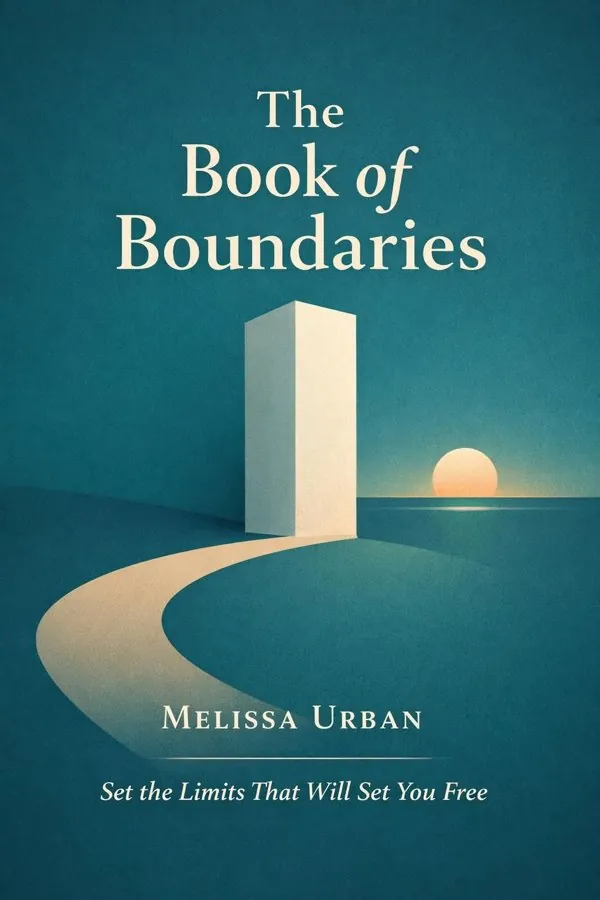
The Book of Boundaries: Set the Limits That Will Set You Free: Summary & Key Insights
 10 min4 chaptersAudio available
What Is The Book of Boundaries: Set the Limits That Will Set You Free About?
The Book of Boundaries: Set the Limits That Will Set You Free by Melissa Urban is a self_awareness book spanning 4 pages. A practical guide to setting healthy boundaries in relationships, work, and daily life. Melissa Urban, co-founder of Whole30, offers actionable advice and real-life examples to help readers communicate limits clearly and protect their mental and emotional well-being.
This FizzRead summary covers all 4 key chapters of The Book of Boundaries: Set the Limits That Will Set You Free in approximately 10 minutes, distilling the most important ideas, arguments, and takeaways from Melissa Urban's work. Also available as an audio summary and Key Quotes Podcast.
The Book of Boundaries: Set the Limits That Will Set You Free
A practical guide to setting healthy boundaries in relationships, work, and daily life. Melissa Urban, co-founder of Whole30, offers actionable advice and real-life examples to help readers communicate limits clearly and protect their mental and emotional well-being.
Who Should Read The Book of Boundaries: Set the Limits That Will Set You Free?
This book is perfect for anyone interested in self_awareness and looking to gain actionable insights in a short read. Whether you're a student, professional, or lifelong learner, the key ideas from The Book of Boundaries: Set the Limits That Will Set You Free by Melissa Urban will help you think differently.
- ✓Readers who enjoy self_awareness and want practical takeaways
- ✓Professionals looking to apply new ideas to their work and life
- ✓Anyone who wants the core insights of The Book of Boundaries: Set the Limits That Will Set You Free in just 10 minutes
Want the full summary?
Get instant access to this book summary and 100K+ more with Fizz Moment.
Get Free SummaryAvailable on App Store • Free to download
Key Chapters
Before we can set boundaries, we need to understand what they actually are. Boundaries define what’s acceptable and what isn’t in our interactions—they’re the invisible lines that delineate our emotional space, time, and energy. I often explain that boundaries aren’t barriers designed to keep people out; they’re guidelines designed to protect the best parts of who we are.
There are three general types of boundaries: healthy, porous, and rigid. Healthy boundaries are flexible and clear; they protect you while allowing connection. Porous boundaries often lead to over-sharing, over-giving, or neglecting your own needs because you’re too eager to please others. Rigid boundaries, on the other hand, shut others out completely and can lead to isolation or coldness. The balance lies in learning to communicate what you need in a way that keeps your relationships responsive, not defensive.
For many of us, boundaries feel like confrontation, but they’re actually conversation. A healthy boundary might sound like, “I can’t stay late today—I have other commitments.” Or “I’m not comfortable discussing that topic.” It’s not an argument; it’s simply clarity. The truth is, when you clearly define your limits, you give others a chance to understand you better rather than guess at your discomfort. Clarity is kindness.
Learning to observe your body’s reactions is a vital part of boundary awareness. When you feel drained, anxious, or resentful around certain people or situations, these emotions are signals—your body is telling you that a boundary is missing. Every “yes” that feels forced and every “no” that’s buried under guilt is an opportunity to reconnect with your integrity. Once you start listening to those cues, you can begin building boundaries that honor your wellbeing and restore balance to every part of your life.
To make boundaries more tangible, I introduced a color-coded system that I call the Boundary Spectrum—green, yellow, and red. It’s a simple, relatable way to understand how far interactions can go before trespassing your comfort zone.
Green zones represent safety, comfort, and clear respect for your needs. These are people and circumstances in which you feel at ease and seen. Yellow zones are the gray areas—moments that may push your limits but don’t yet cross them. You may feel uncertain or slightly uneasy, signaling that communication is needed before discomfort turns into resentment. Red zones, however, are where the line has been crossed, where your emotional, physical, or mental space has been violated.
Using this spectrum helps you identify your limits in real time. For instance, a colleague who frequently asks you to cover extra shifts may start as a green interaction—helping out occasionally feels fine. But when those requests become habitual and your personal time starts to suffer, you move into yellow. If the colleague insists despite your clear “no,” you’re now in red territory. Understanding these gradients allows you to act before frustration builds.
The spectrum also applies to internal boundaries. Think about how you treat yourself. Are you letting your own self-talk drift from green to yellow—fading from encouragement to criticism—until it turns red with self-judgment? Boundaries are as much about protecting you from yourself as they are from others.
This color system isn’t about labeling people as good or bad—it’s about identifying context and emotional safety. It teaches you proportional response: not every situation needs a harsh reaction; sometimes, a simple clarification restores balance. The more you practice noticing these shades, the quicker you’ll recognize and articulate your limits. Over time, you’ll respond to challenges with calm confidence instead of emotional depletion.
+ 2 more chapters — available in the FizzRead app
All Chapters in The Book of Boundaries: Set the Limits That Will Set You Free
About the Author
Melissa Urban is an American author, speaker, and CEO of Whole30. She is known for her work in wellness, habit formation, and personal development, focusing on empowerment through self-care and boundary-setting.
Get This Summary in Your Preferred Format
Read or listen to the The Book of Boundaries: Set the Limits That Will Set You Free summary by Melissa Urban anytime, anywhere. FizzRead offers multiple formats so you can learn on your terms — all free.
Available formats: App · Audio · PDF · EPUB — All included free with FizzRead
Download The Book of Boundaries: Set the Limits That Will Set You Free PDF and EPUB Summary
Key Quotes from The Book of Boundaries: Set the Limits That Will Set You Free
“Before we can set boundaries, we need to understand what they actually are.”
“To make boundaries more tangible, I introduced a color-coded system that I call the Boundary Spectrum—green, yellow, and red.”
Frequently Asked Questions about The Book of Boundaries: Set the Limits That Will Set You Free
The Book of Boundaries: Set the Limits That Will Set You Free by Melissa Urban is a self_awareness book that explores key ideas across 4 chapters. A practical guide to setting healthy boundaries in relationships, work, and daily life. Melissa Urban, co-founder of Whole30, offers actionable advice and real-life examples to help readers communicate limits clearly and protect their mental and emotional well-being.
You Might Also Like
Rising Strong
Brené Brown
10 min
You Do You
Sarah Knight
10 min
Master Your Emotions: A Practical Guide to Overcome Negativity and Better Manage Your Feelings
Thibaut Meurisse
10 min
The Mountain Is You: Transforming Self-Sabotage Into Self-Mastery
Brianna Wiest
10 min
101 Essays That Will Change The Way You Think
Brianna Wiest
10 min
A Radical Awakening: Turn Pain into Power, Embrace Your Truth, Live Free
Shefali Tsabary
10 minBrowse by Category
Ready to read The Book of Boundaries: Set the Limits That Will Set You Free?
Get the full summary and 100K+ more books with Fizz Moment.