
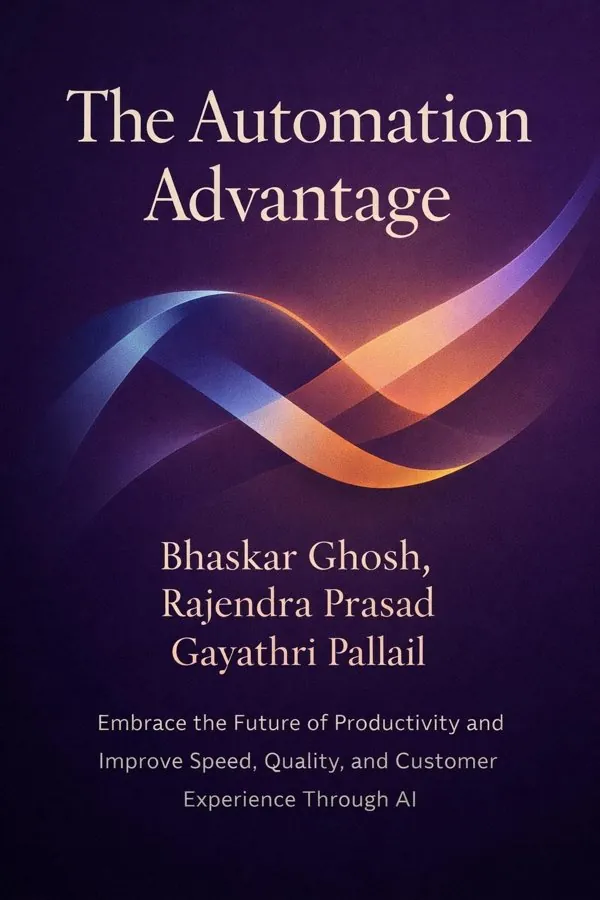
The Automation Advantage: Embrace the Future of Productivity and Improve Speed, Quality, and Customer Experience Through AI: Summary & Key Insights
by Bhaskar Ghosh, Rajendra Prasad, Gayathri Pallail
 10 min9 chaptersAudio available
Key Takeaways from The Automation Advantage: Embrace the Future of Productivity and Improve Speed, Quality, and Customer Experience Through AI
The biggest mistake organizations make is treating automation as a cheaper way to do the same old work.
Automation efforts fail when they optimize what is easy instead of what matters.
Not every process should be automated, and not every pain point is worth solving first.
Technology changes processes, but people determine whether transformation sticks.
Automation creates power, and power without guardrails creates risk.
What Is The Automation Advantage: Embrace the Future of Productivity and Improve Speed, Quality, and Customer Experience Through AI About?
The Automation Advantage: Embrace the Future of Productivity and Improve Speed, Quality, and Customer Experience Through AI by Bhaskar Ghosh, Rajendra Prasad, Gayathri Pallail is a strategy book spanning 6 pages. The Automation Advantage is a strategic guide to one of the most important shifts in modern business: the move from basic task automation to intelligent, AI-enabled enterprise transformation. Bhaskar Ghosh, Rajendra Prasad, and Gayathri Pallail argue that automation is no longer just a back-office efficiency tool. When designed well, it becomes a company-wide capability that improves speed, raises quality, strengthens customer experience, and helps organizations adapt faster in an increasingly digital economy. What makes this book especially useful is its practical perspective. Rather than presenting automation as a futuristic buzzword, the authors show how leaders can identify high-impact opportunities, redesign workflows, align people and technology, and scale change responsibly. Their framework is grounded in real enterprise experience, shaped by years of helping large organizations modernize operations through intelligent automation. The book matters because many companies invest in AI and automation without a clear operating model, measurable outcomes, or employee buy-in. The authors provide a more disciplined approach: start with business value, build human-centered systems, govern them carefully, and scale what works. For executives, operations leaders, and transformation teams, this is a playbook for using AI to create lasting competitive advantage.
This FizzRead summary covers all 9 key chapters of The Automation Advantage: Embrace the Future of Productivity and Improve Speed, Quality, and Customer Experience Through AI in approximately 10 minutes, distilling the most important ideas, arguments, and takeaways from Bhaskar Ghosh, Rajendra Prasad, Gayathri Pallail's work. Also available as an audio summary and Key Quotes Podcast.
The Automation Advantage: Embrace the Future of Productivity and Improve Speed, Quality, and Customer Experience Through AI
The Automation Advantage is a strategic guide to one of the most important shifts in modern business: the move from basic task automation to intelligent, AI-enabled enterprise transformation. Bhaskar Ghosh, Rajendra Prasad, and Gayathri Pallail argue that automation is no longer just a back-office efficiency tool. When designed well, it becomes a company-wide capability that improves speed, raises quality, strengthens customer experience, and helps organizations adapt faster in an increasingly digital economy.
What makes this book especially useful is its practical perspective. Rather than presenting automation as a futuristic buzzword, the authors show how leaders can identify high-impact opportunities, redesign workflows, align people and technology, and scale change responsibly. Their framework is grounded in real enterprise experience, shaped by years of helping large organizations modernize operations through intelligent automation.
The book matters because many companies invest in AI and automation without a clear operating model, measurable outcomes, or employee buy-in. The authors provide a more disciplined approach: start with business value, build human-centered systems, govern them carefully, and scale what works. For executives, operations leaders, and transformation teams, this is a playbook for using AI to create lasting competitive advantage.
Who Should Read The Automation Advantage: Embrace the Future of Productivity and Improve Speed, Quality, and Customer Experience Through AI?
This book is perfect for anyone interested in strategy and looking to gain actionable insights in a short read. Whether you're a student, professional, or lifelong learner, the key ideas from The Automation Advantage: Embrace the Future of Productivity and Improve Speed, Quality, and Customer Experience Through AI by Bhaskar Ghosh, Rajendra Prasad, Gayathri Pallail will help you think differently.
- ✓Readers who enjoy strategy and want practical takeaways
- ✓Professionals looking to apply new ideas to their work and life
- ✓Anyone who wants the core insights of The Automation Advantage: Embrace the Future of Productivity and Improve Speed, Quality, and Customer Experience Through AI in just 10 minutes
Want the full summary?
Get instant access to this book summary and 100K+ more with Fizz Moment.
Get Free SummaryAvailable on App Store • Free to download
Key Chapters
The biggest mistake organizations make is treating automation as a cheaper way to do the same old work. The book begins by showing how automation has evolved from simple rule-based scripts into intelligent systems that can analyze information, support decisions, and continuously improve processes. Traditional automation was useful for repetitive, predictable tasks such as data entry, invoice matching, or report generation. But intelligent automation combines workflow tools, robotic process automation, analytics, machine learning, and AI to transform how work gets done across functions.
This shift matters because modern enterprises are too interconnected for isolated automation wins to create major impact. A finance team may automate reconciliations, but if upstream data is inconsistent and downstream approvals remain manual, the full value is lost. Intelligent transformation looks across the end-to-end process. It asks not only, “What can we automate?” but also, “What should we redesign, simplify, augment, or eliminate?” That broader lens turns automation from a local efficiency tactic into a strategic operating model.
Consider customer onboarding in a bank. Basic automation might transfer customer data between systems. Intelligent automation, by contrast, can validate documents, flag risk patterns, route exceptions, personalize communications, and reduce turnaround time dramatically. The result is not just lower labor cost, but a faster and more reliable customer journey.
The authors emphasize that this evolution requires leaders to change their mindset. Automation should not be judged only by headcount reduction. It should be evaluated by its ability to improve responsiveness, reduce friction, and unlock capacity for higher-value work. The real advantage comes when companies redesign work around intelligence, not just efficiency.
Actionable takeaway: Map one critical business process end to end and identify where automation can eliminate work, where AI can improve decisions, and where redesign can create a fundamentally better outcome.
Automation efforts fail when they optimize what is easy instead of what matters. One of the book’s central ideas is that successful automation programs should be anchored in three clear business outcomes: speed, quality, and customer experience. These three pillars help leaders focus on value rather than technology for its own sake.
Speed is about reducing cycle times and increasing responsiveness. In many industries, customers and business partners now expect near-instant service. Delays that were once tolerated now feel like dysfunction. Automation accelerates workflows by reducing handoffs, minimizing waiting time, and enabling around-the-clock execution. A claims process that once took days can be reduced to hours; a procurement request can move in minutes rather than weeks.
Quality is equally important. Manual work often introduces inconsistency, errors, and rework. Intelligent automation improves accuracy by enforcing standards, validating inputs, and capturing process data in real time. In healthcare, for example, automation can reduce billing mistakes and improve compliance documentation. In manufacturing, it can help standardize inspections and detect anomalies earlier.
Customer experience ties everything together. Faster service and fewer errors matter because customers feel the difference. Automation can personalize interactions, reduce repetitive questions, and create smoother journeys across channels. A retail company using AI to predict delivery issues and notify customers proactively creates trust, not just efficiency.
The authors argue that these pillars should shape prioritization, metrics, and investment decisions. If an automation initiative does not clearly improve at least one of these outcomes, it may not deserve attention. This framework also helps cross-functional leaders align, because speed, quality, and experience are universally relevant measures of value.
Actionable takeaway: Before approving any automation project, define the exact speed, quality, and customer experience metrics it must improve, and use those metrics to guide design and evaluation.
Not every process should be automated, and not every pain point is worth solving first. The book highlights the importance of disciplined opportunity identification: selecting use cases where automation can create meaningful business value and where the organization is ready to act. This is where many automation programs either gain momentum or waste years on fragmented pilots.
The authors suggest looking beyond highly repetitive tasks and evaluating processes across several dimensions: volume, complexity, variability, business criticality, customer impact, error rates, and the effort currently required to complete them. High-value candidates often combine large transaction volumes with frequent delays, poor visibility, or high exception handling costs. Processes that affect both employees and customers tend to offer especially strong returns.
Integration is also a crucial theme. Enterprises often run on legacy systems, disconnected platforms, and siloed data. Automating a process without addressing those dependencies can simply make broken workflows run faster. A better approach is to assess where APIs, workflow orchestration, data standardization, or process redesign are needed alongside automation. For example, a company automating order management may need to unify inventory data first so that bots and AI models are working with reliable information.
Practical prioritization often starts with a portfolio view. Some initiatives should deliver quick wins to build confidence, such as automating HR service tickets or invoice processing. Others should be longer-term strategic bets, such as modernizing supply chain planning or customer service operations with AI support. A balanced pipeline keeps leaders focused on both momentum and transformation.
The book’s message is clear: opportunity selection is not a technical exercise. It is a business design decision. The best automation roadmap reflects enterprise priorities, available data, process maturity, and change readiness.
Actionable takeaway: Build an automation opportunity matrix that ranks processes by business impact, feasibility, and strategic importance, then sequence quick wins and transformational bets in the same roadmap.
Technology changes processes, but people determine whether transformation sticks. A major strength of the book is its insistence that automation must be human-centric. Too many organizations introduce AI and automation in ways that create fear, confusion, or passive resistance. Employees worry about job loss, managers protect old workflows, and teams see automation as something being done to them rather than with them.
The authors argue that leaders must frame automation as a way to augment human capability, not merely replace labor. In practice, this means redesigning roles so people spend less time on repetitive administrative work and more time on judgment, creativity, customer interaction, and exception handling. For example, in a customer service function, AI may classify requests and recommend responses, while human agents focus on emotional nuance, relationship repair, or complex cases.
Successful change also requires transparency. Employees need to understand what is changing, why it matters, how work will shift, and what skills they will need next. Training and reskilling are not side activities; they are central to the automation agenda. Teams often need new capabilities in process thinking, data interpretation, bot supervision, model governance, and continuous improvement.
Just as important, frontline employees should help design automation solutions. They often know where bottlenecks, exceptions, and workarounds actually occur. Their input improves solution quality and increases adoption. When staff members see that automation removes the most frustrating parts of their work, they are more likely to become advocates rather than skeptics.
A human-centric approach also means measuring employee experience. If automation speeds up a process but increases cognitive overload or creates new frustrations, the design is incomplete. Sustainable automation improves work as well as output.
Actionable takeaway: For every automation initiative, create a people plan that includes role redesign, reskilling, frontline involvement, and clear communication about how human work will become more valuable.
Automation creates power, and power without guardrails creates risk. As organizations scale AI-enabled automation, the book stresses the need for robust governance, ethical oversight, and disciplined measurement. This is especially important because intelligent automation increasingly influences decisions, customer interactions, compliance activities, and operational priorities.
Governance begins with clarity about ownership. Who approves use cases? Who validates business value? Who is responsible for controls, model performance, data quality, security, and exception management? Without clear accountability, automation can spread unevenly across functions, producing redundant tools, inconsistent standards, and hidden risks. A centralized or federated governance model can help organizations maintain consistency while still allowing business units to innovate.
Ethics is not an abstract concern. AI systems can reflect bias, make opaque recommendations, or produce outcomes that are hard to explain to regulators and customers. In sectors such as banking, healthcare, and insurance, these issues are especially sensitive. An automated underwriting process, for example, must be tested not only for speed and accuracy but also for fairness, explainability, and legal compliance.
Measurement is another key discipline. Leaders should track both direct and indirect results: cycle-time reduction, error rates, customer satisfaction, employee productivity, compliance outcomes, and financial returns. They should also monitor drift, exceptions, and unintended effects over time. What works in a pilot may degrade in production if data changes or user behavior shifts.
The authors make a compelling point: trust is the foundation of scale. If stakeholders do not believe the system is safe, fair, and controllable, adoption will stall. Good governance is not bureaucracy; it is an enabler of confidence and speed.
Actionable takeaway: Establish an automation governance framework with named owners, risk controls, ethical review standards, and a scorecard that measures both performance gains and potential harms.
Many organizations achieve isolated automation successes but never turn them into enterprise capability. The difference between experimentation and transformation, the authors explain, lies in the operating model. Scaling automation requires more than tools; it requires structure, talent, funding, standards, and a repeatable way to move from idea to impact.
A scalable operating model usually includes shared platforms, reusable components, common design principles, and a clear decision-making process. Instead of each department buying its own tools and building its own bots, the organization creates a coordinated automation ecosystem. This lowers technical debt, improves interoperability, and accelerates delivery because teams can reuse workflows, connectors, governance practices, and analytics methods.
The book also points to the importance of cross-functional collaboration. Automation sits at the intersection of business operations, IT, data, risk, HR, and customer experience. If these groups work in silos, automation becomes fragmented. A strong operating model creates mechanisms for joint prioritization, process ownership, and continuous improvement. This can take the form of a center of excellence, a federated automation council, or product teams responsible for business outcomes rather than narrow technical outputs.
Funding models matter too. If automation projects must fight for one-off budgets, progress will be inconsistent. Leading organizations treat automation as a strategic capability and invest accordingly. They build internal expertise, set outcome targets, and maintain portfolios of initiatives that align with enterprise goals.
The practical implication is simple: scale is designed, not discovered. Companies that institutionalize automation as a core capability are far more likely to sustain value than those chasing scattered pilots.
Actionable takeaway: Define a formal automation operating model with shared standards, cross-functional governance, reusable assets, and a funding approach that supports continuous scaling rather than one-time experiments.
Intelligent automation is only as good as the information it relies on. One of the less glamorous but most decisive themes in the book is the central role of data. Organizations often rush toward AI-powered automation without confronting the basic reality that poor data quality, fragmented sources, and inconsistent definitions can undermine even the most promising solutions.
Automation needs reliable inputs, whether it is processing invoices, predicting maintenance failures, routing customer requests, or assessing risk. If data is duplicated, incomplete, outdated, or scattered across incompatible systems, the automated process may become faster but not better. In fact, bad data can allow errors to scale at machine speed. This is why intelligent automation should be paired with data governance, standardized taxonomies, and clear ownership of critical data elements.
The authors implicitly encourage leaders to see data readiness as part of automation readiness. For example, a company introducing AI into customer service may need to consolidate interaction histories, standardize issue categories, and clean product data before the system can reliably suggest responses or identify root causes. Similarly, an automated finance workflow may require consistent vendor records and invoice formats to avoid downstream exceptions.
There is also a learning dimension. Strong data foundations make it easier to monitor processes, identify bottlenecks, and improve models over time. When companies capture high-quality operational data, automation becomes smarter with use. That creates a feedback loop in which execution and insight reinforce each other.
Actionable takeaway: Before scaling any AI-driven automation initiative, assess data quality, ownership, and system integration for the process involved, and treat data cleanup as a core project deliverable rather than an afterthought.
A surprising number of automation programs celebrate effort instead of results. They count bots deployed, workflows built, or hours theoretically saved, yet struggle to prove strategic impact. The book pushes leaders to move beyond vanity metrics and measure what automation actually changes for the business.
Meaningful measurement starts with baseline performance. If an organization does not know the current cycle time, defect rate, escalation volume, employee effort, or customer satisfaction level of a process, it cannot credibly assess improvement. Once baselines are established, automation initiatives should track outcomes tied to business value. These may include faster time to resolution, lower cost per transaction, improved first-time-right performance, reduced compliance breaches, increased revenue conversion, or stronger net promoter scores.
The authors also imply that measurement should be dynamic, not one-time. A process may improve in the first quarter after automation but worsen later if exception volumes rise or if users develop workarounds outside the system. Continuous monitoring helps leaders catch drift early and improve process design. In an AI-enabled environment, this is especially important because models may lose accuracy as conditions change.
Another useful distinction is between direct and indirect benefits. Direct benefits include labor savings and throughput gains. Indirect benefits may include better employee morale, stronger auditability, or increased capacity to handle growth without adding headcount. Both matter. A mature automation program captures the full business case rather than relying on simplistic cost calculations.
Ultimately, measurement disciplines decision-making. They help organizations stop weak initiatives, scale successful ones, and learn systematically from both.
Actionable takeaway: For each automation effort, define a baseline, three to five business outcome metrics, and a quarterly review process so success is measured by sustained impact rather than initial deployment.
The future of automation is not a one-time upgrade; it is a new way of running the enterprise. In the book’s forward-looking sections, the authors describe a world where AI, automation, analytics, and human expertise increasingly work together as an integrated system. The goal is not simply to digitize current operations but to create organizations that are more adaptive, predictive, and resilient.
In an intelligent enterprise, automation is woven into daily decision-making. Processes are not only executed faster; they are sensed, analyzed, and improved in near real time. Supply chains adjust to disruptions earlier. Customer service becomes more anticipatory. Finance and risk teams gain continuous visibility instead of relying on delayed reports. Employees are supported by systems that surface patterns, recommend actions, and reduce administrative drag.
This vision also changes leadership expectations. Executives must think in terms of ecosystems, capabilities, and learning loops rather than fixed process maps. The technologies will continue to evolve, but the deeper challenge is organizational adaptability. Companies that can combine automation with experimentation, governance, and skill development will outpace those that treat digital transformation as a finite program.
A practical example is a manufacturer using AI and automation across planning, procurement, production, quality control, and service. Instead of optimizing each function separately, the company creates feedback loops across the value chain. Demand shifts influence sourcing; equipment signals trigger maintenance; quality anomalies feed back into design and supplier decisions. The enterprise becomes more intelligent because data and action are connected.
The message is optimistic but demanding: the winners will be those who treat automation as an evolving strategic capability, not a temporary initiative.
Actionable takeaway: Build your automation roadmap as a multi-year capability journey, with regular reassessment of processes, skills, data, and customer needs so the enterprise keeps learning as technology advances.
All Chapters in The Automation Advantage: Embrace the Future of Productivity and Improve Speed, Quality, and Customer Experience Through AI
About the Authors
Bhaskar Ghosh, Rajendra Prasad, and Gayathri Pallail are senior leaders at Accenture with extensive experience in technology, operations, and enterprise transformation. Bhaskar Ghosh has served in top strategic leadership roles and is widely recognized for helping global organizations navigate digital change at scale. Rajendra Prasad has deep expertise in automation strategy and execution, with a strong focus on building intelligent operating models across industries. Gayathri Pallail is a technology and transformation executive known for her work in intelligent automation, innovation, and organizational modernization. Together, they bring a combination of strategic vision and practical implementation knowledge. Their perspective in The Automation Advantage is shaped by years of advising large enterprises on how to use AI and automation to improve productivity, service quality, and customer outcomes.
Get This Summary in Your Preferred Format
Read or listen to the The Automation Advantage: Embrace the Future of Productivity and Improve Speed, Quality, and Customer Experience Through AI summary by Bhaskar Ghosh, Rajendra Prasad, Gayathri Pallail anytime, anywhere. FizzRead offers multiple formats so you can learn on your terms — all free.
Available formats: App · Audio · PDF · EPUB — All included free with FizzRead
Download The Automation Advantage: Embrace the Future of Productivity and Improve Speed, Quality, and Customer Experience Through AI PDF and EPUB Summary
Key Quotes from The Automation Advantage: Embrace the Future of Productivity and Improve Speed, Quality, and Customer Experience Through AI
“The biggest mistake organizations make is treating automation as a cheaper way to do the same old work.”
“Automation efforts fail when they optimize what is easy instead of what matters.”
“Not every process should be automated, and not every pain point is worth solving first.”
“Technology changes processes, but people determine whether transformation sticks.”
“Automation creates power, and power without guardrails creates risk.”
Frequently Asked Questions about The Automation Advantage: Embrace the Future of Productivity and Improve Speed, Quality, and Customer Experience Through AI
The Automation Advantage: Embrace the Future of Productivity and Improve Speed, Quality, and Customer Experience Through AI by Bhaskar Ghosh, Rajendra Prasad, Gayathri Pallail is a strategy book that explores key ideas across 9 chapters. The Automation Advantage is a strategic guide to one of the most important shifts in modern business: the move from basic task automation to intelligent, AI-enabled enterprise transformation. Bhaskar Ghosh, Rajendra Prasad, and Gayathri Pallail argue that automation is no longer just a back-office efficiency tool. When designed well, it becomes a company-wide capability that improves speed, raises quality, strengthens customer experience, and helps organizations adapt faster in an increasingly digital economy. What makes this book especially useful is its practical perspective. Rather than presenting automation as a futuristic buzzword, the authors show how leaders can identify high-impact opportunities, redesign workflows, align people and technology, and scale change responsibly. Their framework is grounded in real enterprise experience, shaped by years of helping large organizations modernize operations through intelligent automation. The book matters because many companies invest in AI and automation without a clear operating model, measurable outcomes, or employee buy-in. The authors provide a more disciplined approach: start with business value, build human-centered systems, govern them carefully, and scale what works. For executives, operations leaders, and transformation teams, this is a playbook for using AI to create lasting competitive advantage.
You Might Also Like

Mastery
Robert Greene
10 min
Cut Costs Not Corners: A Practical Guide to Staying Competitive and Improving Profits
Colin Barrow
10 min
Good Strategy/Bad Strategy: The Difference and Why It Matters
Richard P. Rumelt
10 min
On Grand Strategy
John Lewis Gaddis
10 min
The Six Disciplines of Digital Transformation
George Westerman
10 min
7 Powers: The Foundations of Business Strategy
Hamilton Helmer
10 minBrowse by Category
Ready to read The Automation Advantage: Embrace the Future of Productivity and Improve Speed, Quality, and Customer Experience Through AI?
Get the full summary and 100K+ more books with Fizz Moment.