
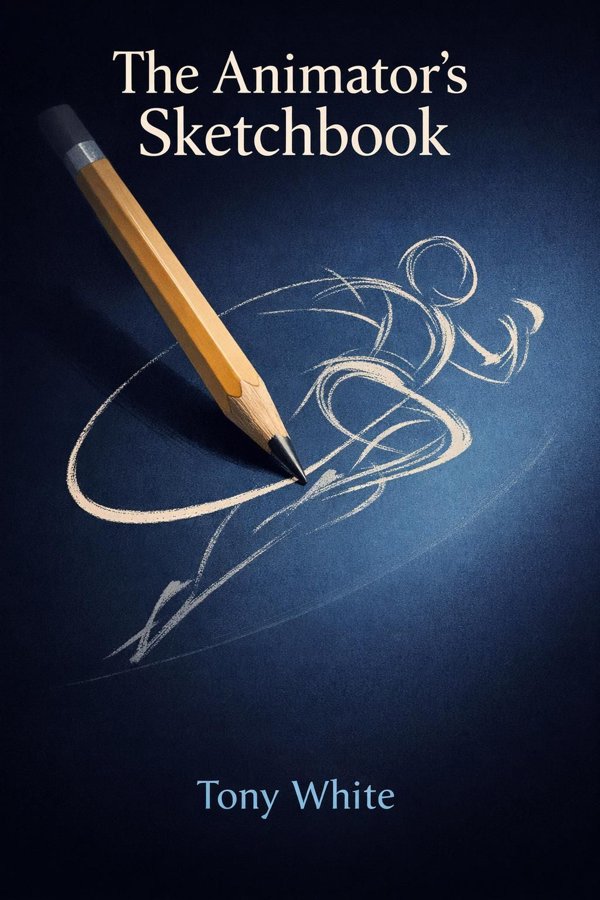
The Animator's Sketchbook: How to See, Interpret & Draw Like a Master Animator: Summary & Key Insights
by Tony White
 10 min9 chaptersAudio available
Key Takeaways from The Animator's Sketchbook: How to See, Interpret & Draw Like a Master Animator
Animation begins long before software, rigs, or polished frames.
Creative growth rarely comes from occasional inspiration; it comes from repetition with intent.
A lifeless drawing can be anatomically correct, while a powerful gesture drawing can feel alive with only a few lines.
An animator needs anatomical knowledge, but not for the sake of showing off academic precision.
Great animation does not come only from imagination; it comes from close attention to real life.
What Is The Animator's Sketchbook: How to See, Interpret & Draw Like a Master Animator About?
The Animator's Sketchbook: How to See, Interpret & Draw Like a Master Animator by Tony White is a design book spanning 8 pages. The Animator's Sketchbook: How to See, Interpret & Draw Like a Master Animator is a hands-on guide to developing the most fundamental skill in animation: the ability to observe life and translate it into expressive drawings. Rather than treating drawing as a separate artistic hobby, Tony White presents it as the core training system for animators who want to create believable movement, appealing characters, and visual storytelling that feels alive. The book is structured like a working studio companion, filled with exercises, prompts, and practical principles that sharpen both the eye and the hand. What makes this book especially valuable is its emphasis on process over polish. White encourages readers to sketch constantly, study gesture, analyze anatomy, simplify forms, and build a habit of seeing motion everywhere. His approach is rooted in the traditions of classical hand-drawn animation, but the lessons apply equally well to digital animators, storyboard artists, illustrators, and designers. As an award-winning animator, director, and educator, White brings decades of professional experience to the page, making this book both an artistic manifesto and a disciplined training manual for anyone serious about animation.
This FizzRead summary covers all 9 key chapters of The Animator's Sketchbook: How to See, Interpret & Draw Like a Master Animator in approximately 10 minutes, distilling the most important ideas, arguments, and takeaways from Tony White's work. Also available as an audio summary and Key Quotes Podcast.
The Animator's Sketchbook: How to See, Interpret & Draw Like a Master Animator
The Animator's Sketchbook: How to See, Interpret & Draw Like a Master Animator is a hands-on guide to developing the most fundamental skill in animation: the ability to observe life and translate it into expressive drawings. Rather than treating drawing as a separate artistic hobby, Tony White presents it as the core training system for animators who want to create believable movement, appealing characters, and visual storytelling that feels alive. The book is structured like a working studio companion, filled with exercises, prompts, and practical principles that sharpen both the eye and the hand.
What makes this book especially valuable is its emphasis on process over polish. White encourages readers to sketch constantly, study gesture, analyze anatomy, simplify forms, and build a habit of seeing motion everywhere. His approach is rooted in the traditions of classical hand-drawn animation, but the lessons apply equally well to digital animators, storyboard artists, illustrators, and designers. As an award-winning animator, director, and educator, White brings decades of professional experience to the page, making this book both an artistic manifesto and a disciplined training manual for anyone serious about animation.
Who Should Read The Animator's Sketchbook: How to See, Interpret & Draw Like a Master Animator?
This book is perfect for anyone interested in design and looking to gain actionable insights in a short read. Whether you're a student, professional, or lifelong learner, the key ideas from The Animator's Sketchbook: How to See, Interpret & Draw Like a Master Animator by Tony White will help you think differently.
- ✓Readers who enjoy design and want practical takeaways
- ✓Professionals looking to apply new ideas to their work and life
- ✓Anyone who wants the core insights of The Animator's Sketchbook: How to See, Interpret & Draw Like a Master Animator in just 10 minutes
Want the full summary?
Get instant access to this book summary and 100K+ more with Fizz Moment.
Get Free SummaryAvailable on App Store • Free to download
Key Chapters
Animation begins long before software, rigs, or polished frames. It starts with the animator’s ability to understand motion, weight, rhythm, and intent through drawing. Tony White treats sketching not as a decorative side skill but as the foundation of the entire animation craft. If you cannot draw what a character is feeling, how it is moving, or what force is driving an action, your animation will often look mechanical, even when the technical execution is competent.
The book connects drawing directly to core animation principles such as timing, spacing, anticipation, action, reaction, and follow-through. A quick sketch can reveal whether a pose reads clearly, whether a movement has energy, and whether an idea has emotional direction. White’s central point is that animation principles are not abstract rules to memorize; they are visible truths that can be tested on paper. The animator’s sketchbook becomes the place where invisible motion is made visible, examined, and improved.
This approach matters because many learners jump too quickly into finished scenes. They focus on tools, menus, and effects before training their observational instincts. White argues that drawing forces you to slow down and think: What is this figure doing? Where is the weight? What happened just before this moment, and what comes next? These are animation questions, not merely drawing questions.
A practical application is to pause films, study athletes, or observe people in public places and sketch their poses in a few lines. Instead of aiming for accuracy alone, aim for cause and effect. What force created this posture? What movement is implied? By practicing this regularly, you build a visual intelligence that supports every later stage of animation.
Actionable takeaway: Treat every sketch as a motion study. Draw daily with the specific goal of understanding movement, not just making attractive images.
Creative growth rarely comes from occasional inspiration; it comes from repetition with intent. One of Tony White’s most practical lessons is that the sketchbook should become a constant companion and a regular training ground. He rejects the idea that a sketchbook must contain beautiful, finished work. Instead, it should function as a laboratory where mistakes are expected, experiments are welcome, and progress accumulates quietly over time.
This is a powerful shift in mindset. Many artists avoid drawing because they fear producing weak pages. White encourages the opposite attitude: the sketchbook is where weak pages belong, because they are part of the process of becoming stronger. A professional animator does not wait for ideal conditions or perfect motivation. They build a routine that keeps their observational muscles active. Short, repeated sessions often matter more than dramatic bursts of effort.
A personal sketchbook practice also helps develop consistency in visual thinking. By recording everyday gestures, expressions, environments, and movement patterns, you begin to build a private library of reference material. Over time, your pages reveal recurring interests, design habits, weaknesses, and strengths. You may notice that your figures feel stiff, your hands are underdeveloped, or your staging lacks clarity. That awareness is useful. The sketchbook becomes not just a place of output, but a mirror of your development.
In practical terms, White’s advice can be turned into a simple routine: carry a portable sketchbook, set a daily minimum, and vary your exercises. One day focus on commuters, another on animal movement, another on drapery, hands, or rapid gesture poses. Add notes about action, emotion, or timing. Even ten focused minutes can matter if done consistently.
Actionable takeaway: Create a daily sketchbook habit with a fixed minimum target, such as one page or ten minutes, and protect it as essential animation training.
A lifeless drawing can be anatomically correct, while a powerful gesture drawing can feel alive with only a few lines. White emphasizes gesture as the fastest route to capturing energy, emotion, and directional movement. In animation, this matters enormously because audiences respond first to vitality and intent, not surface detail. A pose that communicates action clearly is more useful than a polished figure that says nothing.
Gesture drawing is not about tracing outlines. It is about finding the action flowing through the body. The line of action, the tilt of shoulders and hips, the compression and stretch of the torso, and the relationship between balance and force all help define what a figure is doing and feeling. White encourages artists to search for the essence of a pose rather than becoming trapped in little corrections and decorative marks.
This principle is especially useful for animators because movement must read instantly. A character who is sneaking, collapsing, leaping, bragging, or hesitating should communicate that state in a single pose. Gesture drawing trains you to identify those signals. Quick studies of dancers, athletes, pedestrians, or even pets can sharpen your ability to simplify movement into expressive structure.
A practical exercise is to use timed poses of 15, 30, and 60 seconds. In the shortest poses, focus only on the main directional thrust. In the longer ones, add mass and balance without losing the original energy. Another useful method is to draw a sequence of a person standing up, sitting down, or turning, recording only the changes in action. These exercises make you more sensitive to movement arcs and emotional transitions.
Actionable takeaway: Practice fast gesture drawing several times a week, prioritizing force, balance, and emotion over anatomy and detail.
An animator needs anatomical knowledge, but not for the sake of showing off academic precision. White presents anatomy as a functional tool that supports believable motion, clearer construction, and stronger design choices. The goal is not to render every muscle; the goal is to understand how the body bends, twists, compresses, stretches, and carries weight so that your drawings feel convincing and usable in animation.
This distinction is important. Many students either ignore anatomy entirely or become so obsessed with it that their figures turn rigid. White’s approach sits between those extremes. Anatomy should explain motion. It helps you know why the shoulder rises during strain, how the spine curves in action, or where the hips shift when weight transfers from one leg to another. Once you understand structure, exaggeration becomes more effective because it is grounded in reality.
Line also plays a crucial role here. White encourages artists to use line as a descriptive and dynamic force, not just a contour. A line can suggest pressure, softness, speed, or tension. Combined with anatomical awareness, line becomes a tool for directing the eye and clarifying the flow of form. Rather than treating body parts as isolated pieces, the animator learns to connect them through rhythm and volume.
A useful application is to alternate between structural studies and expressive sketches. Spend one session breaking the body into simple masses like rib cage, pelvis, limbs, and joints. In the next session, draw animated poses using that structure without overexplaining it. You can also study one body area, such as the arm or torso, across multiple actions instead of from a static textbook view.
Actionable takeaway: Learn anatomy as moving structure. Study how forms connect and shift in action, then apply that knowledge in simplified, expressive figure drawings.
Great animation does not come only from imagination; it comes from close attention to real life. White insists that observation is one of the animator’s most valuable skills because storytelling depends on believable behavior, convincing staging, and meaningful visual choices. A character feels true when its gestures, reactions, and body language are rooted in observed reality, even if the final design is highly stylized.
Observation works on multiple levels. At the most basic level, it trains you to notice how people move, pause, fidget, lean, and react. At a deeper level, it teaches you to see intention. A person waiting nervously at a station looks different from a person resting confidently in the same spot. The animator’s job is to notice those differences and translate them into readable visual storytelling.
White’s method encourages drawing from life not just to collect forms but to understand behavior. This is what makes a sketchbook such a rich storytelling tool. A page of observational studies can reveal character types, emotional states, social dynamics, and environmental context. For example, sketching workers in a café may teach you about repetitive action, while observing children on a playground may reveal imbalance, spontaneity, and timing patterns.
Practical application can include assigning yourself story-driven observation tasks. Instead of merely drawing five people, draw five people who are tired, distracted, rushed, or proud. Observe how posture changes with mood. You can also thumbnail simple scene ideas from public spaces: who is the focal point, what is the conflict, where does the eye go first, and what gesture tells the story fastest?
Actionable takeaway: Use your sketchbook to observe behavior, not just appearance. Every time you draw from life, ask what story the pose, expression, and setting are already telling.
In animation, realism alone is rarely enough. White highlights exaggeration as one of the most important artistic tools for making action, character, and emotion clear. Exaggeration does not mean random distortion or cartoon chaos. It means selecting the most important truth in a pose or movement and pushing it so the audience can feel it instantly.
This idea is essential because animation must often communicate quickly and across multiple visual layers. A slight shift in posture that might be readable in live action may disappear in drawn performance unless it is emphasized. Exaggeration helps preserve intent. If a character is exhausted, you may lower the torso more, drag the arms further, or compress the spine to reinforce that feeling. If a character is arrogant, you may elevate the chin, broaden the chest, and sharpen the silhouette.
White links exaggeration to design as well. Strong animation depends on clear shapes, readable silhouettes, and selective emphasis. The animator is not reproducing reality frame by frame; they are interpreting it. That interpretation should improve clarity, emotional force, and entertainment value. The best exaggeration grows from understanding. When grounded in observation and structure, it feels expressive rather than fake.
A practical way to study this is to create three versions of the same pose: observed, clarified, and exaggerated. In the first, draw what you see. In the second, simplify and improve the pose for readability. In the third, push the dominant action or emotion significantly while preserving balance and intent. Comparing the three teaches you how much design intervention strengthens communication.
Actionable takeaway: When drawing a pose, identify its single strongest idea and push that idea intentionally through silhouette, line of action, and body language.
Characters do not move in empty space. White reminds readers that environment is not background decoration but an active part of animation thinking. The world around a character influences posture, behavior, staging, and story. A figure walking uphill, squeezing through a crowd, balancing on a narrow ledge, or resting in a cramped room will move differently in each situation. To draw animation convincingly, you must understand the relationship between body and setting.
This has both practical and storytelling implications. From a practical perspective, environments create perspective challenges, scale relationships, and contact points that affect movement. A chair determines how someone sits. A staircase changes rhythm. Wind changes clothing and balance. From a narrative perspective, environments reveal mood, class, tension, danger, or comfort before a character even moves. An animator who can sketch spaces well gains a stronger ability to stage action clearly and create believable worlds.
White encourages artists to observe and draw places as actively as they draw people. Streets, interiors, parks, workshops, stations, and natural settings all offer useful lessons in structure and atmosphere. A sketchbook page might combine figures with props, architecture, and directional cues to explore how movement flows through a scene. This is especially valuable for storyboard artists and layout-minded animators who must think beyond isolated characters.
One useful exercise is to sketch the same action in different environments. Draw a person running in an open field, a cluttered kitchen, and a busy train platform. The action remains similar, but spacing, posture, and emotional effect all change. Another exercise is to draw props that invite action: doors, bicycles, benches, ladders, bags, umbrellas.
Actionable takeaway: Sketch characters in real spaces, paying attention to how surroundings alter movement, staging, and emotional tone.
A strong animator does not stop at making one good drawing. White encourages readers to think in sequences, because animation is the art of change across time. A beautiful isolated pose can still fail if it does not connect logically and rhythmically to what comes before and after. The sketchbook therefore becomes a place to explore transitions, not just snapshots.
This shift from image-making to sequence-thinking is one of the book’s most valuable contributions. It teaches artists to ask temporal questions: What initiates this action? Where is the anticipation? How does momentum carry through? What reaction follows? These questions turn drawing into performance design. Rather than treating each sketch as independent, the animator begins to map movement arcs, emotional beats, and visual continuity.
White’s approach supports this through repeated observation and shorthand studies. If you sketch a person reaching for a bag, lifting it, adjusting their grip, and walking away, you are training yourself to notice timing and mechanical logic. If you sketch a face changing from surprise to relief, you are studying emotional progression. Animation thrives on these in-between changes.
A practical method is to create small thumbnail strips of three, five, or nine panels. Use them to capture everyday actions such as sitting down, opening a window, or greeting someone across a room. Focus on what changes most from one beat to the next. You can also use video clips, pausing them at intervals and sketching the key poses while asking why each pose is necessary.
Actionable takeaway: Fill part of your sketchbook with short pose sequences that show actions unfolding over time, not just isolated figure studies.
Talent may attract attention, but sustained professional growth comes from disciplined, honest practice. White closes much of his advice around the idea that becoming an animator is not about occasional breakthroughs; it is about building habits of seeing, studying, reviewing, and improving. The sketchbook is central to that process because it records not only what you can do, but how seriously you are engaging with your own development.
Honest practice means drawing what is difficult, not only what feels comfortable. It means studying weak areas repeatedly, seeking clarity over style, and accepting that progress is uneven. White’s perspective as an educator is especially helpful here. He understands that many artists become discouraged when their ambitions outpace their current skill. His answer is not to lower ambition, but to create a framework of regular work that slowly closes the gap.
For professionals and aspiring professionals alike, this also includes reflection. Looking back through old sketchbooks can reveal recurring problems in proportion, stiffness, perspective, or staging. It can also show improvement that is easy to miss day by day. In a career context, sketchbook practice sharpens pitch ideas, character development, storyboard planning, and visual memory. It keeps the artist flexible and responsive.
A practical system might include weekly review sessions, monthly focus themes, and periodic self-assessments. One month could target hands and action poses; another could focus on animal locomotion or environmental staging. Sharing selected studies with mentors or peers can add accountability and feedback.
Actionable takeaway: Treat your sketchbook as a long-term professional training record. Review it regularly, identify your weakest areas, and design focused practice around them.
All Chapters in The Animator's Sketchbook: How to See, Interpret & Draw Like a Master Animator
About the Author
Tony White is an award-winning British animator, director, teacher, and author best known for his commitment to traditional hand-drawn animation. Over a long career, he has worked across commercials, short films, and animation education, combining professional studio experience with a strong passion for teaching core craft skills. White has written several respected books on animation, often focusing on the classical principles that underpin believable movement, acting, and visual storytelling. His work stands out for emphasizing observation, drawing discipline, and performance rather than relying solely on technology. As an educator, he has helped generations of students understand animation as both an art and a practical profession. The Animator's Sketchbook reflects his belief that strong drawing habits remain essential to mastering animated expression.
Get This Summary in Your Preferred Format
Read or listen to the The Animator's Sketchbook: How to See, Interpret & Draw Like a Master Animator summary by Tony White anytime, anywhere. FizzRead offers multiple formats so you can learn on your terms — all free.
Available formats: App · Audio · PDF · EPUB — All included free with FizzRead
Download The Animator's Sketchbook: How to See, Interpret & Draw Like a Master Animator PDF and EPUB Summary
Key Quotes from The Animator's Sketchbook: How to See, Interpret & Draw Like a Master Animator
“Animation begins long before software, rigs, or polished frames.”
“Creative growth rarely comes from occasional inspiration; it comes from repetition with intent.”
“A lifeless drawing can be anatomically correct, while a powerful gesture drawing can feel alive with only a few lines.”
“An animator needs anatomical knowledge, but not for the sake of showing off academic precision.”
“Great animation does not come only from imagination; it comes from close attention to real life.”
Frequently Asked Questions about The Animator's Sketchbook: How to See, Interpret & Draw Like a Master Animator
The Animator's Sketchbook: How to See, Interpret & Draw Like a Master Animator by Tony White is a design book that explores key ideas across 9 chapters. The Animator's Sketchbook: How to See, Interpret & Draw Like a Master Animator is a hands-on guide to developing the most fundamental skill in animation: the ability to observe life and translate it into expressive drawings. Rather than treating drawing as a separate artistic hobby, Tony White presents it as the core training system for animators who want to create believable movement, appealing characters, and visual storytelling that feels alive. The book is structured like a working studio companion, filled with exercises, prompts, and practical principles that sharpen both the eye and the hand. What makes this book especially valuable is its emphasis on process over polish. White encourages readers to sketch constantly, study gesture, analyze anatomy, simplify forms, and build a habit of seeing motion everywhere. His approach is rooted in the traditions of classical hand-drawn animation, but the lessons apply equally well to digital animators, storyboard artists, illustrators, and designers. As an award-winning animator, director, and educator, White brings decades of professional experience to the page, making this book both an artistic manifesto and a disciplined training manual for anyone serious about animation.
You Might Also Like
The Design of Everyday Things
Don Norman
10 min
The Better Angels of Our Nature
Steven Pinker
10 min
A Designer's Art
Paul Rand
10 min
Architects' Sketchbooks
Various Editors
10 min
Architectural Graphic Standards
The American Institute of Architects
10 min
Design Is Storytelling
Ellen Lupton
10 minBrowse by Category
Ready to read The Animator's Sketchbook: How to See, Interpret & Draw Like a Master Animator?
Get the full summary and 100K+ more books with Fizz Moment.