
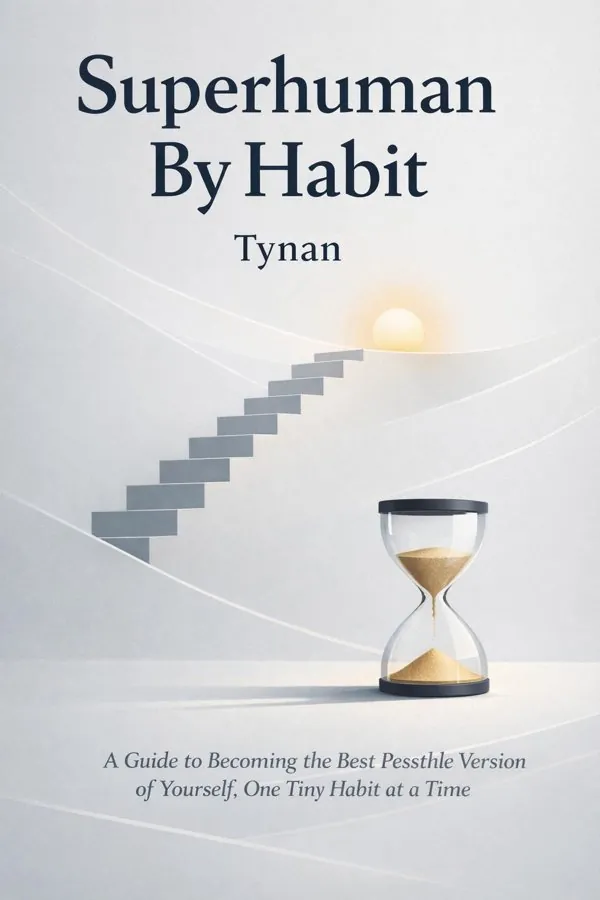
Superhuman By Habit: A Guide to Becoming the Best Possible Version of Yourself, One Tiny Habit at a Time: Summary & Key Insights
by Tynan
 10 min9 chaptersAudio available
Key Takeaways from Superhuman By Habit: A Guide to Becoming the Best Possible Version of Yourself, One Tiny Habit at a Time
Most people overestimate how much progress can come from a burst of motivation and underestimate how much can come from automation.
One of the biggest reasons people fail at change is that they confuse seriousness with size.
People often abandon good habits not because the habits are ineffective, but because they cannot perform them perfectly.
A habit usually does not fail at the moment you begin it.
Many people think they need to feel like a new person before they can act differently.
What Is Superhuman By Habit: A Guide to Becoming the Best Possible Version of Yourself, One Tiny Habit at a Time About?
Superhuman By Habit: A Guide to Becoming the Best Possible Version of Yourself, One Tiny Habit at a Time by Tynan is a habits book spanning 5 pages. Superhuman By Habit is a practical guide to personal transformation built on a simple but profound idea: the quality of your life is largely determined by what you do automatically. Rather than asking readers to become more motivated, more intense, or more disciplined in the moment, Tynan argues that the real path to lasting improvement is to design habits that make good behavior almost inevitable. The book combines philosophy, psychology, and hands-on strategy to show how tiny, consistent actions can produce extraordinary long-term results. What makes the book valuable is its realism. Tynan does not treat self-improvement as an emotional breakthrough or a dramatic reinvention. He treats it as a system. He explains why people fail when they rely on willpower, why small habits succeed where ambitious plans collapse, and how carefully chosen routines can improve health, productivity, relationships, finances, and peace of mind. As a writer, entrepreneur, and long-time experimenter in intentional living, Tynan brings credibility through experience. His message is both empowering and demanding: you do not need to become a different person overnight, but you do need to build behaviors that your future self can depend on.
This FizzRead summary covers all 9 key chapters of Superhuman By Habit: A Guide to Becoming the Best Possible Version of Yourself, One Tiny Habit at a Time in approximately 10 minutes, distilling the most important ideas, arguments, and takeaways from Tynan's work. Also available as an audio summary and Key Quotes Podcast.
Superhuman By Habit: A Guide to Becoming the Best Possible Version of Yourself, One Tiny Habit at a Time
Superhuman By Habit is a practical guide to personal transformation built on a simple but profound idea: the quality of your life is largely determined by what you do automatically. Rather than asking readers to become more motivated, more intense, or more disciplined in the moment, Tynan argues that the real path to lasting improvement is to design habits that make good behavior almost inevitable. The book combines philosophy, psychology, and hands-on strategy to show how tiny, consistent actions can produce extraordinary long-term results.
What makes the book valuable is its realism. Tynan does not treat self-improvement as an emotional breakthrough or a dramatic reinvention. He treats it as a system. He explains why people fail when they rely on willpower, why small habits succeed where ambitious plans collapse, and how carefully chosen routines can improve health, productivity, relationships, finances, and peace of mind. As a writer, entrepreneur, and long-time experimenter in intentional living, Tynan brings credibility through experience. His message is both empowering and demanding: you do not need to become a different person overnight, but you do need to build behaviors that your future self can depend on.
Who Should Read Superhuman By Habit: A Guide to Becoming the Best Possible Version of Yourself, One Tiny Habit at a Time?
This book is perfect for anyone interested in habits and looking to gain actionable insights in a short read. Whether you're a student, professional, or lifelong learner, the key ideas from Superhuman By Habit: A Guide to Becoming the Best Possible Version of Yourself, One Tiny Habit at a Time by Tynan will help you think differently.
- ✓Readers who enjoy habits and want practical takeaways
- ✓Professionals looking to apply new ideas to their work and life
- ✓Anyone who wants the core insights of Superhuman By Habit: A Guide to Becoming the Best Possible Version of Yourself, One Tiny Habit at a Time in just 10 minutes
Want the full summary?
Get instant access to this book summary and 100K+ more with Fizz Moment.
Get Free SummaryAvailable on App Store • Free to download
Key Chapters
Most people overestimate how much progress can come from a burst of motivation and underestimate how much can come from automation. That is the central insight behind Tynan’s approach. Willpower feels powerful because it is emotionally vivid: it shows up in dramatic moments when you force yourself to resist temptation, wake up early, or push through discomfort. But in practice, willpower is fragile. It is affected by stress, fatigue, hunger, mood, and decision overload. When your plan for self-improvement depends on feeling strong every day, your progress becomes unpredictable.
Habits solve this problem by shifting behavior out of the arena of constant decision-making. Instead of asking, “Will I do the right thing today?” you begin to act in a way that makes the question less relevant. A person with an exercise habit does not negotiate with themselves every morning. A person with a saving habit does not reinvent their financial plan every month. The action becomes normal, expected, and easier to perform than to avoid.
Tynan’s larger point is that successful people are not always exerting more effort in the moment. Often, they have simply built lives that require less effort to stay on track. For example, someone who automatically prepares tomorrow’s lunch after dinner removes the need for morning discipline. Someone who writes for fifteen minutes at the same time each day avoids the emotional drag of waiting for inspiration.
The takeaway is practical: stop building your life around heroic effort. Pick one behavior you currently try to force through willpower and redesign it as a repeatable habit tied to a reliable cue.
One of the biggest reasons people fail at change is that they confuse seriousness with size. We imagine that meaningful improvement must begin with an ambitious plan: a two-hour workout routine, a complete diet overhaul, a strict budget, a flawless morning ritual. Tynan argues the opposite. If you want a habit to survive, it must begin at a scale that feels almost too easy.
This is not laziness or lack of ambition. It is strategy. Large changes create internal resistance because they demand too much energy, attention, and emotional adjustment at once. A tiny habit, by contrast, slips past that resistance. Reading one page is easier than reading thirty. Doing five push-ups is easier than committing to a full gym program. Tracking every expense may feel overwhelming, but checking your bank balance each evening is manageable.
Small habits work because they prioritize consistency over intensity. Once a behavior becomes regular, it can grow. But if you start with a habit so demanding that you break it repeatedly, you are not building discipline; you are training yourself to quit. Tynan’s approach respects the psychology of change. The first goal is not maximum performance. It is establishing a pattern your brain accepts as part of normal life.
A good example is meditation. Many beginners promise themselves twenty minutes a day and stop within a week. A two-minute practice done daily, however, creates identity and continuity. Over time, the person starts seeing themselves as someone who meditates, and increasing duration becomes far easier.
The actionable lesson is clear: reduce your target habit until failure feels almost unreasonable. Build a winning streak first. Expansion can come later.
People often abandon good habits not because the habits are ineffective, but because they cannot perform them perfectly. Tynan challenges this all-or-nothing mindset. A habit does not need to be impressive to be valuable; it needs to be repeated. Consistency is the engine of transformation because it compounds over time, while perfection usually creates pressure, guilt, and eventual dropout.
This insight is especially important when life becomes messy. Travel, illness, deadlines, family demands, and low-energy days will interrupt even the best routines. If your standard is perfection, any disruption feels like failure. But if your standard is continuity, you can adapt without breaking the chain. A shortened workout still counts. A rough journal entry still counts. Saving a small amount still counts. The point is to preserve the identity and rhythm of the behavior.
Tynan’s philosophy helps readers avoid the common trap of emotional overreaction. Missing one day becomes dangerous only when it turns into a story: “I am off track,” “I always do this,” “I’ll start again next week.” Habit builders learn to respond differently. They treat lapses as logistical problems rather than moral failures. If the routine broke, what needs to be adjusted so it becomes easier to continue?
Imagine someone trying to write every day. On a busy day, writing 500 words may be impossible. But writing 50 words preserves momentum. Over a year, that flexibility matters more than occasional bursts of brilliance followed by long gaps.
The key takeaway: define habits in a way that allows for bad days. Make your system resilient enough that you can keep going imperfectly rather than stopping entirely.
A habit usually does not fail at the moment you begin it. It fails at the moment reality pushes back. Tynan emphasizes that if you want a behavior to last, you must think ahead about friction, temptation, inconvenience, and distraction. The most effective habit builders are not simply determined; they are prepared.
This means identifying what will likely interfere with your plan before those obstacles arise. If you intend to cook healthy meals, what happens when you are exhausted after work? If you want to run in the morning, what happens when the weather is bad or you sleep poorly? If you plan to read every night, what happens when your phone is within reach? By anticipating these moments, you reduce the chance that a temporary obstacle becomes a permanent excuse.
Practical design matters. Put running clothes beside the bed. Keep fruit visible and junk food out of immediate reach. Use automatic transfers for saving. Prepare a backup version of your habit for low-energy days. Create environmental defaults that support your intentions. Tynan’s approach is grounded in the idea that behavior is shaped not just by inner resolve but by outer structure.
This mindset also encourages self-honesty. Instead of telling yourself that you will “just try harder,” you admit that your future self will be busy, distracted, and imperfect. That is not weakness; it is normal. Habit systems should be built for real humans, not idealized versions of ourselves.
The actionable takeaway is to stress-test each habit in advance. Ask: what are the three most likely reasons this will fail, and what system can I put in place now to protect against them?
Many people think they need to feel like a new person before they can act differently. Tynan flips this idea upside down. You do not build habits by first changing your identity; you build identity by repeatedly performing the habit. In other words, the way you prove to yourself who you are is through behavior, not intention.
This matters because self-image quietly influences everything. If you think of yourself as disorganized, unhealthy, unreliable, or undisciplined, you may unconsciously act in ways that confirm that story. But every repeated habit becomes a vote for a different identity. Preparing your meals says, “I am someone who takes care of my body.” Reviewing your finances says, “I am someone who pays attention.” Writing daily says, “I am a writer.” The action may seem small, but the psychological effect is deep.
Tynan’s perspective helps remove the emotional drama from self-improvement. You do not need to announce a new personality or wait until you feel transformed. You just need evidence. Small, consistent behaviors provide that evidence. Over time, the identity becomes more believable because it has been practiced.
This also explains why breaking promises to yourself feels so damaging. It is not only the missed action that hurts; it is the identity message attached to it. Conversely, following through on tiny commitments creates trust in yourself, which strengthens future action.
The practical lesson is to choose habits that support the kind of person you want to become, then perform them consistently enough that the identity starts to feel natural. Do not ask, “Who am I?” Ask, “What does that person do regularly?”
Not all habits have equal value. Some improve one part of life, while others trigger benefits across many areas. Tynan encourages readers to identify habits with cascading effects, because these produce disproportionate returns. A single well-chosen routine can improve energy, mood, focus, relationships, and self-respect all at once.
Consider sleep. Going to bed on time is not just a sleep habit. It affects emotional regulation, eating choices, productivity, patience, and physical health the next day. Exercise does something similar: it can boost confidence, improve mental clarity, reduce stress, and support better sleep. Planning your day each morning can lower anxiety, increase output, and make evenings more relaxed. These are keystone habits because they create positive chains.
Tynan’s emphasis on leverage helps readers avoid spreading themselves too thin. Instead of trying to improve ten areas at once, focus on the few habits that naturally make other good behaviors easier. Someone who starts meal prepping may also spend less money, eat healthier, and feel more in control. Someone who begins journaling may become more self-aware, communicate better, and make wiser decisions.
This idea also works in reverse. Certain negative habits create destructive chains: poor sleep leads to caffeine overload, poor food choices, irritability, and skipped workouts. The question is not simply whether a habit is good or bad in isolation, but what else it tends to bring with it.
Your takeaway is to audit your routines for leverage. Ask which one habit, if practiced consistently, would make several other important behaviors easier. Start there to maximize momentum.
Behavior is often less about values than about convenience. Even when we genuinely want to make better choices, we usually drift toward what is easiest in the moment. Tynan understands this and treats friction as one of the most important forces in habit formation. The easier a habit is to start, the more likely it is to happen.
This is why environment and preparation matter so much. If your guitar is packed away in a closet, you will practice less. If healthy ingredients require a complicated trip to the store, you will order takeout more often. If your budgeting app takes ten steps to open, you will avoid looking at your spending. Small inconveniences may seem trivial, but repeated daily, they shape behavior dramatically.
Tynan’s method is to make desired habits absurdly accessible. Keep the book on your pillow if you want to read at night. Fill a water bottle in advance and leave it on your desk. Open the document you plan to work on before going to bed. Set up automatic investing. Use website blockers during work sessions. In each case, the habit becomes easier to begin because the setup cost has already been paid.
Equally important is adding friction to bad habits. Logging out of distracting apps, keeping unhealthy snacks out of the house, or charging your phone in another room can dramatically reduce impulsive behavior. You do not need perfect self-control if the environment no longer constantly tempts you.
The actionable takeaway is simple: identify one good habit you want to strengthen and remove at least two sources of friction from it today. Make the right choice the path of least resistance.
What gets measured often improves, but what gets overmeasured can become exhausting. Tynan takes a balanced approach to tracking habits. Measurement is useful because it provides clarity. It turns vague intention into visible reality. You may think you exercise regularly, save consistently, or study enough, but tracking reveals whether that belief is true. A simple record also strengthens motivation by showing streaks, patterns, and progress over time.
At the same time, Tynan does not treat tracking as the goal. The purpose of measurement is to support behavior, not to become another perfectionist burden. If your system is so complex that logging the habit becomes harder than doing it, the system is broken. A calendar mark, checklist, spreadsheet, or app can help, but only if it stays lightweight and sustainable.
Tracking is especially powerful during the early stages of a habit, when the behavior is not yet automatic. It provides external accountability and helps you notice what conditions support success. Maybe you see that workouts happen more consistently when scheduled before work. Maybe you realize your reading habit disappears on nights when you watch television first. These insights allow adjustment.
The emotional side matters too. Data can be grounding. Instead of relying on feelings like “I am failing” or “I have not done enough,” you can look at the record and respond intelligently. Three missed days in two months is not collapse; it is feedback.
The key takeaway is to track in the simplest way possible. Use measurement to encourage honesty and improvement, but keep the system light enough that it supports the habit rather than replacing it.
The most dangerous misunderstanding about habits is that small actions do not matter. Tynan shows that they matter precisely because they are small enough to repeat. The power of habits is not found in any single instance, but in accumulation. Tiny actions, performed day after day, create outcomes that look dramatic only in hindsight.
This is the logic of compounding. Saving a modest amount consistently can grow into meaningful financial security. Ten pages of reading a day can become dozens of books a year. A daily walk can improve weight, mood, and energy over time. Writing a paragraph a day can eventually become a manuscript. None of these actions feels life-changing in the moment, which is why people underestimate them. But repeated over months and years, they reshape reality.
Tynan’s message is ultimately hopeful because it replaces the fantasy of overnight change with something more reliable. You do not need a radical personality shift or a perfect season of life. You need a system of actions that is small enough to sustain and valuable enough to compound. This perspective also builds patience. Results may appear slow at first, but that does not mean the habit is failing. Often the visible payoff arrives later, after a long period of invisible growth.
This is true not just externally but internally. Small habits build confidence, self-trust, and identity. The more often you follow through, the more capable you feel, and that feeling supports further action.
The actionable takeaway: choose one habit whose benefits are easy to dismiss because they seem too small, and commit to it for long enough to let compounding do its work.
All Chapters in Superhuman By Habit: A Guide to Becoming the Best Possible Version of Yourself, One Tiny Habit at a Time
About the Author
Tynan is an author, entrepreneur, and traveler known for his thoughtful approach to self-improvement, productivity, and intentional living. His work often explores how small behavioral changes, clear systems, and conscious design can help people live more effective and fulfilling lives. Rather than focusing on motivation or extreme discipline, he is best known for emphasizing practical habits that create long-term results. Tynan has written about topics such as minimalism, lifestyle design, decision-making, and personal development, often drawing from his own experiments and unconventional life choices. In Superhuman By Habit, he brings that perspective to the science and strategy of habit formation, offering readers a grounded framework for becoming more consistent, capable, and deliberate in everyday life.
Get This Summary in Your Preferred Format
Read or listen to the Superhuman By Habit: A Guide to Becoming the Best Possible Version of Yourself, One Tiny Habit at a Time summary by Tynan anytime, anywhere. FizzRead offers multiple formats so you can learn on your terms — all free.
Available formats: App · Audio · PDF · EPUB — All included free with FizzRead
Download Superhuman By Habit: A Guide to Becoming the Best Possible Version of Yourself, One Tiny Habit at a Time PDF and EPUB Summary
Key Quotes from Superhuman By Habit: A Guide to Becoming the Best Possible Version of Yourself, One Tiny Habit at a Time
“Most people overestimate how much progress can come from a burst of motivation and underestimate how much can come from automation.”
“One of the biggest reasons people fail at change is that they confuse seriousness with size.”
“People often abandon good habits not because the habits are ineffective, but because they cannot perform them perfectly.”
“A habit usually does not fail at the moment you begin it.”
“Many people think they need to feel like a new person before they can act differently.”
Frequently Asked Questions about Superhuman By Habit: A Guide to Becoming the Best Possible Version of Yourself, One Tiny Habit at a Time
Superhuman By Habit: A Guide to Becoming the Best Possible Version of Yourself, One Tiny Habit at a Time by Tynan is a habits book that explores key ideas across 9 chapters. Superhuman By Habit is a practical guide to personal transformation built on a simple but profound idea: the quality of your life is largely determined by what you do automatically. Rather than asking readers to become more motivated, more intense, or more disciplined in the moment, Tynan argues that the real path to lasting improvement is to design habits that make good behavior almost inevitable. The book combines philosophy, psychology, and hands-on strategy to show how tiny, consistent actions can produce extraordinary long-term results. What makes the book valuable is its realism. Tynan does not treat self-improvement as an emotional breakthrough or a dramatic reinvention. He treats it as a system. He explains why people fail when they rely on willpower, why small habits succeed where ambitious plans collapse, and how carefully chosen routines can improve health, productivity, relationships, finances, and peace of mind. As a writer, entrepreneur, and long-time experimenter in intentional living, Tynan brings credibility through experience. His message is both empowering and demanding: you do not need to become a different person overnight, but you do need to build behaviors that your future self can depend on.
You Might Also Like

Atomic Habits: An Easy & Proven Way to Build Good Habits and Break Bad Ones
James Clear
10 min
A Complaint Free World: How to Stop Complaining and Start Enjoying the Life You Always Wanted
Will Bowen
10 minBadass Habits: Cultivate the Awareness, Boundaries, and Daily Upgrades You Need to Make Them Stick
Jen Sincero
10 min
Better Than Before: Mastering The Habits Of Our Everyday Lives
Gretchen Rubin
10 min
Change Anything: The New Science of Personal Success
Kerry Patterson
10 min
Discipline Equals Freedom: Field Manual
Jocko Willink
10 minBrowse by Category
Ready to read Superhuman By Habit: A Guide to Becoming the Best Possible Version of Yourself, One Tiny Habit at a Time?
Get the full summary and 100K+ more books with Fizz Moment.