
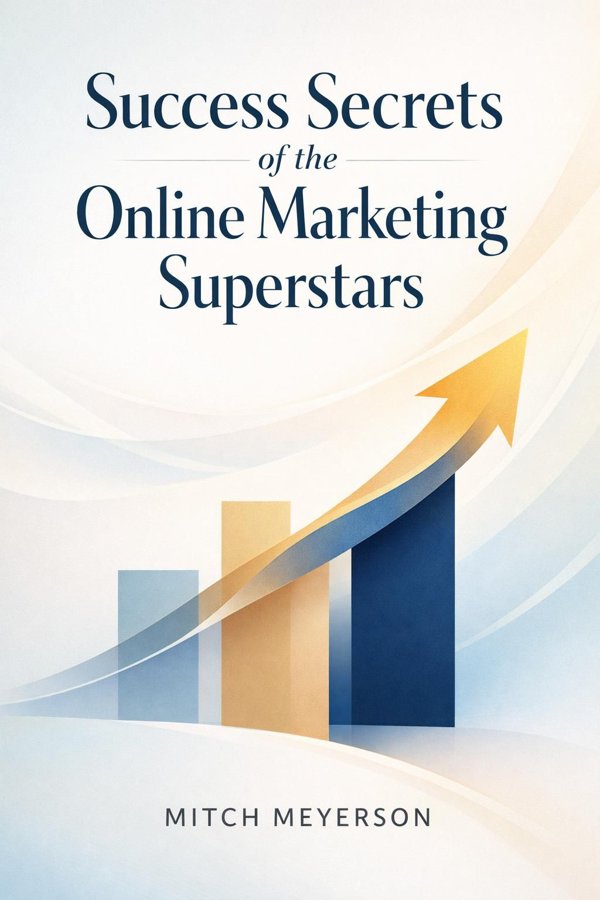
Success Secrets of the Online Marketing Superstars: Summary & Key Insights
 10 min9 chaptersAudio available
Key Takeaways from Success Secrets of the Online Marketing Superstars
The most important change in modern business is not that marketing moved online, but that power moved toward the customer.
In crowded markets, people often buy clarity before they buy products.
A beautiful website that confuses visitors is more dangerous than a simple website that guides them well.
People rarely trust what they have not experienced, and content is how prospects experience your thinking before they ever buy.
Attention is rented on social media, but relationships are owned through systems.
What Is Success Secrets of the Online Marketing Superstars About?
Success Secrets of the Online Marketing Superstars by Mitch Meyerson is a marketing book spanning 7 pages. Success in online marketing rarely comes from a single tactic. It comes from understanding how visibility, trust, relationships, technology, and conversion all work together. In Success Secrets of the Online Marketing Superstars, Mitch Meyerson brings together the wisdom of leading digital entrepreneurs and marketers to show how top performers build audiences, create authority, and turn attention into revenue. Rather than presenting online marketing as a collection of disconnected tools, the book frames it as an evolving system where branding, content, websites, email, traffic, partnerships, and analytics all reinforce one another. What makes the book especially valuable is its practical, expert-driven perspective. Meyerson is not writing as a distant theorist. He is an author, speaker, coach, and longtime business strategist who has spent years studying how successful entrepreneurs market themselves online. That experience allows him to curate advice that is both inspiring and usable. For business owners, creators, consultants, and marketers trying to stand out in a crowded digital world, this book offers a clear message: the internet rewards those who combine authenticity, strategy, and consistent execution.
This FizzRead summary covers all 9 key chapters of Success Secrets of the Online Marketing Superstars in approximately 10 minutes, distilling the most important ideas, arguments, and takeaways from Mitch Meyerson's work. Also available as an audio summary and Key Quotes Podcast.
Success Secrets of the Online Marketing Superstars
Success in online marketing rarely comes from a single tactic. It comes from understanding how visibility, trust, relationships, technology, and conversion all work together. In Success Secrets of the Online Marketing Superstars, Mitch Meyerson brings together the wisdom of leading digital entrepreneurs and marketers to show how top performers build audiences, create authority, and turn attention into revenue. Rather than presenting online marketing as a collection of disconnected tools, the book frames it as an evolving system where branding, content, websites, email, traffic, partnerships, and analytics all reinforce one another.
What makes the book especially valuable is its practical, expert-driven perspective. Meyerson is not writing as a distant theorist. He is an author, speaker, coach, and longtime business strategist who has spent years studying how successful entrepreneurs market themselves online. That experience allows him to curate advice that is both inspiring and usable. For business owners, creators, consultants, and marketers trying to stand out in a crowded digital world, this book offers a clear message: the internet rewards those who combine authenticity, strategy, and consistent execution.
Who Should Read Success Secrets of the Online Marketing Superstars?
This book is perfect for anyone interested in marketing and looking to gain actionable insights in a short read. Whether you're a student, professional, or lifelong learner, the key ideas from Success Secrets of the Online Marketing Superstars by Mitch Meyerson will help you think differently.
- ✓Readers who enjoy marketing and want practical takeaways
- ✓Professionals looking to apply new ideas to their work and life
- ✓Anyone who wants the core insights of Success Secrets of the Online Marketing Superstars in just 10 minutes
Want the full summary?
Get instant access to this book summary and 100K+ more with Fizz Moment.
Get Free SummaryAvailable on App Store • Free to download
Key Chapters
The most important change in modern business is not that marketing moved online, but that power moved toward the customer. Traditional media allowed companies to broadcast messages at scale, but digital platforms created something far more disruptive: conversation, choice, and instant comparison. In this new environment, businesses can no longer rely on repetition alone. They must earn attention through relevance, usefulness, and trust.
Mitch Meyerson shows how this shift opened the door for digital entrepreneurs who may not have large budgets but do have expertise, personality, and the ability to connect directly with niche audiences. Online marketing rewards speed, experimentation, and authenticity. A solo consultant can build authority through blogs, webinars, and social media. A small e-commerce store can compete with larger brands through search optimization, email sequences, and community-building. A coach can turn knowledge into products, memberships, and recurring client relationships.
The deeper lesson is that the internet reduced distribution barriers but increased competition for attention. That means success depends less on having the loudest message and more on having the clearest promise for a specific audience. Instead of asking, “How do I reach everyone?” the smarter question becomes, “How do I become indispensable to the right people?”
A practical application is to revisit your marketing through the lens of dialogue rather than promotion. Are you inviting response? Are you solving a concrete problem? Are you using platforms where your audience already spends time? Businesses that understand the digital shift stop treating marketing as interruption and start treating it as relationship-building.
Actionable takeaway: define one target audience segment, identify its top three pressing problems, and align your messaging, content, and offers around solving those problems better than anyone else.
In crowded markets, people often buy clarity before they buy products. A strong online brand is not just a logo, color palette, or polished website. It is the emotional and intellectual impression people form when they encounter your name, your message, and your work. Meyerson emphasizes that authority online is built deliberately, through consistency, credibility, and visible expertise.
The experts featured in the book point toward a simple truth: trust grows when your public presence sends one coherent message. If your website says one thing, your social channels say another, and your offers feel disconnected, your audience hesitates. But when your positioning is clear, your values are visible, and your communication is consistent, people start to recognize you as a category leader rather than another option.
This kind of authority does not require celebrity status. It can be built through teaching, sharing informed opinions, publishing useful content, speaking on podcasts, or offering case studies that demonstrate real outcomes. For example, a fitness coach might become known for helping busy professionals build short, sustainable routines. A marketing consultant might focus specifically on email funnels for creators. The narrower the promise, the easier it is to become memorable.
Brand-building also means deciding what you want to be known for and what you will not chase. Many online businesses weaken their authority by trying to appeal to everyone. Strong brands make deliberate choices. They create a voice, set expectations, and reinforce a recognizable point of view across every customer touchpoint.
Actionable takeaway: write a one-sentence brand promise that states who you help, what problem you solve, and what makes your approach distinctive, then use it consistently across your website, bio, and marketing materials.
A beautiful website that confuses visitors is more dangerous than a simple website that guides them well. Meyerson treats the website as the central hub of an online business, but he makes clear that traffic alone means little if visitors do not know what to do next. Design matters, yet design must serve conversion.
High-converting websites are built around user experience. That means clarity of navigation, compelling headlines, obvious calls to action, fast load times, mobile compatibility, and messaging that immediately answers the visitor’s silent questions: What is this? Is it for me? Why should I trust it? What should I do now? When these answers are missing, bounce rates rise and opportunities disappear.
A practical website strategy begins with prioritizing outcomes. If your goal is lead generation, your site should prominently feature a free resource, consultation booking, or newsletter sign-up. If your goal is e-commerce, product pages must include sharp benefits, strong images, social proof, and minimal friction at checkout. If your goal is authority-building, the site should make content, testimonials, and media appearances easy to find.
Meyerson’s broader point is that websites should be tested, not admired. The best marketers do not assume they know what will work. They compare headlines, forms, button text, page layouts, and offers to see what actually moves behavior. Small changes, such as reducing form fields or rewriting a value proposition, can dramatically improve conversion rates.
Actionable takeaway: audit your homepage and ask whether a first-time visitor can understand your offer and next step within five seconds; if not, simplify your headline, sharpen your call to action, and remove unnecessary distractions.
People rarely trust what they have not experienced, and content is how prospects experience your thinking before they ever buy. One of the book’s strongest themes is that content marketing is not filler for websites or social feeds. It is the mechanism by which expertise becomes visible, searchable, shareable, and scalable.
Meyerson highlights storytelling as especially powerful because facts inform, but stories persuade. Audiences remember transformation more than theory. A case study showing how a struggling business doubled leads through better email segmentation will often have more impact than a generic article about email best practices. Stories create emotional relevance, and relevance drives engagement.
Good content also performs multiple jobs at once. A blog post can attract search traffic, support email nurturing, provide material for social snippets, and reinforce authority during the sales process. A webinar can generate leads, answer objections, and position a premium offer. A short video can humanize a brand, simplify a complex concept, and build familiarity quickly.
The key is alignment. Content should not be created just to maintain activity. It should connect directly to audience pain points and business goals. Educational content builds trust at the top of the funnel. Comparison content helps prospects evaluate solutions. Success stories reduce hesitation. Opinion pieces sharpen positioning.
In practical terms, businesses can build momentum by choosing a few core themes tied to their offers. A financial advisor might focus on retirement planning, tax-smart investing, and common money mistakes. Over time, repeated value in a defined area creates authority almost automatically.
Actionable takeaway: choose three content pillars linked to your expertise, then publish one helpful piece each week that answers a real customer question and leads naturally toward your offer.
Getting found online is not the same as building a business. One of the book’s practical strengths is its emphasis on turning visibility into profit. Meyerson explores search engine optimization, paid advertising, and affiliate relationships as traffic engines, but his larger message is that acquisition only matters when it connects to a clear conversion strategy.
SEO is powerful because it captures intent. When someone searches for a solution, they are already signaling interest. Businesses that optimize pages around the right keywords, answer common questions, and structure content clearly can build long-term traffic without paying for every click. However, SEO is a long game. It requires patience, relevance, and technical consistency.
Paid traffic offers speed and precision. Ads on search engines or social platforms can put an offer in front of the right audience quickly. But paid campaigns fail when the economics are ignored. If clicks are expensive, landing pages weak, and offers unclear, ad spend disappears fast. Successful marketers test audiences, creatives, and landing pages carefully, then scale only after the numbers make sense.
Affiliate marketing introduces leverage through partnerships. Instead of promoting only through your own channels, you enlist others with trusted audiences to recommend your products in exchange for commissions. This can accelerate growth, especially when affiliates genuinely believe in the offer.
The common thread is strategic alignment. Traffic generation is only effective when it feeds an optimized funnel with a compelling value proposition and measurable results.
Actionable takeaway: choose one primary traffic source for the next quarter, define the conversion step you want from that traffic, and track cost, lead quality, and sales before expanding into additional channels.
What separates professional online marketers from amateurs is not creativity alone, but feedback discipline. Meyerson stresses that digital business creates an unprecedented advantage: nearly everything can be measured. Traffic sources, click-through rates, email opens, conversion rates, cart abandonment, retention, and customer lifetime value all offer clues about what is working and what is quietly failing.
The challenge is that data can either clarify decisions or overwhelm them. Smart marketers focus on metrics that connect directly to business outcomes. Vanity metrics such as raw follower counts may look impressive, but they mean little if engagement is weak and revenue is stagnant. More useful numbers include conversion rate by traffic source, cost per acquisition, average order value, and lead-to-customer percentage.
Optimization begins with curiosity. Why are visitors leaving this page? Why do webinar registrations rise when the headline changes? Why do certain emails produce more replies? Testing turns these questions into growth. A/B testing subject lines, offer framing, pricing presentation, or page layouts can reveal what resonates with an audience far better than opinion can.
Meyerson also points toward the future of digital business: adaptability. Platforms change, algorithms shift, and consumer behaviors evolve. Businesses that develop a culture of measurement can respond intelligently rather than react emotionally. They learn faster than competitors because they treat every campaign as an experiment.
Actionable takeaway: build a simple weekly dashboard with five key metrics tied to your business goals, review it consistently, and identify one small improvement test to run each week based on the results.
Growth accelerates when trust is borrowed from people who already have the audience you want to serve. While many marketers focus narrowly on their own channels, Meyerson’s collection of superstar insights highlights the strategic power of partnerships, joint ventures, and influence networks. Online success is often less about doing everything alone and more about creating mutually beneficial alliances.
Partnerships work because they reduce skepticism and expand exposure at the same time. If a respected blogger, coach, podcaster, or industry expert recommends your product, that endorsement can shorten the trust-building cycle dramatically. Instead of starting from zero, you enter the relationship with borrowed authority. This is especially valuable for newer brands trying to establish credibility quickly.
There are many forms of partnership. Two experts can co-host a webinar and cross-promote to each other’s lists. A software company can create an affiliate program for consultants who serve the same audience. A service provider can guest post or appear on podcasts to introduce their expertise to a qualified market. Even strategic referrals between non-competing businesses can create steady growth.
The key is relevance and reciprocity. Bad partnerships feel transactional and misaligned. Strong partnerships are built on audience fit, shared values, and clear benefits for both sides. They work best when each party genuinely improves the other’s customer experience.
Actionable takeaway: identify five complementary businesses or creators who serve your audience without directly competing with you, then propose one simple collaboration such as a guest appearance, co-created resource, or referral arrangement.
Online marketing often appears to be about persuasion, but its deepest success driver is service. Across the expert advice Meyerson gathers, a recurring message emerges: sustainable digital businesses are built by helping people make better decisions, solve meaningful problems, and feel understood. Short-term tricks may generate spikes in attention, but authenticity creates loyalty, referrals, and repeat revenue.
Authenticity in this context does not mean sharing everything or avoiding professional polish. It means aligning message, behavior, and offer. If your marketing promises personal attention but your customer experience feels automated and indifferent, trust erodes. If your content teaches generously and your product delivers real value, trust grows. Over time, markets reward that consistency.
Service-driven marketing also changes how businesses think about selling. Instead of forcing urgency or leaning on manipulation, the best marketers clarify stakes, reduce confusion, and make the path forward easier. For example, a consultant can offer honest diagnostics before pitching services. A course creator can explain who the product is and is not for. An e-commerce brand can invest in clear FAQs, responsive support, and useful post-purchase communication.
This approach builds more than conversions. It builds reputation. In digital environments where reviews, screenshots, and public commentary shape perception quickly, genuine care becomes a competitive advantage.
Actionable takeaway: review your customer journey from first click to post-purchase follow-up and ask where you can replace friction, ambiguity, or hype with clarity, usefulness, and a stronger sense of human care.
All Chapters in Success Secrets of the Online Marketing Superstars
About the Author
Mitch Meyerson is an author, speaker, trainer, and business coach known for his work in online marketing, entrepreneurship, and personal development. Over the course of his career, he has helped professionals and business owners understand how to communicate their value, build stronger brands, and adapt to a rapidly changing digital marketplace. He has written several books and educational resources focused on growth, visibility, and business strategy, often blending practical marketing advice with motivational insight. Meyerson is especially effective at translating expert knowledge into accessible lessons that entrepreneurs can apply immediately. In Success Secrets of the Online Marketing Superstars, he draws on both his own experience and the perspectives of leading digital marketers to present a useful roadmap for building authority and achieving results online.
Get This Summary in Your Preferred Format
Read or listen to the Success Secrets of the Online Marketing Superstars summary by Mitch Meyerson anytime, anywhere. FizzRead offers multiple formats so you can learn on your terms — all free.
Available formats: App · Audio · PDF · EPUB — All included free with FizzRead
Download Success Secrets of the Online Marketing Superstars PDF and EPUB Summary
Key Quotes from Success Secrets of the Online Marketing Superstars
“The most important change in modern business is not that marketing moved online, but that power moved toward the customer.”
“In crowded markets, people often buy clarity before they buy products.”
“A beautiful website that confuses visitors is more dangerous than a simple website that guides them well.”
“People rarely trust what they have not experienced, and content is how prospects experience your thinking before they ever buy.”
“Attention is rented on social media, but relationships are owned through systems.”
Frequently Asked Questions about Success Secrets of the Online Marketing Superstars
Success Secrets of the Online Marketing Superstars by Mitch Meyerson is a marketing book that explores key ideas across 9 chapters. Success in online marketing rarely comes from a single tactic. It comes from understanding how visibility, trust, relationships, technology, and conversion all work together. In Success Secrets of the Online Marketing Superstars, Mitch Meyerson brings together the wisdom of leading digital entrepreneurs and marketers to show how top performers build audiences, create authority, and turn attention into revenue. Rather than presenting online marketing as a collection of disconnected tools, the book frames it as an evolving system where branding, content, websites, email, traffic, partnerships, and analytics all reinforce one another. What makes the book especially valuable is its practical, expert-driven perspective. Meyerson is not writing as a distant theorist. He is an author, speaker, coach, and longtime business strategist who has spent years studying how successful entrepreneurs market themselves online. That experience allows him to curate advice that is both inspiring and usable. For business owners, creators, consultants, and marketers trying to stand out in a crowded digital world, this book offers a clear message: the internet rewards those who combine authenticity, strategy, and consistent execution.
You Might Also Like
Captivology: The Science of Capturing People's Attention
Ben Parr
10 min
Marketing 5.0: Technology for Humanity
Philip Kotler, Hermawan Kartajaya, Iwan Setiawan
10 min
Marketing Strategy
Paul Fifield
10 min
UnMarketing: Stop Marketing. Start Engaging.
Scott Stratten
10 min
$100M Leads: How to Get Strangers to Want to Buy Your Stuff
Alex Hormozi
10 min
80/20 Sales and Marketing: The Definitive Guide to Working Less and Making More
Perry Marshall
10 minBrowse by Category
Ready to read Success Secrets of the Online Marketing Superstars?
Get the full summary and 100K+ more books with Fizz Moment.