
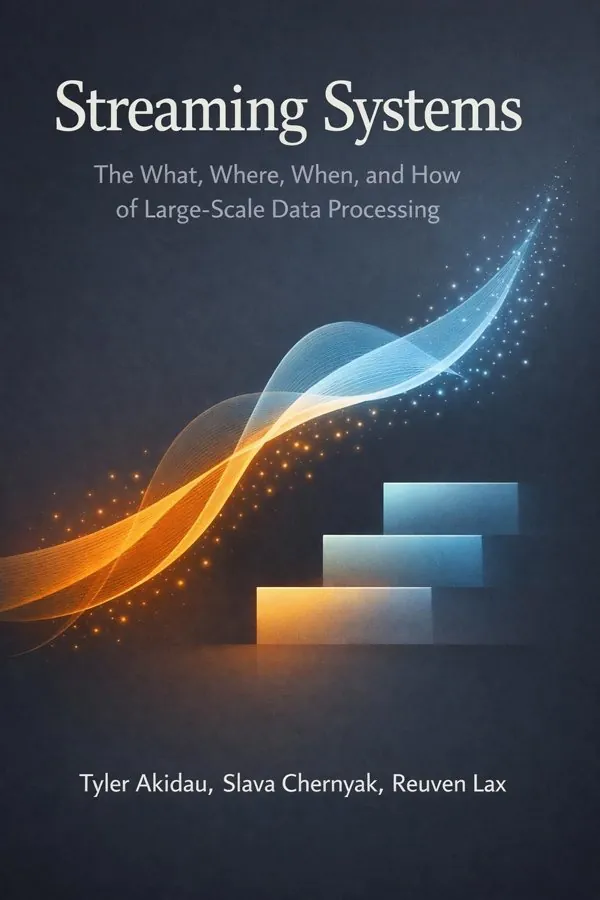
Streaming Systems: The What, Where, When, and How of Large-Scale Data Processing: Summary & Key Insights
by Tyler Akidau, Slava Chernyak, Reuven Lax
 10 min10 chaptersAudio available
What Is Streaming Systems: The What, Where, When, and How of Large-Scale Data Processing About?
Streaming Systems: The What, Where, When, and How of Large-Scale Data Processing by Tyler Akidau, Slava Chernyak, Reuven Lax is a data_science book spanning 10 pages. Streaming Systems explores the theory and practice of building large-scale data processing systems that handle unbounded, real-time data streams. The book introduces the fundamental concepts of stream processing, event time, and windowing, and provides practical guidance for designing robust, scalable, and maintainable streaming architectures. It draws on the authors’ experience developing Google’s data processing frameworks such as MillWheel and Apache Beam.
This FizzRead summary covers all 10 key chapters of Streaming Systems: The What, Where, When, and How of Large-Scale Data Processing in approximately 10 minutes, distilling the most important ideas, arguments, and takeaways from Tyler Akidau, Slava Chernyak, Reuven Lax's work. Also available as an audio summary and Key Quotes Podcast.
Streaming Systems: The What, Where, When, and How of Large-Scale Data Processing
Streaming Systems explores the theory and practice of building large-scale data processing systems that handle unbounded, real-time data streams. The book introduces the fundamental concepts of stream processing, event time, and windowing, and provides practical guidance for designing robust, scalable, and maintainable streaming architectures. It draws on the authors’ experience developing Google’s data processing frameworks such as MillWheel and Apache Beam.
Who Should Read Streaming Systems: The What, Where, When, and How of Large-Scale Data Processing?
This book is perfect for anyone interested in data_science and looking to gain actionable insights in a short read. Whether you're a student, professional, or lifelong learner, the key ideas from Streaming Systems: The What, Where, When, and How of Large-Scale Data Processing by Tyler Akidau, Slava Chernyak, Reuven Lax will help you think differently.
- ✓Readers who enjoy data_science and want practical takeaways
- ✓Professionals looking to apply new ideas to their work and life
- ✓Anyone who wants the core insights of Streaming Systems: The What, Where, When, and How of Large-Scale Data Processing in just 10 minutes
Want the full summary?
Get instant access to this book summary and 100K+ more with Fizz Moment.
Get Free SummaryAvailable on App Store • Free to download
Key Chapters
For decades, batch processing reigned supreme. Early systems like MapReduce were designed to chew through vast, bounded datasets. The implicit assumption was that the data had an end—that it could be collected, stored, and processed as a whole. While this model proved remarkably powerful, the world began to outgrow it.
Modern realities—user interactions on the web, IoT sensors, financial transactions, mobile apps—produce data continuously, unboundedly. Batch systems, in that sense, felt like snapshots of a living reality. They couldn’t keep up with a world in motion. We began to need insight not tomorrow but now.
This realization led to an ideological shift. Instead of viewing data as finite collections, we began to treat it as unending streams of events. Systems like MillWheel emerged to handle data in real time while maintaining correctness despite latency, network faults, and reordering. Yet this transition wasn’t simply about speed. It demanded rethinking computation itself—how to define completeness in a world that never stops producing data.
Streaming processing introduced a new mindset: to compute continuously and incrementally rather than periodically and exhaustively. It was a shift from taking static pictures to filming living processes.
Streaming data is unbounded. It has no natural conclusion, no ‘final record.’ Every second new events arrive, perhaps late, perhaps out of order, perhaps duplicated. That incessant flow introduces beautiful complexity. Traditional algorithms that assume a finite input suddenly break down when faced with infinity.
In writing this book, I wanted to help readers internalize this difference—not as an abstract concept, but as a practical foundation. In a batch system, you compute once you know all your data. In a streaming system, you never have all your data. The art lies in deciding when enough data is sufficient to emit meaningful results.
This results in a fundamental change in how we model processes. Unboundedness forces us to think in terms of continuous computation: we define what it means to process data as it arrives, and how to integrate updates over time. The elegance of streaming comes from embracing this open-endedness rather than fighting it.
+ 8 more chapters — available in the FizzRead app
All Chapters in Streaming Systems: The What, Where, When, and How of Large-Scale Data Processing
About the Authors
Tyler Akidau is a software engineer at Google and a founding member of the Apache Beam project. Slava Chernyak is a senior software engineer at Google specializing in large-scale data processing. Reuven Lax is a software engineer at Google and a committer on Apache Beam, with extensive experience in distributed systems and data pipelines.
Get This Summary in Your Preferred Format
Read or listen to the Streaming Systems: The What, Where, When, and How of Large-Scale Data Processing summary by Tyler Akidau, Slava Chernyak, Reuven Lax anytime, anywhere. FizzRead offers multiple formats so you can learn on your terms — all free.
Available formats: App · Audio · PDF · EPUB — All included free with FizzRead
Download Streaming Systems: The What, Where, When, and How of Large-Scale Data Processing PDF and EPUB Summary
Key Quotes from Streaming Systems: The What, Where, When, and How of Large-Scale Data Processing
“For decades, batch processing reigned supreme.”
“It has no natural conclusion, no ‘final record.”
Frequently Asked Questions about Streaming Systems: The What, Where, When, and How of Large-Scale Data Processing
Streaming Systems: The What, Where, When, and How of Large-Scale Data Processing by Tyler Akidau, Slava Chernyak, Reuven Lax is a data_science book that explores key ideas across 10 chapters. Streaming Systems explores the theory and practice of building large-scale data processing systems that handle unbounded, real-time data streams. The book introduces the fundamental concepts of stream processing, event time, and windowing, and provides practical guidance for designing robust, scalable, and maintainable streaming architectures. It draws on the authors’ experience developing Google’s data processing frameworks such as MillWheel and Apache Beam.
You Might Also Like
Data Science from Scratch: First Principles with Python
Joel Grus
10 min
Applied Predictive Modeling
Max Kuhn, Kjell Johnson
10 min
Better Data Visualizations: A Guide for Scholars, Researchers, and Wonks
Jonathan Schwabish
10 min
Big Data: A Revolution That Will Transform How We Live, Work, and Think
Viktor Mayer-Schönberger, Kenneth Cukier
10 min
Big Data: Principles and Best Practices of Scalable Real-Time Data Systems
Nathan Marz
10 min
Data Points: Visualization That Means Something
Nathan Yau
10 minBrowse by Category
Ready to read Streaming Systems: The What, Where, When, and How of Large-Scale Data Processing?
Get the full summary and 100K+ more books with Fizz Moment.