
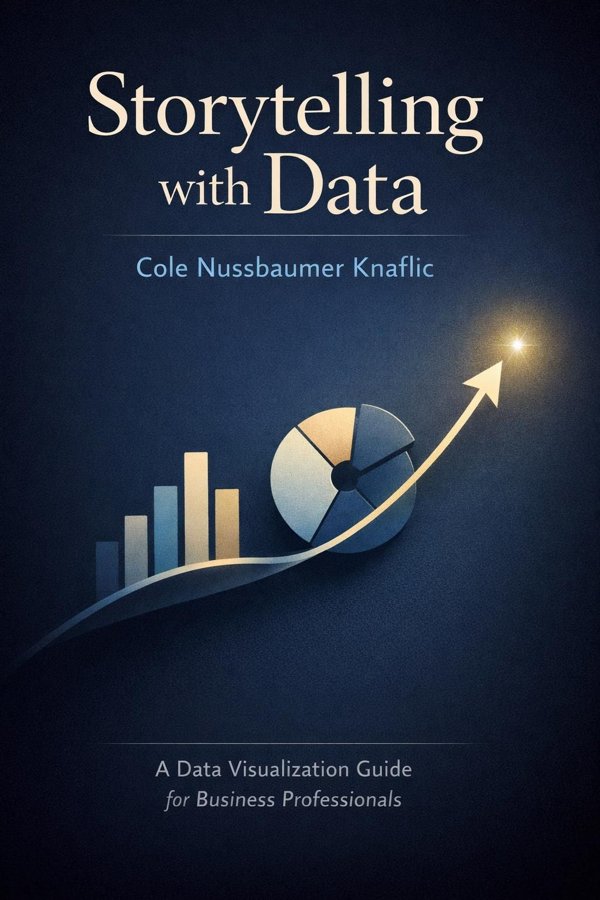
Storytelling with Data: A Data Visualization Guide for Business Professionals: Summary & Key Insights
 10 min9 chaptersAudio available
Key Takeaways from Storytelling with Data: A Data Visualization Guide for Business Professionals
The most common mistake in data communication happens before the first chart is even created: people begin with the data instead of the decision.
A chart is never just decoration; it is an argument in visual form.
What you remove from a chart is often more important than what you add.
People do not see charts all at once; their eyes move through them in sequence.
Insight alone does not guarantee communication.
What Is Storytelling with Data: A Data Visualization Guide for Business Professionals About?
Storytelling with Data: A Data Visualization Guide for Business Professionals by Cole Nussbaumer Knaflic is a data_science book spanning 8 pages. Storytelling with Data is a practical guide to one of the most overlooked business skills: turning analysis into understanding. Cole Nussbaumer Knaflic argues that data alone rarely changes minds. What persuades people is clear communication—visuals and narratives designed around a specific audience, a specific question, and a specific decision. Instead of treating charts as neutral outputs, she teaches readers to treat them as communication tools that must be shaped with purpose. The book matters because modern workplaces are flooded with dashboards, slides, and reports, yet very few of them actually help people act. Leaders are busy, stakeholders are distracted, and dense charts often create confusion rather than clarity. Knaflic shows how to eliminate clutter, direct attention, choose the right visual, and build a narrative that makes the insight obvious. Her authority comes from deep real-world experience in analytics and communication, including work at Google and through her Storytelling with Data workshops. The result is a book that is both visually smart and immediately useful. For analysts, managers, consultants, marketers, and anyone who presents numbers to others, it offers a simple but powerful promise: your data can become clear, memorable, and persuasive.
This FizzRead summary covers all 9 key chapters of Storytelling with Data: A Data Visualization Guide for Business Professionals in approximately 10 minutes, distilling the most important ideas, arguments, and takeaways from Cole Nussbaumer Knaflic's work. Also available as an audio summary and Key Quotes Podcast.
Storytelling with Data: A Data Visualization Guide for Business Professionals
Storytelling with Data is a practical guide to one of the most overlooked business skills: turning analysis into understanding. Cole Nussbaumer Knaflic argues that data alone rarely changes minds. What persuades people is clear communication—visuals and narratives designed around a specific audience, a specific question, and a specific decision. Instead of treating charts as neutral outputs, she teaches readers to treat them as communication tools that must be shaped with purpose.
The book matters because modern workplaces are flooded with dashboards, slides, and reports, yet very few of them actually help people act. Leaders are busy, stakeholders are distracted, and dense charts often create confusion rather than clarity. Knaflic shows how to eliminate clutter, direct attention, choose the right visual, and build a narrative that makes the insight obvious.
Her authority comes from deep real-world experience in analytics and communication, including work at Google and through her Storytelling with Data workshops. The result is a book that is both visually smart and immediately useful. For analysts, managers, consultants, marketers, and anyone who presents numbers to others, it offers a simple but powerful promise: your data can become clear, memorable, and persuasive.
Who Should Read Storytelling with Data: A Data Visualization Guide for Business Professionals?
This book is perfect for anyone interested in data_science and looking to gain actionable insights in a short read. Whether you're a student, professional, or lifelong learner, the key ideas from Storytelling with Data: A Data Visualization Guide for Business Professionals by Cole Nussbaumer Knaflic will help you think differently.
- ✓Readers who enjoy data_science and want practical takeaways
- ✓Professionals looking to apply new ideas to their work and life
- ✓Anyone who wants the core insights of Storytelling with Data: A Data Visualization Guide for Business Professionals in just 10 minutes
Want the full summary?
Get instant access to this book summary and 100K+ more with Fizz Moment.
Get Free SummaryAvailable on App Store • Free to download
Key Chapters
The most common mistake in data communication happens before the first chart is even created: people begin with the data instead of the decision. Knaflic insists that effective storytelling starts by understanding the context. Who is the audience? What do they care about? What action or understanding do you want to create? These questions shape everything that follows, from chart choice to wording to level of detail.
A finance director reviewing quarterly performance needs something very different from a product team exploring user behavior. The director may want a concise visual that highlights variance from plan and signals where intervention is needed. The product team may benefit from a more exploratory view that allows patterns to emerge. If you present the same chart to both groups, one will likely be overwhelmed and the other underinformed.
Knaflic encourages readers to define the communication goal before touching PowerPoint or Excel. Are you asking for approval, explaining a problem, warning of a risk, or showing progress? That purpose determines what belongs in the visual and what does not. Even the same data can tell very different stories depending on the intended outcome. A drop in customer volume, for example, could be framed as a retention problem, a seasonal trend, or evidence that a recent campaign failed.
This mindset also prevents the trap of “showing everything.” When you know the audience and the desired action, you can be selective. You stop treating the presentation as a data dump and start treating it as a designed communication.
Actionable takeaway: before building any chart, write one sentence that defines your audience, your key message, and the action you want them to take.
A chart is never just decoration; it is an argument in visual form. Knaflic emphasizes that the right visual depends on what you want your audience to see. Different chart types support different comparisons, and choosing poorly can obscure the very insight you are trying to communicate.
Bar charts are excellent when you want to compare categories. Line charts work well for trends over time. Scatterplots reveal relationships between variables. Simple tables can be better than charts when precise values matter more than patterns. Yet in business settings, people often default to pie charts, 3D effects, and overloaded dashboards out of habit rather than intention. These choices may look polished, but they often make interpretation harder.
Imagine you need to show that one region is dramatically underperforming. A sorted horizontal bar chart makes that instantly visible. A pie chart with many slices makes it difficult to compare subtle differences. Or suppose you want to show that customer churn spiked after a pricing change. A line chart with a highlighted inflection point makes the story clear; a table of monthly numbers forces the audience to do unnecessary mental work.
Knaflic’s broader point is that visual selection should reduce cognitive burden. The best chart is the one that makes the intended comparison easiest for your audience. It is not about novelty; it is about clarity. Often the most effective visuals are the simplest ones because they direct the eye toward the important pattern without distraction.
Actionable takeaway: ask yourself what comparison matters most—categories, trends, distribution, or relationships—then choose the simplest chart that makes that comparison obvious.
What you remove from a chart is often more important than what you add. One of Knaflic’s core principles is that clutter competes with insight. Gridlines, borders, unnecessary labels, bright colors, redundant legends, and decorative effects all consume attention that should be reserved for the message.
In many default charts, software makes design decisions that are convenient for the program but unhelpful for the audience. Thick axis lines, gray backgrounds, excessive tick marks, and data labels on every point create visual noise. None of these elements are inherently bad, but each must justify its presence. If an element does not support understanding, it should be removed or toned down.
Consider a sales chart for a leadership meeting. If it contains 12 colors, vertical gridlines, a heavy title box, and labels on every bar, leaders will spend time decoding the format instead of grasping the conclusion. But if you strip the chart down to a muted set of bars, remove unnecessary lines, and directly label the relevant series, the key pattern becomes much easier to absorb. Simplicity is not a lack of sophistication; it is disciplined design.
Knaflic draws on the concept of cognitive load: every nonessential element asks the audience to process something irrelevant. The goal is not emptiness for its own sake, but signal over noise. Clean visuals help people focus on what matters and increase the chances that they will remember the point.
Actionable takeaway: review every chart element one by one and ask, “Does this help my audience understand the message?” If not, remove it or reduce its prominence.
People do not see charts all at once; their eyes move through them in sequence. Knaflic teaches that strong data communication intentionally directs that journey. Good design answers the question, “Where should I look first?” and then guides the audience toward the conclusion.
Pre-attentive attributes—such as color, size, position, and boldness—allow certain elements to stand out immediately. When used sparingly, they become powerful storytelling tools. A single orange bar among a set of gray bars instantly signals importance. A bold annotation near a sudden drop in a line chart directs the viewer to the relevant event. A large number at the top of a slide can anchor interpretation before the audience even examines the chart.
The key is restraint. If everything is highlighted, nothing is highlighted. Many business presentations misuse emphasis by applying bright colors to all data series or packing slides with callouts. This creates competition rather than focus. Knaflic recommends using neutral tones for background information and reserving emphasis for the central insight. In a meeting about declining conversion rates, for example, most of the funnel can be shown in gray while the specific stage causing the issue is highlighted in a strong color.
Annotations also matter. A well-placed note can bridge the gap between seeing and understanding by explaining why a pattern matters. Instead of hoping the audience infers the message, the presenter can make it explicit.
Actionable takeaway: decide what your audience should notice in the first three seconds, then use one or two visual cues—such as color and annotation—to direct attention there.
Insight alone does not guarantee communication. Knaflic encourages analysts to adopt a designer’s mindset: organize information intentionally, create hierarchy, and make choices based on how people perceive visuals. This does not require artistic talent. It requires empathy, structure, and thoughtful composition.
Visual hierarchy is central to this approach. Titles, subtitles, chart placement, white space, font size, and emphasis all signal what matters most. A messy slide with multiple competing headlines and charts of equal weight leaves the audience unsure where to focus. By contrast, a well-designed slide leads the eye naturally from the headline to the visual to the supporting detail.
For example, if the core message is that customer acquisition cost rose sharply in one channel, that statement should appear as a clear, takeaway-style title, not a generic label like “Marketing Performance.” The chart should sit prominently beneath it, and any supporting notes should be lighter and secondary. This structure helps the audience process the information in a logical order.
Knaflic also highlights consistency. Repeated formatting conventions—such as using the same color for the same category across slides—reduce friction and make reports easier to follow. Thoughtful alignment and spacing create calm and professionalism, even when the content is complex.
The deeper lesson is that design is not cosmetic. It shapes comprehension. Analysts often pride themselves on rigor, but rigor should extend beyond calculation to presentation. If the audience cannot quickly grasp the point, the analysis has not fully done its job.
Actionable takeaway: build each slide or chart with a clear visual hierarchy by making the main message most prominent, supporting evidence secondary, and everything else unobtrusive.
A series of charts is not the same as a story. Knaflic argues that effective data communication requires narrative structure: context, tension, insight, and implication. Without that arc, even accurate visuals can feel disconnected and forgettable.
Business audiences rarely want raw exploration. They want help answering a question. Why did revenue miss target? Where is customer churn concentrated? Which initiative deserves investment? A narrative helps organize the evidence into a coherent progression. First, establish the situation. Then reveal the important pattern or problem. Next, explain why it matters. Finally, point toward a decision or action.
Imagine presenting employee attrition data. You might begin by showing overall attrition appears stable, then reveal that one critical department has seen a sustained increase, then connect that increase to manager turnover or workload imbalance, and finally recommend a retention intervention. The individual charts are useful, but their sequence creates meaning. The audience is not left to figure out why the data matters; the story carries them there.
Knaflic’s storytelling model is especially useful because it respects both logic and persuasion. It does not mean manipulating the data or oversimplifying complexity. It means arranging information so the audience can follow your reasoning. In practice, this often involves editing aggressively. Some charts that were interesting during analysis may not belong in the final story.
Actionable takeaway: before presenting, outline your data story in four steps—setting, key insight, why it matters, and recommended action—then keep only the visuals that support that arc.
People like to think decisions are made purely on evidence, but in reality, attention and action are shaped by emotion, relevance, and trust. Knaflic does not argue for replacing facts with feeling; she shows how to pair rigorous analysis with a human-centered message that resonates.
Data becomes more persuasive when it is connected to real-world consequences. A chart showing a 5% increase in processing time may seem minor until it is translated into customer frustration, missed revenue, or employee overtime. Likewise, a dashboard full of hospital metrics becomes more meaningful when it highlights how delays affect patient care. The numbers remain central, but their significance is made tangible.
This principle is particularly important when communicating to senior leaders or cross-functional teams. They may not care about methodological details unless those details affect risk or confidence. What they often need is a clear understanding of why the insight matters to customers, strategy, costs, or operational outcomes. The presenter’s job is to bridge that gap.
Knaflic also implies an ethical responsibility here. Human-centered storytelling should illuminate, not manipulate. The point is not to dramatize the data unfairly, but to make the implications understandable and memorable. A carefully chosen title, a concise annotation, or a comparison to a familiar baseline can all strengthen the emotional relevance of a message without sacrificing accuracy.
Actionable takeaway: whenever you present a metric, ask, “So what?” Then answer it in human terms—time saved, money lost, customers affected, or risks reduced.
Great visual communication is rarely created in one draft. Knaflic shows that charts improve through iteration: simplifying, testing, refining, and revising based on how real people interpret them. What seems obvious to the creator is often not obvious to the audience.
Analysts are close to their data. They know the backstory, the caveats, and the expected pattern. That familiarity can create blind spots. A stakeholder seeing the chart for the first time may misunderstand the axes, miss the intended comparison, or focus on a side detail. Feedback exposes these gaps. If multiple viewers ask the same question, the design likely needs improvement.
A practical example is a monthly performance slide that includes four small charts and a paragraph of commentary. The analyst may think it offers a rich overview, but test viewers may only remember one chart and miss the main takeaway entirely. By reducing the slide to one chart, rewriting the title as a conclusion, and adding a short annotation, the message becomes far more effective.
Knaflic’s approach encourages humility. Visualization is not about proving your design skill; it is about ensuring comprehension. Sometimes this means abandoning a technically elegant display in favor of a simpler one that is easier to read. Iteration also builds confidence because each revision sharpens the message and reduces ambiguity.
Actionable takeaway: show your chart to someone unfamiliar with the analysis and ask what they think the main message is; if their answer differs from yours, revise the design until the intended takeaway is clear.
The true test of a data visualization is not whether it looks professional, but whether it helps someone make a better decision. Knaflic’s practical examples demonstrate how complex datasets can be distilled into visuals that clarify action. This is where all her principles—context, chart choice, decluttering, focus, design, and storytelling—come together.
In business, data is often messy and multidimensional. A supply chain report may contain dozens of variables across regions, time periods, and product categories. A marketing dashboard may track awareness, clicks, leads, conversions, and retention all at once. Presenting all of this at equal weight creates paralysis. Effective communication means prioritizing what matters for the decision at hand.
Suppose an operations team needs to know why delivery delays are rising. Rather than sharing a giant dashboard, you might show one visual identifying the most affected route, another highlighting the timing of the increase, and a final annotation linking the issue to warehouse staffing changes. The complexity is not denied, but it is organized around a problem-solving sequence. The audience leaves not just informed, but equipped to respond.
This idea is especially powerful for professionals who believe their work is “too complicated” to simplify. Knaflic’s message is that simplification does not mean dumbing things down. It means surfacing the essential pattern and the relevant action. Clarity is not the enemy of depth; it is how depth becomes usable.
Actionable takeaway: for every analysis, identify the one decision your audience must make next, then structure the visuals to support that decision directly.
All Chapters in Storytelling with Data: A Data Visualization Guide for Business Professionals
About the Author
Cole Nussbaumer Knaflic is a leading expert in data visualization and business communication. She is best known for helping professionals turn complex analysis into clear, persuasive visual stories that support better decisions. Her background includes analytical and strategic work in corporate environments, including experience at Google, where she sharpened her approach to presenting data for real business audiences. She later founded Storytelling with Data, a company dedicated to teaching effective data communication through workshops, books, and educational resources. Knaflic is widely respected for combining practical business insight with accessible design principles, making her work valuable to both technical and nontechnical readers. Her teaching emphasizes simplicity, audience awareness, and purposeful storytelling—principles that have made her one of the most influential voices in modern data visualization.
Get This Summary in Your Preferred Format
Read or listen to the Storytelling with Data: A Data Visualization Guide for Business Professionals summary by Cole Nussbaumer Knaflic anytime, anywhere. FizzRead offers multiple formats so you can learn on your terms — all free.
Available formats: App · Audio · PDF · EPUB — All included free with FizzRead
Download Storytelling with Data: A Data Visualization Guide for Business Professionals PDF and EPUB Summary
Key Quotes from Storytelling with Data: A Data Visualization Guide for Business Professionals
“The most common mistake in data communication happens before the first chart is even created: people begin with the data instead of the decision.”
“A chart is never just decoration; it is an argument in visual form.”
“What you remove from a chart is often more important than what you add.”
“People do not see charts all at once; their eyes move through them in sequence.”
“Insight alone does not guarantee communication.”
Frequently Asked Questions about Storytelling with Data: A Data Visualization Guide for Business Professionals
Storytelling with Data: A Data Visualization Guide for Business Professionals by Cole Nussbaumer Knaflic is a data_science book that explores key ideas across 9 chapters. Storytelling with Data is a practical guide to one of the most overlooked business skills: turning analysis into understanding. Cole Nussbaumer Knaflic argues that data alone rarely changes minds. What persuades people is clear communication—visuals and narratives designed around a specific audience, a specific question, and a specific decision. Instead of treating charts as neutral outputs, she teaches readers to treat them as communication tools that must be shaped with purpose. The book matters because modern workplaces are flooded with dashboards, slides, and reports, yet very few of them actually help people act. Leaders are busy, stakeholders are distracted, and dense charts often create confusion rather than clarity. Knaflic shows how to eliminate clutter, direct attention, choose the right visual, and build a narrative that makes the insight obvious. Her authority comes from deep real-world experience in analytics and communication, including work at Google and through her Storytelling with Data workshops. The result is a book that is both visually smart and immediately useful. For analysts, managers, consultants, marketers, and anyone who presents numbers to others, it offers a simple but powerful promise: your data can become clear, memorable, and persuasive.
You Might Also Like
Data Science from Scratch: First Principles with Python
Joel Grus
10 min
Applied Predictive Modeling
Max Kuhn, Kjell Johnson
10 min
Better Data Visualizations: A Guide for Scholars, Researchers, and Wonks
Jonathan Schwabish
10 min
Big Data: A Revolution That Will Transform How We Live, Work, and Think
Viktor Mayer-Schönberger, Kenneth Cukier
10 min
Big Data: Principles and Best Practices of Scalable Real-Time Data Systems
Nathan Marz
10 min
Data Points: Visualization That Means Something
Nathan Yau
10 minBrowse by Category
Ready to read Storytelling with Data: A Data Visualization Guide for Business Professionals?
Get the full summary and 100K+ more books with Fizz Moment.