
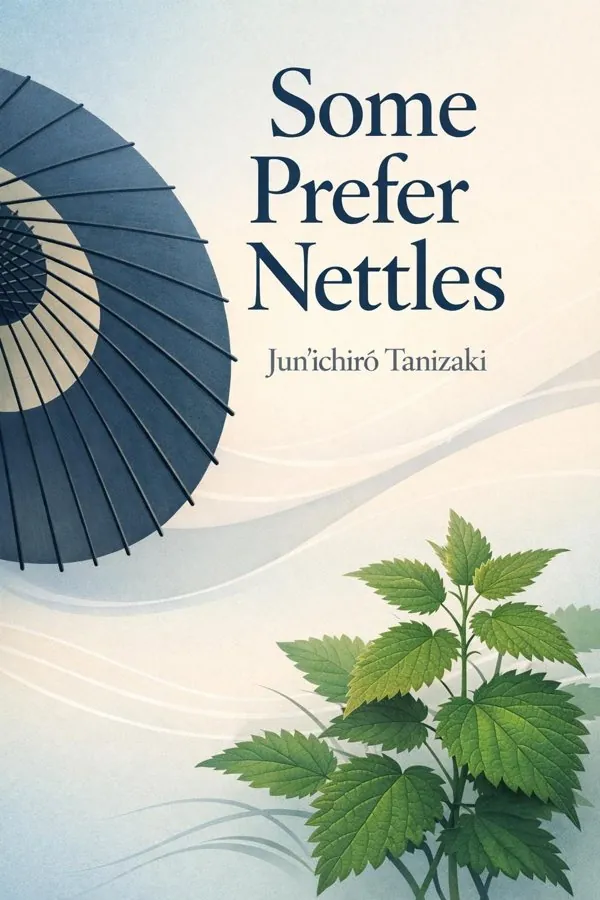
Some Prefer Nettles: Summary & Key Insights
 10 min10 chaptersAudio available
Key Takeaways from Some Prefer Nettles
One of the novel’s sharpest insights is that relationships do not always end with dramatic betrayal; sometimes they decay into ritual long before anyone formally leaves.
Aesthetic taste can feel like a moral position, but Tanizaki suggests it is often a more ambiguous form of desire.
Emotional distance can sometimes be a form of weakness, but in Tanizaki’s novel it can also become a path toward truth.
Tradition in Some Prefer Nettles is not an abstract concept; it arrives embodied in people, tastes, habits, and authority.
Few images in the novel are more revealing than the world of bunraku, the traditional puppet theater that exerts such fascination over its characters.
What Is Some Prefer Nettles About?
Some Prefer Nettles by Jun’ichirō Tanizaki is a classics book spanning 10 pages. Originally published in 1928, Some Prefer Nettles is one of Jun’ichirō Tanizaki’s most subtle and penetrating novels: a quiet story of a marriage drifting toward dissolution that opens into a larger meditation on modern Japan itself. At the center are Kaname and Misako, a couple who remain bound by habit, propriety, and family expectations long after affection has thinned out. Their strained relationship becomes a lens through which Tanizaki examines the pull of competing worlds: Westernized modern life, urban sophistication, erotic experimentation, inherited customs, and the lingering beauty of older Japanese forms. What makes the novel endure is its refusal to simplify these tensions. Tanizaki does not present tradition as pure or modernity as corrupt. Instead, he shows how people use both as masks, refuges, and sources of desire. Through scenes involving theater, domestic ritual, travel, and conversation, he reveals how aesthetics shape identity just as powerfully as love or morality. Tanizaki, one of the essential voices of twentieth-century Japanese literature, writes with extraordinary psychological precision, making this novel indispensable for readers interested in marriage, cultural transition, and the unsettling beauty of lives lived between eras.
This FizzRead summary covers all 10 key chapters of Some Prefer Nettles in approximately 10 minutes, distilling the most important ideas, arguments, and takeaways from Jun’ichirō Tanizaki's work. Also available as an audio summary and Key Quotes Podcast.
Some Prefer Nettles
Originally published in 1928, Some Prefer Nettles is one of Jun’ichirō Tanizaki’s most subtle and penetrating novels: a quiet story of a marriage drifting toward dissolution that opens into a larger meditation on modern Japan itself. At the center are Kaname and Misako, a couple who remain bound by habit, propriety, and family expectations long after affection has thinned out. Their strained relationship becomes a lens through which Tanizaki examines the pull of competing worlds: Westernized modern life, urban sophistication, erotic experimentation, inherited customs, and the lingering beauty of older Japanese forms.
What makes the novel endure is its refusal to simplify these tensions. Tanizaki does not present tradition as pure or modernity as corrupt. Instead, he shows how people use both as masks, refuges, and sources of desire. Through scenes involving theater, domestic ritual, travel, and conversation, he reveals how aesthetics shape identity just as powerfully as love or morality. Tanizaki, one of the essential voices of twentieth-century Japanese literature, writes with extraordinary psychological precision, making this novel indispensable for readers interested in marriage, cultural transition, and the unsettling beauty of lives lived between eras.
Who Should Read Some Prefer Nettles?
This book is perfect for anyone interested in classics and looking to gain actionable insights in a short read. Whether you're a student, professional, or lifelong learner, the key ideas from Some Prefer Nettles by Jun’ichirō Tanizaki will help you think differently.
- ✓Readers who enjoy classics and want practical takeaways
- ✓Professionals looking to apply new ideas to their work and life
- ✓Anyone who wants the core insights of Some Prefer Nettles in just 10 minutes
Want the full summary?
Get instant access to this book summary and 100K+ more with Fizz Moment.
Get Free SummaryAvailable on App Store • Free to download
Key Chapters
One of the novel’s sharpest insights is that relationships do not always end with dramatic betrayal; sometimes they decay into ritual long before anyone formally leaves. Kaname and Misako still share a household, meals, and social obligations, but the emotional core of their marriage has already eroded. What remains is a suspended state: neither true union nor honest separation. Tanizaki shows how people can continue performing domestic life because routine is easier than clarity.
This matters because the novel treats marriage not as a fixed institution but as a lived arrangement shaped by inertia, politeness, and fear of disruption. Kaname and Misako are not consumed by open hatred. Their situation is quieter and, in some ways, more unsettling. They are bound by convenience, by concern for appearances, and by the difficulty of choosing a future that would require explanation to others. That emotional limbo becomes a central condition of the book.
In real life, many personal and professional relationships survive on exactly this logic. A couple avoids difficult conversations because day-to-day cooperation still functions. Business partners continue despite deep misalignment because dissolving the arrangement seems more painful than tolerating it. The novel invites us to notice when peace is only avoidance in refined form.
Tanizaki’s achievement is to make this stasis dramatically meaningful. The lack of decisive action is itself the drama. The question is not simply whether Kaname and Misako will part, but why people remain in structures that no longer nourish them.
Actionable takeaway: examine one relationship or commitment in your life and ask whether what sustains it is love, purpose, and mutual choice—or merely habit and reluctance to change.
Aesthetic taste can feel like a moral position, but Tanizaki suggests it is often a more ambiguous form of desire. Kaname is drawn to traditional Japanese culture—its textures, gestures, theatrical forms, and ideals of femininity—but his attachment is not straightforwardly reverent. He is less a faithful inheritor than a fascinated observer, someone who admires old beauty with a collector’s distance. He wants the atmosphere of tradition, yet he does not fully belong to it.
This tension gives the novel much of its complexity. Kaname’s preferences are not merely personal quirks; they reveal a modern consciousness trying to recover something already half-lost. He is attracted to old Japan not as a practical way of life, but as an aesthetic possibility, almost as a dream. That distance matters. It means his admiration can become passive, selective, and even self-serving. He can idealize the past without embracing its full demands.
The pattern is recognizable today. People romanticize older ways of living—slow food, handmade craft, analog technologies, traditional manners—while remaining deeply shaped by convenience and modern individualism. We curate the past into lifestyle accessories. Tanizaki asks whether such longing is genuine continuity or refined nostalgia.
Kaname’s sensibility also shows how taste can become a refuge from emotional responsibility. It is easier to contemplate beauty than to make painful decisions. The past offers him an atmosphere in which he can linger instead of acting.
Actionable takeaway: when you feel drawn to an older ideal, ask yourself whether you truly want to live by its discipline—or whether you only enjoy its mood, symbolism, and selective pleasures.
Emotional distance can sometimes be a form of weakness, but in Tanizaki’s novel it can also become a path toward truth. Misako, often treated as the less romantically compelling partner, emerges as one of the book’s clearest-minded figures. She no longer inhabits the marriage under any illusion that affection will revive on its own. Her detachment is not simple coldness; it is a recognition that the forms of married life cannot conceal emotional absence forever.
What makes her important is that she represents a more modern willingness to confront unsatisfactory arrangements directly. While others circle around etiquette, family expectation, and cultural idealization, Misako moves closer to practical reality. She understands that a relationship cannot be sustained by appearances alone. In this way, she becomes a counterweight to Kaname’s drift and aesthetic hesitation.
Tanizaki does not turn her into a simplistic emblem of liberation. She is constrained, judged, and entangled in the expectations of family and gender. Yet her relative honesty gives the novel moral traction. She sees what is ending, and she is more prepared than Kaname to admit it.
This is a useful insight beyond the novel. In workplaces, friendships, and marriages, the person who names an uncomfortable truth is often perceived as disruptive, when in fact they are restoring reality to a situation managed by pretense. Honesty can feel harsh only because everyone else has adjusted to avoidance.
Actionable takeaway: identify one uncomfortable truth you have been softening with politeness, and practice stating it plainly, kindly, and without unnecessary delay.
Tradition in Some Prefer Nettles is not an abstract concept; it arrives embodied in people, tastes, habits, and authority. Misako’s father is one of the novel’s most memorable representatives of this world. Through his devotion to older theatrical and cultural forms, he becomes a living conduit to a Japan that resists disappearance. He does not merely appreciate tradition intellectually. He inhabits it, performs it, and expects others to recognize its value.
His presence complicates the marriage plot because he exerts a gravitational pull on Kaname. The older man’s world offers Kaname something his ordinary domestic life does not: coherence, atmosphere, and an aesthetic order that feels richer than modern banality. Yet this attraction is not innocent. It also reveals how cultural authority can shape desire. Kaname is not simply making private choices; he is being seduced by a whole inherited system of values.
In family life, older generations often function in similar ways. They preserve rituals, language, and standards that younger people no longer fully understand but still feel unable to dismiss. Their influence can be comforting, burdensome, or both at once. They remind us that our personal decisions are rarely purely individual; they are negotiated within webs of memory and expectation.
Tanizaki uses the father-in-law to show that tradition survives not just in institutions but in charisma. A person deeply committed to a cultural form can make it feel vividly alive, even to those who only half-believe in it.
Actionable takeaway: consider which inherited values in your life still feel genuinely alive because of a person who embodies them, and distinguish those living influences from empty conventions you are keeping out of habit.
Few images in the novel are more revealing than the world of bunraku, the traditional puppet theater that exerts such fascination over its characters. At first glance, puppets might seem less expressive than real people. Tanizaki turns that expectation inside out. In the stylized movements of performance, he finds a concentrated form of emotion—desire, sorrow, longing, restraint—made visible through artifice. The puppet becomes strangely more legible than the human being.
This is central to the novel’s method. Kaname and others often struggle to understand themselves in ordinary life, where motives are mixed and feelings obscured by etiquette. But in theater, emotion is distilled. The puppet’s controlled gestures expose something essential about how humans also live through roles, scripts, and choreographed behavior. The boundary between performance and authenticity begins to blur.
The idea has broad application. Modern life is full of curated selves: professional personas, online identities, social scripts, and relationship roles. We often imagine that authenticity means stripping away performance, yet Tanizaki suggests performance can reveal truths too. What we repeatedly enact may say more about us than what we claim to feel.
Bunraku also helps explain Kaname’s attraction to stylized femininity and inherited forms. He is captivated by beauty arranged through convention. But the novel asks whether such beauty deepens feeling or replaces it.
Actionable takeaway: notice one role you perform regularly—at work, at home, online—and ask what genuine desire or fear that performance may be expressing rather than concealing.
Tanizaki’s deeper provocation is that people are not as self-directed as they imagine. The image of the puppet extends beyond theater into the psychology of the novel. Characters are tugged by habit, social expectation, sexual attraction, family pressure, aesthetic ideals, and cultural memory. Even when they believe they are choosing freely, they often move along strings they barely perceive.
Kaname is a perfect example. He seems contemplative and autonomous, yet much of his life is shaped by passivity. He drifts toward what attracts him, recoils from what demands decision, and allows external circumstances to organize his emotional life. Misako, too, is constrained by systems larger than herself. Their marriage is not simply the story of two individuals failing each other; it is the story of two people maneuvering within a cultural stage already partly scripted.
This does not mean human beings lack agency. Rather, Tanizaki insists that agency begins with perception. Before we can choose, we must recognize what is moving us. Many contemporary readers will recognize this pattern in subtler forms: staying in a career because of parental expectations, repeating dating habits shaped by unexamined ideals, or pursuing lifestyles marketed as personal freedom but actually copied from social aspiration.
The novel’s brilliance lies in refusing easy emancipation. Awareness does not instantly solve entanglement. But it does create the possibility of less deluded living.
Actionable takeaway: write down one major decision you are currently facing and list the visible and invisible forces influencing you—desire, fear, family, status, nostalgia, convenience—so you can separate your own will from inherited momentum.
What we desire often reveals more about our inner conflicts than about the object of desire itself. Kaname’s encounters with forms of traditional femininity are shaped by this principle. He is drawn not merely to women as individuals, but to a carefully coded ideal: reserve, delicacy, refinement, and a beauty associated with older Japanese culture. This attraction is sensual, but it is also symbolic. He seeks in femininity a world of order and atmosphere that modern life seems to have weakened.
Tanizaki treats this longing with both sensitivity and irony. On one level, the allure is real; aesthetic forms carry emotional power. On another level, such desire can become projection. Kaname’s idealized image of traditional womanhood risks reducing living people to vessels for his cultural nostalgia. He does not simply want a partner; he wants a mood, an era, an arrangement of beauty that confirms his sensibility.
This remains strikingly contemporary. People often pursue partners who fit a narrative they find comforting—someone “grounded,” “elegant,” “ambitious,” ���old-fashioned,” or “free-spirited”—without asking whether they are seeing a person or a private fantasy. Attraction can be a mirror in disguise.
Tanizaki does not dismiss beauty, nor does he deny the legitimacy of erotic taste. Instead, he asks readers to examine how taste can conceal escapism. The person we idealize may be carrying meanings we ourselves have placed there.
Actionable takeaway: reflect on the qualities you find most attractive in others and ask which of them belong to the actual person, and which express your own unresolved longings, fears, or cultural fantasies.
Modernity enters the novel not as abstract progress but as a new kind of female possibility. Misako represents, however imperfectly, a woman less willing to remain enclosed within purely traditional expectations of marriage and dependence. Her choices and attitude suggest a shift in social reality: women can seek different arrangements, different forms of honesty, and a different relationship to desire. Yet Tanizaki presents this emergence with ambiguity rather than celebration.
That ambiguity is crucial. The “new woman” is not portrayed as simply liberated and fulfilled. Modern freedom comes with instability, social judgment, and emotional uncertainty. Misako’s position is not easy, and the novel does not pretend that rejecting old roles automatically produces happiness. Instead, it captures a transitional condition in which women gain new room to maneuver but must still navigate powerful expectations.
This insight still resonates. Social change rarely arrives in clean moral victories. New freedoms often coexist with older burdens. A person may have more options on paper while still carrying inherited guilt, economic constraints, and the emotional cost of defying norms. Tanizaki’s realism lies in showing that transformation is lived unevenly.
Misako’s importance, then, is not that she perfectly embodies modern independence, but that she exposes the insufficiency of older arrangements. Her dissatisfaction becomes evidence that the world has changed, even if no one yet knows the ideal form of what comes next.
Actionable takeaway: when evaluating your own choices, avoid asking only whether they fit tradition or rebellion; ask whether they create a life that is more truthful, sustainable, and self-respecting.
Not every ending requires rupture. One of the novel’s most mature achievements is its portrayal of separation as a gradual recognition rather than a theatrical collapse. Kaname and Misako move toward parting without explosive confrontation, and this subdued emotional register is exactly the point. Tanizaki understands that many important endings occur not through crisis but through attrition, acknowledgment, and exhausted civility.
This restraint distinguishes the book from more sentimental narratives of marriage. There is pain here, but it is diffused through politeness, family mediation, and uncertainty. The absence of melodrama does not make the situation trivial. If anything, it makes it more realistic. People often persist in compromised relationships because there is no single unforgivable act to justify departure. Instead there is accumulated estrangement, and eventually a sense that continuing would itself be the greater falsehood.
The novel also shows how separation can coexist with lingering obligation and mutual comprehension. Kaname and Misako are not transformed into villains. Their incompatibility is not solved by blame. This gives the story unusual emotional intelligence. It suggests that maturity sometimes means accepting misalignment without demanding a grand moral narrative.
Readers can apply this idea broadly. Projects, partnerships, friendships, and identities may all end quietly once they no longer correspond to who we have become. We do not always need catastrophe to validate transition.
Actionable takeaway: if something in your life is ending, resist the urge to invent drama for clarity; instead ask whether steady, honest acknowledgment may be enough to justify a dignified change.
Underlying the entire novel is a haunting idea: beauty is often most moving when we sense it is passing away. Traditional culture, marital intimacy, inherited forms of femininity, and older social rhythms all appear in Some Prefer Nettles under the sign of fragility. Tanizaki does not simply lament loss, nor does he celebrate change. He dwells in the ache produced when something remains visible precisely because it is vanishing.
This sensitivity to impermanence helps explain the novel’s emotional atmosphere. Kaname’s attraction to older forms is sharpened by their instability. The father-in-law’s world feels compelling because it is no longer secure. Even the marriage at the center of the story gains clarity as it fades. Loss, in Tanizaki’s hands, becomes a mode of perception. We see most intensely what we know cannot be held indefinitely.
This is not only a literary insight but a practical one. People often postpone appreciation until a place changes, a relationship cools, a parent ages, or a way of life becomes impossible to recover. Impermanence is painful, but it can also teach attention. The novel asks readers to look more closely at what still exists in front of them before it hardens into nostalgia.
At the same time, Tanizaki warns against turning transience into mere aesthetic pleasure. To admire decline beautifully is easier than responding to it honestly. Awareness must deepen life, not replace it.
Actionable takeaway: choose one ordinary thing in your life—a routine, a room, a relationship, a family custom—and attend to it as if it were temporary, allowing impermanence to sharpen gratitude instead of only regret.
All Chapters in Some Prefer Nettles
About the Author
Jun’ichirō Tanizaki (1886–1965) was one of the most celebrated writers in modern Japanese literature. Born in Tokyo, he came of age during a period of rapid cultural transformation, and his work repeatedly explored the tensions between Western modernity and older Japanese traditions. Tanizaki was fascinated by beauty, desire, performance, and the hidden workings of obsession, and he wrote with unusual elegance and psychological depth. His major works include Naomi, Some Prefer Nettles, The Makioka Sisters, The Key, and the influential essay In Praise of Shadows. Across novels, stories, and essays, he examined how aesthetics shape identity and how private longing reflects broader social change. Today, Tanizaki is widely read for his stylistic refinement, moral ambiguity, and enduring insight into modern life.
Get This Summary in Your Preferred Format
Read or listen to the Some Prefer Nettles summary by Jun’ichirō Tanizaki anytime, anywhere. FizzRead offers multiple formats so you can learn on your terms — all free.
Available formats: App · Audio · PDF · EPUB — All included free with FizzRead
Download Some Prefer Nettles PDF and EPUB Summary
Key Quotes from Some Prefer Nettles
“One of the novel’s sharpest insights is that relationships do not always end with dramatic betrayal; sometimes they decay into ritual long before anyone formally leaves.”
“Aesthetic taste can feel like a moral position, but Tanizaki suggests it is often a more ambiguous form of desire.”
“Emotional distance can sometimes be a form of weakness, but in Tanizaki’s novel it can also become a path toward truth.”
“Tradition in Some Prefer Nettles is not an abstract concept; it arrives embodied in people, tastes, habits, and authority.”
“Few images in the novel are more revealing than the world of bunraku, the traditional puppet theater that exerts such fascination over its characters.”
Frequently Asked Questions about Some Prefer Nettles
Some Prefer Nettles by Jun’ichirō Tanizaki is a classics book that explores key ideas across 10 chapters. Originally published in 1928, Some Prefer Nettles is one of Jun’ichirō Tanizaki’s most subtle and penetrating novels: a quiet story of a marriage drifting toward dissolution that opens into a larger meditation on modern Japan itself. At the center are Kaname and Misako, a couple who remain bound by habit, propriety, and family expectations long after affection has thinned out. Their strained relationship becomes a lens through which Tanizaki examines the pull of competing worlds: Westernized modern life, urban sophistication, erotic experimentation, inherited customs, and the lingering beauty of older Japanese forms. What makes the novel endure is its refusal to simplify these tensions. Tanizaki does not present tradition as pure or modernity as corrupt. Instead, he shows how people use both as masks, refuges, and sources of desire. Through scenes involving theater, domestic ritual, travel, and conversation, he reveals how aesthetics shape identity just as powerfully as love or morality. Tanizaki, one of the essential voices of twentieth-century Japanese literature, writes with extraordinary psychological precision, making this novel indispensable for readers interested in marriage, cultural transition, and the unsettling beauty of lives lived between eras.
You Might Also Like




Browse by Category
Ready to read Some Prefer Nettles?
Get the full summary and 100K+ more books with Fizz Moment.