
Jun’ichirō Tanizaki Books
Jun’ichirō Tanizaki (1886–1965) was a major Japanese novelist known for his exploration of aestheticism, eroticism, and cultural identity. His works, including "The Makioka Sisters," "Naomi," and "In Praise of Shadows," are celebrated for their stylistic elegance and deep psychological insight into modern Japanese life.
Known for: Some Prefer Nettles
Books by Jun’ichirō Tanizaki
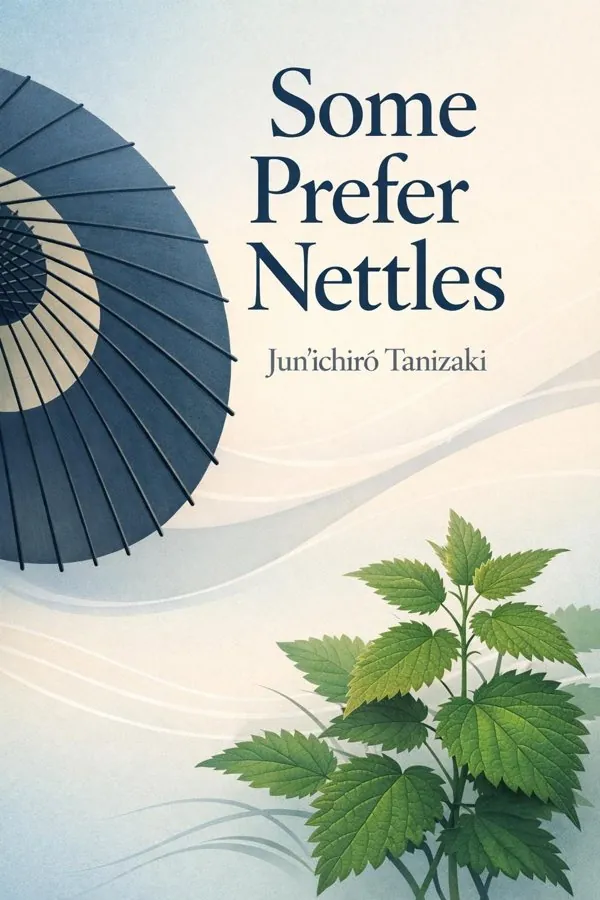
Some Prefer Nettles
Originally published in 1928, Some Prefer Nettles is one of Jun’ichirō Tanizaki’s most subtle and penetrating novels: a quiet story of a marriage drifting toward dissolution that opens into a larger meditation on modern Japan itself. At the center are Kaname and Misako, a couple who remain bound by habit, propriety, and family expectations long after affection has thinned out. Their strained relationship becomes a lens through which Tanizaki examines the pull of competing worlds: Westernized modern life, urban sophistication, erotic experimentation, inherited customs, and the lingering beauty of older Japanese forms. What makes the novel endure is its refusal to simplify these tensions. Tanizaki does not present tradition as pure or modernity as corrupt. Instead, he shows how people use both as masks, refuges, and sources of desire. Through scenes involving theater, domestic ritual, travel, and conversation, he reveals how aesthetics shape identity just as powerfully as love or morality. Tanizaki, one of the essential voices of twentieth-century Japanese literature, writes with extraordinary psychological precision, making this novel indispensable for readers interested in marriage, cultural transition, and the unsettling beauty of lives lived between eras.
Read SummaryKey Insights from Jun’ichirō Tanizaki
A Marriage Suspended Between Habit and Exit
One of the novel’s sharpest insights is that relationships do not always end with dramatic betrayal; sometimes they decay into ritual long before anyone formally leaves. Kaname and Misako still share a household, meals, and social obligations, but the emotional core of their marriage has already ero...
From Some Prefer Nettles
Kaname’s Taste for a Vanishing Past
Aesthetic taste can feel like a moral position, but Tanizaki suggests it is often a more ambiguous form of desire. Kaname is drawn to traditional Japanese culture—its textures, gestures, theatrical forms, and ideals of femininity—but his attachment is not straightforwardly reverent. He is less a fai...
From Some Prefer Nettles
Misako’s Detachment and Hard-Won Honesty
Emotional distance can sometimes be a form of weakness, but in Tanizaki’s novel it can also become a path toward truth. Misako, often treated as the less romantically compelling partner, emerges as one of the book’s clearest-minded figures. She no longer inhabits the marriage under any illusion that...
From Some Prefer Nettles
The Father-in-Law as Guardian of Tradition
Tradition in Some Prefer Nettles is not an abstract concept; it arrives embodied in people, tastes, habits, and authority. Misako’s father is one of the novel’s most memorable representatives of this world. Through his devotion to older theatrical and cultural forms, he becomes a living conduit to a...
From Some Prefer Nettles
Bunraku Reveals the Theater of Desire
Few images in the novel are more revealing than the world of bunraku, the traditional puppet theater that exerts such fascination over its characters. At first glance, puppets might seem less expressive than real people. Tanizaki turns that expectation inside out. In the stylized movements of perfor...
From Some Prefer Nettles
The Puppet and the Human Heart
Tanizaki’s deeper provocation is that people are not as self-directed as they imagine. The image of the puppet extends beyond theater into the psychology of the novel. Characters are tugged by habit, social expectation, sexual attraction, family pressure, aesthetic ideals, and cultural memory. Even ...
From Some Prefer Nettles
About Jun’ichirō Tanizaki
Jun’ichirō Tanizaki (1886–1965) was a major Japanese novelist known for his exploration of aestheticism, eroticism, and cultural identity. His works, including "The Makioka Sisters," "Naomi," and "In Praise of Shadows," are celebrated for their stylistic elegance and deep psychological insight into ...
Read more
Jun’ichirō Tanizaki (1886–1965) was a major Japanese novelist known for his exploration of aestheticism, eroticism, and cultural identity. His works, including "The Makioka Sisters," "Naomi," and "In Praise of Shadows," are celebrated for their stylistic elegance and deep psychological insight into ...
Jun’ichirō Tanizaki (1886–1965) was a major Japanese novelist known for his exploration of aestheticism, eroticism, and cultural identity. His works, including "The Makioka Sisters," "Naomi," and "In Praise of Shadows," are celebrated for their stylistic elegance and deep psychological insight into modern Japanese life.





Frequently Asked Questions
Jun’ichirō Tanizaki (1886–1965) was a major Japanese novelist known for his exploration of aestheticism, eroticism, and cultural identity. His works, including "The Makioka Sisters," "Naomi," and "In Praise of Shadows," are celebrated for their stylistic elegance and deep psychological insight into modern Japanese life.
Read Jun’ichirō Tanizaki's books in 15 minutes
Get AI-powered summaries with key insights from 1 book by Jun’ichirō Tanizaki.