
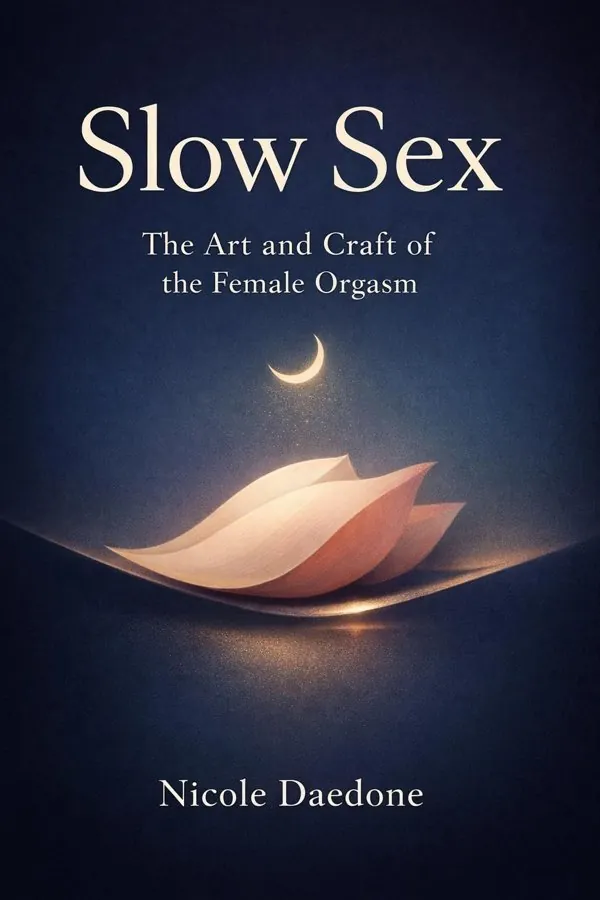
Slow Sex: The Art and Craft of the Female Orgasm: Summary & Key Insights
 10 min9 chapters
Key Takeaways from Slow Sex: The Art and Craft of the Female Orgasm
Many people never truly experience intimacy because they are too busy trying to succeed at it.
Transformation often begins not with intensity but with attention.
What if orgasm is not just a sexual event but a form of life force?
Real intimacy begins where image management ends.
A sexual practice has limited value if it cannot influence the way you live the rest of your life.
What Is Slow Sex: The Art and Craft of the Female Orgasm About?
Slow Sex: The Art and Craft of the Female Orgasm by Nicole Daedone is a romantic_relationships book spanning 5 pages. Slow Sex: The Art and Craft of the Female Orgasm challenges one of the most deeply ingrained assumptions of modern intimacy: that sex is primarily about performance, speed, and climax. In this provocative and practical book, Nicole Daedone argues that orgasm is not merely a peak event but an expansive state of awareness that can deepen connection, awaken vitality, and transform relationships. At the center of her approach is Orgasmic Meditation, or OM, a structured partnered practice that uses focused attention and sensation to cultivate presence rather than pursuit. What makes the book matter is its refusal to treat female sexuality as either a mystery to solve or a problem to fix. Instead, Daedone presents it as a source of intelligence, creativity, and emotional truth. Her perspective blends mindfulness, relational insight, and sexual philosophy, inviting readers to slow down enough to feel what is actually happening beneath habit and expectation. As the founder of OneTaste and a prominent voice in conversations about conscious sexuality, Daedone writes with the conviction of a teacher who has spent years developing and sharing these methods. The result is a book that asks readers to rethink desire, intimacy, and the meaning of pleasure itself.
This FizzRead summary covers all 9 key chapters of Slow Sex: The Art and Craft of the Female Orgasm in approximately 10 minutes, distilling the most important ideas, arguments, and takeaways from Nicole Daedone's work.
Slow Sex: The Art and Craft of the Female Orgasm
Slow Sex: The Art and Craft of the Female Orgasm challenges one of the most deeply ingrained assumptions of modern intimacy: that sex is primarily about performance, speed, and climax. In this provocative and practical book, Nicole Daedone argues that orgasm is not merely a peak event but an expansive state of awareness that can deepen connection, awaken vitality, and transform relationships. At the center of her approach is Orgasmic Meditation, or OM, a structured partnered practice that uses focused attention and sensation to cultivate presence rather than pursuit.
What makes the book matter is its refusal to treat female sexuality as either a mystery to solve or a problem to fix. Instead, Daedone presents it as a source of intelligence, creativity, and emotional truth. Her perspective blends mindfulness, relational insight, and sexual philosophy, inviting readers to slow down enough to feel what is actually happening beneath habit and expectation. As the founder of OneTaste and a prominent voice in conversations about conscious sexuality, Daedone writes with the conviction of a teacher who has spent years developing and sharing these methods. The result is a book that asks readers to rethink desire, intimacy, and the meaning of pleasure itself.
Who Should Read Slow Sex: The Art and Craft of the Female Orgasm?
This book is perfect for anyone interested in romantic_relationships and looking to gain actionable insights in a short read. Whether you're a student, professional, or lifelong learner, the key ideas from Slow Sex: The Art and Craft of the Female Orgasm by Nicole Daedone will help you think differently.
- ✓Readers who enjoy romantic_relationships and want practical takeaways
- ✓Professionals looking to apply new ideas to their work and life
- ✓Anyone who wants the core insights of Slow Sex: The Art and Craft of the Female Orgasm in just 10 minutes
Want the full summary?
Get instant access to this book summary and 100K+ more with Fizz Moment.
Get Free SummaryAvailable on App Store • Free to download
Key Chapters
Many people never truly experience intimacy because they are too busy trying to succeed at it. Daedone begins by exposing the cultural script that dominates modern sexuality: sex is often framed as a performance with goals, milestones, and visible outcomes. People are taught to focus on what they should do, how they should look, whether they are satisfying a partner, and whether orgasm has been “achieved.” In that framework, sensation becomes secondary to evaluation.
This performance mentality creates anxiety, comparison, and disconnection. Instead of inhabiting the body, people monitor themselves from the outside. A woman may wonder whether she appears responsive enough. A partner may worry whether they are doing the “right” technique. The shared field of feeling is replaced by self-consciousness. Daedone argues that this is especially limiting for female sexuality, which often unfolds through subtle sensation, emotional openness, and gradual trust rather than quick escalation.
The book invites readers to recognize how inherited beliefs shape their intimate lives. These beliefs can come from media, past relationships, family silence, or even therapeutic language that treats orgasm as an outcome to produce. Daedone’s point is not that pleasure should be effortless, but that authentic pleasure cannot emerge when attention is trapped in proving, performing, or pleasing.
In practical terms, this means noticing when you are chasing a result instead of experiencing the present moment. It may mean pausing during intimacy to ask, “What am I actually feeling right now?” rather than “How is this going?” It can also mean releasing rigid ideas about what a successful sexual encounter must include.
Actionable takeaway: Before your next intimate experience, identify one performance-based expectation you carry and consciously replace it with one intention rooted in presence, such as curiosity, honesty, or sensation.
Transformation often begins not with intensity but with attention. Daedone’s signature contribution is Orgasmic Meditation, or OM, a partnered practice designed to train people out of distraction and into direct sensation. The practice is highly structured: for fifteen minutes, one partner strokes the upper-left quadrant of the woman’s clitoris in a precise and attentive way, while both partners focus on noticing sensation rather than trying to create a particular result.
The structure matters because it removes ambiguity and performance pressure. OM is not framed as conventional sex, foreplay, or a technique for producing climax. Instead, it functions more like meditation, with the body as the object of awareness. There is a clear beginning, a defined role for each participant, a time boundary, and an emphasis on reporting simple sensations rather than analyzing emotions or narrating fantasies. This container allows participants to enter a state of focused connection without needing to improvise or impress.
Daedone presents OM as a discipline that refines sensitivity. Over time, practitioners may become more aware of subtle shifts in arousal, emotional state, and relational attunement. The practice also encourages direct communication. Because OM depends on consent, clear setup, and mutual agreement, it can foster a more honest form of intimacy than encounters shaped by assumption or habit.
A practical application of this idea extends beyond the practice itself. Even couples who do not adopt OM formally can borrow its principles: create a clear container, slow down, focus on one sensation at a time, and remove the pressure to “go somewhere.” For many people, that alone can change the quality of intimacy.
Actionable takeaway: Experiment with creating one short, structured intimacy ritual—whether touch, eye contact, or sensual attention—in which the goal is simply to notice sensation, not to escalate or achieve anything.
What if orgasm is not just a sexual event but a form of life force? One of Daedone’s most distinctive claims is that the female orgasm should not be reduced to climax or genital release. She portrays it as a current of creative energy that can animate the whole person—emotionally, mentally, relationally, and even spiritually. In this view, orgasm is less like crossing a finish line and more like plugging into a deeper power source.
This reframing challenges narrow definitions of female pleasure. If orgasm is understood only as a brief peak, then many forms of sensation, openness, and energetic aliveness are overlooked. Daedone argues that women often possess a much broader orgasmic capacity than culture acknowledges. The more attention is given to sensation without forcing an outcome, the more this field can expand. Pleasure then becomes not something extracted from a moment, but something cultivated as an ongoing state of receptivity and responsiveness.
Daedone links this energy to creativity and vitality in daily life. A person who feels connected to their erotic current may also feel more expressive, more alive, and more honest. They may have greater access to intuition, confidence, and emotional range. This is why the book treats female orgasm not as a private luxury but as a significant human resource.
In practical life, this could look like paying attention to where you feel most alive rather than limiting sensuality to explicitly sexual settings. It might mean noticing how music, movement, conversation, or beauty affect your body, and allowing that responsiveness to inform your work and relationships.
Actionable takeaway: Reframe orgasm from a single event to a broader experience of aliveness, and spend a week noticing when your body feels most energized, expressive, and deeply responsive.
Real intimacy begins where image management ends. Daedone emphasizes that slow sex requires a willingness to be seen without the usual defenses of charm, control, or competence. Vulnerability is not presented as emotional oversharing, but as a direct encounter with what is genuinely felt in the body and in the relationship. To slow down enough to sense clearly is also to risk discovering fear, numbness, grief, desire, or unmet longing.
This is why the practice can be transformative. Many people use speed, seduction, humor, or technique to avoid the rawness of genuine contact. Slowing down removes some of those escape routes. A partner may realize they are more disconnected than they thought. Another may discover that what they called desire was actually pressure. Yet within Daedone’s framework, these realizations are not failures. They are openings into truth.
Vulnerability also changes the quality of connection between partners. When people stop pretending and start reporting honestly—“I feel numb,” “I feel shy,” “I feel warmth,” “I want to pull away,” “I want more”—they create conditions for real trust. This can be especially powerful in long-term relationships where routines have replaced curiosity. Instead of acting out familiar roles, partners begin meeting each other in the present.
Practical application does not require dramatic confessions. It can begin with very simple honesty. During intimate moments, rather than saying what seems expected, each person can practice naming one real sensation or emotional truth. That honesty builds capacity over time.
Actionable takeaway: In your next meaningful interaction, sexual or otherwise, replace one polished response with one grounded truth about what you are actually feeling in the moment.
A sexual practice has limited value if it cannot influence the way you live the rest of your life. Daedone argues that slow sex is not merely a bedroom technique but a broader orientation toward attention, receptivity, and relational presence. The same habits that interfere with orgasm—rushing, controlling, dissociating, performing—also affect conversations, work, creativity, and self-care. To cultivate an orgasmic life is to become more available to experience across the board.
This means the principles of slow sex can be applied far beyond erotic touch. Slowing down while eating, walking, listening, or speaking can reveal how often people skim over sensation in order to get to the next task. Daedone suggests that the capacity to feel deeply is trainable. When you stop overriding the body’s signals, you may become more discerning about your boundaries, your desires, and the environments that nourish or deplete you.
In relationships, integrating slow sex might mean giving more space to anticipation and less to urgency. It may involve making time for sensual connection without attaching it to intercourse. In personal life, it can mean treating pleasure not as a reward after productivity, but as information that helps orient you toward what is most alive and true.
A practical example would be ending the day with ten minutes of device-free presence with a partner: touch hands, breathe, and share what each of you is sensing rather than discussing logistics. For individuals, it might mean taking a shower, stretching, or listening to music with full bodily attention instead of multitasking.
Actionable takeaway: Choose one ordinary daily activity and do it at half your usual speed for a week, using it as a practice in sensation, attention, and embodied presence.
Most people think desire grows by adding more stimulation, but Daedone suggests it often grows by noticing more deeply. A central distinction in the book is between sensation and mental overlay. Fantasy, interpretation, memory, and expectation all have their place, but they can also pull people away from what is actually happening in the body. When attention drifts into narrative—what this means, where this is going, whether it is enough—sensation becomes muffled.
Daedone’s approach trains people to return again and again to direct experience. Warmth, tingling, pressure, openness, resistance, fluttering, numbness—these are the raw materials of embodied awareness. By learning to identify and stay with subtle sensation, people can discover a richer and more nuanced erotic life. This is particularly important because female arousal often unfolds in gradients rather than dramatic spikes. What seems insignificant at first can develop into powerful responsiveness if given sustained attention.
This idea also has emotional implications. Sensation is often the doorway to truth. Before a person can explain sadness, longing, attraction, or fear, they may first feel tightness in the chest, electricity in the belly, or heaviness in the limbs. Returning to sensation can therefore reconnect people with inner knowledge that intellectual analysis misses.
In practical terms, one application is to use more descriptive language and less evaluative language during intimacy. Instead of saying, “This is good” or “This isn’t working,” describe what you feel: “I feel warmth spreading,” “I feel distant,” or “I notice a soft pulsing.” This keeps attention grounded in reality.
Actionable takeaway: Practice naming three physical sensations each day—during stress, pleasure, and rest—to strengthen your ability to stay connected to the body rather than disappearing into thought.
Connection often deepens when each person knows their role clearly enough to relax into it. In Daedone’s presentation of OM and slow sex, polarity is not about rigid gender stereotypes so much as relational clarity. One person attends, one receives; one strokes, one notices; both participate in a shared field of awareness. The value of these roles lies in their precision. When responsibilities are defined, both partners can become more present.
Daedone suggests that much confusion in intimacy comes from trying to do everything at once. People want to please, monitor, feel, direct, and interpret simultaneously. The result is fragmentation. Conscious partnership, by contrast, involves clear agreements, explicit consent, and respect for the different functions each person serves in a given moment. This can create a surprising sense of freedom. The giver is freed from guessing; the receiver is freed from performing gratitude or reciprocal action.
The broader implication is that healthy erotic connection relies on communication, trust, and intentionality. Couples benefit when they can discuss what they are doing, why they are doing it, and what each person needs to remain present. This is not less romantic than spontaneity; in Daedone’s framework, it is what makes deeper spontaneity possible because the foundation is secure.
Outside of OM, partners can apply this by clarifying their intentions before intimate time. Are they seeking comfort, exploration, erotic play, or simply contact? Clear roles and agreements reduce misunderstanding and invite more embodied engagement.
Actionable takeaway: Before your next intimate encounter, spend two minutes clarifying roles, intentions, and boundaries so that both people can relax into presence instead of navigating uncertainty.
Pleasure is often treated as indulgence, but Daedone presents it as information. The sensations that draw us open, make us more alive, or bring us into coherence are not trivial. They reveal something about our nature, our desires, and our capacity for connection. In this sense, pleasure becomes a path of self-knowledge rather than an escape from serious life.
This is a radical shift for many readers. People are often trained to mistrust pleasure unless it is earned, modest, or carefully controlled. Women in particular may receive mixed messages: be desirable but not too desiring, responsive but not demanding, sensual but never fully sovereign in pleasure. Daedone challenges this split by suggesting that learning to receive and track pleasure can restore a more integrated sense of self.
Self-knowledge through pleasure requires discernment. Not all pleasure is nourishing, and immediate gratification is not the same as deep fulfillment. Daedone’s emphasis on attention helps distinguish between numbing stimulation and enlivening contact. One leaves a person depleted or disconnected; the other leaves them more awake, honest, and available.
In everyday application, this means asking not just “What do I want?” but “What actually makes me feel more alive afterward?” That question can reshape sexual choices, relational dynamics, and even work habits. A person may realize that certain environments deaden them while others subtly awaken joy and presence.
Actionable takeaway: Start a simple pleasure journal for one week, noting which experiences leave you feeling more connected, energized, and truthful, and which leave you feeling drained or less present.
The deepest promise of slow sex is not better technique but a different model of being together. Daedone proposes that intimacy can be based on presence rather than possession, attention rather than conquest, and mutual revelation rather than mutual performance. This model shifts fulfillment away from climax, frequency, or novelty as the primary measures of erotic success.
Under the conventional model, sexual satisfaction is often judged by visible markers: Did intercourse happen? Did both partners climax? Was it exciting enough? While these questions are not meaningless, they can obscure the subtler dimensions of intimacy—how deeply people met, whether they felt seen, whether truth emerged, whether the body came alive. Daedone wants readers to value these dimensions at least as much as any endpoint.
This new model also helps explain why people can have technically competent sex yet still feel lonely. Without real presence, erotic activity can remain transactional or disconnected. Slow sex offers an alternative in which fulfillment grows through attunement, patience, and embodied honesty. It may be especially meaningful for couples who feel stuck in routine, for individuals recovering from sexual numbness, or for anyone seeking a more conscious relational life.
Practically, this perspective can change how people evaluate intimate experiences. Instead of asking whether it was intense enough, they might ask whether they felt more connected to themselves and their partner afterward. That single shift can transform priorities.
Actionable takeaway: Redefine success in intimacy by creating one personal metric beyond climax—such as presence, honesty, attunement, or aliveness—and use it to reflect on your experiences going forward.
All Chapters in Slow Sex: The Art and Craft of the Female Orgasm
About the Author
Nicole Daedone is an American author, public speaker, and founder of OneTaste, the organization that popularized Orgasmic Meditation as a practice of attention, connection, and embodied awareness. Her work sits at the intersection of sexuality, mindfulness, and personal transformation, with a particular emphasis on reclaiming female orgasm as a source of vitality and intelligence rather than viewing it solely through the lens of performance or climax. Daedone became widely known for challenging conventional ideas about intimacy and for presenting pleasure as a disciplined path to self-knowledge and relational depth. Through her writing and teaching, she has influenced conversations about conscious sexuality, emotional honesty, and the role of presence in human connection.
Get This Summary in Your Preferred Format
Read or listen to the Slow Sex: The Art and Craft of the Female Orgasm summary by Nicole Daedone anytime, anywhere. FizzRead offers multiple formats so you can learn on your terms — all free.
Available formats: App · Audio · PDF · EPUB — All included free with FizzRead
Download Slow Sex: The Art and Craft of the Female Orgasm PDF and EPUB Summary
Key Quotes from Slow Sex: The Art and Craft of the Female Orgasm
“Many people never truly experience intimacy because they are too busy trying to succeed at it.”
“Transformation often begins not with intensity but with attention.”
“What if orgasm is not just a sexual event but a form of life force?”
“Real intimacy begins where image management ends.”
“A sexual practice has limited value if it cannot influence the way you live the rest of your life.”
Frequently Asked Questions about Slow Sex: The Art and Craft of the Female Orgasm
Slow Sex: The Art and Craft of the Female Orgasm by Nicole Daedone is a romantic_relationships book that explores key ideas across 9 chapters. Slow Sex: The Art and Craft of the Female Orgasm challenges one of the most deeply ingrained assumptions of modern intimacy: that sex is primarily about performance, speed, and climax. In this provocative and practical book, Nicole Daedone argues that orgasm is not merely a peak event but an expansive state of awareness that can deepen connection, awaken vitality, and transform relationships. At the center of her approach is Orgasmic Meditation, or OM, a structured partnered practice that uses focused attention and sensation to cultivate presence rather than pursuit. What makes the book matter is its refusal to treat female sexuality as either a mystery to solve or a problem to fix. Instead, Daedone presents it as a source of intelligence, creativity, and emotional truth. Her perspective blends mindfulness, relational insight, and sexual philosophy, inviting readers to slow down enough to feel what is actually happening beneath habit and expectation. As the founder of OneTaste and a prominent voice in conversations about conscious sexuality, Daedone writes with the conviction of a teacher who has spent years developing and sharing these methods. The result is a book that asks readers to rethink desire, intimacy, and the meaning of pleasure itself.
You Might Also Like

Rebel
Beverly Jenkins
10 min
The Last Letter
Rebecca Yarros
10 min
A Thousand Boy Kisses
Tillie Cole
10 min
Aflame
Penelope Douglas
10 min
After The Bite
Lynsay Sands
10 min
Alchemised
SenLinYu
10 minBrowse by Category
Ready to read Slow Sex: The Art and Craft of the Female Orgasm?
Get the full summary and 100K+ more books with Fizz Moment.