
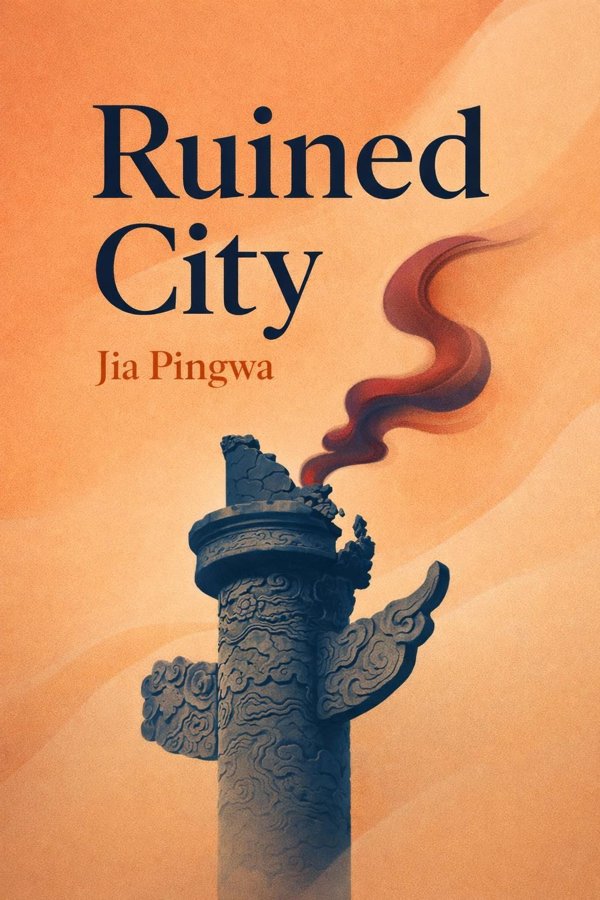
Ruined City: Summary & Key Insights
by Jia Pingwa
 10 min10 chaptersAudio available
Key Takeaways from Ruined City
A city can preserve its walls long after it has lost its inner coherence.
Recognition often reveals character more brutally than struggle does.
People often discover their values not in public speeches, but in private longing.
Modern freedom can widen experience while hollowing meaning.
The most absurd institutions are often those still speaking in noble tones.
What Is Ruined City About?
Ruined City by Jia Pingwa is a classics book spanning 10 pages. Originally published in 1993, Ruined City is one of the most controversial and important Chinese novels of the late twentieth century. Set in Xi’an during the early reform era, Jia Pingwa’s novel follows the celebrated writer Zhuang Zhidie as he moves through literary salons, political networks, romantic entanglements, and private moral compromise. On the surface, it is a story of fame, desire, and social ambition. At a deeper level, it is a bleak and brilliant portrait of a society losing its moral center while gaining new freedoms, new appetites, and new forms of corruption. The novel became famous not only for its candid sexual material, which led to its banning in China for years, but also for its sharp satire of intellectual life, official culture, and spiritual decay. Jia Pingwa, one of modern China’s most acclaimed novelists, writes with earthy realism, irony, and symbolic force. His authority comes from his unmatched ability to capture how large historical changes distort ordinary feeling, private ethics, and public language. Ruined City matters because it turns one man’s decline into a diagnosis of an entire era: a civilization caught between inherited ideals and the seductions of a new marketplace.
This FizzRead summary covers all 10 key chapters of Ruined City in approximately 10 minutes, distilling the most important ideas, arguments, and takeaways from Jia Pingwa's work. Also available as an audio summary and Key Quotes Podcast.
Ruined City
Originally published in 1993, Ruined City is one of the most controversial and important Chinese novels of the late twentieth century. Set in Xi’an during the early reform era, Jia Pingwa’s novel follows the celebrated writer Zhuang Zhidie as he moves through literary salons, political networks, romantic entanglements, and private moral compromise. On the surface, it is a story of fame, desire, and social ambition. At a deeper level, it is a bleak and brilliant portrait of a society losing its moral center while gaining new freedoms, new appetites, and new forms of corruption.
The novel became famous not only for its candid sexual material, which led to its banning in China for years, but also for its sharp satire of intellectual life, official culture, and spiritual decay. Jia Pingwa, one of modern China’s most acclaimed novelists, writes with earthy realism, irony, and symbolic force. His authority comes from his unmatched ability to capture how large historical changes distort ordinary feeling, private ethics, and public language. Ruined City matters because it turns one man’s decline into a diagnosis of an entire era: a civilization caught between inherited ideals and the seductions of a new marketplace.
Who Should Read Ruined City?
This book is perfect for anyone interested in classics and looking to gain actionable insights in a short read. Whether you're a student, professional, or lifelong learner, the key ideas from Ruined City by Jia Pingwa will help you think differently.
- ✓Readers who enjoy classics and want practical takeaways
- ✓Professionals looking to apply new ideas to their work and life
- ✓Anyone who wants the core insights of Ruined City in just 10 minutes
Want the full summary?
Get instant access to this book summary and 100K+ more with Fizz Moment.
Get Free SummaryAvailable on App Store • Free to download
Key Chapters
A city can preserve its walls long after it has lost its inner coherence. Ruined City opens in Xi’an, an ancient capital whose cultural prestige gives the illusion of continuity, dignity, and order. Yet Jia Pingwa quickly shows that beneath this historic surface lies uncertainty. Reform-era China is creating new opportunities, but it is also dissolving old certainties. In this atmosphere, Zhuang Zhidie rises as a respected writer, a man admired for talent, refinement, and literary seriousness. At first, he seems to represent the possibility that culture might still offer moral direction in a changing society.
But this beginning is already unstable. Zhuang’s status depends not only on artistic merit, but on networks, reputation, and symbolic power. Xi’an’s literary scene is less a sanctuary than a stage where old cultural authority is being repackaged for a new age of competition. Jia uses the city itself as an allegory: ancient, burdened, proud, and quietly decaying.
This idea matters beyond the novel. Institutions, professions, and communities often retain the language of purpose after their purpose has weakened. A university may still speak of learning while rewarding branding. A workplace may praise values while promoting vanity. A person may think they are living by principle when they are really living by inherited appearances.
Jia’s insight is that decline rarely begins with open collapse. It begins when symbols of meaning outlast actual belief. Zhuang enters the story not as a villain, but as someone already standing on compromised ground.
Actionable takeaway: When entering any admired world, ask what genuinely sustains it: shared values, or merely prestige, ritual, and appearance.
Recognition often reveals character more brutally than struggle does. As Zhuang’s reputation grows, he is pulled into the vanity, rivalry, and manipulation of Xi’an’s literary circles. Writers’ associations, editors, banquets, prizes, and friendships all appear to serve culture, yet Jia portrays them as systems of bargaining, envy, and self-display. Literary life becomes a social marketplace in which language is traded for influence and sincerity is weakened by performance.
What makes this section powerful is that Jia does not present corruption as purely external. Zhuang is not simply victimized by a rotten environment; he participates in it. He enjoys admiration. He learns to navigate factions. He accepts the flattering attention that accompanies status. The very gift that made him notable as a writer now becomes entangled with ego. Art no longer stands apart from social ambition; it becomes one of its tools.
This is a recognizable pattern in many fields. A teacher may start by caring about students and end up chasing titles. An entrepreneur may begin with a useful idea and become obsessed with visibility. A writer may start with truth and shift toward networking, signaling, and personal myth-making. Success amplifies temptation because it rewards image management as much as substance.
Jia’s satire of the literary world is therefore broader than literature. It asks what happens when communities dedicated to thought, beauty, or service become status arenas. Once prestige becomes the hidden currency, people begin performing conviction instead of living it.
Actionable takeaway: If success increases your audience, increase your self-scrutiny. Measure your work by its integrity, not by applause around it.
People often discover their values not in public speeches, but in private longing. One of the central currents in Ruined City is Zhuang Zhidie’s emotional and sexual entanglement with Tang Xiaozhou. Their relationship is not merely romantic subplot; it is a test of intimacy, self-knowledge, and restraint. Jia treats desire as something both human and destabilizing. It promises connection, intensity, and authenticity, yet it also exposes self-deception. Zhuang tells himself stories about feeling, tenderness, and need, but beneath them lies vanity, restlessness, and an inability to accept limits.
Tang Xiaozhou is important because she is not just an object of temptation. Through her presence, the novel reveals how men often translate confusion into romance and appetite into emotional destiny. Zhuang’s desire is linked to his larger crisis: he wants to feel alive, admired, renewed. Instead of confronting dissatisfaction directly, he seeks emotional rescue through intimacy. The result is not liberation, but deeper fragmentation.
This pattern remains common. People dissatisfied with work, marriage, aging, or identity may invest another person with impossible significance. Affairs, obsessive attachments, or emotionally blurred relationships often begin as attempts to escape emptiness rather than honest acts of love. The problem is not desire itself, but using desire to avoid truth.
Jia refuses easy moralizing. He understands the ache of human longing. Yet he also shows that desire without discipline becomes another form of drift. Relationships become mirrors of inner disorder.
Actionable takeaway: When intense attraction appears, ask what need it is really serving: love, escape, validation, or fear of confronting your own life.
Modern freedom can widen experience while hollowing meaning. Through characters such as Bailin and Zhou Mengdie, Ruined City expands beyond one affair into a whole urban atmosphere of desire. Xi’an is no longer simply an old city adapting to reform; it becomes a psychological landscape where appetite circulates through conversation, social exchange, and personal fantasy. Sexuality in the novel is not presented as pure liberation. Instead, it often appears as a language of loneliness, transaction, and failed transcendence.
Bailin in particular carries symbolic weight. Her presence draws together tenderness, vulnerability, and doom. She is touched by the city’s emotional climate, where attachment is unstable and sincerity is constantly threatened by self-interest. Zhou Mengdie and others further expose a social order in which people move toward one another physically while drifting apart morally and spiritually. Bodies meet, but worlds do not.
Jia’s controversial explicitness serves a larger purpose. He uses erotic life to depict the collapse of older moral frameworks without the emergence of a mature new ethics. Desire is everywhere, but wisdom is scarce. People seek stimulation because transcendence has vanished. They pursue intensity because they no longer trust institutions, ideals, or communal bonds to provide significance.
In contemporary terms, this insight extends far beyond sexuality. Consumer culture often encourages us to confuse access with fulfillment: more choice, more novelty, more sensation. But abundance can coexist with inner vacancy. The city becomes crowded with opportunities and poor in meaning.
Actionable takeaway: Notice where immediate gratification is substituting for deeper purpose. Ask not only what you want, but what kind of life your desires are building.
The most absurd institutions are often those still speaking in noble tones. Jia Pingwa’s portrait of the literary world is one of the novel’s sharpest achievements. Intellectuals, critics, officials, and cultural gatekeepers speak endlessly about art, refinement, and responsibility, yet their behavior is shaped by calculation, flattery, favoritism, and fear. This is not corruption as scandal; it is corruption as routine. Everyone knows the rules are compromised, but everyone continues acting as if seriousness remains intact.
What makes the satire sting is its familiarity. The literary scene becomes a miniature society where rhetoric covers cowardice. Mediocre figures rise through connections. Public praise masks private contempt. Cultural authority is maintained through mutual convenience rather than genuine discernment. Instead of defending standards, institutions produce rituals that imitate seriousness while avoiding risk.
This pattern applies anywhere language becomes detached from moral courage. In companies, people praise innovation while punishing honesty. In politics, leaders celebrate service while rewarding loyalty over competence. In families, members speak of love while preserving silence around harm. Hypocrisy survives not because people believe it, but because it offers a livable compromise between conscience and comfort.
Jia’s achievement is to show that decay can become theatrical. People perform culture precisely when culture has weakened. The louder the claims to seriousness, the more one suspects insecurity underneath. For Zhuang, participation in this absurd stage is fatal because it erodes the distance he would need to remain truthful as a writer.
Actionable takeaway: Pay attention to repeated moral language in any institution. If words and incentives consistently diverge, trust the incentives and act with clear-eyed caution.
Talent does not disappear all at once; it is often suffocated by the life built around it. As Zhuang becomes more entangled in vanity, desire, and social maneuvering, he experiences a creative crisis. The problem is not simply writer’s block. It is a deeper severance between artistic ability and moral center. Jia suggests that meaningful creation depends not on purity, but on some inward coherence. Once a person’s public image, private appetites, and self-understanding drift too far apart, creative work becomes strained, imitative, or empty.
Zhuang still possesses intelligence and skill, but he can no longer draw from conviction with the same force. He is overexposed to distraction and underexposed to truth. Instead of observing the world with disciplined attention, he is absorbed by his own entanglements. The self becomes noisy, and art requires silence enough to hear what lies beyond vanity.
This idea applies to many forms of work. A leader who says one thing and does another loses clarity. A designer overwhelmed by trends loses originality. A scholar trapped in prestige games forgets the questions that once mattered. Excellence is not only technical; it also depends on integrity between purpose and practice.
Jia does not romanticize suffering as the source of art. Rather, he shows that serious work asks for honesty, restraint, and the courage to endure one’s own emptiness without constantly escaping it. Zhuang cannot do that consistently, and his artistry begins to corrode.
Actionable takeaway: Protect the conditions that make your best work possible. Reduce distractions, confront self-deception early, and align your daily habits with your deepest reasons for creating.
Public decline often begins in the spaces where no audience is present. As Ruined City moves forward, Zhuang’s domestic life and inner life both deteriorate. The household, which should anchor a person against public confusion, becomes another site of estrangement. Emotional distance, secrecy, resentment, and exhaustion gradually replace trust. Jia shows that moral collapse rarely arrives through one dramatic event. More often, it unfolds through repeated evasions: truths not spoken, boundaries not honored, tenderness not renewed.
Zhuang’s solitude becomes increasingly important. Yet his solitude is ambiguous. It could have become a place of reckoning, a chance to confront guilt and ask what remains worth saving. Instead, it often deepens his passivity. He is aware enough to suffer, but not decisive enough to transform. This is one of the novel’s most painful insights: awareness alone does not redeem. One may recognize ruin and still continue contributing to it.
Readers can see here a common human dynamic. We may imagine that competence in public life compensates for disorder at home, but private fracture eventually alters judgment, energy, and character. The inability to repair intimate bonds often signals an inability to face oneself honestly. Home is not separate from ethics; it is where ethics become ordinary.
Jia’s portrayal also resists sentimentalizing family. A home is not automatically virtuous. It requires maintenance, humility, and daily fidelity. Without these, the private sphere becomes another theater of decay.
Actionable takeaway: Treat small domestic truths as seriously as public responsibilities. Repair conversations early, honor ordinary commitments, and do not assume private damage will remain private.
Some deaths in literature do not close a subplot; they reveal the moral cost of an entire world. Bailin’s death is one of the emotional and symbolic turning points of Ruined City. By the time it occurs, Jia has already shown a city saturated with vanity, appetite, and compromised feeling. Bailin’s fate gathers these currents into a devastating conclusion. Her death is not simply personal tragedy. It signifies the destruction of delicacy, hope, and the possibility that genuine feeling might survive in a corrupted environment.
What makes this moment so powerful is that Bailin embodies more than innocence. She represents a fragile alternative to the coarseness surrounding her. In losing her, the novel confirms that ruin is not abstract. Cultural decay extracts its price in actual lives, actual tenderness, and actual souls. The city’s corruption is no longer something one can discuss ironically. It has become irreversible damage.
For Zhuang, this loss intensifies the reckoning he has long postponed. Yet Jia avoids easy redemption through grief. Suffering does not automatically ennoble those who witness it. Tragedy may awaken conscience, but it may also simply expose how late awakening has come. In this sense, Bailin’s death is less a lesson than a verdict on a society that has normalized emotional carelessness.
In real life, people often recognize the seriousness of neglect only after irreversible consequences: a broken relationship, a burnt-out colleague, a friend’s crisis, a family estrangement. By then, insight is expensive.
Actionable takeaway: Do not wait for loss to teach you what care requires. Respond to vulnerability while something can still be protected, repaired, or preserved.
The end of corruption is not always punishment; sometimes it is emptiness. In the final movement of Ruined City, Zhuang faces a form of exile shaped as much by inner desolation as by external consequence. The novel does not conclude with moral clarity neatly restored. Instead, Jia leaves the reader in a landscape of silence, estrangement, and diminished possibility. This is fitting. A ruined city cannot be repaired by a final speech, and a ruined self cannot be redeemed by self-awareness alone.
Exile in the novel is both literal and spiritual. Zhuang becomes detached from the networks, roles, and illusions that once sustained him, but detachment is not freedom. It is exposure. He must confront what remains when fame, appetite, and social theater lose their force. The result is not triumph, but vacancy. Jia suggests that the ultimate cost of a compromised life is not scandal, but the inability to inhabit oneself with dignity.
This ending gives the novel its lasting seriousness. Ruined City is not just about criticizing a corrupt era; it is about showing what happens when a person repeatedly fails to defend the core of his own being. External systems matter, but they do not erase responsibility. One can be shaped by an age and still answer for how one lives within it.
For modern readers, this is a warning against drifting through compromise until the self feels unrecognizable. Recovery begins not with grand reinvention, but with truthful naming: what has been lost, what was traded away, and what remains worth rebuilding.
Actionable takeaway: Periodically step back from your roles and ask a hard question: if the status, noise, and distractions vanished, would you still respect the person left behind?
All Chapters in Ruined City
About the Author
Jia Pingwa, born in 1952 in Danfeng County, Shaanxi Province, is one of China’s most celebrated contemporary writers. Deeply associated with the landscapes, dialects, and social realities of northwestern China, he has built a career on fiction that examines the tensions between tradition, modernization, and moral change. His prose combines earthy realism, satire, symbolism, and close observation of ordinary life. Jia’s major works include Ruined City, Turbulence, and Qinqiang, and his writing often explores how large historical transformations reshape intimate relationships and cultural values. Over the decades, he has received numerous honors, including the Mao Dun Literature Prize. Though sometimes controversial, he remains a central figure in modern Chinese literature for his fearless depiction of social complexity and spiritual unease.
Get This Summary in Your Preferred Format
Read or listen to the Ruined City summary by Jia Pingwa anytime, anywhere. FizzRead offers multiple formats so you can learn on your terms — all free.
Available formats: App · Audio · PDF · EPUB — All included free with FizzRead
Download Ruined City PDF and EPUB Summary
Key Quotes from Ruined City
“A city can preserve its walls long after it has lost its inner coherence.”
“Recognition often reveals character more brutally than struggle does.”
“People often discover their values not in public speeches, but in private longing.”
“Modern freedom can widen experience while hollowing meaning.”
“The most absurd institutions are often those still speaking in noble tones.”
Frequently Asked Questions about Ruined City
Ruined City by Jia Pingwa is a classics book that explores key ideas across 10 chapters. Originally published in 1993, Ruined City is one of the most controversial and important Chinese novels of the late twentieth century. Set in Xi’an during the early reform era, Jia Pingwa’s novel follows the celebrated writer Zhuang Zhidie as he moves through literary salons, political networks, romantic entanglements, and private moral compromise. On the surface, it is a story of fame, desire, and social ambition. At a deeper level, it is a bleak and brilliant portrait of a society losing its moral center while gaining new freedoms, new appetites, and new forms of corruption. The novel became famous not only for its candid sexual material, which led to its banning in China for years, but also for its sharp satire of intellectual life, official culture, and spiritual decay. Jia Pingwa, one of modern China’s most acclaimed novelists, writes with earthy realism, irony, and symbolic force. His authority comes from his unmatched ability to capture how large historical changes distort ordinary feeling, private ethics, and public language. Ruined City matters because it turns one man’s decline into a diagnosis of an entire era: a civilization caught between inherited ideals and the seductions of a new marketplace.
More by Jia Pingwa
You Might Also Like
Browse by Category
Ready to read Ruined City?
Get the full summary and 100K+ more books with Fizz Moment.