
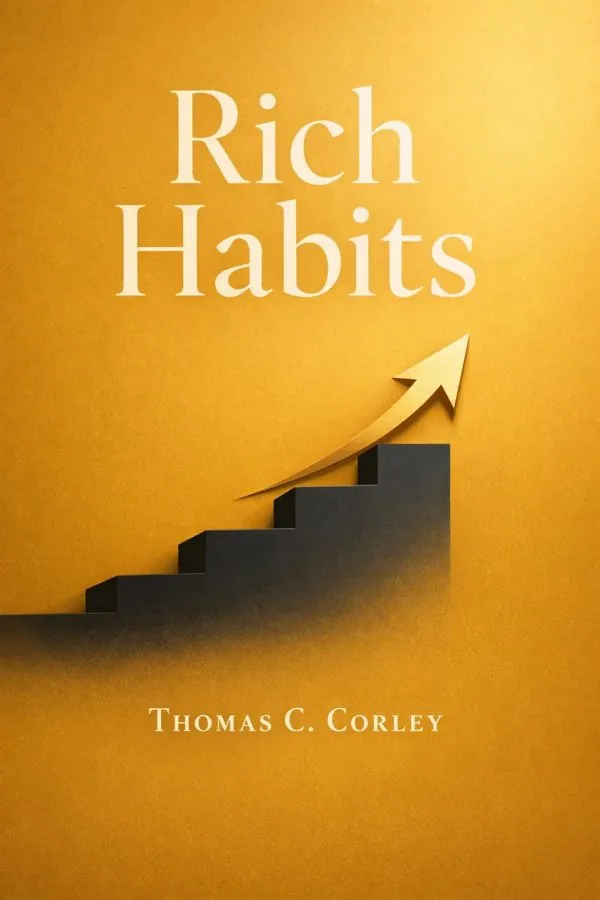
Rich Habits: The Daily Success Habits of Wealthy Individuals: Summary & Key Insights
 10 min9 chaptersAudio available
Key Takeaways from Rich Habits: The Daily Success Habits of Wealthy Individuals
Success rarely arrives as a dramatic breakthrough; more often, it grows from invisible routines repeated for years.
Motivation is unreliable, but routines are dependable.
The people who grow the most are often the ones who never stop being students.
No one succeeds alone, and the people around you quietly influence what you normalize.
It is difficult to build wealth with a mind and body that are constantly running on low power.
What Is Rich Habits: The Daily Success Habits of Wealthy Individuals About?
Rich Habits: The Daily Success Habits of Wealthy Individuals by Thomas C. Corley is a habits book spanning 5 pages. What if wealth is less about luck, talent, or inheritance and more about the small choices repeated every day? In Rich Habits, Thomas C. Corley argues that success leaves behavioral clues. After spending five years studying the routines, decisions, and patterns of both wealthy and struggling individuals, he found that prosperity is often built through ordinary habits practiced consistently over time. The book is not simply about making more money; it is about developing a lifestyle that supports discipline, health, learning, strong relationships, and long-term thinking. Corley’s central idea is both simple and demanding: your daily behaviors shape your future more than your intentions do. The wealthy, in his research, were more likely to read, plan, set goals, manage their health, limit entertainment, and nurture productive relationships. Those trapped in financial difficulty often followed habits that reinforced stress, distraction, and stagnation. What makes this book matter is its practicality. Corley, a certified public accountant and financial planner, translates his findings into habits readers can adopt immediately. Rich Habits offers a useful framework for anyone who wants to build a more successful, focused, and financially secure life.
This FizzRead summary covers all 9 key chapters of Rich Habits: The Daily Success Habits of Wealthy Individuals in approximately 10 minutes, distilling the most important ideas, arguments, and takeaways from Thomas C. Corley's work. Also available as an audio summary and Key Quotes Podcast.
Rich Habits: The Daily Success Habits of Wealthy Individuals
What if wealth is less about luck, talent, or inheritance and more about the small choices repeated every day? In Rich Habits, Thomas C. Corley argues that success leaves behavioral clues. After spending five years studying the routines, decisions, and patterns of both wealthy and struggling individuals, he found that prosperity is often built through ordinary habits practiced consistently over time. The book is not simply about making more money; it is about developing a lifestyle that supports discipline, health, learning, strong relationships, and long-term thinking.
Corley’s central idea is both simple and demanding: your daily behaviors shape your future more than your intentions do. The wealthy, in his research, were more likely to read, plan, set goals, manage their health, limit entertainment, and nurture productive relationships. Those trapped in financial difficulty often followed habits that reinforced stress, distraction, and stagnation.
What makes this book matter is its practicality. Corley, a certified public accountant and financial planner, translates his findings into habits readers can adopt immediately. Rich Habits offers a useful framework for anyone who wants to build a more successful, focused, and financially secure life.
Who Should Read Rich Habits: The Daily Success Habits of Wealthy Individuals?
This book is perfect for anyone interested in habits and looking to gain actionable insights in a short read. Whether you're a student, professional, or lifelong learner, the key ideas from Rich Habits: The Daily Success Habits of Wealthy Individuals by Thomas C. Corley will help you think differently.
- ✓Readers who enjoy habits and want practical takeaways
- ✓Professionals looking to apply new ideas to their work and life
- ✓Anyone who wants the core insights of Rich Habits: The Daily Success Habits of Wealthy Individuals in just 10 minutes
Want the full summary?
Get instant access to this book summary and 100K+ more with Fizz Moment.
Get Free SummaryAvailable on App Store • Free to download
Key Chapters
Success rarely arrives as a dramatic breakthrough; more often, it grows from invisible routines repeated for years. That is the foundational insight of Rich Habits. Corley distinguishes between “rich habits,” which support growth, health, productivity, and prosperity, and “poor habits,” which reinforce stagnation, stress, and financial struggle. A rich habit might be reading to learn, exercising regularly, tracking expenses, or maintaining a strong work ethic. A poor habit might be excessive television, impulsive spending, chronic lateness, or neglecting personal development.
The power of this distinction lies in its cumulative effect. One unhealthy meal does not ruin a life, and one skipped workout does not create failure. But patterns repeated daily eventually become identity. Corley’s research suggests that wealthy individuals tend to build routines that improve their odds of success, while poor habits often quietly sabotage opportunities before they can grow.
This framework is empowering because it shifts the conversation away from fixed traits. You do not have to be born brilliant, connected, or wealthy to begin changing your trajectory. You can alter your habits. For example, replacing one hour of nightly mindless entertainment with reading, planning, or skill-building may feel small, but over a year it compounds into knowledge, discipline, and confidence. Similarly, tracking where your money goes for just a month can expose damaging patterns and create the basis for better decisions.
Corley’s message is not that rich people are morally superior. It is that certain behaviors are more likely to produce better outcomes. Habits become systems, systems become results, and results reinforce future behavior.
Actionable takeaway: Identify three daily poor habits currently draining your time, money, or energy, and replace each with one rich habit that supports learning, health, or financial progress.
Motivation is unreliable, but routines are dependable. One of Corley’s clearest findings is that successful people do not wait to feel inspired before acting. They create structure. Many of the wealthy individuals in his research woke up early, followed a morning routine, and reviewed their goals consistently. This gave them a sense of direction before the demands of the day could scatter their attention.
Goals matter in Corley’s framework because they convert desire into measurable targets. Wanting to “be successful” is vague. Deciding to save a fixed amount per month, call three prospects per day, lose ten pounds, or read two books per month is concrete. Specific goals help people make better decisions because they create a filter. When your objective is clear, you can judge whether a behavior supports or undermines it.
Routines reduce decision fatigue. If you wake up at the same time, exercise before work, review your top priorities, and schedule your highest-value task first, you preserve energy for meaningful work rather than wasting it on endless choices. A person who plans the next day every evening will usually outperform someone who begins each morning in reaction mode.
Corley also emphasizes daily review. Goals are not set once and forgotten; they are tracked, adjusted, and acted upon. A salesperson might review leads each morning. A freelancer may block two hours for deep work before checking messages. A family might automate savings to align with long-term financial goals. These are not glamorous acts, but they create momentum.
Actionable takeaway: Build a 30-minute morning routine that includes goal review, priority setting, and one action that moves your most important objective forward before distractions begin.
The people who grow the most are often the ones who never stop being students. Corley found that many wealthy individuals devoted significant time to self-education, especially through reading. Importantly, they did not read only for entertainment. They read to acquire practical knowledge, deepen expertise, understand people, and improve decision-making. In contrast, financially struggling individuals in his research were less likely to engage in consistent educational habits.
This idea matters because earning power is closely linked to value creation. The more useful your knowledge, the more opportunities you can recognize and the more effectively you can solve problems. Continuous learning sharpens judgment, broadens perspective, and makes adaptation easier in a changing economy. Someone who reads about sales, investing, leadership, communication, or their industry is actively increasing their ability to contribute and earn.
Corley’s point is not that formal schooling is the only route to advancement. Self-directed learning counts. A manager can improve by listening to leadership podcasts and reading biographies. An entrepreneur can study marketing, negotiation, and customer psychology. An employee can learn software, analytics, or communication skills that make them more valuable at work. Even 20 to 30 minutes a day adds up significantly over time.
Reading also improves language, focus, and mental flexibility. It exposes you to better questions and stronger models of thinking. Instead of reacting emotionally or impulsively, educated people often make more informed choices because they have a wider frame of reference.
Corley treats learning as a daily habit, not an occasional project. If you want a richer life, become the kind of person who keeps growing regardless of age, title, or income level.
Actionable takeaway: Set a daily learning target, such as reading 10 pages of nonfiction or spending 20 minutes studying a skill that directly improves your work, finances, or personal effectiveness.
No one succeeds alone, and the people around you quietly influence what you normalize. Corley emphasizes that wealthy individuals tend to cultivate relationships with optimistic, disciplined, goal-oriented people. They are intentional about who they spend time with because they understand that attitudes, standards, and behaviors are contagious. Negative, cynical, and self-destructive relationships can drain ambition and distort what feels acceptable.
This does not mean using people or abandoning anyone who is struggling. It means recognizing that your environment matters. If your closest circle ridicules ambition, overspends, avoids responsibility, or blames others for everything, it becomes harder to maintain productive habits. By contrast, when you spend time with people who read, build, save, plan, and solve problems, you absorb those norms almost automatically.
Corley also highlights the importance of giving value within relationships. Successful people often invest in networking, mentorship, and mutual support. They show up on time, follow through, express gratitude, and stay in touch. These behaviors create trust, and trust opens doors. A career opportunity, partnership, or introduction often comes not from formal applications but from credibility built over years.
Relationships also affect emotional resilience. Supportive people can encourage you when progress is slow, while destructive people can intensify doubt. For practical application, consider auditing your social environment. Which relationships energize your growth? Which ones push you toward bad habits? Can you spend more time with mentors, peers, and communities aligned with your goals?
Corley’s broader lesson is that success is social. Habits spread through networks, and your future is shaped partly by whose mindset you repeatedly encounter.
Actionable takeaway: Intentionally strengthen one relationship each week with a mentor, disciplined peer, or positive contact who models the habits and standards you want to develop.
It is difficult to build wealth with a mind and body that are constantly running on low power. Corley’s research ties success not only to financial habits but also to personal discipline in health, energy, and emotional regulation. Wealthy individuals were more likely to exercise, control their eating habits, and monitor behaviors that affected long-term performance. This may sound unrelated to money, but it is not. Energy is an economic asset. Focus, stamina, and consistency all depend on physical and mental well-being.
Self-mastery means learning to delay gratification. It is choosing sleep over late-night distractions, exercise over excuses, and a thoughtful response over emotional impulse. People often sabotage themselves not because they lack intelligence, but because they cannot sustain the behaviors required for progress. A person may know they should save, study, or network, but without discipline those intentions dissolve.
Corley suggests that many poor habits are rooted in unmanaged impulses: overeating, overspending, procrastinating, or escaping into entertainment. Rich habits, by contrast, strengthen self-command. Even simple routines like walking daily, limiting junk food, keeping a regular sleep schedule, or planning meals can improve mood and decision quality. Over time, that greater stability helps you perform better at work, think more clearly, and avoid costly mistakes.
The connection between health and prosperity becomes obvious when you consider productivity. A person with steady energy can handle complex tasks, maintain better relationships, and persist through setbacks. Someone exhausted and reactive may know what to do but fail to execute.
Actionable takeaway: Choose one physical self-mastery habit this week, such as 30 minutes of walking, a fixed bedtime, or eliminating one unhealthy food trigger, and treat it as a foundation for better financial and professional performance.
You cannot simply remove a destructive habit and expect life to improve; a vacuum usually gets filled by the same behavior returning in a different form. Corley’s approach to habit change is practical: poor habits must be identified, understood, and intentionally replaced with richer alternatives. The goal is not self-condemnation but conscious redesign.
Many people fail to change because they focus on outcomes rather than triggers. They say, “I need to stop overspending,” but never examine when, where, and why they spend impulsively. Is it boredom? Stress? Social pressure? Convenience? Once the trigger is visible, a replacement becomes possible. For example, someone who shops online when anxious might create a new ritual: taking a walk, calling a friend, or delaying any nonessential purchase for 24 hours.
Replacement also works because habits operate through repetition and reward. If nightly television is your default, simply forbidding it may fail. But replacing one hour of it with reading, planning, or a side project creates a new pattern. Similarly, replacing unstructured mornings with a checklist of exercise, goal review, and focused work can gradually redefine your identity.
Corley’s message is hopeful: transformation is not instant, but it is possible through persistence. You do not need to overhaul your entire life in one week. Small substitutions matter. Saving automatically instead of spending first is a replacement. Bringing lunch instead of buying impulsively is a replacement. Listening to educational content during a commute instead of consuming random noise is a replacement.
The deeper point is that habits are trainable. The future changes when daily defaults change.
Actionable takeaway: Pick one poor habit that repeatedly costs you time, health, or money, identify its trigger, and design a specific replacement behavior you can practice every day for the next 30 days.
Most people underestimate what repeated small actions can do because the results are invisible at first. Corley places major emphasis on compounding: habits do not just produce isolated outcomes; they accumulate into radically different lives. A few dollars saved each day, a short workout repeated weekly, a chapter read every night, or one extra call made consistently can produce outsized long-term effects.
This is why rich habits feel unimpressive in the moment. Reading ten pages does not make you an expert today. Walking for half an hour does not transform your body overnight. Setting aside a modest amount each week does not create instant wealth. But over months and years, these choices create knowledge, health, confidence, savings, and opportunity. The opposite is also true. Repeated lateness, overspending, junk food, procrastination, and negativity produce a slow downward drift that is easy to ignore until the damage is substantial.
Compounding works in behavior, relationships, and reputation as well as money. If you keep promises, arrive prepared, and follow up consistently, people begin to trust you. That trust compounds into referrals, promotions, and influence. If you neglect details, miss deadlines, and make excuses, that pattern also compounds, closing doors quietly.
Corley’s research reinforces the idea that success is not typically a single event but the delayed reward of disciplined repetition. This perspective is especially useful when progress feels slow. If your habits are aligned, the absence of immediate results does not mean failure; it often means the compounding process is still underway.
Actionable takeaway: Start tracking one small daily behavior with long-term value, such as savings, reading, exercise, or outreach, and commit to consistency for 90 days to experience the power of compounding firsthand.
People often say they value growth, health, and financial security, but their calendars tell a different story. Corley repeatedly shows that how people spend their time is one of the clearest predictors of their future. Wealthy individuals in his research tended to use time intentionally. They limited low-value activities, especially excessive entertainment, and gave more attention to work, learning, planning, and relationship-building.
Time management is not just about squeezing more tasks into a day. It is about aligning hours with meaningful priorities. A person who spends three hours each evening consuming entertainment may sincerely want a better job or stronger finances, but their schedule is strengthening a different future. By contrast, one focused hour spent learning a skill, managing money, or building a side business can significantly change life over time.
Corley’s work suggests that wasted time is often disguised as harmless habit. Endless scrolling, gossip, aimless web browsing, and unplanned television are not always catastrophic individually, but together they steal years. Intentional people protect their attention because they understand that attention directs effort, and effort shapes outcomes.
Practical application begins with awareness. Track your time for a week. How much goes to work, sleep, family, exercise, learning, entertainment, and distraction? The results may be uncomfortable, but they reveal where change is possible. Then redesign. Reduce one low-value activity and reassign that time to a high-return behavior. Time cannot be saved, only spent differently.
In Corley’s framework, productive time use is not about becoming robotic. It is about making sure your schedule reflects the life you claim to want.
Actionable takeaway: Audit your time for seven days, identify your two biggest low-value time drains, and replace at least 30 minutes of one with an activity that improves your income, health, or personal growth.
Opportunity often favors people who expect improvement and act before certainty arrives. Corley observed that wealthy individuals were generally more optimistic and proactive than those stuck in cycles of financial struggle. This optimism was not blind positivity. It was a practical belief that effort matters, problems can be solved, and setbacks can be overcome. That mindset changes behavior.
Pessimistic thinking encourages passivity. If you believe nothing will work, you stop trying. You do not make the call, submit the proposal, ask for help, or learn the skill. Optimism, by contrast, makes initiative more likely. You follow up after rejection. You seek mentors. You test ideas. You continue improving. Over time, these extra attempts dramatically increase the number of opportunities available to you.
Corley’s findings suggest that attitude and action are tightly linked. People who think positively are more likely to persist, and people who persist gather more evidence that progress is possible. This creates an upward cycle. Initiative also signals value to others. Employers, clients, and collaborators tend to trust people who take responsibility, solve problems, and move things forward without constant supervision.
In practical terms, this could mean volunteering for a project at work, pitching a new idea, reaching out to someone you admire, or taking the first step on a business concept instead of endlessly preparing. Optimism does not guarantee success, but it increases engagement with reality in a way that makes success more likely.
The broader lesson is that mindset matters most when it translates into behavior. Hope becomes powerful when it produces effort.
Actionable takeaway: Each day for the next week, take one initiative you have been delaying, however small, and pair it with a written statement of possibility: “This may not work immediately, but taking action improves my odds.”
All Chapters in Rich Habits: The Daily Success Habits of Wealthy Individuals
About the Author
Thomas C. Corley is an American certified public accountant, financial planner, speaker, and author best known for his research on the daily habits of wealthy individuals. Over several years, he studied the routines and behaviors of rich and poor people to understand how patterns of thinking and action affect financial outcomes. His work focuses on the link between personal habits, success, and long-term prosperity, making him a recognizable voice in the fields of self-development and financial behavior. Corley writes in a practical, accessible style, translating research observations into habits readers can apply in everyday life. Through books such as Rich Habits, he has helped popularize the idea that wealth is often built through consistent discipline, learning, and intentional choices rather than dramatic one-time events.
Get This Summary in Your Preferred Format
Read or listen to the Rich Habits: The Daily Success Habits of Wealthy Individuals summary by Thomas C. Corley anytime, anywhere. FizzRead offers multiple formats so you can learn on your terms — all free.
Available formats: App · Audio · PDF · EPUB — All included free with FizzRead
Download Rich Habits: The Daily Success Habits of Wealthy Individuals PDF and EPUB Summary
Key Quotes from Rich Habits: The Daily Success Habits of Wealthy Individuals
“Success rarely arrives as a dramatic breakthrough; more often, it grows from invisible routines repeated for years.”
“Motivation is unreliable, but routines are dependable.”
“The people who grow the most are often the ones who never stop being students.”
“No one succeeds alone, and the people around you quietly influence what you normalize.”
“It is difficult to build wealth with a mind and body that are constantly running on low power.”
Frequently Asked Questions about Rich Habits: The Daily Success Habits of Wealthy Individuals
Rich Habits: The Daily Success Habits of Wealthy Individuals by Thomas C. Corley is a habits book that explores key ideas across 9 chapters. What if wealth is less about luck, talent, or inheritance and more about the small choices repeated every day? In Rich Habits, Thomas C. Corley argues that success leaves behavioral clues. After spending five years studying the routines, decisions, and patterns of both wealthy and struggling individuals, he found that prosperity is often built through ordinary habits practiced consistently over time. The book is not simply about making more money; it is about developing a lifestyle that supports discipline, health, learning, strong relationships, and long-term thinking. Corley’s central idea is both simple and demanding: your daily behaviors shape your future more than your intentions do. The wealthy, in his research, were more likely to read, plan, set goals, manage their health, limit entertainment, and nurture productive relationships. Those trapped in financial difficulty often followed habits that reinforced stress, distraction, and stagnation. What makes this book matter is its practicality. Corley, a certified public accountant and financial planner, translates his findings into habits readers can adopt immediately. Rich Habits offers a useful framework for anyone who wants to build a more successful, focused, and financially secure life.
You Might Also Like

Atomic Habits: An Easy & Proven Way to Build Good Habits and Break Bad Ones
James Clear
10 min
A Complaint Free World: How to Stop Complaining and Start Enjoying the Life You Always Wanted
Will Bowen
10 minBadass Habits: Cultivate the Awareness, Boundaries, and Daily Upgrades You Need to Make Them Stick
Jen Sincero
10 min
Better Than Before: Mastering The Habits Of Our Everyday Lives
Gretchen Rubin
10 min
Change Anything: The New Science of Personal Success
Kerry Patterson
10 min
Discipline Equals Freedom: Field Manual
Jocko Willink
10 minBrowse by Category
Ready to read Rich Habits: The Daily Success Habits of Wealthy Individuals?
Get the full summary and 100K+ more books with Fizz Moment.