
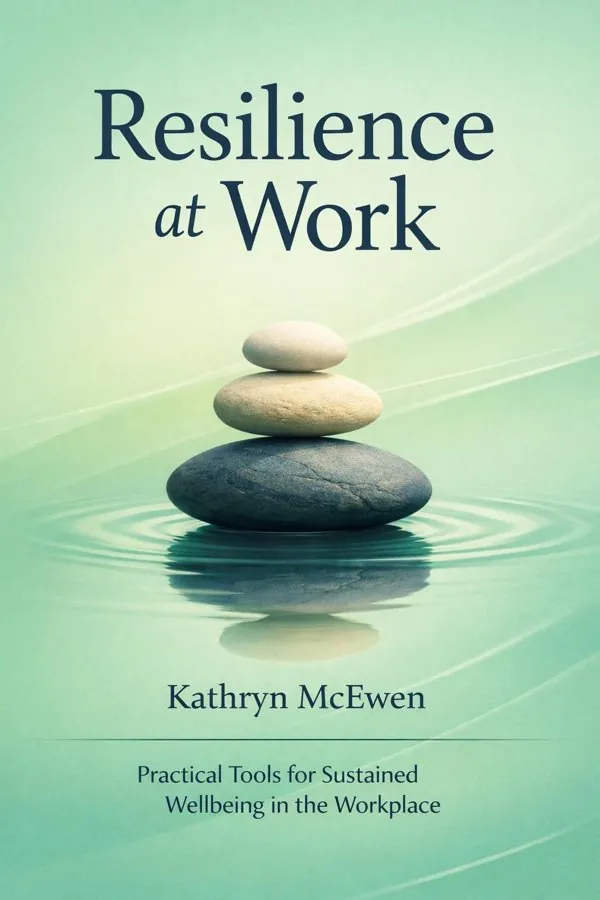
Resilience at Work: Practical Tools for Sustained Wellbeing in the Workplace: Summary & Key Insights
 10 min8 chaptersAudio available
Key Takeaways from Resilience at Work: Practical Tools for Sustained Wellbeing in the Workplace
Resilience becomes useful only when it stops being a buzzword and starts becoming something people can understand, assess, and build.
Two people can face the same deadline, the same workload, and the same uncertainty, yet experience the situation in completely different ways.
Many workplaces quietly reward depletion.
Pressure does not just test skill; it tests emotional control.
People often imagine resilience as an individual quality, but McEwen makes clear that no one sustains resilience alone.
What Is Resilience at Work: Practical Tools for Sustained Wellbeing in the Workplace About?
Resilience at Work: Practical Tools for Sustained Wellbeing in the Workplace by Kathryn McEwen is a organization book spanning 7 pages. Modern work asks people to do something difficult every day: perform well under pressure without sacrificing their health, motivation, or humanity. In Resilience at Work, organizational psychologist Kathryn McEwen tackles this challenge head-on by showing that resilience is not a vague personality trait or a motivational slogan. It is a set of learnable capacities that help individuals, teams, and organizations respond to stress, adapt to change, and keep functioning effectively over time. Drawing on psychology, coaching practice, and workplace research, McEwen offers a practical framework for understanding what resilience really looks like in professional life. What makes this book especially valuable is its balance of evidence and application. McEwen does not simply describe why people burn out or why workplaces become overwhelming; she maps the habits, attitudes, relationships, and cultural conditions that support sustained wellbeing. Her R@W model translates resilience into concrete dimensions that employees can strengthen and leaders can reinforce. For anyone navigating uncertainty, high demands, organizational change, or chronic stress, this book provides a grounded and useful guide to staying steady, healthy, and effective at work.
This FizzRead summary covers all 8 key chapters of Resilience at Work: Practical Tools for Sustained Wellbeing in the Workplace in approximately 10 minutes, distilling the most important ideas, arguments, and takeaways from Kathryn McEwen's work. Also available as an audio summary and Key Quotes Podcast.
Resilience at Work: Practical Tools for Sustained Wellbeing in the Workplace
Modern work asks people to do something difficult every day: perform well under pressure without sacrificing their health, motivation, or humanity. In Resilience at Work, organizational psychologist Kathryn McEwen tackles this challenge head-on by showing that resilience is not a vague personality trait or a motivational slogan. It is a set of learnable capacities that help individuals, teams, and organizations respond to stress, adapt to change, and keep functioning effectively over time. Drawing on psychology, coaching practice, and workplace research, McEwen offers a practical framework for understanding what resilience really looks like in professional life.
What makes this book especially valuable is its balance of evidence and application. McEwen does not simply describe why people burn out or why workplaces become overwhelming; she maps the habits, attitudes, relationships, and cultural conditions that support sustained wellbeing. Her R@W model translates resilience into concrete dimensions that employees can strengthen and leaders can reinforce. For anyone navigating uncertainty, high demands, organizational change, or chronic stress, this book provides a grounded and useful guide to staying steady, healthy, and effective at work.
Who Should Read Resilience at Work: Practical Tools for Sustained Wellbeing in the Workplace?
This book is perfect for anyone interested in organization and looking to gain actionable insights in a short read. Whether you're a student, professional, or lifelong learner, the key ideas from Resilience at Work: Practical Tools for Sustained Wellbeing in the Workplace by Kathryn McEwen will help you think differently.
- ✓Readers who enjoy organization and want practical takeaways
- ✓Professionals looking to apply new ideas to their work and life
- ✓Anyone who wants the core insights of Resilience at Work: Practical Tools for Sustained Wellbeing in the Workplace in just 10 minutes
Want the full summary?
Get instant access to this book summary and 100K+ more with Fizz Moment.
Get Free SummaryAvailable on App Store • Free to download
Key Chapters
Resilience becomes useful only when it stops being a buzzword and starts becoming something people can understand, assess, and build. That is the central contribution of Kathryn McEwen’s Resilience at Work, or R@W, model. Rather than treating resilience as a fixed personality trait that some people naturally possess, McEwen presents it as a multidimensional capacity shaped by habits, beliefs, relationships, and workplace conditions. This is important because if resilience can be broken down into parts, it can also be developed intentionally.
The R@W model integrates psychological research, coaching experience, and organizational observation into a practical structure. It highlights the factors that help people stay effective and well under pressure, such as confidence, emotional regulation, support networks, adaptability, purpose, and healthy work practices. By organizing resilience into clear dimensions, McEwen gives employees and organizations a shared language for discussing stress and performance without reducing the issue to willpower alone.
In practice, this means a struggling employee is not simply labeled “not resilient.” Instead, the question becomes more precise: Is the problem low recovery? poor boundaries? weak social support? lack of role clarity? emotional overload? For a manager, the model can guide coaching conversations. For HR teams, it can shape wellbeing initiatives. For individuals, it can reveal blind spots. Someone may be highly motivated yet lacking recovery habits. Another may be skilled and calm but disconnected from purpose.
The power of the model lies in this diagnostic usefulness. Resilience is not one thing; it is a system. Actionable takeaway: assess your resilience by identifying which dimensions are strongest and which are under strain, then focus your energy on improving one weak area at a time rather than trying to “be more resilient” in general.
Two people can face the same deadline, the same workload, and the same uncertainty, yet experience the situation in completely different ways. The difference often lies in mindset. McEwen emphasizes that resilience begins with how people interpret challenge, control, and possibility. A resilient mindset does not deny difficulty; it frames difficulty as something that can be managed, learned from, or worked through rather than as proof of helplessness or failure.
This perspective matters because thoughts influence emotional reactions and behavior. When employees interpret setbacks as personal inadequacy, stress escalates and performance narrows. They may procrastinate, avoid feedback, or become defensive. In contrast, when they view challenges as temporary, specific, and solvable, they are more likely to seek support, experiment with solutions, and stay engaged. This links resilience to cognitive habits such as realistic optimism, self-belief, and adaptability.
McEwen also connects personal resilience to strengths. People cope better under pressure when they know what they do well and can apply those strengths deliberately. A person with strong analytical ability may reduce anxiety by breaking complexity into manageable steps. Someone with strong interpersonal skills may preserve resilience by building support quickly during change. The point is not to become fearless, but to develop confidence in your capacity to respond.
A practical example is a team member facing a major restructuring. One response is, “Everything is out of my hands.” A more resilient response is, “I cannot control the restructure, but I can control how I communicate, prepare, and adapt.” That shift creates agency.
Actionable takeaway: when stress rises, ask yourself three questions: What is actually happening? What part can I influence? Which of my strengths can I use here? Those questions interrupt helpless thinking and restore constructive action.
Many workplaces quietly reward depletion. People who work late, skip breaks, and remain constantly available are often seen as committed, while those who protect their energy can feel guilty. McEwen challenges this culture by arguing that resilience is not about enduring more and more strain. It is about sustaining energy, health, and effectiveness over time. Without recovery, even high performers eventually erode.
Wellbeing in this book is practical rather than idealized. It includes sleep, movement, nutrition, pacing, boundaries, and the ability to switch off psychologically from work. These are not secondary lifestyle tips; they are the biological foundation of resilient performance. When people are tired, overloaded, or chronically activated, they think less clearly, react more emotionally, and lose flexibility. In other words, burnout often begins as an energy-management problem long before it becomes a motivation problem.
McEwen encourages readers to pay attention to rhythms rather than heroic effort. Short pauses between tasks, proper lunch breaks, walking meetings, realistic meeting loads, and end-of-day shutdown rituals all help regulate stress. A manager who expects instant replies at all hours may unknowingly undermine team resilience. Likewise, an employee who never uses leave may believe they are being responsible while actually becoming less effective.
Consider a professional services team during a busy quarter. Instead of glorifying overwork, the team leader builds in workload triage, protected focus time, and mandatory recovery after major deadlines. Performance often improves because people make fewer mistakes and remain engaged.
Actionable takeaway: identify one recovery habit you can standardize this week, such as a defined lunch break, a no-email cutoff after work, or a 10-minute reset between demanding tasks. Resilience grows when recovery becomes routine rather than occasional.
Pressure does not just test skill; it tests emotional control. McEwen shows that one of the most important features of workplace resilience is the ability to notice, manage, and respond to emotions without being ruled by them. This does not mean suppressing frustration, anxiety, or disappointment. It means developing enough awareness and regulation to keep those emotions from hijacking behavior and decision-making.
In stressful workplaces, emotional contagion spreads quickly. One anxious leader can make an entire team feel unsafe. One defensive reaction in a meeting can shut down collaboration. Resilient employees are not emotionless; they are more capable of pausing before reacting, separating facts from assumptions, and choosing a constructive response. This is where cognitive flexibility becomes essential. People who can reframe situations, consider alternative interpretations, and tolerate ambiguity are less likely to become trapped in catastrophic thinking.
McEwen’s approach is practical. Emotional regulation can involve breathing techniques before difficult conversations, naming emotions accurately, stepping back from an escalating interaction, or using reflective questions such as, “What else could explain this?” For example, if a manager receives a blunt email, an unregulated response might assume hostility and fire back. A more resilient response might recognize the trigger, delay reply, and consider that the sender may be under pressure rather than being disrespectful.
This skill is especially valuable during change, conflict, and uncertainty, where incomplete information easily breeds fear. Emotional resilience enables steadier communication and better problem-solving.
Actionable takeaway: create a simple pause practice for stressful moments: stop, breathe slowly, name what you are feeling, and ask what response would be most helpful rather than most immediate. That brief gap can prevent unnecessary conflict and preserve clear thinking.
People often imagine resilience as an individual quality, but McEwen makes clear that no one sustains resilience alone. Supportive relationships are one of the strongest buffers against workplace stress. Connection provides perspective, practical assistance, emotional reassurance, and a sense of belonging that helps people cope with pressure more effectively. In contrast, isolation magnifies strain and makes setbacks harder to absorb.
At work, resilient relationships are built through trust, mutual respect, and psychological safety. Colleagues need to feel able to ask for help, speak honestly about workload, admit mistakes, and share concerns without fearing humiliation or punishment. A workplace may offer wellness programs, but if the culture discourages vulnerability or treats support-seeking as weakness, resilience remains fragile.
McEwen highlights both informal and formal forms of connection. Informal support might include a colleague who checks in after a difficult client meeting. Formal support could involve mentoring, coaching, peer networks, or structured team debriefs. Leaders play a major role here. A manager who listens well, notices strain early, and normalizes help-seeking strengthens the resilience of the whole team.
Consider the difference between two environments. In one, employees quietly struggle and conceal overload until errors appear. In the other, team members regularly discuss pressure points, redistribute tasks when needed, and debrief after intense periods. The second environment is not softer; it is more sustainable.
Strong relationships also improve adaptation during change. People are more willing to face uncertainty when they trust the people around them. Belonging reduces the psychological cost of challenge.
Actionable takeaway: invest deliberately in one resilience-supporting relationship at work this month. Schedule a genuine check-in, offer help, ask for perspective, or create a regular peer conversation. Resilience strengthens when connection becomes an everyday practice, not just a crisis response.
Work becomes far more draining when effort feels disconnected from meaning. McEwen argues that resilience is strengthened when people can link what they do each day to personal values, contribution, and purpose. Purpose does not eliminate stress, but it changes the experience of stress by helping people see why the struggle matters. Without that connection, pressure can feel arbitrary, demoralizing, and empty.
This idea is especially relevant in demanding roles. People can tolerate challenge better when they believe their work aligns with something important. That may be service to others, craftsmanship, learning, justice, community impact, or supporting a family. Values act as an internal compass, especially in times of uncertainty. When external conditions shift, values offer continuity.
McEwen does not present purpose as a grand or abstract ideal reserved for senior leaders. It can be found in everyday work. A customer service professional may draw meaning from solving problems for people in distress. A project manager may value bringing order to complexity. A leader may see purpose in creating conditions where others can thrive. The key is conscious reflection. If people never examine what matters to them, they are more likely to drift into disengagement.
Purpose also supports difficult decisions. When priorities clash, values help individuals choose where to spend time and energy. For instance, someone who values integrity may resist cutting ethical corners during a high-pressure deadline. Someone who values development may interpret a stretch assignment as growth rather than punishment.
Actionable takeaway: write down your top three work-related values and identify one current task or challenge that connects to each. If a major part of your role connects to none of them, that is an important signal to address through redesign, conversation, or career reflection.
Resilience is often discussed as if it were an employee responsibility, but McEwen insists that organizations themselves either support resilience or steadily undermine it. Team and organizational resilience depend heavily on leadership behavior, cultural norms, workload design, communication quality, and the degree of psychological safety people experience. In other words, resilient workers cannot fully compensate for unhealthy systems.
Leaders set the emotional and operational tone. If leaders model overwork, unpredictability, blame, or silence during uncertainty, teams absorb those patterns. If they model calm, transparency, fairness, and realistic expectations, resilience becomes easier to sustain. This is why culture matters as much as individual coping skills. A workplace that rewards constant urgency, ignores recovery, and treats people as endlessly available will eventually convert pressure into burnout.
McEwen encourages leaders to think systemically. Team resilience grows when goals are clear, roles are defined, support is accessible, and setbacks are treated as learning opportunities rather than personal failures. Regular communication during change reduces unnecessary anxiety. Fair workload allocation prevents resentment. Recognition reinforces effort and meaning. Debriefs after stressful events help teams recover and improve.
Imagine two departments facing budget cuts. In one, leaders withhold information, creating rumors and fear. In the other, leaders communicate what is known, acknowledge uncertainty honestly, invite questions, and involve staff in problem-solving. The second team may still feel stressed, but it is more likely to remain engaged and cohesive.
Actionable takeaway: if you lead people, audit your team culture through one question: “What in our current way of working makes resilience easier, and what makes it harder?” Then choose one structural improvement, such as clearer priorities, better check-ins, or healthier communication norms.
One of the most encouraging messages in McEwen’s book is that resilience is built less by dramatic transformation than by repeated small behaviors. People often wait until they are overwhelmed before trying to change, but resilience is strongest when developed proactively through habits that prepare the mind and body for pressure before crisis hits.
These habits include planning realistic workloads, noticing early warning signs of stress, maintaining routines that support sleep and recovery, seeking feedback, strengthening social support, and reflecting on what works after setbacks. Small actions matter because stress accumulates gradually. Likewise, resilience accumulates gradually. A five-minute planning ritual at the start of the day, a short walk after intense meetings, or a weekly reflection on energy levels may seem minor, but over time these practices increase self-awareness and reduce avoidable strain.
McEwen’s approach also helps demystify resilience training. It is not necessarily about adding one more major program to a busy schedule. It can be woven into normal work. Teams can begin meetings with priority clarification. Managers can ask not only about progress but about capacity. Individuals can identify their personal stress signatures, such as irritability, poor concentration, or withdrawal, and act earlier.
This idea is especially valuable because it reduces all-or-nothing thinking. You do not need perfect balance, complete calm, or a low-stress job to become more resilient. You need repeatable practices that help you respond better than you did before.
Actionable takeaway: choose one daily and one weekly resilience habit. For example, daily task prioritization and a weekly review of stress triggers. Consistency matters more than intensity, and small habits are often the most durable route to lasting resilience.
All Chapters in Resilience at Work: Practical Tools for Sustained Wellbeing in the Workplace
About the Author
Kathryn McEwen is an Australian organizational psychologist with deep expertise in workplace resilience, wellbeing, and leadership development. Her career has focused on helping individuals and organizations respond more effectively to stress, pressure, and change. Drawing on psychological research as well as extensive consulting and coaching experience, she has worked across sectors to design practical resilience tools that can be used in real workplace settings. McEwen is best known for developing the Resilience at Work model, which translates the broad idea of resilience into clear, measurable dimensions that employees, teams, and leaders can strengthen. Her work is valued for its balance of scientific credibility and practical usefulness, making her a trusted voice in the field of sustainable performance and workplace mental health.
Get This Summary in Your Preferred Format
Read or listen to the Resilience at Work: Practical Tools for Sustained Wellbeing in the Workplace summary by Kathryn McEwen anytime, anywhere. FizzRead offers multiple formats so you can learn on your terms — all free.
Available formats: App · Audio · PDF · EPUB — All included free with FizzRead
Download Resilience at Work: Practical Tools for Sustained Wellbeing in the Workplace PDF and EPUB Summary
Key Quotes from Resilience at Work: Practical Tools for Sustained Wellbeing in the Workplace
“Resilience becomes useful only when it stops being a buzzword and starts becoming something people can understand, assess, and build.”
“Two people can face the same deadline, the same workload, and the same uncertainty, yet experience the situation in completely different ways.”
“Many workplaces quietly reward depletion.”
“Pressure does not just test skill; it tests emotional control.”
“People often imagine resilience as an individual quality, but McEwen makes clear that no one sustains resilience alone.”
Frequently Asked Questions about Resilience at Work: Practical Tools for Sustained Wellbeing in the Workplace
Resilience at Work: Practical Tools for Sustained Wellbeing in the Workplace by Kathryn McEwen is a organization book that explores key ideas across 8 chapters. Modern work asks people to do something difficult every day: perform well under pressure without sacrificing their health, motivation, or humanity. In Resilience at Work, organizational psychologist Kathryn McEwen tackles this challenge head-on by showing that resilience is not a vague personality trait or a motivational slogan. It is a set of learnable capacities that help individuals, teams, and organizations respond to stress, adapt to change, and keep functioning effectively over time. Drawing on psychology, coaching practice, and workplace research, McEwen offers a practical framework for understanding what resilience really looks like in professional life. What makes this book especially valuable is its balance of evidence and application. McEwen does not simply describe why people burn out or why workplaces become overwhelming; she maps the habits, attitudes, relationships, and cultural conditions that support sustained wellbeing. Her R@W model translates resilience into concrete dimensions that employees can strengthen and leaders can reinforce. For anyone navigating uncertainty, high demands, organizational change, or chronic stress, this book provides a grounded and useful guide to staying steady, healthy, and effective at work.
You Might Also Like

A Guide to the Project Management Body of Knowledge (PMBOK® Guide)
Project Management Institute
10 min
Organizational Behavior
Stephen P. Robbins
10 min
Accelerate: The Science of Lean Software and DevOps – Building and Scaling High Performing Technology Organizations
Nicole Forsgren, Jez Humble, Gene Kim
10 min
Awakening Compassion at Work: The Quiet Power That Elevates People and Organizations
Monica C. Worline, Jane E. Dutton
10 min
Building an Inclusive Organization: Leveraging the Power of a Diverse Workforce
Stephen Frost
10 min
Collaborative Intelligence: Thinking with People Who Think Differently
Dawna Markova, Angie McArthur
10 minBrowse by Category
Ready to read Resilience at Work: Practical Tools for Sustained Wellbeing in the Workplace?
Get the full summary and 100K+ more books with Fizz Moment.