
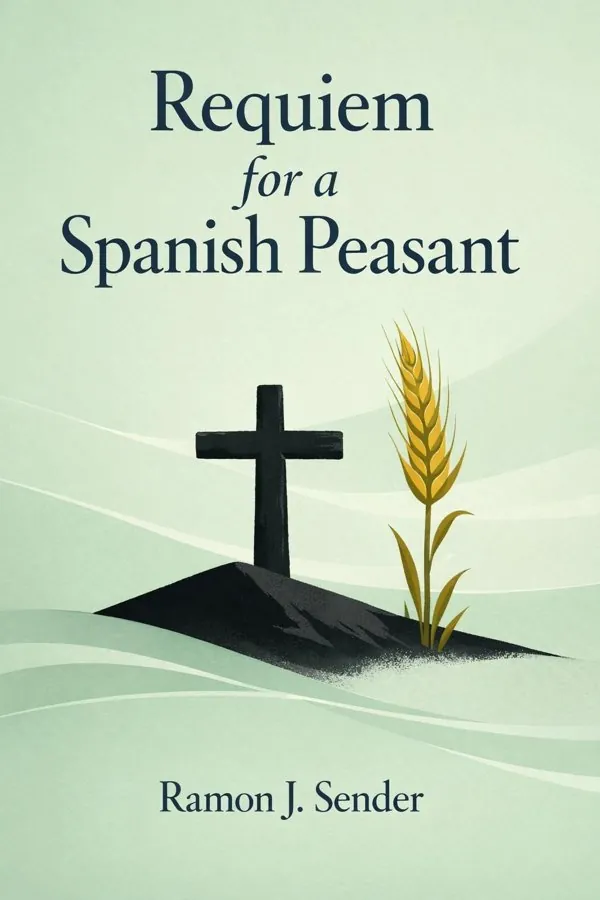
Requiem for a Spanish Peasant: Summary & Key Insights
 10 min8 chaptersAudio available
Key Takeaways from Requiem for a Spanish Peasant
A man can perform a sacred ritual and still be unable to escape what he has done.
In unjust societies, innocence is rarely protection.
The most unsettling transformations begin when private morality becomes public action.
Moments of joy in tragic novels are never merely decorative; they show what is truly at stake.
Communities do not collapse all at once; they collapse when fear teaches neighbors to abandon one another.
What Is Requiem for a Spanish Peasant About?
Requiem for a Spanish Peasant by Ramon J. Sender is a classics book spanning 6 pages. Originally published in 1953, Requiem for a Spanish Peasant is one of the most powerful short novels to emerge from the trauma of the Spanish Civil War. Ramón J. Sender condenses an entire social order, a political catastrophe, and a moral indictment into the story of one village peasant, Paco the Miller, whose life and death are recalled by the priest Mosén Millán as he prepares to say a requiem mass for him. What begins as a quiet vigil inside a church becomes a devastating reckoning with injustice, betrayal, and the way institutions can fail the people they claim to serve. Sender’s achievement lies in his precision: through spare language, shifting memories, and symbolic detail, he reveals how personal relationships are shaped by class hierarchy, religious authority, and fear. The novel matters because it transforms one local tragedy into a universal meditation on complicity and remembrance. Sender wrote from experience as a Spanish journalist, novelist, and exile deeply marked by war and repression, and that lived historical authority gives the book its enduring emotional and political force.
This FizzRead summary covers all 8 key chapters of Requiem for a Spanish Peasant in approximately 10 minutes, distilling the most important ideas, arguments, and takeaways from Ramon J. Sender's work. Also available as an audio summary and Key Quotes Podcast.
Requiem for a Spanish Peasant
Originally published in 1953, Requiem for a Spanish Peasant is one of the most powerful short novels to emerge from the trauma of the Spanish Civil War. Ramón J. Sender condenses an entire social order, a political catastrophe, and a moral indictment into the story of one village peasant, Paco the Miller, whose life and death are recalled by the priest Mosén Millán as he prepares to say a requiem mass for him. What begins as a quiet vigil inside a church becomes a devastating reckoning with injustice, betrayal, and the way institutions can fail the people they claim to serve. Sender’s achievement lies in his precision: through spare language, shifting memories, and symbolic detail, he reveals how personal relationships are shaped by class hierarchy, religious authority, and fear. The novel matters because it transforms one local tragedy into a universal meditation on complicity and remembrance. Sender wrote from experience as a Spanish journalist, novelist, and exile deeply marked by war and repression, and that lived historical authority gives the book its enduring emotional and political force.
Who Should Read Requiem for a Spanish Peasant?
This book is perfect for anyone interested in classics and looking to gain actionable insights in a short read. Whether you're a student, professional, or lifelong learner, the key ideas from Requiem for a Spanish Peasant by Ramon J. Sender will help you think differently.
- ✓Readers who enjoy classics and want practical takeaways
- ✓Professionals looking to apply new ideas to their work and life
- ✓Anyone who wants the core insights of Requiem for a Spanish Peasant in just 10 minutes
Want the full summary?
Get instant access to this book summary and 100K+ more with Fizz Moment.
Get Free SummaryAvailable on App Store • Free to download
Key Chapters
A man can perform a sacred ritual and still be unable to escape what he has done. That tension defines the opening of Requiem for a Spanish Peasant. Mosén Millán sits in the sacristy preparing for Paco’s funeral mass, waiting for villagers who never seem to arrive. Outwardly, he is carrying out his priestly duty. Inwardly, he is trapped inside memory. As he waits, the story unfolds through his recollections, and what looks like pious remembrance gradually becomes an exposure of guilt.
The setting matters. The church should be a place of consolation, yet here it becomes a chamber of unease. The silence around the mass reflects more than grief; it signals collective fear, political division, and moral avoidance. The absence of mourners suggests that the village has not healed and perhaps does not want to confront the truth. Mosén Millán’s mind moves from ceremony to memory because ritual alone cannot contain what happened.
Sender uses this vigil to show how institutions often preserve appearances while suppressing responsibility. The priest remembers Paco’s life intimately, yet that intimacy only deepens the reader’s sense of betrayal. The more he recalls, the more obvious it becomes that memory is not neutral. It can honor the dead, but it can also reveal the compromises of the living.
In practical terms, the novel asks readers to notice how people use formal gestures to avoid harder truths. Public tributes, official statements, and symbolic acts can be meaningful, but they can also function as substitutes for accountability. In workplaces, families, or communities, people often prefer ceremony to honest reckoning.
Actionable takeaway: when you participate in acts of remembrance, ask not only who is being honored, but also what truths are still being left unsaid.
In unjust societies, innocence is rarely protection. Paco’s early life is rooted in the ordinary world of rural labor: the mill, the fields, the river, animals, family, and the close rhythms of village existence. Sender presents him first as a boy shaped by work, curiosity, and compassion rather than ideology. This is crucial because Paco does not begin as a political symbol. He begins as a human being whose moral instincts are awakened by what he sees around him.
Mosén Millán has known Paco since childhood, and the priest’s memories capture the intimacy of village life. Paco is brave, energetic, and open-hearted. He notices suffering instinctively. His compassion for the poor and vulnerable emerges before any formal political consciousness does. This development gives the novel emotional power: Paco’s later defiance grows naturally out of decency, not ambition.
Sender also uses Paco’s upbringing to show how social hierarchy is normalized. Children absorb class divisions long before they can name them. A village may appear unified by religion, tradition, and shared customs, but beneath that surface lie deep inequalities. Paco’s innocence lets readers see these structures freshly. As he begins to perceive injustice, the reader experiences that awakening with him.
This pattern remains familiar. Many people first recognize unfair systems not through theory but through direct encounters: a friend denied opportunity, a worker exploited, a family humiliated by power. Moral awareness often starts in concrete human situations rather than abstract debates.
Paco’s childhood reminds us that empathy can be politically disruptive. People who truly see the suffering around them may become dangerous to systems built on silence.
Actionable takeaway: pay attention to the moments when your conscience is stirred by ordinary experience; those moments often reveal the truths a society is trained not to notice.
Moments of joy in tragic novels are never merely decorative; they show what is truly at stake. Paco’s courtship and marriage bring warmth and tenderness into the narrative, but they also highlight how fragile ordinary happiness becomes in a community organized by inequality and fear. Love here is not an escape from politics. It is one of the human goods that political violence eventually destroys.
Through Paco’s marriage, Sender presents him not simply as a rebel or victim, but as a man trying to build a life. He wants work, dignity, companionship, and continuity. These desires are modest, even universal. That universality deepens the tragedy because Paco’s fate is not the result of exceptional ambition. He is punished for believing that common people deserve to live fully and honorably.
The marriage also sharpens social tensions in the village. Family ties, expectations, and alliances reveal who belongs where and under what conditions. Happiness does not erase class hierarchy; it often makes its boundaries more visible. When a peasant with growing social awareness forms a household, he becomes harder to dismiss as a restless youth. He starts to represent a future. That is precisely what threatened elites fear.
In practical terms, the novel shows how personal milestones often expose political realities. Starting a family, seeking stable housing, or pursuing fair work can reveal the invisible systems governing access, status, and security. What seems private quickly becomes social.
Sender’s insight is sobering: oppression is not only the destruction of bodies, but also the interruption of ordinary human flourishing. To deny people justice is to deny them the chance to love, build, and belong without fear.
Actionable takeaway: treat everyday hopes—home, family, work, dignity—not as small concerns, but as essential measures of whether a society is genuinely just.
Communities do not collapse all at once; they collapse when fear teaches neighbors to abandon one another. As the Spanish Civil War reaches the village, the tensions long embedded in daily life become deadly. Sender shows that the violence does not emerge from nowhere. The war acts as an accelerant, giving old hierarchies and resentments the means to eliminate those who had begun to challenge them.
Paco’s fate is tied not only to ideology but to local power. Wealthy landowners, political opportunists, and supporters of the new violent order see him as dangerous because he has moral credibility among the poor. He is not merely one man; he is a reminder that injustice has been seen and named. Under such conditions, betrayal becomes systemic. People inform, remain silent, rationalize, and protect themselves by sacrificing others.
Mosén Millán’s role is central here. He is not portrayed as a cartoon villain but as a tragic participant in the machinery of betrayal. His closeness to Paco makes his failure more painful. He understands the human cost, yet he remains tied to authority, order, and the belief that mediation is possible even when violence has already chosen its victims. The novel insists that passivity in such moments is never neutral.
This dynamic remains recognizable in many settings. When institutions grow coercive, some people become active persecutors, but many more become facilitators through silence, procedural obedience, or faith in stability. Betrayal often arrives dressed as moderation.
Sender’s great moral challenge is this: what do loyalty, duty, and prudence mean when power turns openly unjust? The novel offers no easy comfort. It suggests that good intentions cannot excuse the failure to protect the vulnerable.
Actionable takeaway: in times of pressure, judge your choices not by whether they preserve order, but by whether they protect the people most at risk.
A funeral mass can honor the dead, but it can also expose the emptiness of the living. In the final movement of the novel, the requiem becomes more than a religious ceremony. It is a test of sincerity, memory, and communal truth. Mosén Millán performs the rite, yet the sparse attendance and emotional atmosphere reveal that no liturgy can repair what betrayal has broken.
Sender uses the requiem to question whether symbolic acts have value when they are not joined to repentance. The priest knows Paco’s life. He knows his goodness, his suffering, and the circumstances that led to his death. But the mass occurs after the irreparable has happened. That timing gives the event an almost unbearable irony. Respect for the dead arrives too late when courage was absent in life.
At the same time, Sender does not wholly dismiss ritual. The ceremony still matters because it names the loss and preserves memory against erasure. Yet its meaning depends on the moral integrity of those involved. Ritual without truth becomes performance. Ritual with truth can become witness.
This idea applies widely. Organizations often hold commemorations, issue apologies, or celebrate values after failing people in real time. Such gestures can be important, but only if they lead to examination, restitution, and changed behavior. Otherwise, they serve the conscience of the powerful more than the dignity of the harmed.
The requiem therefore forces readers to ask a difficult question: when we remember victims, are we honoring them, or protecting ourselves from what their lives demand of us?
Actionable takeaway: let remembrance lead to responsibility—whenever you honor a loss, identify one concrete way to confront the conditions that produced it.
The most chilling force in the novel is not hatred alone, but silence shared by many. One reason Requiem for a Spanish Peasant remains so powerful is that Sender refuses to isolate guilt in a few obvious villains. The village itself becomes a moral landscape shaped by omissions, evasions, and fearful accommodation. Some people benefit from the system directly, but others simply learn to survive by saying nothing.
Collective complicity does not mean everyone is equally guilty. Sender is too precise for that. The powerful bear the greatest responsibility. Yet the novel insists that injustice hardens when communities normalize absence: absent protest, absent testimony, absent solidarity, absent memory. The thin attendance at Paco’s mass is emblematic. Fear has entered public life so deeply that even mourning becomes dangerous.
This insight helps explain how oppressive systems endure. They do not rely only on propaganda or force. They depend on fragmented communities in which people believe private safety is possible if they remain uninvolved. Sender demonstrates the opposite. Silence may postpone immediate danger for some, but it ultimately impoverishes the whole moral life of a community.
Modern readers can apply this lesson in many contexts: workplace misconduct everyone knows about, discriminatory practices no one challenges, public corruption treated as normal, harmful family dynamics managed through denial. In each case, people often tell themselves that speaking up would change nothing or make things worse. The novel shows the cost of that logic.
Silence is rarely empty. It often functions as consent, cover, or surrender. The tragedy of Paco is intensified because too many people accepted the narrowing of what could be said and done.
Actionable takeaway: identify one silence in your environment that protects wrongdoing, and consider the smallest truthful act that could begin to break it.
The smaller the setting, the larger the truth can become. Sender places almost the entire emotional world of the novel inside one village, one church, and one network of memories. Yet this local story resonates far beyond Aragón or the Spanish Civil War because it captures recurring patterns of human history: inequality disguised as tradition, institutions shielding power, conscience awakening from lived experience, and violence justified in the name of order.
Paco is both singular and representative. He is a specific peasant with a family, a place, and a recognizable moral character. But he also stands for the countless ordinary people crushed when historical upheaval exposes the brutality hidden inside social hierarchies. Mosén Millán, likewise, is more than one priest. He represents the tragedy of those who mistake proximity to suffering for innocence in relation to it.
This universality is one reason the novel remains a staple of classic literature. It offers not just a historical account but a framework for interpreting how communities remember, distort, or suppress the past. Readers from many societies can recognize versions of Paco’s story in their own histories—where reformers were betrayed, where institutions failed, and where remembrance arrived after courage should have.
The book’s brevity strengthens this effect. Sender strips away excess so that the structure feels almost archetypal. A reader finishes the novel with the sense of having encountered both one death and many deaths, one village and many villages.
That is the lasting power of the book: it converts historical specificity into moral permanence without flattening either.
Actionable takeaway: when reading historical fiction, ask not only what happened there and then, but what recurring pattern of power and conscience it reveals about here and now.
All Chapters in Requiem for a Spanish Peasant
About the Author
Ramón J. Sender (1901–1982) was a Spanish novelist, journalist, and one of the most significant literary voices shaped by the upheavals of 20th-century Spain. Born in Aragón, he became active in the political and cultural life of the Second Republic and gained recognition for fiction and reportage attentive to social conflict and human suffering. The Spanish Civil War marked his life profoundly, and after the Nationalist victory he lived in exile, writing much of his major work abroad. Sender’s fiction frequently examines injustice, memory, violence, and the moral pressures of history. His style combines narrative economy with psychological and political insight. Among his best-known books are Requiem for a Spanish Peasant and Chronicle of Dawn, works that helped secure his place in Spanish and exile literature.
Get This Summary in Your Preferred Format
Read or listen to the Requiem for a Spanish Peasant summary by Ramon J. Sender anytime, anywhere. FizzRead offers multiple formats so you can learn on your terms — all free.
Available formats: App · Audio · PDF · EPUB — All included free with FizzRead
Download Requiem for a Spanish Peasant PDF and EPUB Summary
Key Quotes from Requiem for a Spanish Peasant
“A man can perform a sacred ritual and still be unable to escape what he has done.”
“In unjust societies, innocence is rarely protection.”
“The most unsettling transformations begin when private morality becomes public action.”
“Moments of joy in tragic novels are never merely decorative; they show what is truly at stake.”
“Communities do not collapse all at once; they collapse when fear teaches neighbors to abandon one another.”
Frequently Asked Questions about Requiem for a Spanish Peasant
Requiem for a Spanish Peasant by Ramon J. Sender is a classics book that explores key ideas across 8 chapters. Originally published in 1953, Requiem for a Spanish Peasant is one of the most powerful short novels to emerge from the trauma of the Spanish Civil War. Ramón J. Sender condenses an entire social order, a political catastrophe, and a moral indictment into the story of one village peasant, Paco the Miller, whose life and death are recalled by the priest Mosén Millán as he prepares to say a requiem mass for him. What begins as a quiet vigil inside a church becomes a devastating reckoning with injustice, betrayal, and the way institutions can fail the people they claim to serve. Sender’s achievement lies in his precision: through spare language, shifting memories, and symbolic detail, he reveals how personal relationships are shaped by class hierarchy, religious authority, and fear. The novel matters because it transforms one local tragedy into a universal meditation on complicity and remembrance. Sender wrote from experience as a Spanish journalist, novelist, and exile deeply marked by war and repression, and that lived historical authority gives the book its enduring emotional and political force.
You Might Also Like




Browse by Category
Ready to read Requiem for a Spanish Peasant?
Get the full summary and 100K+ more books with Fizz Moment.