
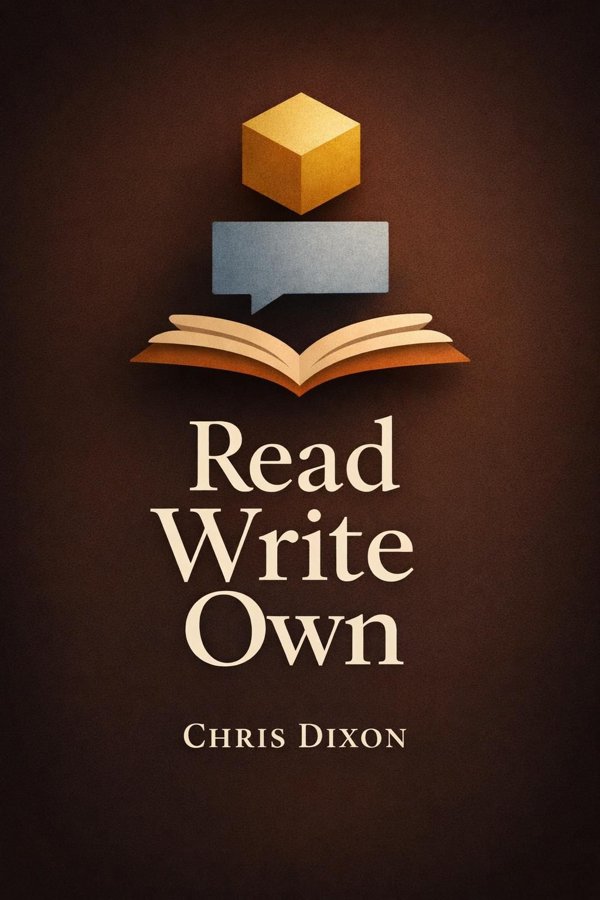
Read Write Own: Building the Next Era of the Internet: Summary & Key Insights
by Chris Dixon
 10 min11 chaptersAudio available
What Is Read Write Own: Building the Next Era of the Internet About?
Read Write Own: Building the Next Era of the Internet by Chris Dixon is a emerging_tech book spanning 11 pages. A potent exploration of how blockchain technology can reshape the future of the internet, 'Read Write Own' by Chris Dixon traces the evolution of the web through three eras—'Read' (the early web), 'Write' (the social media age), and 'Own' (the emerging blockchain-based internet). Dixon argues that decentralized networks can restore user ownership and creativity online, offering a vision for a more open and equitable digital future.
This FizzRead summary covers all 11 key chapters of Read Write Own: Building the Next Era of the Internet in approximately 10 minutes, distilling the most important ideas, arguments, and takeaways from Chris Dixon's work. Also available as an audio summary and Key Quotes Podcast.
Read Write Own: Building the Next Era of the Internet
A potent exploration of how blockchain technology can reshape the future of the internet, 'Read Write Own' by Chris Dixon traces the evolution of the web through three eras—'Read' (the early web), 'Write' (the social media age), and 'Own' (the emerging blockchain-based internet). Dixon argues that decentralized networks can restore user ownership and creativity online, offering a vision for a more open and equitable digital future.
Who Should Read Read Write Own: Building the Next Era of the Internet?
This book is perfect for anyone interested in emerging_tech and looking to gain actionable insights in a short read. Whether you're a student, professional, or lifelong learner, the key ideas from Read Write Own: Building the Next Era of the Internet by Chris Dixon will help you think differently.
- ✓Readers who enjoy emerging_tech and want practical takeaways
- ✓Professionals looking to apply new ideas to their work and life
- ✓Anyone who wants the core insights of Read Write Own: Building the Next Era of the Internet in just 10 minutes
Want the full summary?
Get instant access to this book summary and 100K+ more with Fizz Moment.
Get Free SummaryAvailable on App Store • Free to download
Key Chapters
In the Read Era, the internet was still young, brimming with idealism and experimentation. It was the era of Web1, where protocols like HTTP, SMTP, and FTP ruled. Websites were static: digital brochures, text and images without interactivity. Yet, beneath this simplicity lay a profound idea—anyone could access the same open network. No single company controlled which pages could be published or read; the web’s power resided in its universality and its permissionless nature.
I recall how creators of that time were pioneers, coding by hand, sharing ideas via open forums, and linking to one another as equals. These early architects embraced a vision of digital democracy. The protocols were open standards—no entity owned them, everyone could implement them. That freedom nurtured a flourishing landscape of small websites, independent voices, and experimentation. Innovation happened at the edges, not in corporate silos.
However, the Read Era also had limitations. Users were passive consumers. You could read, but you couldn’t easily contribute. Content creation required technical skills, from writing HTML to hosting servers. That technological barrier created an imbalance: while ideas were free, participation wasn’t. The early web gave us access, but not agency.
Still, what made the Read Era special was its architecture of openness. It taught us that decentralization wasn’t just a technical design—it was a social contract. It meant responsibility and community. You controlled your own website, your own data, and your own representation online. The culture emphasized autonomy and collaboration. That foundation matters because, as I show throughout *Read Write Own*, the philosophies behind the early internet continue to inform the principles of decentralization today. The Read Era reminds us what we lost—and what we might recover.
The Write Era changed everything. Suddenly, the internet wasn’t just about consumption—it was about participation. Web2, as we later named it, arrived with platforms that made publishing effortless. With a click, you could share your thoughts on Twitter, upload videos to YouTube, or connect with friends on Facebook. It was a creative explosion. The barriers that had restricted the Read Era fell away, unleashing a generation of digital storytellers.
But herein lies the paradox. While the Write Era empowered billions to express themselves, it came at the cost of ownership. The platforms that facilitated this new creativity were centralized corporations. They weren’t neutral intermediaries—they were extractive systems. By making distribution free and easy, they built irresistible ecosystems. But within those ecosystems, the participants were users, not owners. When you published on these platforms, you gave them your data, your reach, and often, the fruits of your creativity.
The Write Era’s architecture created incentives that tilted power. Algorithms decided visibility. Monetization was gated by corporate terms. As social networks scaled, attention became the universal currency—and corporations mastered the art of harvesting it. The economic model shifted from user empowerment to surveillance and manipulation. Over time, network effects entrenched monopolies, stifling competition and innovation.
I often describe this period as the exchange of freedom for convenience. The Write Era was intoxicating because of its seamlessness—sign in, share, like, repeat—but invisible to most users was the trade. Instead of decentralized protocols, we interacted through proprietary APIs. Instead of owning our content and data, we rented space in digital kingdoms. The infrastructure of creativity became a marketplace controlled by a handful of entities.
Yet, we shouldn’t dismiss this era entirely. It taught us the social and economic potential of networked participation. It revealed the sheer power of interconnected communities. What it lacked was a mechanism to translate participation into ownership. That missing piece sets the stage for the transformation I call the Own Era.
+ 9 more chapters — available in the FizzRead app
All Chapters in Read Write Own: Building the Next Era of the Internet
About the Author
Chris Dixon is a general partner at Andreessen Horowitz, where he leads the firm’s crypto and blockchain investments. A longtime entrepreneur and technologist, he has founded multiple startups and written extensively about the evolution of the internet and emerging technologies.
Get This Summary in Your Preferred Format
Read or listen to the Read Write Own: Building the Next Era of the Internet summary by Chris Dixon anytime, anywhere. FizzRead offers multiple formats so you can learn on your terms — all free.
Available formats: App · Audio · PDF · EPUB — All included free with FizzRead
Download Read Write Own: Building the Next Era of the Internet PDF and EPUB Summary
Key Quotes from Read Write Own: Building the Next Era of the Internet
“In the Read Era, the internet was still young, brimming with idealism and experimentation.”
“Suddenly, the internet wasn’t just about consumption—it was about participation.”
Frequently Asked Questions about Read Write Own: Building the Next Era of the Internet
Read Write Own: Building the Next Era of the Internet by Chris Dixon is a emerging_tech book that explores key ideas across 11 chapters. A potent exploration of how blockchain technology can reshape the future of the internet, 'Read Write Own' by Chris Dixon traces the evolution of the web through three eras—'Read' (the early web), 'Write' (the social media age), and 'Own' (the emerging blockchain-based internet). Dixon argues that decentralized networks can restore user ownership and creativity online, offering a vision for a more open and equitable digital future.
You Might Also Like
Blockchain Technology Guide (Chinese Edition)
Li Qilei
10 min
21st Century Technologies Revisited: What is Happening and What is Next
Organisation for Economic Co-operation and Development (OECD)
10 min
Autonomous Vehicles: Opportunities, Strategies, and Challenges
Various Authors
10 min
Autonomy
Lawrence Burns
10 min
Blockchain Basics: A Non-Technical Introduction in 25 Steps
Daniel Drescher
10 min
Blockchain Revolution: How the Technology Behind Bitcoin and Other Cryptocurrencies Is Changing the World
Don Tapscott & Alex Tapscott
10 minBrowse by Category
Ready to read Read Write Own: Building the Next Era of the Internet?
Get the full summary and 100K+ more books with Fizz Moment.