
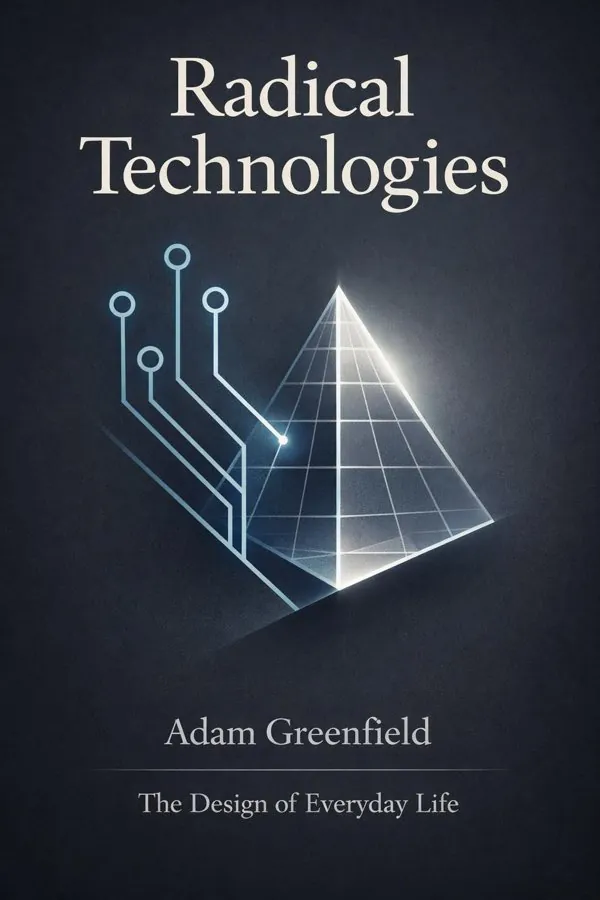
Radical Technologies: The Design of Everyday Life: Summary & Key Insights
 10 min11 chaptersAudio available
What Is Radical Technologies: The Design of Everyday Life About?
Radical Technologies: The Design of Everyday Life by Adam Greenfield is a emerging_tech book spanning 11 pages. Radical Technologies explores how emerging digital technologies—such as smartphones, blockchain, augmented reality, and artificial intelligence—are reshaping the fabric of everyday life. Adam Greenfield critically examines the social, political, and ethical implications of these tools, arguing that they are not neutral but deeply embedded in systems of power and control. The book invites readers to question the narratives of progress and innovation that accompany technological change.
This FizzRead summary covers all 11 key chapters of Radical Technologies: The Design of Everyday Life in approximately 10 minutes, distilling the most important ideas, arguments, and takeaways from Adam Greenfield's work. Also available as an audio summary and Key Quotes Podcast.
Radical Technologies: The Design of Everyday Life
Radical Technologies explores how emerging digital technologies—such as smartphones, blockchain, augmented reality, and artificial intelligence—are reshaping the fabric of everyday life. Adam Greenfield critically examines the social, political, and ethical implications of these tools, arguing that they are not neutral but deeply embedded in systems of power and control. The book invites readers to question the narratives of progress and innovation that accompany technological change.
Who Should Read Radical Technologies: The Design of Everyday Life?
This book is perfect for anyone interested in emerging_tech and looking to gain actionable insights in a short read. Whether you're a student, professional, or lifelong learner, the key ideas from Radical Technologies: The Design of Everyday Life by Adam Greenfield will help you think differently.
- ✓Readers who enjoy emerging_tech and want practical takeaways
- ✓Professionals looking to apply new ideas to their work and life
- ✓Anyone who wants the core insights of Radical Technologies: The Design of Everyday Life in just 10 minutes
Want the full summary?
Get instant access to this book summary and 100K+ more with Fizz Moment.
Get Free SummaryAvailable on App Store • Free to download
Key Chapters
The smartphone is where this story begins because it has become both the symbol and instrument of contemporary life. When I describe it as the 'Rosetta Stone of networked life,' I mean that it encodes in miniature nearly every significant dynamic of our digital condition. The smartphone collapses distance, erases waiting, and compresses multiple identities into a single glowing screen. But beneath that intimacy lies an intricate web of dependence: on rare earth minerals mined under exploitative conditions, on manufacturing labor spread across Asia, and on proprietary software ecosystems that bind us to a corporation's logic.
We carry the smartphone everywhere, and it carries us — it observes, records, and transmits our behavior. Where early adopters spoke of connection and empowerment, I see a quiet restructuring of subjectivity. The boundary between private thought and public action blurs, as location data, facial recognition, and app permissions feed into massive behavioral archives. The smartphone subtly trains us in constant responsiveness; it reprograms our sense of time, teaching us that no moment should be idle. From work to romance, every interaction becomes mediated through an interface whose design serves commercial imperatives first.
Yet this is precisely why we must dwell on it. The question is not whether the smartphone makes life better or worse — such moral binaries miss the deeper issue. It is how the social relations encoded in the device become habitual, how dependency masquerades as choice. By making this visible, we begin to retake a measure of agency, to imagine technological arrangements that answer to human communities rather than markets.
From smartphones, the logic extends outward into the built environment. The Internet of Things promises frictionless living — thermostats that anticipate comfort, lamps that respond to your presence, cities that watch their own traffic. On the surface this seems like benign convenience. But the spread of sensors and connected devices also marks the entrance of computation into every nook of the physical world. The room no longer simply shelters you; it observes and reports.
The danger is not merely one of surveillance, though that is grave enough. It is a transformation of autonomy. Each sensor extends a form of visibility that is rarely symmetrical. The data flows upward to landlords, platform owners, or municipal authorities, while the citizen or inhabitant becomes increasingly legible. The logic of optimization — once confined to corporate logistics — now reaches domestic and civic life.
What I ask readers to see is the political design of these infrastructures. A smart light bulb is not 'smart' in itself; its intelligence lies in the networks and servers it speaks to. Each connected object intensifies dependence on corporate ecosystems, embedding systems of property and profit deep into the routines of everyday life. If we fail to question this arrangement, the walls around us will soon act less as protection than as sensors reporting to distant powers.
+ 9 more chapters — available in the FizzRead app
All Chapters in Radical Technologies: The Design of Everyday Life
About the Author
Adam Greenfield is a writer and urbanist known for his work on technology, design, and the future of cities. He has served as Nokia’s head of design direction and taught at New York University. His writing often focuses on the intersection of technology and society, emphasizing human-centered design and ethical considerations.
Get This Summary in Your Preferred Format
Read or listen to the Radical Technologies: The Design of Everyday Life summary by Adam Greenfield anytime, anywhere. FizzRead offers multiple formats so you can learn on your terms — all free.
Available formats: App · Audio · PDF · EPUB — All included free with FizzRead
Download Radical Technologies: The Design of Everyday Life PDF and EPUB Summary
Key Quotes from Radical Technologies: The Design of Everyday Life
“The smartphone is where this story begins because it has become both the symbol and instrument of contemporary life.”
“From smartphones, the logic extends outward into the built environment.”
Frequently Asked Questions about Radical Technologies: The Design of Everyday Life
Radical Technologies: The Design of Everyday Life by Adam Greenfield is a emerging_tech book that explores key ideas across 11 chapters. Radical Technologies explores how emerging digital technologies—such as smartphones, blockchain, augmented reality, and artificial intelligence—are reshaping the fabric of everyday life. Adam Greenfield critically examines the social, political, and ethical implications of these tools, arguing that they are not neutral but deeply embedded in systems of power and control. The book invites readers to question the narratives of progress and innovation that accompany technological change.
You Might Also Like

Blockchain Technology Guide (Chinese Edition)
Li Qilei
10 min
21st Century Technologies Revisited: What is Happening and What is Next
Organisation for Economic Co-operation and Development (OECD)
10 min
Autonomous Vehicles: Opportunities, Strategies, and Challenges
Various Authors
10 min
Autonomy
Lawrence Burns
10 min
Blockchain Basics: A Non-Technical Introduction in 25 Steps
Daniel Drescher
10 min
Blockchain Revolution: How the Technology Behind Bitcoin and Other Cryptocurrencies Is Changing the World
Don Tapscott & Alex Tapscott
10 minBrowse by Category
Ready to read Radical Technologies: The Design of Everyday Life?
Get the full summary and 100K+ more books with Fizz Moment.