
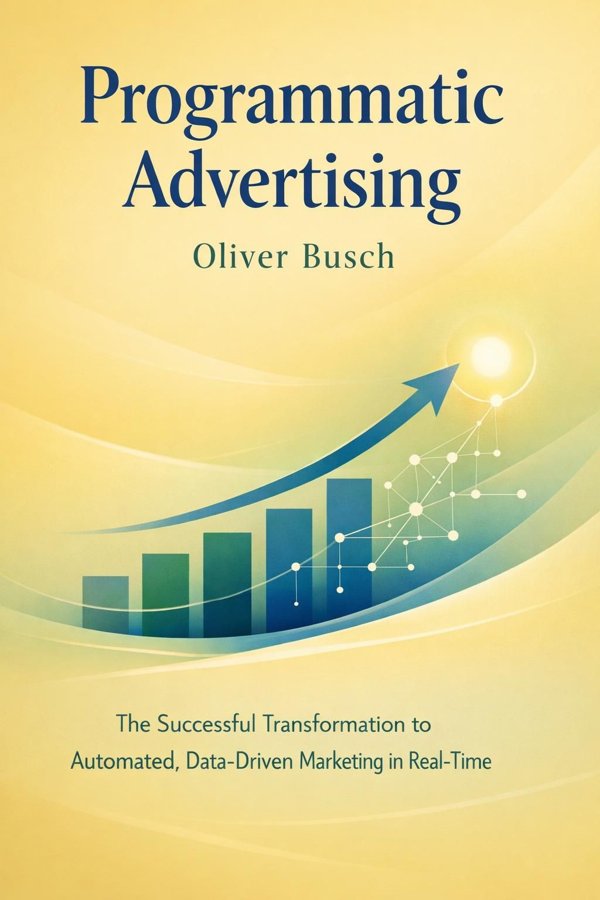
Programmatic Advertising: The Successful Transformation to Automated, Data-Driven Marketing in Real-Time: Summary & Key Insights
by Oliver Busch
 10 min5 chaptersAudio available
What Is Programmatic Advertising: The Successful Transformation to Automated, Data-Driven Marketing in Real-Time About?
Programmatic Advertising: The Successful Transformation to Automated, Data-Driven Marketing in Real-Time by Oliver Busch is a marketing book spanning 5 pages. Dieses Buch bietet eine umfassende Einführung in das Thema Programmatic Advertising und zeigt, wie automatisierte, datengetriebene Werbung in Echtzeit funktioniert. Es behandelt die technologischen Grundlagen, die strategischen Implikationen und die praktischen Anwendungen für Marketingfachleute, die den Wandel zur automatisierten Medienplanung verstehen und nutzen möchten.
This FizzRead summary covers all 5 key chapters of Programmatic Advertising: The Successful Transformation to Automated, Data-Driven Marketing in Real-Time in approximately 10 minutes, distilling the most important ideas, arguments, and takeaways from Oliver Busch's work. Also available as an audio summary and Key Quotes Podcast.
Programmatic Advertising: The Successful Transformation to Automated, Data-Driven Marketing in Real-Time
Dieses Buch bietet eine umfassende Einführung in das Thema Programmatic Advertising und zeigt, wie automatisierte, datengetriebene Werbung in Echtzeit funktioniert. Es behandelt die technologischen Grundlagen, die strategischen Implikationen und die praktischen Anwendungen für Marketingfachleute, die den Wandel zur automatisierten Medienplanung verstehen und nutzen möchten.
Who Should Read Programmatic Advertising: The Successful Transformation to Automated, Data-Driven Marketing in Real-Time?
This book is perfect for anyone interested in marketing and looking to gain actionable insights in a short read. Whether you're a student, professional, or lifelong learner, the key ideas from Programmatic Advertising: The Successful Transformation to Automated, Data-Driven Marketing in Real-Time by Oliver Busch will help you think differently.
- ✓Readers who enjoy marketing and want practical takeaways
- ✓Professionals looking to apply new ideas to their work and life
- ✓Anyone who wants the core insights of Programmatic Advertising: The Successful Transformation to Automated, Data-Driven Marketing in Real-Time in just 10 minutes
Want the full summary?
Get instant access to this book summary and 100K+ more with Fizz Moment.
Get Free SummaryAvailable on App Store • Free to download
Key Chapters
The story of programmatic advertising begins with the broader evolution of digital marketing. When I first observed the rise of online advertising in the early 2000s, it was driven largely by direct deals, manual negotiation, and static placements. Advertisers bought website inventory through human intermediaries, guided by experience and relationships rather than by measurable performance data. This model could not scale with the explosion of digital media and audience fragmentation.
The emergence of programmatic systems solved that scaling problem. The combination of ad exchanges, demand-side platforms (DSPs), and supply-side platforms (SSPs) created an automated marketplace. In this ecosystem, advertisers use DSPs to bid for impressions in real time, publishers use SSPs to manage and sell their inventory, and ad exchanges act as the neutral ground where transactions are executed automatically. The entire process takes milliseconds.
What makes programmatic technology revolutionary is its ability to connect advertisers with users at the impression level rather than at the campaign level. Each ad placement becomes a data-driven decision, evaluated by algorithms that consider user information, contextual signals, and campaign objectives. Instead of pre-purchasing audiences in bulk, advertisers can now evaluate each potential impression individually—asking not simply *where* to show an ad, but *to whom*, *when*, and *under what conditions*.
This automation has not only increased efficiency but also improved targeting precision. Through data integration, brands can match messaging to consumer intent, behavior, and location. Real-time bidding introduced a dynamic pricing mechanism that reflects supply and demand, making every ad exposure an outcome of competitive algorithmic negotiation. For marketers, this means greater control over ROI and performance tuning—but also the need to understand technology deeply.
Programmatic advertising thus represents a new operating system for media buying—one where mathematics, data science, and behavioral analysis converge. It demands a new skill set and strategic mindset: media planners become data analysts, creative teams collaborate with machine learning engineers, and decisions rely on continuous feedback rather than periodic reporting. This chapter establishes the foundation of that transition and sets the stage for everything that follows.
At the heart of programmatic advertising lies data—the raw material from which intelligence and automation are crafted. The moment we began merging advertising inventory with audience data, marketing moved from mass broadcasting to granular communication. But the challenge was never the quantity of data; it was how to use it intelligently.
Real-time bidding (RTB) exemplifies this principle in action. Every time a user visits a webpage, thousands of potential advertisers evaluate that individual’s profile and context within milliseconds. Data management platforms (DMPs) provide the backbone for this evaluation by aggregating, organizing, and interpreting user data from multiple sources: CRM systems, website analytics, third-party providers, and social interactions. The algorithm inside a DSP then decides whether the user fits the advertiser’s target criteria, and if so, how much to bid.
This decision-making process transforms media buying from a static plan to a dynamic, data-driven system. Each impression becomes an opportunity to act based on real-time intelligence—adjusting bids, optimizing frequency, and adjusting creative dynamically. Through RTB and DMP integration, advertisers can segment audiences with extraordinary precision: not only by demographics but by intent, behavior, and psychographic patterns. For example, a travel brand can target individuals who have recently searched for flights *and* compared hotel prices *and* engaged with content about tropical destinations—all in one coherent moment.
This real-time responsiveness changes how campaign performance evolves. Instead of waiting for post-campaign reports, marketers analyze live data streams and reallocate budgets proactively. Efficiency grows not from spending less, but from spending smarter—on impressions that have the highest likelihood of generating desired outcomes.
The book emphasizes that data alone does not guarantee success. It must be interpreted through strategic clarity and ethical awareness. Automation makes decisions fast, but human oversight ensures they remain right. Balancing algorithmic intelligence with creative strategy is the true art of programmatic advertising. As you adopt data-driven marketing, the goal is not only to connect signals but to uncover meaning—to transform information into relevance at scale.
+ 3 more chapters — available in the FizzRead app
All Chapters in Programmatic Advertising: The Successful Transformation to Automated, Data-Driven Marketing in Real-Time
About the Author
Oliver Busch ist ein Experte für digitales Marketing und Medienmanagement. Er arbeitet seit vielen Jahren in der digitalen Medienbranche und ist bekannt für seine Beiträge zur Entwicklung von Programmatic Advertising und datengetriebenem Marketing.
Get This Summary in Your Preferred Format
Read or listen to the Programmatic Advertising: The Successful Transformation to Automated, Data-Driven Marketing in Real-Time summary by Oliver Busch anytime, anywhere. FizzRead offers multiple formats so you can learn on your terms — all free.
Available formats: App · Audio · PDF · EPUB — All included free with FizzRead
Download Programmatic Advertising: The Successful Transformation to Automated, Data-Driven Marketing in Real-Time PDF and EPUB Summary
Key Quotes from Programmatic Advertising: The Successful Transformation to Automated, Data-Driven Marketing in Real-Time
“The story of programmatic advertising begins with the broader evolution of digital marketing.”
“At the heart of programmatic advertising lies data—the raw material from which intelligence and automation are crafted.”
Frequently Asked Questions about Programmatic Advertising: The Successful Transformation to Automated, Data-Driven Marketing in Real-Time
Programmatic Advertising: The Successful Transformation to Automated, Data-Driven Marketing in Real-Time by Oliver Busch is a marketing book that explores key ideas across 5 chapters. Dieses Buch bietet eine umfassende Einführung in das Thema Programmatic Advertising und zeigt, wie automatisierte, datengetriebene Werbung in Echtzeit funktioniert. Es behandelt die technologischen Grundlagen, die strategischen Implikationen und die praktischen Anwendungen für Marketingfachleute, die den Wandel zur automatisierten Medienplanung verstehen und nutzen möchten.
You Might Also Like
Captivology: The Science of Capturing People's Attention
Ben Parr
10 min
Marketing 5.0: Technology for Humanity
Philip Kotler, Hermawan Kartajaya, Iwan Setiawan
10 min
Marketing Strategy
Paul Fifield
10 min
UnMarketing: Stop Marketing. Start Engaging.
Scott Stratten
10 min
$100M Leads: How to Get Strangers to Want to Buy Your Stuff
Alex Hormozi
10 min
80/20 Sales and Marketing: The Definitive Guide to Working Less and Making More
Perry Marshall
10 minBrowse by Category
Ready to read Programmatic Advertising: The Successful Transformation to Automated, Data-Driven Marketing in Real-Time?
Get the full summary and 100K+ more books with Fizz Moment.