
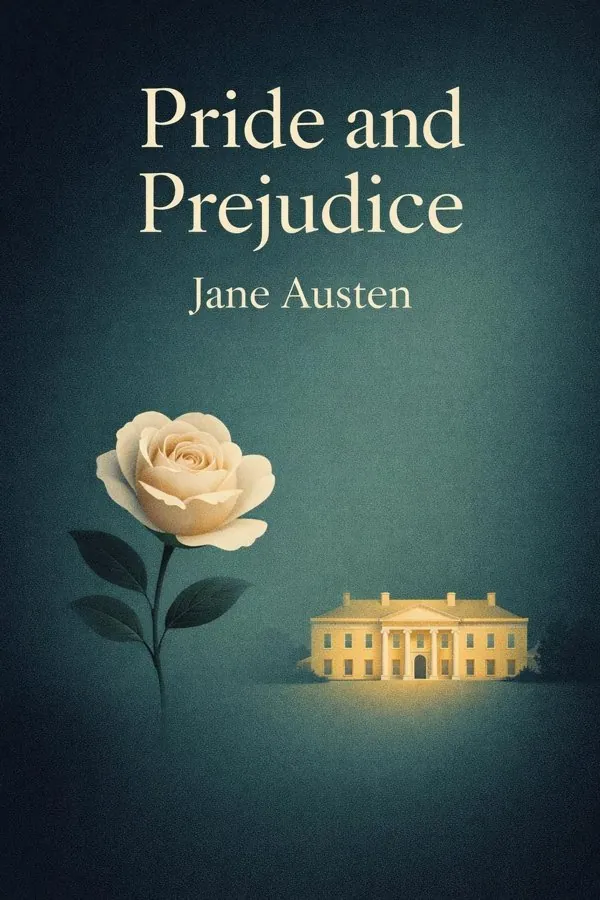
Pride and Prejudice: Summary & Key Insights
by Jane Austen
 10 min10 chaptersAudio available
Key Takeaways from Pride and Prejudice
A family can be both a source of affection and a pressure system that determines one’s future.
Sometimes character becomes visible only in comparison.
Few mistakes feel as satisfying as the ones we are certain about.
People reveal themselves most clearly in small moments of inconvenience.
Nothing clarifies a novel’s moral vision faster than a bad proposal.
What Is Pride and Prejudice About?
Pride and Prejudice by Jane Austen is a classics book spanning 10 pages. First published in 1813, Pride and Prejudice is one of the most beloved novels in English literature because it offers far more than a memorable love story. At its heart, the book follows Elizabeth Bennet, a quick-witted young woman from a respectable but financially vulnerable family, as she navigates courtship, reputation, family pressure, and the rigid social codes of Regency England. Her evolving relationship with the proud, reserved Mr. Darcy becomes the novel’s emotional center, but Austen uses that romance to examine larger questions: How well do we truly know ourselves? How often do first impressions mislead us? And what happens when social class distorts moral judgment? What makes the novel endure is Austen’s remarkable ability to combine satire, psychological insight, and emotional precision. She exposes vanity, foolishness, and hypocrisy without losing sympathy for human weakness. Austen writes with unmatched authority about manners, marriage, money, and status, not as abstract themes, but as forces shaping everyday life. Pride and Prejudice still matters because its central concerns—miscommunication, ego, social pressure, and the challenge of honest self-knowledge—remain deeply familiar to modern readers.
This FizzRead summary covers all 10 key chapters of Pride and Prejudice in approximately 10 minutes, distilling the most important ideas, arguments, and takeaways from Jane Austen's work. Also available as an audio summary and Key Quotes Podcast.
Pride and Prejudice
First published in 1813, Pride and Prejudice is one of the most beloved novels in English literature because it offers far more than a memorable love story. At its heart, the book follows Elizabeth Bennet, a quick-witted young woman from a respectable but financially vulnerable family, as she navigates courtship, reputation, family pressure, and the rigid social codes of Regency England. Her evolving relationship with the proud, reserved Mr. Darcy becomes the novel’s emotional center, but Austen uses that romance to examine larger questions: How well do we truly know ourselves? How often do first impressions mislead us? And what happens when social class distorts moral judgment?
What makes the novel endure is Austen’s remarkable ability to combine satire, psychological insight, and emotional precision. She exposes vanity, foolishness, and hypocrisy without losing sympathy for human weakness. Austen writes with unmatched authority about manners, marriage, money, and status, not as abstract themes, but as forces shaping everyday life. Pride and Prejudice still matters because its central concerns—miscommunication, ego, social pressure, and the challenge of honest self-knowledge—remain deeply familiar to modern readers.
Who Should Read Pride and Prejudice?
This book is perfect for anyone interested in classics and looking to gain actionable insights in a short read. Whether you're a student, professional, or lifelong learner, the key ideas from Pride and Prejudice by Jane Austen will help you think differently.
- ✓Readers who enjoy classics and want practical takeaways
- ✓Professionals looking to apply new ideas to their work and life
- ✓Anyone who wants the core insights of Pride and Prejudice in just 10 minutes
Want the full summary?
Get instant access to this book summary and 100K+ more with Fizz Moment.
Get Free SummaryAvailable on App Store • Free to download
Key Chapters
A family can be both a source of affection and a pressure system that determines one’s future. Austen establishes this truth through the Bennets, whose home life is lively, comic, and quietly precarious. Mr. Bennet is intelligent but detached, preferring irony to responsibility. Mrs. Bennet is foolish and anxious, obsessed with marrying off her daughters because the estate is entailed away from the female line. Jane is gentle, Elizabeth perceptive, Mary pedantic, Kitty impressionable, and Lydia reckless. Together they create not only a memorable domestic world but the moral environment from which the novel grows.
Longbourn is not a place of great poverty, yet it is economically insecure. Because the daughters cannot inherit the estate, marriage is not merely romantic possibility; it is material necessity. Austen therefore makes clear that personal character develops within social realities. Elizabeth’s intelligence and independence are admirable, but they do not free her from the consequences of family reputation. Jane’s sweetness is attractive, but it cannot compensate for the impropriety of younger sisters. In this way, Austen shows that individual merit and social perception do not always align.
This dynamic still feels modern. People are often judged by family background, social circles, or the behavior of those around them. A talented professional may still struggle against assumptions tied to class, region, or family history. Pride and Prejudice reminds us that identity is shaped not only by who we are, but by the contexts others attach to us.
Actionable takeaway: Reflect on how your family, environment, or inherited assumptions shape your decisions, and consciously separate what is truly yours from what has merely been handed to you.
Few mistakes feel as satisfying as the ones we are certain about. The Meryton ball captures this perfectly when Darcy refuses to dance with Elizabeth and dismisses her as "not handsome enough" to tempt him. Elizabeth hears of the insult and, with understandable wit and pride, forms a lasting dislike. This moment gives the novel its original title, First Impressions, and launches Austen’s central investigation into how quickly wounded vanity becomes moral certainty.
Elizabeth’s judgment feels justified because Darcy is rude. Yet Austen complicates the scene by showing how one humiliating interaction shapes everything that follows. Elizabeth becomes eager to interpret Darcy negatively, while Darcy, despite his growing admiration, remains trapped by his own prideful reserve. Their mutual misunderstanding is not based on total falsehood. Each does see something real: his arrogance and her prejudice are genuine. The problem is that each takes a partial truth and treats it as a complete one.
This is one of Austen’s most enduring insights. In everyday life, first impressions often harden into stories we tell ourselves about other people. One cold email, one awkward conversation, one moment of perceived disrespect can frame every later interaction. Social media intensifies this tendency, encouraging snap judgments with little context. Austen shows that intelligence does not protect us from misreading others; in fact, cleverness can make us better at defending our errors.
Actionable takeaway: When a first impression feels especially strong, revisit it later with fresh evidence and ask whether you are observing the person honestly or protecting your ego.
People reveal themselves most clearly in small moments of inconvenience. Jane’s illness during her stay at Netherfield creates exactly that kind of test. Elizabeth walks through mud to care for her sister, shocking the elegant company with her disregard for appearance. At Netherfield, confined conversations bring characters into sharper focus: Bingley’s kindness, Darcy’s growing admiration, Miss Bingley’s jealousy, and Elizabeth’s wit all become more visible.
Austen uses this episode to show the tension between authenticity and performance. Elizabeth acts from genuine affection, not from calculation, and this sincerity sets her apart. Miss Bingley, by contrast, performs refinement while using politeness as a weapon. Darcy notices Elizabeth’s intelligence and liveliness, even as he tries to resist his attraction on social grounds. Jane remains charitable in her interpretations, while Elizabeth sees more clearly but still not completely.
What makes this section so effective is its focus on conversation as moral action. In Austen’s world, drawing-room talk is not trivial. It reveals values, insecurities, and ambitions. Who mocks, who listens, who flatters, who judges, who serves: all matter. Modern life has its own Netherfields—offices, group chats, dinners, family gatherings—where stress and proximity reveal who people really are.
Actionable takeaway: Notice how people behave when plans go wrong, status is uncertain, or someone vulnerable needs care; those moments often provide truer evidence of character than polished public appearances.
Nothing clarifies a novel’s moral vision faster than a bad proposal. Mr. Collins’s offer of marriage to Elizabeth is absurd, self-important, and unintentionally revealing. He believes he is doing her a favor, listing practical advantages and treating marriage as a sensible arrangement that should naturally satisfy her. His proposal is comic, but Austen uses the comedy to expose how often women were expected to accept security in place of respect, affection, or compatibility.
Elizabeth’s refusal is one of the novel’s defining acts of integrity. She understands the realities facing her family, yet she will not enter a marriage that insults her intelligence and individuality. This is especially significant because Charlotte Lucas, more pragmatic and less romantic, later accepts Collins. Austen does not portray Charlotte as wicked or foolish. Instead, she shows that different women, facing different fears and prospects, may make different choices within a limited system. The contrast between Elizabeth and Charlotte is therefore not just personal; it is social criticism.
This episode remains relevant because people still face pressure to choose relationships for status, stability, or external approval. The forms may have changed, but the question endures: Is a partnership a genuine meeting of minds, or merely an arrangement that looks sensible from the outside? Austen values realism, but she insists that self-respect matters.
Actionable takeaway: Before making a major commitment, ask not only whether it is practical, but whether it allows you to remain honest, respected, and fully yourself.
Love does not automatically improve character; sometimes it first exposes how flawed that character is. At Rosings Park, where Lady Catherine de Bourgh reigns with comic tyranny, Darcy’s feelings for Elizabeth intensify, but so do the contradictions within him. He admires her mind and spirit, yet remains deeply conscious of her lower connections. When he finally proposes, his declaration is passionate but disastrously framed: he offers love while dwelling on the inferiority of her family and the struggle he has endured in loving her.
Elizabeth’s rejection is one of the most electrifying scenes in the novel because she answers not only his pride but also his actions. She accuses him of ungentlemanly behavior toward Jane and Bingley and condemns his treatment of Wickham. In doing so, she voices the reader’s own objections. Darcy’s proposal is sincere, but sincerity does not excuse self-importance. Austen demonstrates that emotion without humility can still wound.
This scene matters because it overturns a common romantic fantasy: intense feeling is not enough. The moral quality of expression matters. Good intentions can still be insulting when filtered through entitlement. In modern terms, someone may offer affection while also carrying assumptions about status, background, or superiority. Attraction is not the same as respect.
Actionable takeaway: In moments of vulnerability or confession, examine whether your language truly honors the other person, or whether hidden pride is undermining what you most want to say.
Transformation often begins not with triumph, but with the shock of being seen accurately. After Elizabeth rejects him, Darcy writes a letter explaining his role in separating Bingley from Jane and revealing Wickham’s deception. The letter is one of Austen’s great devices because it forces both Elizabeth and the reader to reassess previous assumptions. Darcy is not entirely innocent, but he is not the villain Elizabeth imagined. Wickham is not the wronged hero he appeared to be. The story Elizabeth has been confidently telling herself starts to collapse.
Her response is the novel’s moral turning point. Instead of stubbornly defending her earlier views, Elizabeth reflects with painful honesty: "Till this moment, I never knew myself." Austen presents self-knowledge as difficult because it requires more than new information; it requires humility. Elizabeth must admit that vanity, resentment, and charm-based judgment have misled her. Darcy, too, begins changing because her criticism has struck home. Both characters grow because both are willing, eventually, to learn.
This is perhaps the book’s deepest practical lesson. Mature judgment depends on the ability to revise our opinions when evidence changes. Many conflicts persist not because truth is unavailable, but because pride resists correction. In leadership, relationships, and personal growth, the willingness to re-evaluate is essential.
Actionable takeaway: When confronted with information that challenges your view of a person or event, resist the urge to defend your original judgment and instead ask, “What have I been unwilling to see?”
Sometimes the truest introduction to a person comes in their absence. When Elizabeth visits Pemberley, Darcy’s estate, she expects magnificence but fears evidence of arrogance. Instead, she encounters order, beauty, and, most importantly, testimony from the housekeeper that Darcy is generous, responsible, and beloved by those who depend on him. Soon after, Darcy himself appears and behaves with a courtesy and warmth that astonish her. He is attentive not only to Elizabeth but also to her relatives, whose lower status he once despised.
Pemberley matters because Austen uses place as moral metaphor. The estate reflects stewardship rather than vanity. Darcy’s wealth is no longer simply an abstract social advantage; it is shown as something he manages with discipline and care. Elizabeth begins to understand that she judged him too narrowly through wounded pride and hearsay. At the same time, Darcy’s changed behavior demonstrates that growth is real. He has not become a different person altogether; he has become a better version of himself.
In life, reputation often shifts when we observe people in contexts where they hold responsibility. How someone treats staff, family, or those with less power says more than polished charm ever can. Pemberley teaches that integrity is visible in patterns of care, not in dramatic declarations alone.
Actionable takeaway: If you want to assess character well, look beyond words and impressions to the environments a person shapes and the people who know their daily conduct.
A single reckless act can expose the weakness of an entire family system. Lydia Bennet’s elopement with Wickham is not just a sensational plot twist; it is the culmination of parental negligence, unchecked vanity, and social irresponsibility. Lydia treats flirtation as amusement, Wickham pursues selfish advantage, and the Bennet family suddenly faces public disgrace. In Austen’s society, such a scandal could destroy not only Lydia’s prospects but those of her sisters as well.
This crisis reveals several moral truths at once. Mr. Bennet’s habitual irony has failed as parenting. Mrs. Bennet’s indulgence has encouraged foolishness. Wickham’s charm is finally exposed as predatory irresponsibility. Most importantly, Darcy’s quiet intervention—tracking the couple down, paying Wickham’s debts, and arranging the marriage—demonstrates a form of love grounded in action rather than display. He helps not to gain praise, and he initially hides his role. This is the strongest contrast with Wickham, whose appeal has always depended on appearance.
The episode also highlights how fragile reputation can be. A family may ignore warning signs until consequences become public and severe. Modern readers can recognize similar patterns in financial recklessness, online behavior, or repeated boundary violations excused as harmless fun. Austen shows that private folly often becomes social crisis.
Actionable takeaway: Do not dismiss recurring irresponsibility as merely amusing; address small patterns of bad judgment early, before they become consequences that affect everyone around them.
The happy ending in Pride and Prejudice matters because it is morally earned. By the time Elizabeth and Darcy come together, neither is simply rewarded for existing as a romantic lead. Both have changed. Elizabeth has learned that wit and intelligence do not guarantee fairness. Darcy has learned that rank and restraint do not excuse arrogance. Their eventual union succeeds because each has become more capable of respect, humility, and clear sight.
Austen reinforces this achievement by contrasting different marriages throughout the novel. Mr. and Mrs. Bennet represent attraction without compatibility and wit without mutual respect. Charlotte and Mr. Collins show practical compromise absent affection. Lydia and Wickham reveal impulsive attraction without responsibility. Jane and Bingley represent sweetness and mutual affection, though not without vulnerability to influence. Against these models, Elizabeth and Darcy stand out as the novel’s ideal: not perfection, but a marriage grounded in esteem, honesty, and growth.
This conclusion is why the book remains powerful. Austen does not argue that love should ignore practical realities, nor that prudence alone is enough. She imagines a partnership in which feeling and judgment, desire and respect, finally align. That standard continues to resonate in a world still debating what makes a relationship truly sound.
Actionable takeaway: Think of a strong relationship not as one built only on chemistry or convenience, but as one in which both people become wiser, kinder, and more truthful through knowing each other.
All Chapters in Pride and Prejudice
About the Author
Jane Austen (1775–1817) was an English novelist whose works transformed the novel of manners into a vehicle for sharp social observation and enduring psychological insight. Born in Steventon, Hampshire, she was the daughter of a clergyman and grew up in a close-knit family that encouraged reading and writing. Austen published four novels during her lifetime—Sense and Sensibility, Pride and Prejudice, Mansfield Park, and Emma—while Northanger Abbey and Persuasion appeared posthumously. Her fiction focuses on courtship, family dynamics, class, money, and the limited options available to women, yet her themes remain timeless because of her wit, irony, and deep understanding of human behavior. Today, Austen is celebrated as one of the greatest novelists in English literature, admired for making ordinary social life feel both comic and profound.
Get This Summary in Your Preferred Format
Read or listen to the Pride and Prejudice summary by Jane Austen anytime, anywhere. FizzRead offers multiple formats so you can learn on your terms — all free.
Available formats: App · Audio · PDF · EPUB — All included free with FizzRead
Download Pride and Prejudice PDF and EPUB Summary
Key Quotes from Pride and Prejudice
“A family can be both a source of affection and a pressure system that determines one’s future.”
“Sometimes character becomes visible only in comparison.”
“Few mistakes feel as satisfying as the ones we are certain about.”
“People reveal themselves most clearly in small moments of inconvenience.”
“Nothing clarifies a novel’s moral vision faster than a bad proposal.”
Frequently Asked Questions about Pride and Prejudice
Pride and Prejudice by Jane Austen is a classics book that explores key ideas across 10 chapters. First published in 1813, Pride and Prejudice is one of the most beloved novels in English literature because it offers far more than a memorable love story. At its heart, the book follows Elizabeth Bennet, a quick-witted young woman from a respectable but financially vulnerable family, as she navigates courtship, reputation, family pressure, and the rigid social codes of Regency England. Her evolving relationship with the proud, reserved Mr. Darcy becomes the novel’s emotional center, but Austen uses that romance to examine larger questions: How well do we truly know ourselves? How often do first impressions mislead us? And what happens when social class distorts moral judgment? What makes the novel endure is Austen’s remarkable ability to combine satire, psychological insight, and emotional precision. She exposes vanity, foolishness, and hypocrisy without losing sympathy for human weakness. Austen writes with unmatched authority about manners, marriage, money, and status, not as abstract themes, but as forces shaping everyday life. Pride and Prejudice still matters because its central concerns—miscommunication, ego, social pressure, and the challenge of honest self-knowledge—remain deeply familiar to modern readers.
More by Jane Austen


You Might Also Like






Browse by Category
Ready to read Pride and Prejudice?
Get the full summary and 100K+ more books with Fizz Moment.