
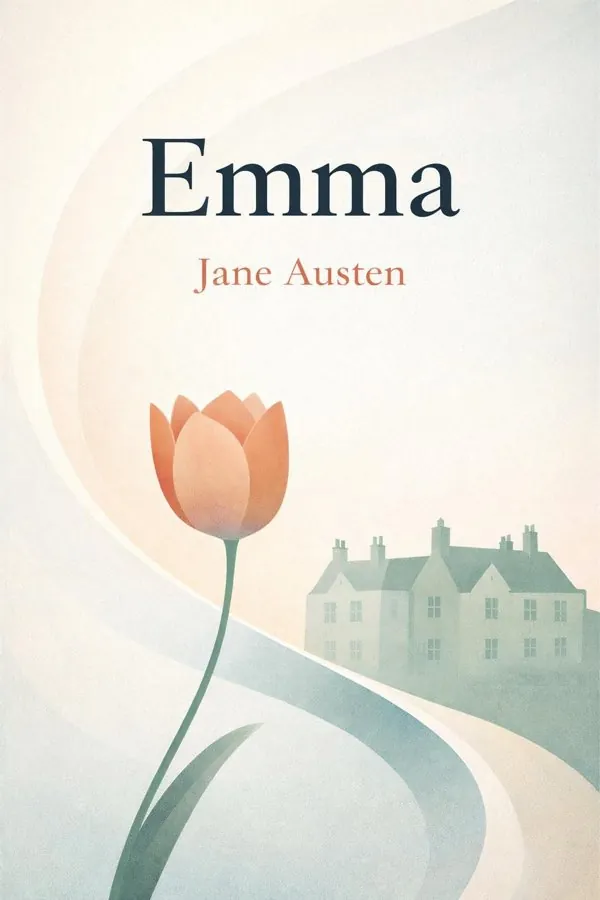
Emma: Summary & Key Insights
by Jane Austen
 10 min9 chaptersAudio available
Key Takeaways from Emma
A person can be both intelligent and deeply mistaken, and Emma Woodhouse proves this from the first pages.
The wish to elevate someone can easily become a refusal to accept who they really are.
Real growth often begins with the presence of someone who refuses to flatter us.
Charm can be more misleading than obvious deceit, because people happily complete the illusion themselves.
Character is revealed most clearly when wit is used at someone else’s expense.
What Is Emma About?
Emma by Jane Austen is a classics book spanning 5 pages. First published in 1815, Emma is Jane Austen’s brilliant comedy of manners about a young woman who believes she understands other people’s hearts better than they do themselves. Emma Woodhouse is rich, admired, and comfortably settled in the village of Highbury. Certain she will never marry, she channels her energy into matchmaking, determined to arrange happiness for friends and neighbors. But every confident scheme she launches produces confusion, embarrassment, and emotional pain, forcing her to confront a truth she has long avoided: intelligence without humility can become a form of blindness. More than a love story, Emma is a sharp exploration of class, self-deception, friendship, and moral growth. Austen combines sparkling dialogue, precise social observation, and subtle psychological insight to reveal how people misread one another and themselves. The novel matters because it captures a timeless human tendency—the urge to control outcomes while misunderstanding motives. Austen’s authority rests in her unmatched ability to turn drawing-room conversations into profound studies of character. In Emma, she gives us one of literature’s most memorable heroines: flawed, funny, frustrating, and ultimately capable of real transformation.
This FizzRead summary covers all 9 key chapters of Emma in approximately 10 minutes, distilling the most important ideas, arguments, and takeaways from Jane Austen's work. Also available as an audio summary and Key Quotes Podcast.
Emma
First published in 1815, Emma is Jane Austen’s brilliant comedy of manners about a young woman who believes she understands other people’s hearts better than they do themselves. Emma Woodhouse is rich, admired, and comfortably settled in the village of Highbury. Certain she will never marry, she channels her energy into matchmaking, determined to arrange happiness for friends and neighbors. But every confident scheme she launches produces confusion, embarrassment, and emotional pain, forcing her to confront a truth she has long avoided: intelligence without humility can become a form of blindness. More than a love story, Emma is a sharp exploration of class, self-deception, friendship, and moral growth. Austen combines sparkling dialogue, precise social observation, and subtle psychological insight to reveal how people misread one another and themselves. The novel matters because it captures a timeless human tendency—the urge to control outcomes while misunderstanding motives. Austen’s authority rests in her unmatched ability to turn drawing-room conversations into profound studies of character. In Emma, she gives us one of literature’s most memorable heroines: flawed, funny, frustrating, and ultimately capable of real transformation.
Who Should Read Emma?
This book is perfect for anyone interested in classics and looking to gain actionable insights in a short read. Whether you're a student, professional, or lifelong learner, the key ideas from Emma by Jane Austen will help you think differently.
- ✓Readers who enjoy classics and want practical takeaways
- ✓Professionals looking to apply new ideas to their work and life
- ✓Anyone who wants the core insights of Emma in just 10 minutes
Want the full summary?
Get instant access to this book summary and 100K+ more with Fizz Moment.
Get Free SummaryAvailable on App Store • Free to download
Key Chapters
A person can be both intelligent and deeply mistaken, and Emma Woodhouse proves this from the first pages. She is beautiful, wealthy, socially secure, and used to being praised. Having successfully encouraged the marriage of her former governess, Miss Taylor, to Mr. Weston, Emma convinces herself that she possesses an extraordinary gift for arranging other people’s lives. That confidence becomes the engine of the novel. In Highbury, a village governed by rank, familiarity, and subtle social expectations, Emma acts like a benevolent strategist, deciding who should marry whom and what future would best suit each acquaintance. Yet Austen immediately signals the danger in Emma’s self-assurance: she acts not from full understanding, but from the pleasure of influence.
This opening matters because it establishes the novel’s central tension between perception and reality. Emma interprets her success with Miss Taylor as proof of talent, when it may have been coincidence. Her certainty blinds her to limits, especially the emotional autonomy of others. In modern terms, Emma resembles someone who gives relationship advice after one successful setup or assumes professional competence in people management after a single lucky outcome. Confidence can feel like wisdom even when it is merely comfort with one’s own viewpoint.
Austen does not make Emma malicious. She is generous, lively, and genuinely wishes others well. That makes her errors more interesting. The problem is not bad intent but unchecked certainty. Her story invites readers to ask where confidence becomes interference and where helpfulness becomes vanity.
Actionable takeaway: Before offering guidance or trying to “improve” someone’s life, pause and ask whether you truly understand their desires—or are simply enjoying the role of expert.
The wish to elevate someone can easily become a refusal to accept who they really are. Emma’s friendship with Harriet Smith exposes this danger. Harriet is affectionate, pretty, and highly impressionable, but her uncertain parentage leaves her socially vulnerable. Emma decides that Harriet is too refined for the respectable farmer Robert Martin, who sincerely loves her and proposes marriage. Rather than encouraging Harriet to value affection, steadiness, and compatibility, Emma pushes her toward a more ambitious match. She subtly trains Harriet to reject Robert Martin and to imagine a future among gentlemen.
What makes this episode so powerful is that Emma mistakes manipulation for mentorship. She believes she is expanding Harriet’s possibilities, but she is actually imposing her own fantasies on a friend who lacks the confidence to resist. Harriet’s judgment becomes an extension of Emma’s ego. Austen is especially sharp here about class. Emma cannot comfortably accept a match that feels socially beneath the image she has constructed for Harriet, even though Robert Martin is kind, sensible, and dependable. The result is emotional harm: Harriet loses a genuine opportunity because Emma prefers appearances and possibilities to practical happiness.
This dynamic remains familiar. People often pressure friends toward jobs, partners, or lifestyles that seem more impressive rather than more suitable. A person might discourage a stable but unglamorous relationship because it does not fit an idealized narrative of success. Emma teaches that affection guided by vanity can still wound.
Harriet’s situation also reveals how influence works: the more uncertain a person is, the more careful others must be with advice. To shape someone else’s choices is a moral responsibility, not a pastime.
Actionable takeaway: When advising a less confident friend, prioritize their values, temperament, and long-term well-being over your sense of what would look best for them.
Real growth often begins with the presence of someone who refuses to flatter us. In Emma, that person is Mr. Knightley. Older, perceptive, and consistently honest, he serves as Emma’s moral counterweight from the beginning. Where Emma is imaginative, he is grounded; where she is socially confident, he is ethically clear; where she indulges in schemes, he examines consequences. He criticizes her handling of Harriet and Robert Martin not because he enjoys disapproval, but because he sees more clearly what Emma cannot: that her meddling is selfishly disguised as benevolence.
Knightley’s importance goes beyond romance. He functions as the novel’s standard of mature judgment. Unlike many in Emma’s world, he does not indulge her simply because she is charming and privileged. He respects her enough to tell her the truth. That honesty is rare and valuable. Austen suggests that character develops not through constant praise, but through trustworthy correction. Knightley’s rebukes sting because they are accurate, and Emma gradually learns to hear them.
In practical life, most people benefit from having at least one Knightley-like figure: a friend, mentor, colleague, or family member who sees through self-serving narratives. Such people help distinguish confidence from arrogance and intention from impact. They are particularly important for those in positions of comfort or authority, who may be insulated from criticism.
Knightley also models constructive correction. He does not humiliate Emma for sport. He challenges her with seriousness and care, holding her accountable while believing she can improve. That combination of honesty and regard gives his criticism moral force.
Actionable takeaway: Identify one person in your life whose judgment you trust enough to accept uncomfortable feedback, and listen especially when their honesty challenges your preferred story about yourself.
Charm can be more misleading than obvious deceit, because people happily complete the illusion themselves. This truth comes alive with the arrival of Frank Churchill, whose good manners, wit, and pleasing attention make him instantly attractive in Highbury. Emma imagines him as a possible match for herself, then later treats him as a figure in her social speculations. At the same time, Mr. Elton’s earlier behavior has already shown how disastrously Emma can misread signs when she filters reality through her expectations. She believes Elton admires Harriet when he is actually pursuing Emma. Her confidence in her interpretive powers leads directly to humiliation.
These episodes reveal Austen’s remarkable understanding of projection. Emma does not simply observe others; she writes stories for them. Frank’s elegance and sociability invite interpretation, and Emma provides one that flatters her imagination. Mr. Elton’s politeness becomes evidence for a romance she has already decided upon. The problem is not lack of intelligence but an excess of narrative certainty. Emma sees clues everywhere because she wants to be the author of events.
This is a timeless social error. In friendships, workplaces, and dating, people often confuse friendliness with intimacy, charisma with integrity, and attention with commitment. A few pleasant conversations become proof of hidden affection. A polished public persona is mistaken for depth. Austen warns that we rarely misread others by accident alone; we misread them because the false reading serves some emotional desire.
To read others well, we must separate observed facts from interpretations. What has actually been said or done? What assumptions are filling the gaps? Emma improves only when experience forces her to recognize that she has treated possibilities as certainties.
Actionable takeaway: When you think someone’s motives are obvious, write down the facts separately from your interpretation; that small pause can prevent major emotional misjudgments.
Character is revealed most clearly when wit is used at someone else’s expense. One of the most important scenes in Emma occurs during the outing to Box Hill, where social boredom and strained conversation lead Emma to make a cruel joke at the expense of Miss Bates. Miss Bates is talkative, harmless, and socially vulnerable—a poor unmarried woman sustained by goodwill. Hoping to display cleverness, Emma publicly wounds her. The comment is brief, but its significance is enormous. It exposes the moral danger of Emma’s privilege: because she is admired and secure, she can treat another person’s dignity too lightly.
Mr. Knightley’s response is immediate and unforgettable. He tells Emma that her behavior was badly done. His rebuke matters not only because it is severe, but because it names the ethical asymmetry Emma ignored. Miss Bates is not an equal sparring partner. She is someone whom Emma, because of her status, has a special duty to treat kindly. Here Austen moves beyond romantic confusion into moral seriousness. The issue is no longer mistaken matchmaking but the misuse of social power.
Emma’s reaction marks a turning point. Unlike earlier embarrassments, this one cannot be dismissed as comic misunderstanding. She feels genuine shame and acts on it by visiting Miss Bates and trying to repair the hurt. Austen shows that growth requires more than inward regret; it demands outward amendment.
This scene still resonates because social cruelty often hides behind humor. Jokes at the expense of quieter, older, less fashionable, or less powerful people are frequently excused as harmless. Emma teaches that intelligence without kindness becomes vanity, and wit without mercy becomes bullying.
Actionable takeaway: Before making a clever remark, ask whether it depends on someone else being diminished; if it does, choose kindness over performance.
Many of life’s sharpest lessons arrive when reality finally dismantles a flattering illusion. In the later part of Emma, hidden truths emerge with force. Frank Churchill’s secret engagement to Jane Fairfax explains a host of puzzling behaviors and exposes how easily Emma has been distracted by appearances. More painfully, Harriet confesses that she believes Mr. Knightley may care for her—and that she herself hopes to marry him. This shocks Emma into recognizing what she has not admitted even to herself: she loves Knightley.
The brilliance of this section lies in how Austen turns revelation into self-knowledge. Emma has spent much of the novel managing others’ romances while remaining detached from her own emotional life. She thought herself above romantic entanglement, content to observe and direct. Harriet’s confession breaks that pose. Suddenly Emma experiences jealousy, fear, and loss—not because events have changed entirely, but because her own heart has become visible to her. What she called clarity was often evasion.
At the same time, Frank and Jane’s secret exposes the limits of social confidence. Emma, who assumed she could interpret every interaction around her, entirely missed one of the most important attachments in her circle. Austen suggests that private realities often exist beneath public performances, and no amount of cleverness guarantees access to them.
In modern life, people often realize their feelings only when they imagine losing someone. A friend’s new relationship, a colleague’s departure, or a changed routine can uncover long-unrecognized attachment. Self-knowledge is sometimes retrospective: we understand our hearts only when comfort is threatened.
Actionable takeaway: Pay attention to moments of unexpected jealousy or anxiety—they may reveal values and attachments you have been avoiding rather than creating emotions out of nowhere.
The loudest person in a story is not always the one with the deepest struggle. Jane Fairfax, elegant, talented, and reserved, offers a quiet contrast to Emma. Unlike Emma, Jane lacks wealth and social freedom. Her accomplishments are not ornaments of leisure but tools of survival. Without marriage or independent fortune, she faces the grim prospect of becoming a governess—a respectable but isolating role that Austen presents as emotionally costly. Jane’s composure conceals intense pressure, especially while navigating her secret engagement to Frank Churchill, whose delays and flirtations leave her exposed.
Jane matters because she reveals the structural limits that Emma barely notices. Emma can indulge whims because money shields her. Jane must manage reputation, secrecy, uncertainty, and dependency. Where Emma speaks freely, Jane must remain guarded. Where Emma plays at romance, Jane bears its risks. Austen uses this contrast to broaden the novel beyond one heroine’s growth into a critique of the unequal options available to women.
This theme remains relevant wherever talent exists without security. A capable person may appear aloof when they are actually exhausted by practical constraints. Someone who seems “too serious” may simply lack the luxury of public mistakes. Jane’s reserve is not a deficiency of feeling but a discipline shaped by circumstance.
Readers can apply this insight by reconsidering how they judge quiet or self-contained people. Not everyone has Emma’s margin for error. Some must be prudent because the cost of misstep is high. Austen asks for moral imagination: the ability to see hidden burdens behind polished behavior.
Actionable takeaway: When someone seems distant or overly controlled, consider what pressures they may be carrying before assuming coldness, and respond with curiosity rather than quick judgment.
Good intentions do not erase social prejudice; often they simply make it harder to recognize. Emma is deeply shaped by class consciousness, and Austen never lets readers forget it. In Highbury, every friendship, visit, invitation, and marriage possibility is filtered through rank. Emma considers herself kind and open-hearted, yet her choices repeatedly reveal assumptions about who belongs with whom. Her treatment of Harriet, her dismissal of Robert Martin, and her uneven responses to figures like Miss Bates and Jane Fairfax all show how status quietly governs feeling.
Austen’s genius lies in portraying class not as abstract theory but as daily instinct. Emma is not a villainous snob in a simple sense. Rather, she has absorbed a social world in which distinctions seem natural. That is why her prejudice is so believable. She can be affectionate toward individuals while still interpreting their worth through hierarchy. Her moral development involves not only better romantic judgment but a wider sympathy—an increased ability to value people apart from their social position.
This idea extends far beyond Regency England. People still sort others by education, income, profession, neighborhood, accent, or cultural polish. They may sincerely believe they are fair-minded while instinctively granting more attention and credibility to those from familiar or prestigious backgrounds. Emma reminds readers that bias often lives in reflexes, not declarations.
The novel also shows that class distorts possibility. Harriet’s confusion, Jane’s anxiety, and Miss Bates’s fragility are all shaped by their economic situations. Emma can afford mistakes because she occupies the top of her local world. Others cannot.
Actionable takeaway: Examine one recent judgment you made about someone’s suitability, intelligence, or prospects and ask how much of it was based on character—and how much on status markers you barely noticed.
A satisfying ending means more when it is earned through inner change rather than mere coincidence. The final movement of Emma restores social harmony—Harriet is reunited with Robert Martin, Frank Churchill and Jane Fairfax are openly engaged, and Emma and Mr. Knightley come to understand and declare their love. But Austen’s conclusion is not simply a neat arrangement of marriages. Its real achievement is moral. Emma becomes capable of happiness because she has grown less self-deceived, less presumptuous, and more attentive to others as independent beings rather than pieces in her designs.
Her development is subtle but significant. She learns to regret real harm, to value sincerity over cleverness, and to recognize the limits of her judgment. Crucially, she does not become passive or dull. Austen does not punish Emma’s liveliness; she refines it. The same energy that once fueled interference can, under the guidance of humility, become warmth, loyalty, and emotional intelligence. This is why Emma remains such a compelling heroine. She does not achieve perfection. She achieves perspective.
The romance with Knightley embodies this transformation. Their union works not because he finally “wins” her, but because she grows into the kind of honesty and maturity that make genuine partnership possible. Love here is not fantasy fulfilled; it is clear-sighted affection between people who know one another’s strengths and faults.
For readers today, the ending offers a practical model of change. Personal growth does not require erasing personality. It requires correcting the habits that distort it—vanity, haste, and the temptation to dominate others’ lives.
Actionable takeaway: Instead of trying to become a different person, identify one recurring flaw in how you relate to others and work on transforming it into a strength through humility and deliberate practice.
All Chapters in Emma
About the Author
Jane Austen (1775–1817) was an English novelist whose works transformed the domestic novel into a form of sharp social observation and psychological insight. Born in Steventon, Hampshire, she wrote about the world she knew—families, courtship, money, manners, and the limited options available to women—but did so with extraordinary wit, irony, and formal control. Her major novels include Sense and Sensibility, Pride and Prejudice, Mansfield Park, Emma, Northanger Abbey, and Persuasion. Although she published anonymously during her lifetime, Austen became one of the most influential figures in English literature. Her fiction endures because it captures timeless truths about pride, self-deception, love, class, and moral growth. Emma, often considered one of her finest achievements, showcases her unmatched ability to make everyday social life both comic and profound.
Get This Summary in Your Preferred Format
Read or listen to the Emma summary by Jane Austen anytime, anywhere. FizzRead offers multiple formats so you can learn on your terms — all free.
Available formats: App · Audio · PDF · EPUB — All included free with FizzRead
Download Emma PDF and EPUB Summary
Key Quotes from Emma
“A person can be both intelligent and deeply mistaken, and Emma Woodhouse proves this from the first pages.”
“The wish to elevate someone can easily become a refusal to accept who they really are.”
“Real growth often begins with the presence of someone who refuses to flatter us.”
“Charm can be more misleading than obvious deceit, because people happily complete the illusion themselves.”
“Character is revealed most clearly when wit is used at someone else’s expense.”
Frequently Asked Questions about Emma
Emma by Jane Austen is a classics book that explores key ideas across 9 chapters. First published in 1815, Emma is Jane Austen’s brilliant comedy of manners about a young woman who believes she understands other people’s hearts better than they do themselves. Emma Woodhouse is rich, admired, and comfortably settled in the village of Highbury. Certain she will never marry, she channels her energy into matchmaking, determined to arrange happiness for friends and neighbors. But every confident scheme she launches produces confusion, embarrassment, and emotional pain, forcing her to confront a truth she has long avoided: intelligence without humility can become a form of blindness. More than a love story, Emma is a sharp exploration of class, self-deception, friendship, and moral growth. Austen combines sparkling dialogue, precise social observation, and subtle psychological insight to reveal how people misread one another and themselves. The novel matters because it captures a timeless human tendency—the urge to control outcomes while misunderstanding motives. Austen’s authority rests in her unmatched ability to turn drawing-room conversations into profound studies of character. In Emma, she gives us one of literature’s most memorable heroines: flawed, funny, frustrating, and ultimately capable of real transformation.
More by Jane Austen


You Might Also Like






Browse by Category
Ready to read Emma?
Get the full summary and 100K+ more books with Fizz Moment.