
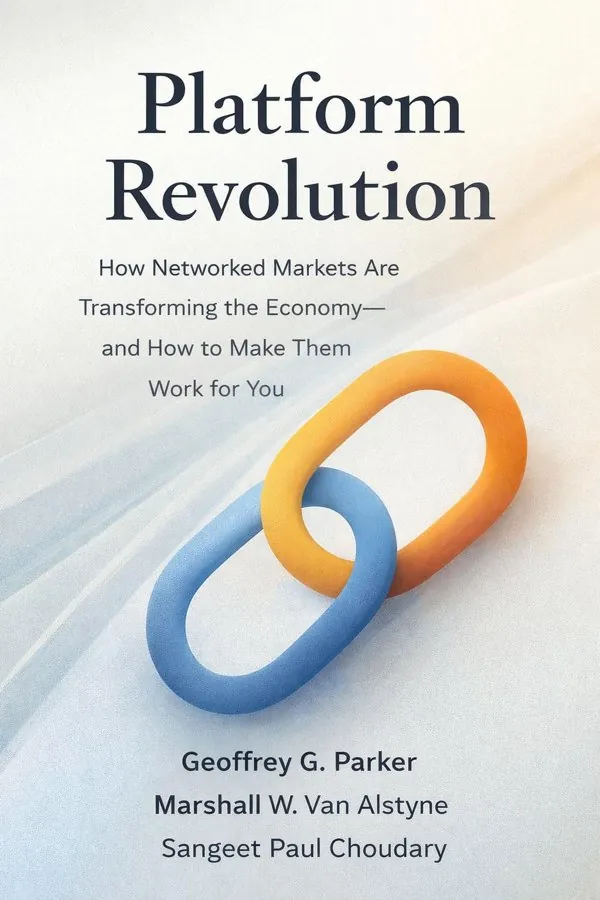
Platform Revolution: How Networked Markets Are Transforming the Economy—and How to Make Them Work for You: Summary & Key Insights
by Geoffrey G. Parker, Marshall W. Van Alstyne, Sangeet Paul Choudary
 10 min10 chaptersAudio available
What Is Platform Revolution: How Networked Markets Are Transforming the Economy—and How to Make Them Work for You About?
Platform Revolution: How Networked Markets Are Transforming the Economy—and How to Make Them Work for You by Geoffrey G. Parker, Marshall W. Van Alstyne, Sangeet Paul Choudary is a strategy book spanning 10 pages. Platform Revolution explains how digital platforms such as Uber, Airbnb, and Amazon have reshaped industries by connecting producers and consumers directly. The authors outline the principles behind successful platform businesses, including network effects, governance, and monetization strategies, and provide guidance for entrepreneurs and executives seeking to build or adapt to platform-based models.
This FizzRead summary covers all 10 key chapters of Platform Revolution: How Networked Markets Are Transforming the Economy—and How to Make Them Work for You in approximately 10 minutes, distilling the most important ideas, arguments, and takeaways from Geoffrey G. Parker, Marshall W. Van Alstyne, Sangeet Paul Choudary's work. Also available as an audio summary and Key Quotes Podcast.
Platform Revolution: How Networked Markets Are Transforming the Economy—and How to Make Them Work for You
Platform Revolution explains how digital platforms such as Uber, Airbnb, and Amazon have reshaped industries by connecting producers and consumers directly. The authors outline the principles behind successful platform businesses, including network effects, governance, and monetization strategies, and provide guidance for entrepreneurs and executives seeking to build or adapt to platform-based models.
Who Should Read Platform Revolution: How Networked Markets Are Transforming the Economy—and How to Make Them Work for You?
This book is perfect for anyone interested in strategy and looking to gain actionable insights in a short read. Whether you're a student, professional, or lifelong learner, the key ideas from Platform Revolution: How Networked Markets Are Transforming the Economy—and How to Make Them Work for You by Geoffrey G. Parker, Marshall W. Van Alstyne, Sangeet Paul Choudary will help you think differently.
- ✓Readers who enjoy strategy and want practical takeaways
- ✓Professionals looking to apply new ideas to their work and life
- ✓Anyone who wants the core insights of Platform Revolution: How Networked Markets Are Transforming the Economy—and How to Make Them Work for You in just 10 minutes
Want the full summary?
Get instant access to this book summary and 100K+ more with Fizz Moment.
Get Free SummaryAvailable on App Store • Free to download
Key Chapters
For centuries, economic exchange has revolved around linear processes: inputs are transformed into outputs, then moved down a supply chain toward a consumer. We call these systems pipelines. They are efficient, but rigid—value flows in one direction, and control resides with the business operator. Platforms, by contrast, revolutionize this flow. They provide open frameworks that allow producers and consumers to find each other directly, with the platform facilitating the exchange.
The shift began subtly with the digitization of information, but soon it spread to physical goods and services. Airbnb connects travelers and homeowners; Uber connects drivers and riders; YouTube connects creators and viewers. In each case, the platform itself doesn’t produce the core value—it enables others to create and exchange it. This reorientation redefines what it means to “own” an ecosystem. The platform’s power lies not in assets, but in its ability to orchestrate interactions.
From my perspective, what’s critical is understanding that these systems thrive on participation. Every new user, every new piece of content, every new data point adds fuel to the system. Traditional firms seek efficiency in production; platforms seek efficiency in connection. Once you recognize this, you begin to see why small startups can topple global giants—they scale through networked value, not linear expansion.
At the heart of every successful platform lies the phenomenon of network effects—the mechanism by which each additional user increases the value of the network for others. When designed well, network effects produce an unstoppable feedback loop. More users attract more producers; more producers attract more users. It’s a virtuous cycle that propels growth exponentially.
But not all network effects are the same. There are direct ones, where users benefit from others like them joining (as with social networks), and indirect ones, where users on one side benefit from participants on another side (as with marketplaces). Understanding which type applies to your platform helps determine how to design your matching algorithms, pricing incentives, and engagement tools.
In the early stages, achieving liquidity—the point where enough participants are active to make interactions valuable—is critical. This is why many successful platforms start small, focusing on a narrow use case or locality. Once a dense community forms and network effects ignite, expansion becomes self-sustaining. From my experience working with firms across industries, I’ve learned that nurturing and protecting these effects matter more than chasing immediate profits. A healthy network effect is the moat that keeps competitors at bay.
+ 8 more chapters — available in the FizzRead app
All Chapters in Platform Revolution: How Networked Markets Are Transforming the Economy—and How to Make Them Work for You
About the Authors
Geoffrey G. Parker is a professor of engineering at Dartmouth College and a research fellow at the MIT Initiative on the Digital Economy. Marshall W. Van Alstyne is a professor at Boston University and a visiting scholar at MIT. Sangeet Paul Choudary is a business strategist and founder of Platformation Labs, specializing in platform business models.
Get This Summary in Your Preferred Format
Read or listen to the Platform Revolution: How Networked Markets Are Transforming the Economy—and How to Make Them Work for You summary by Geoffrey G. Parker, Marshall W. Van Alstyne, Sangeet Paul Choudary anytime, anywhere. FizzRead offers multiple formats so you can learn on your terms — all free.
Available formats: App · Audio · PDF · EPUB — All included free with FizzRead
Download Platform Revolution: How Networked Markets Are Transforming the Economy—and How to Make Them Work for You PDF and EPUB Summary
Key Quotes from Platform Revolution: How Networked Markets Are Transforming the Economy—and How to Make Them Work for You
“For centuries, economic exchange has revolved around linear processes: inputs are transformed into outputs, then moved down a supply chain toward a consumer.”
“At the heart of every successful platform lies the phenomenon of network effects—the mechanism by which each additional user increases the value of the network for others.”
Frequently Asked Questions about Platform Revolution: How Networked Markets Are Transforming the Economy—and How to Make Them Work for You
Platform Revolution: How Networked Markets Are Transforming the Economy—and How to Make Them Work for You by Geoffrey G. Parker, Marshall W. Van Alstyne, Sangeet Paul Choudary is a strategy book that explores key ideas across 10 chapters. Platform Revolution explains how digital platforms such as Uber, Airbnb, and Amazon have reshaped industries by connecting producers and consumers directly. The authors outline the principles behind successful platform businesses, including network effects, governance, and monetization strategies, and provide guidance for entrepreneurs and executives seeking to build or adapt to platform-based models.
More by Geoffrey G. Parker, Marshall W. Van Alstyne, Sangeet Paul Choudary

You Might Also Like

Mastery
Robert Greene
10 min
Cut Costs Not Corners: A Practical Guide to Staying Competitive and Improving Profits
Colin Barrow
10 min
Good Strategy/Bad Strategy: The Difference and Why It Matters
Richard P. Rumelt
10 min
On Grand Strategy
John Lewis Gaddis
10 min
The Six Disciplines of Digital Transformation
George Westerman
10 min
7 Powers: The Foundations of Business Strategy
Hamilton Helmer
10 minBrowse by Category
Ready to read Platform Revolution: How Networked Markets Are Transforming the Economy—and How to Make Them Work for You?
Get the full summary and 100K+ more books with Fizz Moment.