

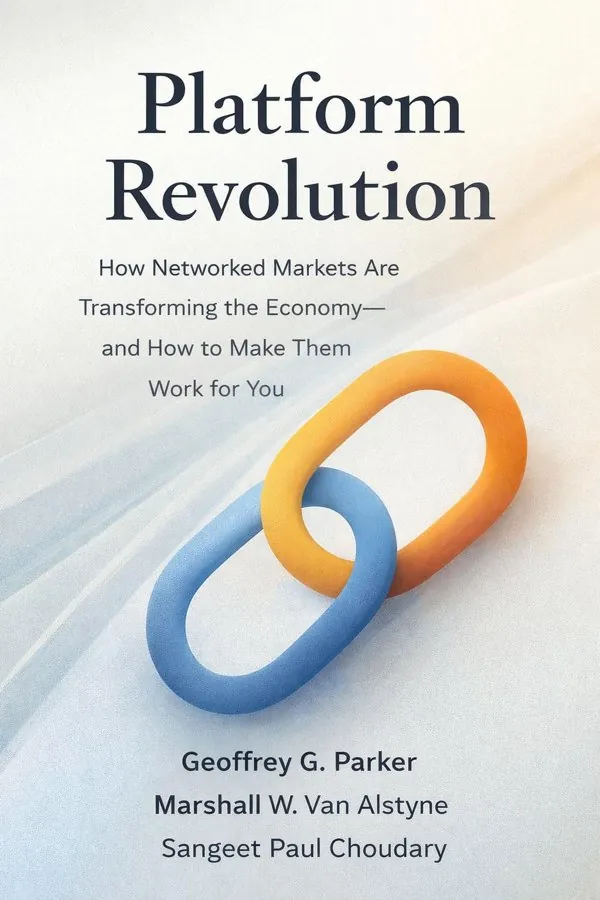
Platform Revolution: How Networked Markets Are Transforming the Economy and How to Make Them Work for You: Summary & Key Insights
by Geoffrey G. Parker, Marshall W. Van Alstyne, Sangeet Paul Choudary
 10 min10 chaptersAudio available
Key Takeaways from Platform Revolution: How Networked Markets Are Transforming the Economy and How to Make Them Work for You
The most disruptive businesses of our time did not simply optimize the old industrial model; they replaced it.
Growth becomes explosive when each new participant makes the platform more valuable for everyone else.
A platform succeeds not because it has the most features, but because it enables the right interactions repeatedly and at scale.
A platform without trust is just a crowded digital space.
Monetization is not simply about charging users; it is about capturing value without weakening the interactions that create that value.
What Is Platform Revolution: How Networked Markets Are Transforming the Economy and How to Make Them Work for You About?
Platform Revolution: How Networked Markets Are Transforming the Economy and How to Make Them Work for You by Geoffrey G. Parker, Marshall W. Van Alstyne, Sangeet Paul Choudary is a entrepreneurship book spanning 10 pages. What if the most powerful companies in the world no longer made products in the traditional sense, but instead built systems that helped other people create value for one another? That is the core idea behind Platform Revolution, a sharp and highly practical guide to one of the most important business shifts of the modern era. Geoffrey G. Parker, Marshall W. Van Alstyne, and Sangeet Paul Choudary explain how digital platforms such as Uber, Airbnb, Amazon, and Facebook have transformed markets by connecting producers and consumers directly, reducing friction, and unleashing powerful network effects. The book matters because platform businesses now shape competition across nearly every industry, from retail and media to finance, education, and healthcare. The authors do more than describe famous success stories. They break down how platforms are designed, launched, governed, monetized, and defended, while also addressing the risks they create, including trust failures, regulatory pressure, and market concentration. Drawing on deep expertise in platform economics, strategy, and digital business models, the authors provide a framework that helps entrepreneurs, managers, investors, and policymakers understand how networked markets work and how to succeed within them.
This FizzRead summary covers all 10 key chapters of Platform Revolution: How Networked Markets Are Transforming the Economy and How to Make Them Work for You in approximately 10 minutes, distilling the most important ideas, arguments, and takeaways from Geoffrey G. Parker, Marshall W. Van Alstyne, Sangeet Paul Choudary's work. Also available as an audio summary and Key Quotes Podcast.
Platform Revolution: How Networked Markets Are Transforming the Economy and How to Make Them Work for You
What if the most powerful companies in the world no longer made products in the traditional sense, but instead built systems that helped other people create value for one another? That is the core idea behind Platform Revolution, a sharp and highly practical guide to one of the most important business shifts of the modern era. Geoffrey G. Parker, Marshall W. Van Alstyne, and Sangeet Paul Choudary explain how digital platforms such as Uber, Airbnb, Amazon, and Facebook have transformed markets by connecting producers and consumers directly, reducing friction, and unleashing powerful network effects.
The book matters because platform businesses now shape competition across nearly every industry, from retail and media to finance, education, and healthcare. The authors do more than describe famous success stories. They break down how platforms are designed, launched, governed, monetized, and defended, while also addressing the risks they create, including trust failures, regulatory pressure, and market concentration. Drawing on deep expertise in platform economics, strategy, and digital business models, the authors provide a framework that helps entrepreneurs, managers, investors, and policymakers understand how networked markets work and how to succeed within them.
Who Should Read Platform Revolution: How Networked Markets Are Transforming the Economy and How to Make Them Work for You?
This book is perfect for anyone interested in entrepreneurship and looking to gain actionable insights in a short read. Whether you're a student, professional, or lifelong learner, the key ideas from Platform Revolution: How Networked Markets Are Transforming the Economy and How to Make Them Work for You by Geoffrey G. Parker, Marshall W. Van Alstyne, Sangeet Paul Choudary will help you think differently.
- ✓Readers who enjoy entrepreneurship and want practical takeaways
- ✓Professionals looking to apply new ideas to their work and life
- ✓Anyone who wants the core insights of Platform Revolution: How Networked Markets Are Transforming the Economy and How to Make Them Work for You in just 10 minutes
Want the full summary?
Get instant access to this book summary and 100K+ more with Fizz Moment.
Get Free SummaryAvailable on App Store • Free to download
Key Chapters
The most disruptive businesses of our time did not simply optimize the old industrial model; they replaced it. For decades, companies created value through pipelines: they designed products, controlled production, pushed goods through supply chains, and sold them to consumers. Efficiency, scale, and control were the main sources of advantage. Platform businesses follow a different logic. Instead of producing all value internally, they create the conditions for others to interact, transact, and co-create value.
A pipeline business grows by adding assets, employees, and inventory. A platform grows by improving interactions among participants. Uber does not need to own most of the cars; Airbnb does not need to own most of the rooms; YouTube does not create most of the videos. Their job is to reduce transaction costs, match supply with demand, and create rules that allow a market to function smoothly.
This shift changes strategy. In a pipeline, the customer is usually the endpoint of a process. In a platform, the user may be both producer and consumer. The company’s role becomes one of orchestration rather than command. That means the core questions are no longer just about internal efficiency but about liquidity, participation, quality, trust, and engagement.
Traditional firms can apply this thinking too. A retailer can add a marketplace. A manufacturer can build a developer ecosystem. A media company can enable user-generated content. The point is not to copy Silicon Valley jargon but to rethink how value might be created by facilitating interactions rather than controlling every step.
Actionable takeaway: Map your business model and ask where value currently flows in a straight line, then identify one area where enabling interactions between outside participants could create more value than owning the entire process yourself.
Growth becomes explosive when each new participant makes the platform more valuable for everyone else. This is the power of network effects, the engine behind nearly every dominant platform. Unlike linear businesses, where each additional customer adds revenue but also requires additional capacity, platforms can become stronger as participation increases. More riders attract more drivers, more sellers attract more buyers, more app users attract more developers, and more developers create better experiences for users.
The authors distinguish between same-side effects and cross-side effects. Same-side effects occur when users on one side benefit from more users like themselves, as with social networks where more friends make the service more useful. Cross-side effects occur when growth on one side benefits the other, as in marketplaces where more sellers create more choice for buyers and more buyers create more opportunity for sellers.
But network effects are not automatically positive. Congestion, spam, low-quality participation, or excessive competition can create negative network effects. A dating app with too many fake profiles becomes less valuable as it grows. A marketplace flooded with poor listings frustrates buyers. This is why platform design matters as much as scale.
Early-stage platforms face the famous chicken-and-egg problem: buyers want sellers, and sellers want buyers. Successful platforms solve this by seeding one side, focusing on a niche market, subsidizing early participation, or providing tools that create standalone value before the full network matures.
Actionable takeaway: Identify the core network effect in your model, then design product features, incentives, and onboarding flows that strengthen positive effects while actively limiting congestion, low quality, and other negative effects.
A platform succeeds not because it has the most features, but because it enables the right interactions repeatedly and at scale. The authors argue that the basic unit of value in a platform is the interaction: a match, an exchange, a message, a transaction, a review, or a collaboration. Great platform architecture is built around making those interactions easy, relevant, safe, and rewarding.
This requires three essential elements: participants, value units, and filters. Participants are the different user groups, such as buyers and sellers, hosts and guests, drivers and riders. Value units are the things being exchanged, such as products, listings, videos, code, data, or expertise. Filters are the algorithms, rules, search tools, and reputation systems that help the right participants find the right value units.
Think about Spotify, which helps listeners discover music through recommendation filters, or the Apple App Store, which structures how developers submit apps and how users find them. Without intelligent filters, scale creates noise. Without clear value units, users do not know what is being exchanged. Without defined participant roles, interactions become confusing or unsafe.
Designing platform architecture also means lowering friction. Sign-up should be easy, participation should be intuitive, and matching should happen with minimal delay. The platform should collect the right data to improve future interactions without overwhelming users.
Actionable takeaway: Define your platform’s core interaction in one sentence, then audit your product to ensure participants, value units, and filters all work together to make that interaction faster, better, and more trustworthy.
A platform without trust is just a crowded digital space. Because platforms connect strangers, governance becomes central to value creation. The platform must create enough openness to encourage participation while also enforcing rules that prevent fraud, abuse, manipulation, and poor-quality behavior. Governance is not a side issue; it is the invisible infrastructure that keeps the market functioning.
The authors show that governance operates through rules, standards, monitoring, feedback systems, dispute resolution, and penalties. Ratings and reviews are one familiar example. On Airbnb, hosts and guests evaluate one another, helping future users assess reliability. On eBay, seller ratings reduce uncertainty. On app stores, submission rules and review processes protect users from malicious or low-quality software.
Good governance is rarely static. Early in a platform’s life, looser rules may encourage experimentation and growth. As scale increases, stronger moderation and more formal standards become necessary. Platforms must also decide who gets to participate, what behavior is allowed, how data is used, and when intervention is justified. Too much control can stifle growth; too little can destroy trust.
Governance also shapes brand reputation and regulatory exposure. A ride-sharing platform that ignores safety concerns invites public backlash. A social platform that fails to manage harmful content risks losing users and facing government scrutiny. Effective governance is therefore strategic, not merely operational.
Actionable takeaway: Build a governance system early by defining participation rules, quality standards, feedback mechanisms, and escalation procedures before trust failures force you to react under pressure.
Monetization is not simply about charging users; it is about capturing value without weakening the interactions that create that value. The authors emphasize that platforms often serve multiple user groups with different sensitivities, so pricing must be strategic. In many cases, one side is subsidized while another side pays. Users may join for free while advertisers fund the system. Riders may receive discounts while drivers face commissions. Developers may access tools at low cost while premium distribution features generate revenue.
The key is understanding who creates value, who captures value, and where friction can be introduced without damaging growth. Charging too early or charging the wrong side can choke network formation. A startup marketplace that imposes high seller fees before buyer demand exists may never reach liquidity. Conversely, a platform that never develops a value capture strategy may attract users but fail as a business.
Common revenue models include transaction fees, subscriptions, advertising, premium placement, access fees, software licensing, data services, and complementary offerings. Amazon Marketplace charges seller fees. LinkedIn blends subscriptions, recruitment tools, and advertising. App stores take a percentage of transactions while also benefiting from the broader ecosystem they support.
Monetization should also reflect the platform’s stage. Early on, the goal is often participation and network density. Later, monetization can increase as the platform’s value becomes undeniable. The smartest platforms align pricing with successful outcomes rather than simply taxing presence.
Actionable takeaway: Choose a pricing strategy based on which user side is hardest to attract, which side gains the most economic value, and how you can monetize success without discouraging the interactions your platform depends on.
Every platform faces a strategic tension: should it be open to maximize participation or controlled to protect quality and profits? There is no universal answer. The right balance depends on the platform’s purpose, maturity, competitive environment, and trust requirements. Open systems can scale rapidly by inviting more producers, developers, and partners. Controlled systems can deliver higher consistency, better security, and tighter brand management.
The book illustrates this through ecosystem battles. Apple has historically exercised strong control over hardware, software, and app distribution, creating a curated experience. Android has been more open, enabling wide adoption across manufacturers and developers. Each model creates advantages and trade-offs. More openness can accelerate innovation, but it can also increase fragmentation, abuse, or quality problems. More control can improve reliability, but it may limit experimentation and reduce network breadth.
Strategic control is not all-or-nothing. A platform might open APIs while restricting sensitive data. It might welcome many participants but impose strict certification standards. It might allow third-party sellers while controlling payment and logistics. The challenge is deciding where openness creates value and where control protects the ecosystem.
Leaders often get this wrong by assuming that more openness is always better or that tighter control always means quality. In reality, the answer changes over time. A young platform may open aggressively to attract users, then tighten standards as usage scales and risks grow.
Actionable takeaway: List the parts of your platform that should remain open to encourage growth and the parts that require tight control to preserve trust, quality, or strategic advantage, then revisit that balance as the business evolves.
The hardest moment in a platform’s life is the beginning, when no one wants to join because no one else is there. This startup challenge is not a side detail; it is the central strategic problem of platform creation. The authors explain that successful platforms rarely begin as broad, fully formed ecosystems. They start by engineering liquidity in a narrow context where interactions can reliably occur.
One approach is to target a specific niche with concentrated demand and supply. Facebook began with college networks rather than the entire world. Another is to single-side the market by building a product that is useful even before the full network arrives. OpenTable offered restaurants reservation management tools while gradually building diner demand. A third strategy is to subsidize one side heavily, as many ride-sharing companies did by offering incentives to drivers or discounts to riders.
Platforms can also stage interactions manually at first. Founders may recruit participants one by one, curate early content, or act as the intermediary themselves until enough activity emerges. This unscalable work is often necessary to prove the model. The goal is not just user acquisition but interaction success. If early users do not quickly experience value, they leave before network effects can take hold.
Metrics matter here. The authors suggest focusing on liquidity, match quality, repeat interactions, and conversion rather than vanity metrics such as raw downloads. A platform with fewer users but high successful interaction rates is healthier than one with huge sign-up numbers and little activity.
Actionable takeaway: Launch by dominating one tightly defined market where you can reliably create successful interactions, then expand outward only after you have achieved real liquidity and repeat usage.
When platforms scale, they do not merely disrupt markets; they reshape social systems. That is why the book does not treat regulation and ethics as afterthoughts. Platforms can create enormous convenience and opportunity, but they also raise serious questions about labor conditions, data rights, competition, misinformation, discrimination, taxation, and public accountability.
Ride-sharing platforms, for example, challenge traditional employment categories and local transport rules. Short-term rental platforms can increase tourism income while also pressuring housing markets and neighborhood stability. Social media platforms connect billions of people but struggle with harmful content, manipulation, and privacy breaches. Marketplace platforms can empower small businesses while also favoring their own products or squeezing suppliers.
The authors encourage leaders to recognize that governance choices have societal consequences. A platform that optimizes only for growth may create external costs that invite public backlash or state intervention. Long-term success depends on designing for legitimacy as well as profit. That means being transparent about rules, protecting users, cooperating with reasonable regulation, and addressing unfair outcomes before they become crises.
Ethics is practical strategy here. Trust, public acceptance, and regulatory goodwill are assets. Companies that ignore these issues may grow quickly but become fragile. Policymakers, meanwhile, must understand platform economics well enough to regulate intelligently without crushing innovation.
Actionable takeaway: Conduct a platform impact review that examines your business not only for growth opportunities but also for labor, privacy, fairness, competition, and community risks, then build safeguards before external pressure forces change.
The platform revolution is not only about startups defeating incumbents; it is also about whether established firms can reinvent themselves. Many traditional companies still think in product lines, channels, and supply chains. The authors argue that incumbents can remain relevant if they stop treating platforms as a tech-sector curiosity and begin seeing them as a new organizational logic.
Transformation starts with recognizing existing assets that can become ecosystem advantages. A manufacturer may have customer relationships, data, technical standards, and service networks that can support a platform for partners and developers. A bank may build a financial marketplace that connects consumers with third-party products. A healthcare system may create a platform linking patients, physicians, labs, insurers, and digital health tools.
However, incumbents face internal resistance. Pipeline businesses are optimized for control, predictability, and ownership. Platforms demand openness, external participation, and a willingness to let others create part of the value. This can feel threatening to managers used to command structures and direct monetization. Metrics must also change. Instead of tracking only unit sales and margins, companies must monitor engagement, ecosystem health, and participant success.
The greatest risk is complacency. Established firms often assume brand strength or scale will protect them, only to discover that platforms win by reorganizing the market itself. The right response is not always building a platform from scratch. Sometimes the smarter move is joining, partnering with, or selectively competing against existing platforms.
Actionable takeaway: Audit your current business for ecosystem assets you already control, then choose whether to build, join, or hybridize a platform strategy before an outside player reorganizes your industry around you.
The rise of platforms is not a temporary trend but a structural change in how modern economies coordinate value. The authors show that platforms alter competition, labor markets, innovation patterns, and even the boundaries of the firm. In a platform-centered economy, advantage increasingly comes from owning the rules of interaction, the data generated by participation, and the mechanisms that attract and retain network activity.
This has broad consequences. Innovation accelerates because outsiders can build on top of a platform rather than starting from zero. Consumers gain more choice and convenience. Small producers can reach global markets without building full distribution systems. At the same time, market power can become concentrated because strong network effects and data advantages make leading platforms hard to challenge.
The future likely involves platform logic spreading into sectors once considered resistant to digitization. Education platforms can connect learners, instructors, and credential providers. Energy platforms can coordinate producers, consumers, and storage. Industrial platforms can connect machines, analytics providers, and maintenance services. In each case, value shifts from isolated products to connected ecosystems.
The book’s deeper contribution is teaching readers how to think in systems. Platform strategy is not only about apps or marketplaces. It is about designing environments where productive interactions flourish. Those who understand this logic can identify opportunities earlier, respond to disruption faster, and build more adaptive businesses.
Actionable takeaway: Train yourself to analyze industries through the lens of interactions, data flows, and network effects, because the businesses that dominate tomorrow will often be those that best organize ecosystems rather than merely produce outputs.
All Chapters in Platform Revolution: How Networked Markets Are Transforming the Economy and How to Make Them Work for You
About the Authors
Geoffrey G. Parker is a professor at Dartmouth College and a leading expert on platform economics, digital competition, and networked business models. Marshall W. Van Alstyne is a professor at Boston University and a respected scholar in information economics, technology strategy, and digital innovation. Sangeet Paul Choudary is a business strategist, author, and founder of Platformation Labs, widely known for advising companies on platform design, growth, and transformation. Together, they bring a rare combination of academic depth and practical strategic insight. Their work has helped shape how entrepreneurs, executives, and policymakers understand the rise of platform businesses. In Platform Revolution, they combine research, case studies, and applied frameworks to explain one of the most important shifts in the modern economy.
Get This Summary in Your Preferred Format
Read or listen to the Platform Revolution: How Networked Markets Are Transforming the Economy and How to Make Them Work for You summary by Geoffrey G. Parker, Marshall W. Van Alstyne, Sangeet Paul Choudary anytime, anywhere. FizzRead offers multiple formats so you can learn on your terms — all free.
Available formats: App · Audio · PDF · EPUB — All included free with FizzRead
Download Platform Revolution: How Networked Markets Are Transforming the Economy and How to Make Them Work for You PDF and EPUB Summary
Key Quotes from Platform Revolution: How Networked Markets Are Transforming the Economy and How to Make Them Work for You
“The most disruptive businesses of our time did not simply optimize the old industrial model; they replaced it.”
“Growth becomes explosive when each new participant makes the platform more valuable for everyone else.”
“A platform succeeds not because it has the most features, but because it enables the right interactions repeatedly and at scale.”
“A platform without trust is just a crowded digital space.”
“Monetization is not simply about charging users; it is about capturing value without weakening the interactions that create that value.”
Frequently Asked Questions about Platform Revolution: How Networked Markets Are Transforming the Economy and How to Make Them Work for You
Platform Revolution: How Networked Markets Are Transforming the Economy and How to Make Them Work for You by Geoffrey G. Parker, Marshall W. Van Alstyne, Sangeet Paul Choudary is a entrepreneurship book that explores key ideas across 10 chapters. What if the most powerful companies in the world no longer made products in the traditional sense, but instead built systems that helped other people create value for one another? That is the core idea behind Platform Revolution, a sharp and highly practical guide to one of the most important business shifts of the modern era. Geoffrey G. Parker, Marshall W. Van Alstyne, and Sangeet Paul Choudary explain how digital platforms such as Uber, Airbnb, Amazon, and Facebook have transformed markets by connecting producers and consumers directly, reducing friction, and unleashing powerful network effects. The book matters because platform businesses now shape competition across nearly every industry, from retail and media to finance, education, and healthcare. The authors do more than describe famous success stories. They break down how platforms are designed, launched, governed, monetized, and defended, while also addressing the risks they create, including trust failures, regulatory pressure, and market concentration. Drawing on deep expertise in platform economics, strategy, and digital business models, the authors provide a framework that helps entrepreneurs, managers, investors, and policymakers understand how networked markets work and how to succeed within them.
More by Geoffrey G. Parker, Marshall W. Van Alstyne, Sangeet Paul Choudary
You Might Also Like

Lean Analytics
Alistair Croll, Benjamin Yoskovitz
10 min
21 Days To A Big Idea: Creating Breakthrough Business Concepts
Bryan Mattimore
10 min
Sam Walton: Made in America: My Story
Sam Walton
10 min
10x Is Easier Than 2x: How World-Class Entrepreneurs Achieve More by Doing Less
Dan Sullivan, Benjamin Hardy
10 min
12 Months to $1 Million: How to Pick a Winning Product, Build a Real Business, and Become a Seven-Figure Entrepreneur
Ryan Daniel Moran
10 min
24 Assets: Create a Digital, Scalable, Valuable Business
Daniel Priestley
10 minBrowse by Category
Ready to read Platform Revolution: How Networked Markets Are Transforming the Economy and How to Make Them Work for You?
Get the full summary and 100K+ more books with Fizz Moment.